
Humminbird Helix 5 Chirp GPS G3
4.5Editor score
Dual Spectrum CHIRP sonar
Expanded GPS chart compatibility
AutoChart Live contour mapping
A small boat depth finder can make shallow fishing safer, improve navigation in unfamiliar water, and reveal fish-holding structure that is difficult to identify visually. The right unit depends on hull construction, available mounting space, desired sonar detail, and whether you want basic depth readings or advanced mapping and navigation features.
We compared ten depth-finding solutions using their supplied specifications, including sonar technology, display size, depth capability, transducer type, GPS functions, portability, and installation requirements. The guide covers permanently mounted in-dash systems, portable wireless units, handheld wired designs, and compact color fishfinders for small boats.
Each review explains the product's strongest benefits, practical limitations, and ideal boating situation. Ratings and product details reflect the supplied information, while specifications and availability can change. Readers should verify current compatibility, mounting requirements, included accessories, and retailer terms before purchasing.
4.5Editor score

4.6Editor score
4.6Editor score
As an Amazon Associate we earn from qualifying purchases.
The comparison below organizes all ten options by display, sonar approach, depth capability, installation style, and navigation functions, making it easier to identify the most suitable depth finder for your particular small boat.


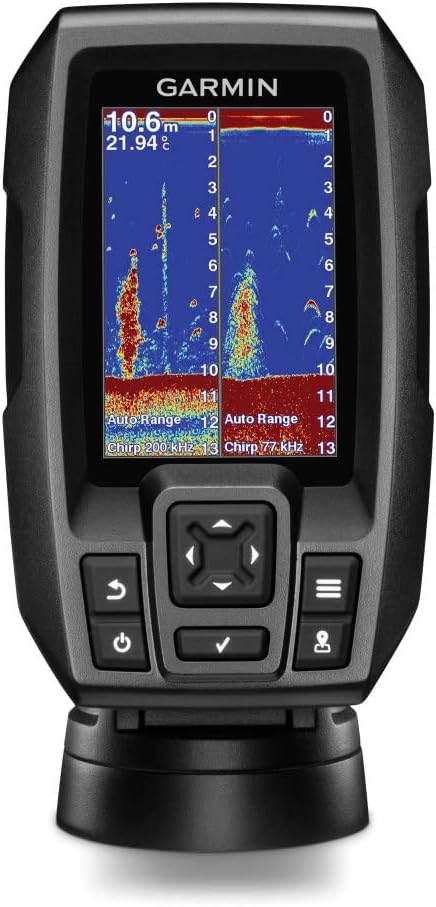
The Garmin Striker 4 combines a compact 3.5-inch display with a surprisingly capable sonar package, earning a supplied rating of 4.6. It is a strong fit for small fishing boats where screen space is limited but useful structure information remains important. ClearVu scanning sonar and CHIRP traditional sonar work together to balance detail with reliable target identification.
We may earn a commission when you buy through this link, at no additional cost to you.
Its standout feature is the combination of ClearVu scanning sonar and CHIRP. ClearVu is designed to provide near-photographic representations of underwater objects, fish, and structure, while the continuous frequency sweep of CHIRP can produce crisper arches and better target separation. For anglers trying to distinguish a submerged branch from a productive drop-off, that combination is more meaningful than a basic depth-only readout.
The trade-offs center on the compact 3.5-inch screen and the absence of built-in contour mapping in the listed specification. You can still mark and revisit waypoints, which helps navigate between fishing areas, but it cannot create Garmin Quickdraw contour maps. The keyed interface is straightforward, though it is less touch-oriented than newer color units with larger screens.
This is an excellent recommendation for anglers operating a jon boat, small skiff, pontoon, or compact fishing boat with limited dashboard room. It also makes sense for anyone who values dependable sonar over expansive navigation features. Choose this model when clear underwater imaging, easy operation, and a modest footprint matter more than a large display or automatic contour storage.
ClearVu scanning sonar gives this small unit a wider visual search than a conventional depth-only display. The result is useful when locating brush piles, stumps, docks, rocks, and fish structure around a small boat.
The built-in waypoint map lets you record productive locations and return to them later. That makes the Striker 4 more useful than a disposable depth gauge, particularly for anglers rotating among several familiar spots.
We may earn a commission when you buy through this link, at no additional cost to you.
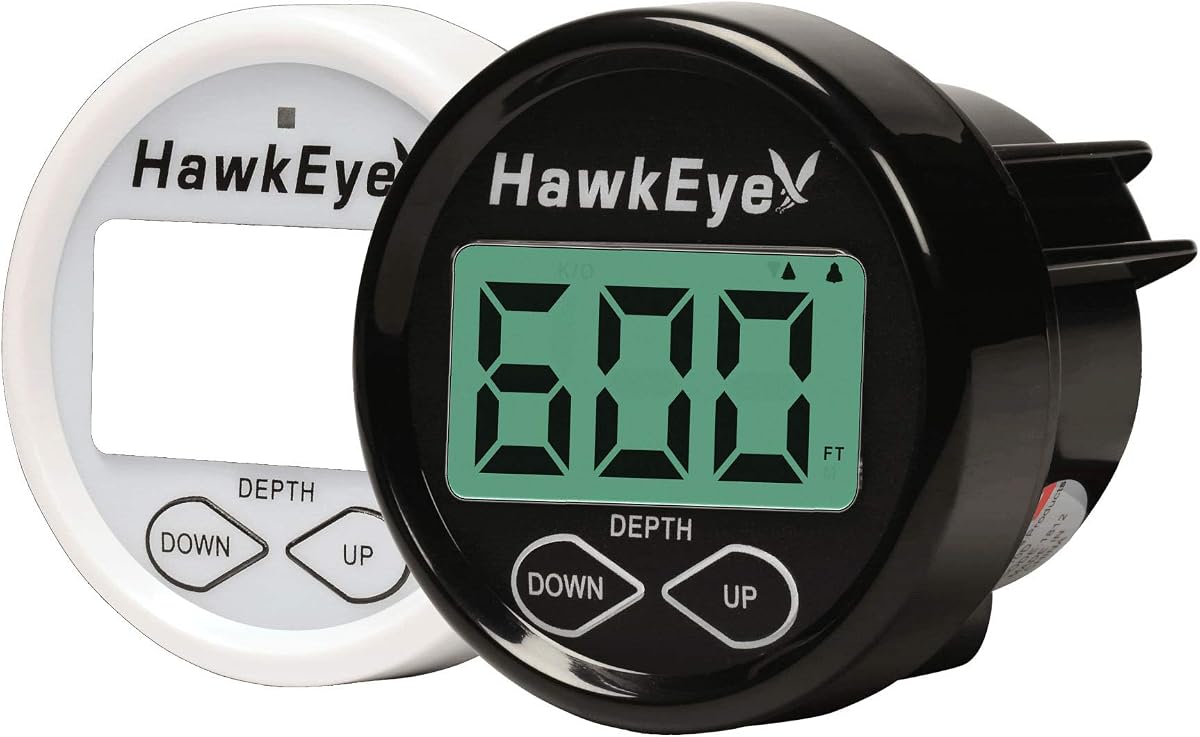
The DepthTrax 2B is a dedicated in-dash depth sounder for boat owners who want depth information without adding a separate fishfinder screen to the console. Its supplied rating is 4.2, and its appeal comes from a clean installation, a prominent display, and a clear warning system. It is less versatile than a GPS fishfinder but more focused on dependable depth measurement.
We may earn a commission when you buy through this link, at no additional cost to you.
The unit delivers continuous readings from 2.5 to 600 feet and can maintain those readings while the boat travels up to 60 mph. Its 200 kHz transducer is available in either transom or glue-in configurations, giving installers some flexibility. The algorithm is designed to reduce false readings, while the polarized LCD and supplied sun cover improve visibility in bright conditions.
Its most notable feature is the three-stage advanced warning system, which combines audible alarms, an ultra-bright red warning LED, and LCD alarm indicators. That focus on alerts is particularly relevant for boaters approaching shallow water. However, the installation is not universally suitable: glue-in mounting applies only to non-cored fiberglass or aluminum hulls thinner than 1/8 inch.
The DepthTrax 2B is best for an owner with an existing in-dash opening who values simple, rapid depth information over sonar imagery, GPS charts, or detailed fish arches. Before buying, inspect the hull and dashboard, then confirm that the transducer position can maintain an uninterrupted acoustic connection. For those who meet the requirements, it delivers a clean and purpose-built solution.
Multiple alert methods make rapid depth changes easier to notice. The combination of sound, red light, and on-screen indicators is more informative than relying exclusively on a changing numeric readout.
An in-dash format keeps navigation and depth information in the same visual area as other instruments. It suits permanently rigged boats where a clean helm matters more than a quick, removable installation.
We may earn a commission when you buy through this link, at no additional cost to you.
The Humminbird PiranhaMAX 4 is a straightforward four-inch fishfinder with a supplied rating of 4.6 and a useful dual-beam sonar system. It offers a good middle ground between compact portable units and full navigation systems, making it a practical choice for anglers who want better target coverage and screen visibility without a complicated interface.
We may earn a commission when you buy through this link, at no additional cost to you.
Its dual-beam design lets you choose between a narrow beam for detail and a wide beam for broader coverage. That flexibility is valuable when fishing close to structure or scanning open water. The included tilt-and-swivel mount makes it easy to change the viewing angle, and the XNT 9 28 T transom-mount transducer provides a straightforward permanent or removable installation.
The main limitation is that the supplied information lists neither GPS nor chart mapping. This is a fishfinding and sonar product rather than a full chartplotter, so it cannot serve as the primary navigation system for a boat. Its greater display size and dual-beam coverage are meaningful upgrades over a basic depth gauge, but they do not replace a multifunction display.
Choose the PiranhaMAX 4 for small-boat anglers who want a sizable color screen, clear sonar choices, and an included transducer without paying for extensive navigation features. It is especially suitable for freshwater fishing where anglers alternate between detailed close-range scans and wider structure searches. Its straightforward package and strong supplied rating make it an easy first fishfinder to consider.
The narrow beam emphasizes detail, while the wide beam covers more water. Switching between them lets an angler respond to changing terrain without replacing the transducer or changing the mounting setup.
The included tilt-and-swivel bracket supports frequent angle adjustments, while the transom transducer can usually be removed when the boat is trailered. Verify bracket clearance before installation.
We may earn a commission when you buy through this link, at no additional cost to you.
This portable wireless fish finder offers one of the easiest ways to add sonar to a small boat without drilling the hull. It has a supplied rating of 4.3 and pairs a castable sensor with a handheld color display. The sensor can be tethered and cast, while the wireless connection extends up to 262 feet or 80 meters.
We may earn a commission when you buy through this link, at no additional cost to you.
The display reports water depth, temperature, approximate fish size, fish depth, and bottom contour. A 105-degree beam covers a broad area, while the selectable depth range runs from 2.6 to 164 feet. Two screen backgrounds provide useful flexibility: black is convenient at night, while white improves readability in strong sunlight. It is suitable for lakes, rivers, seas, kayaks, boats, shorelines, and ice fishing.
The sensor's battery indicator can be confusing when the unit is out of the water. According to the supplied instructions, the sensor should be placed in water so it switches on and the display presents an accurate battery indication. Its castable design also requires care to avoid line entanglement or losing the sensor, so it is better suited to anglers comfortable handling fishing tackle.
This is a compelling pick for small-boat owners who want no permanent installation, anglers moving between shore and water, and kayak fishermen who need a quick way to locate fish and bottom structure. It is less appropriate for a permanently rigged console or for navigators expecting GPS charting. Within portable wireless designs, however, its range and information set are notably complete.
The wireless sensor removes the need to cut or modify a hull. That makes the system especially attractive for rental boats, inflatable craft, kayaks, and owners who want equipment they can take with them.
Temperature, approximate fish depth, fish-size categories, and bottom contour provide a broader picture of the water. These readings help anglers decide whether a location is worth further investigation.
We may earn a commission when you buy through this link, at no additional cost to you.
The Garmin STRIKER Vivid 4cv combines a four-inch color display, advanced sonar, GPS, and automatic contour mapping in one reasonably compact package. Its supplied rating of 4.6 reflects a strong balance of features, and it is among the most complete choices here for an angler who wants more than a simple depth gauge without moving to a large premium chartplotter.
We may earn a commission when you buy through this link, at no additional cost to you.
The included GT20 transducer supports both Garmin CHIRP traditional sonar and CHIRP ClearVu scanning sonar. Vivid scanning color palettes help distinguish fish from vegetation, rocks, and other structure, while the high-sensitivity GPS allows waypoint marking, route creation, and boat-speed display. Quickdraw Contours adds saved maps, giving this model capabilities that the smaller Striker 4 does not offer.
Compared with larger Garmin models, the four-inch screen is more restrained and may not be as immersive for complex chart work. Quickdraw mapping also requires time to collect and save useful contours; it is not an instant substitute for a professionally surveyed chart. The included tilt-and-swivel bailmount is helpful, but console space and visibility should be checked before installation.
The STRIKER Vivid 4cv is an excellent recommendation for small-boat anglers who want color sonar, GPS waypoints, and contour creation in a manageable package. It suits anglers moving between lakes, river mouths, and coastal areas who need dependable navigation memory as well as fishfinding detail. Choose it when the Striker 4 feels too basic but a seven-inch unit would dominate the console.
CHIRP and ClearVu cover fish and structure detection, while GPS and Quickdraw address navigation and habitat memory. Combining those functions reduces the need for separate instruments in a crowded small-boat console.
The vivid color options make it easier to distinguish objects and fish-holding features. Anglers can select the palette that best fits their conditions rather than relying on a single monochrome display.
We may earn a commission when you buy through this link, at no additional cost to you.
The portable wired fish finder is a straightforward depth-and-fish display for kayaks, docks, and small boats. Its supplied rating is 4.3 and its strongest attraction is ease of use: toss the wired sensor into the water, turn on the display, and view readings without a complicated installation. It is less sophisticated than a permanently mounted unit but very approachable.
We may earn a commission when you buy through this link, at no additional cost to you.
The display shows water depth, approximate fish location, fish size, and bottom features such as short and tall weeds, sand, and rocks. Five selectable sensitivity levels allow users to adjust the response to different conditions. A battery-saving mode, backlight, fish alarm, and selectable units add practical functions, while the neck strap supports hands-free carrying from a kayak.
Power comes from four AAA batteries, with the supplied information indicating approximately four to five hours of continuous use. Because the sensor is wired, its movement is limited by the cable length. That makes it less convenient than the wireless portable option for casting to distant structure, although it remains practical when the display and sensor stay near the fishing position.
This product is best for beginners, kayak anglers, shore fishers, and small-boat owners seeking a simple sonar screen they can carry. It also fits users who do not want a permanent transducer or dashboard opening. Its limitations are clear: no GPS charting, a narrower beam than the wireless model, and less flexibility than a fixed-mount unit, but its core readings are useful and easy to access.
The wired design avoids permanent hull modifications and complicated initial setup. Most users can begin exploring immediately after adding batteries and placing the sensor in the water.
Five sensitivity levels give users control over how the display reacts to surrounding targets. The fish alarm and adjustable units add convenience without requiring advanced menu navigation.
We may earn a commission when you buy through this link, at no additional cost to you.
The Humminbird Helix 5 Chirp GPS G3 is the most navigation-oriented premium product in this guide. Its supplied rating is 4.5 and its five-inch display provides enough room for sonar, mapping, and route information. It is especially appropriate for boaters who want more than fishfinding and need a credible chartplotter for unfamiliar water.
We may earn a commission when you buy through this link, at no additional cost to you.
Dual Spectrum CHIRP sonar offers wide and narrow search modes, allowing detailed target separation or broad coverage. The Low-Q transducer supports precise 2D separation, while the built-in Humminbird Basemap covers more than 10,000 lakes and the continental U.S. coastline. Compatibility with premium LakeMaster, CoastMaster, and Navionics charts broadens the navigation options further.
AutoChart Live can create maps featuring depth contours, bottom hardness, and vegetation, using eight hours of built-in recording time. Compatible AutoChart Zero Line SD cards can expand that capacity. This is a major benefit for anglers learning a reservoir or saltwater area gradually, although it is more involved than simply switching on a depth display and requires time to gather meaningful data.
The softkey interface is designed to remain reliable in changing weather, and preloaded views simplify access to common settings. This model is a strong choice for a small or midsize boat that can accommodate a five-inch display and needs integrated navigation. It is less attractive for minimalists seeking a pure portable depth gauge, but for anglers building a versatile helm, the Helix 5 Chirp GPS G3 offers the richest feature set here.
The extensive basemap and support for recognized premium chart providers make this more than a fishfinder. It can serve as a central reference for routes, waypoints, and unfamiliar waterways.
AutoChart Live goes beyond a simple depth line by recording bottom hardness and vegetation. Those details can help anglers understand why structure holds fish and where productive areas sit in relation to changing contours.
We may earn a commission when you buy through this link, at no additional cost to you.
The Garmin Striker Plus 4 is a feature-rich four-inch unit with a supplied rating of 4.6. It combines a dual-beam transducer, CHIRP traditional sonar, GPS navigation, and Quickdraw Contours. That combination makes it a strong all-around choice for an angler who wants detailed sonar and the ability to save custom maps on a relatively compact screen.
We may earn a commission when you buy through this link, at no additional cost to you.
Quickdraw Contours can store maps with one-foot contours across as much as two million acres, offering substantial storage for custom lake information. The built-in GPS supports waypoint marking, route creation, and boat-speed display. Its bright 4.3-inch screen is designed for sunlight readability, and the rugged housing is intended for varied fishing environments.
The dual-beam transducer provides detailed images and strong target separation, while supported traditional frequencies of 50, 77, 83, and 200 kHz offer flexibility. Bluetooth is listed as a special feature, though its practical value depends on the phone, software, and accessories used. Compared with a large chartplotter, the four-inch screen is better suited to a small console where every inch matters.
Choose the Striker Plus 4 for anglers who actively collect maps, return to marked spots, and want more sonar flexibility than the basic Garmin Striker 4. It works well on small fishing boats and pontoons with a conventional instrument layout. Those wanting a larger interface, touch controls, or wireless phone connectivity may prefer the Striker Vivid line instead.
The ability to store one-foot contours for up to two million acres makes this model useful for anglers building a personal map archive. It can preserve information that general charts may not represent in sufficient detail.
Multiple supported frequencies and dual-beam operation allow users to balance detail with coverage. That flexibility is helpful across changing depths, vegetation, and fishing styles.
We may earn a commission when you buy through this link, at no additional cost to you.
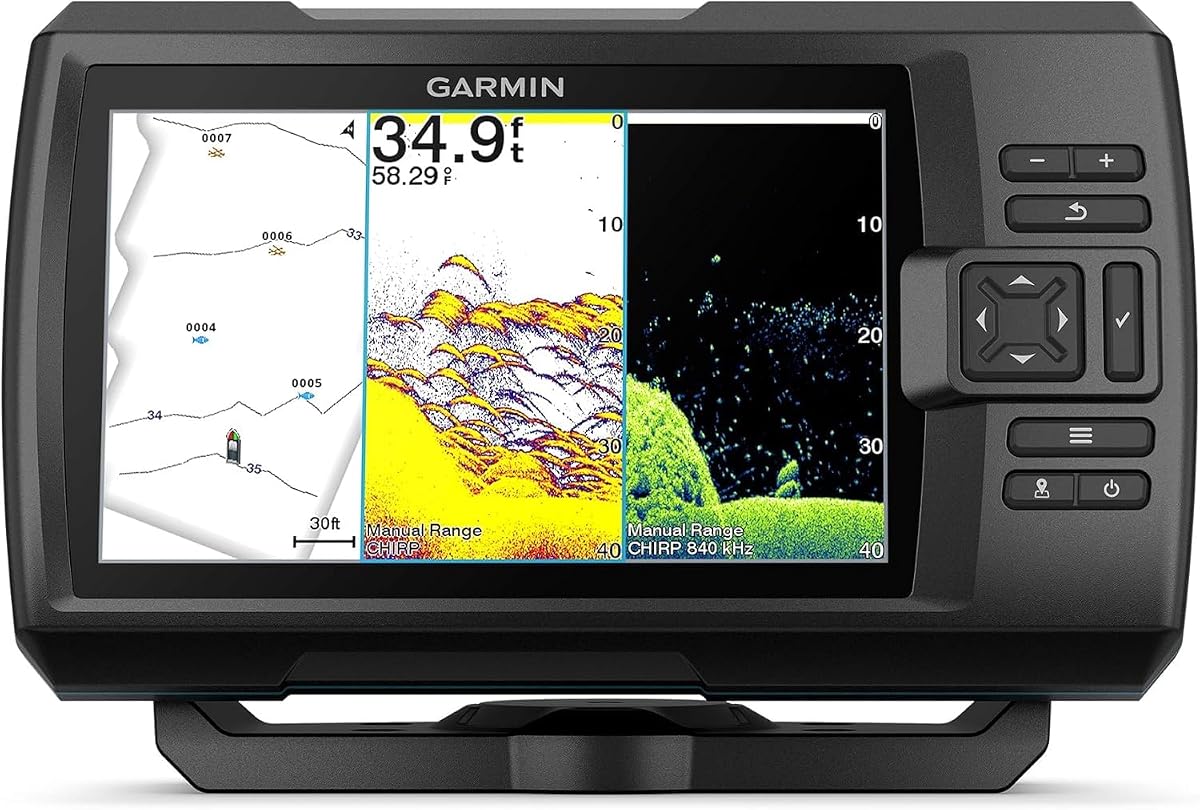
The Garmin Striker Vivid 7cv delivers a large, colorful sonar display with premium navigation and connectivity features. Its supplied rating is 4.5 and the seven-inch screen gives it a clear advantage when an angler wants to compare fish arches, contours, routes, and mapping information at the same time. It is the most visually expansive unit in this roundup.
We may earn a commission when you buy through this link, at no additional cost to you.
The included GT20-TM transducer supports Garmin CHIRP traditional sonar and CHIRP ClearVu scanning sonar, while vivid color palettes help separate fish from structure. High-sensitivity GPS supports waypoints, routes, and speed display. Quickdraw Contours adds saved mapping, creating a complete package for anglers who want a flexible fishfinder and navigation instrument in one unit.
Wi-Fi connectivity raises the feature ceiling by supporting the ActiveCaptain app with a compatible smartphone. Users can transfer waypoints, receive smart notifications and software-update notices, and access the Garmin Quickdraw Community. The screen is excellent for detailed reading, but its large dimensions may crowd a small console, and app connectivity requires compatible hardware and setup.
This model is a strong premium choice for a small boat with a generously sized console, particularly for anglers who fish complex water and want immediate visual clarity. It may be excessive for a simple jon boat or an angler who only needs depth readings. For a larger helm and active use of mapping and connected features, though, the Striker Vivid 7cv provides an excellent viewing and navigation experience.
The seven-inch display makes it easier to inspect fish arches, bottom structure, waypoint lists, and map details. It is particularly useful when switching repeatedly between sonar and navigation information.
ActiveCaptain connectivity allows compatible phones to exchange waypoints and deliver useful notifications. This can simplify moving information between the helm and a mobile device.
We may earn a commission when you buy through this link, at no additional cost to you.
The Garmin Striker 4cv provides many of the premium Striker Vivid features in a more compact four-inch form. With a supplied rating of 4.6, it is one of the strongest general-purpose choices for a small fishing boat. CHIRP traditional and ClearVu scanning sonar, GPS navigation, and Quickdraw Contours give it far more capability than a basic depth sounder.
We may earn a commission when you buy through this link, at no additional cost to you.
The included transducer supports both sonar technologies, allowing users to view detailed fish arches and scan broad underwater areas. Quickdraw Contours stores one-foot contour maps for up to two million acres, while GPS handles waypoint marking, route creation, and boat-speed display. The bright 4.3-inch display remains readable in sunlight and uses an intuitive interface designed for quick helm operation.
Its 300-watt RMS transmit power is a listed strength, but actual performance still depends on transducer placement, hull construction, water conditions, and installation quality. The 4.3-inch screen is less suitable than a larger unit for detailed chart browsing, and the product is intended for permanent installation rather than quick portable use.
The Striker 4cv is a particularly good match for anglers who want mapping and premium sonar but cannot justify a seven-inch display. It works well on compact skiffs, jon boats, and pontoons where console space is limited but navigation memory is valuable. Compared with the smaller Striker 4, it adds the contour-mapping capability that many serious anglers eventually want.
Quickdraw Contours brings meaningful navigation improvement without requiring the footprint of a large chartplotter. The result is especially useful in small boats with limited console space.
CHIRP traditional sonar and ClearVu scanning sonar provide complementary ways to examine structure. That flexibility helps users move from broad searches to closer target identification.
We may earn a commission when you buy through this link, at no additional cost to you.
The best depth finder for a small boat is the one that fits the hull, matches the available console space, and provides the information you actually need. Consider installation method, sonar capability, depth range, power needs, display readability, and navigation features before choosing.
Permanent systems generally provide the most consistent transducer alignment and reliable performance. A transom-mount transducer is quicker to install and easier to remove, while a glue-in or through-hull arrangement can suit boats with suitable construction. In-dash depth finders offer a clean helm but require a compatible dashboard opening and careful wiring. Portable units avoid permanent modifications and suit kayaks, inflatable boats, rental craft, and anglers who move between locations.
A basic numeric depth display is useful for navigation but will not reveal much about underwater habitat. CHIRP sonar sends a continuous range of frequencies and can improve target separation. Scanning sonar such as Garmin ClearVu creates detailed images of fish, objects, and structure. Dual-beam systems provide a choice between a narrow, detailed view and a wider search area. Humminbird Dual Spectrum CHIRP similarly offers wide and narrow modes for different fishing conditions.
Small displays conserve valuable console space and work well for basic readings, but they become tiring when reviewing contours, routes, and multiple sonar returns. Four- to five-inch screens offer a practical balance for many small boats, while seven-inch displays provide excellent visibility when the helm has sufficient room. Consider sunlight readability, nighttime backlighting, button layout, and whether color improves your ability to distinguish structure in local conditions.
The listed depth range should comfortably exceed the deepest water you expect to encounter. Shallow-water anglers may need less than the maximum offered, while offshore and deep-lake users should avoid a unit whose range is too limited. Continuous readings while underway are valuable for navigation, so confirm the product's operating speed. Pay attention to minimum readings as well, especially when fishing very shallow flats or launching near shore.
GPS waypoints let you mark productive structure and return to it. Route creation adds useful directional guidance, while built-in maps are more appropriate for unfamiliar waters. Quickdraw Contours and AutoChart Live create custom maps over time, making them valuable for anglers who repeatedly fish the same lakes or gradually explore new water. Premium chart compatibility can help when detailed navigation is a priority, but it is unnecessary for basic fishfinding.
Permanent units generally draw power from the boat and remain ready whenever the electronics are switched on. Portable designs use removable batteries, built-in rechargeable cells, or both. Compare expected operating duration with the type of outing you take. Fresh batteries can be useful as backups, while a rechargeable sensor reduces ongoing battery replacement. Make sure the display clearly indicates battery status and that the sensor is charged before leaving shore.
The transducer is central to sonar performance because it sends and receives the signals used to create the display image. Confirm whether it is transom-mounted, glue-in, through-hull, or intended to float. Hull material and construction matter, especially for glue-in installations. Some systems can read through certain fiberglass or aluminum hulls, but the limits are model-specific and should not be assumed. Also verify that the supplied transducer matches the unit's frequency and mounting method.
Portable fishfinders are especially valuable when a boat has no room for a permanent display or when the same gear is used from a shoreline, dock, kayak, and boat. Wired systems are simple and reliable but limit sensor movement. Wireless units offer more casting flexibility and longer reach, although they require careful battery management and signal awareness. Ensure a portable unit fits your tackle bag and that its carry system remains secure in a moving craft.
Begin by installing the transducer where the listed instructions specify, usually on the transom or in a suitable hull location. Clean the mounting surface, secure the cable away from sharp edges and moving parts, and check the connector before powering the display. For portable units, confirm that the sensor is charged, activate it in the water when directed, and pair or connect the handheld unit before casting.
Power on the unit, confirm that the depth reading changes appropriately, and adjust the sensitivity or sonar mode for the water conditions. Learn the shallow-water alarm and warning indicators before leaving the launch area. Use waypoints to mark productive structure, store contour data as it develops, and avoid making abrupt changes to controls while the boat is moving at speed.
Rinse the transducer and display with fresh water after use, especially after fishing in salt water. Inspect seals, connectors, mounting straps, and cables for wear. Keep portable electronics dry during storage, remove batteries if the manufacturer recommends it for long-term storage, and recharge the sensor before the next outing. Recalibrate or confirm the reading against known landmarks if the display appears inconsistent.
A depth finder primarily measures the distance from the transducer to the bottom and may include a warning when water becomes shallow. A fishfinder uses sonar to display fish, structure, contours, and other underwater returns, so it normally includes depth information as well. A dedicated depth sounder can be simpler and less expensive, while a fishfinder is more useful when locating habitat or identifying submerged objects.
A compact permanently mounted unit is usually best when the boat has a reliable mounting area and the owner wants consistent readings. A portable wireless model is more suitable for inflatable boats, kayaks, rental boats, or anglers who fish from several locations. The ideal choice depends more on hull construction and installation space than on the small-boat label itself.
Some transducers can operate through solid fiberglass or certain aluminum hulls, but the allowable thickness and construction vary by model. The DepthTrax 2B specification specifically limits glue-in use to non-cored fiberglass or aluminum thinner than 1/8 inch. Always follow the included installation instructions and avoid drilling until the hull type, transducer type, and mounting method have been confirmed.
No. A larger screen makes sonar arches, contours, and routes easier to inspect, but it also consumes more console space and may be unnecessary for simple depth readings. A four-inch display is often sufficient on a compact skiff, while a five- or seven-inch screen makes sense when mapping and navigation are important and the helm has sufficient room.
Several models in this guide are designed for more than permanent boat installation. The wireless portable unit is suitable for shore, kayak, boat, and ice fishing, while the wired portable model supports kayak, dock, and ice use. Always follow local ice-safety guidance, keep the display protected from the cold, and confirm the sensor remains within its specified operating conditions.
CHIRP transmits a continuous sweep of frequencies rather than one very narrow frequency. That broader signal can produce clearer target separation and better-defined fish arches in many conditions. Scanning sonar adds a wider imaging perspective, helping users understand structure around the boat. The actual result depends on transducer placement, hull construction, water conditions, and the unit's processing.
GPS is not required for basic depth measurement, but it is valuable for marking productive fishing locations and returning to them. Mapping adds contour and habitat records over time. An angler who fishes one familiar spot may be satisfied with depth and sonar alone, while someone exploring reservoirs or coastal routes will benefit from GPS waypoints, charts, and contour storage.
Rinse both components with fresh water after use, especially in salt water, and inspect the cable and connectors for damage. Confirm that the transducer remains securely aligned and that the display is stored dry. Check battery levels before each trip, keep wireless sensors charged, and follow the manufacturer's instructions for replacement seals, mounting hardware, and long-term storage.
The Garmin Striker 4cv stands out as the strongest balanced recommendation for its combination of CHIRP and ClearVu sonar, GPS, and Quickdraw Contours in a compact housing. The Humminbird Helix 5 Chirp GPS G3 is the premium navigation choice, while the original Garmin Striker 4 is a practical compact option for anglers who prioritize simple operation and clear structure imaging.
For owners of portable or inflatable boats, the wireless and wired portable units remove installation barriers and can serve multiple fishing locations. The DepthTrax 2B is worth considering when a clean in-dash depth display is more important than fish arches, GPS mapping, or portability. Prioritize transducer compatibility, hull construction, console space, and the sonar information you actually need.
Before purchasing, verify the current manufacturer specifications, included transducer, mounting hardware, display requirements, and compatibility with your boat. Product features and retailer availability can change, so shoppers should review the latest listing before ordering. With those checks complete, the most suitable depth finder is the one that installs cleanly, reads clearly, and supports the way you fish.