
ASUS Dual GeForce RTX 5060 Ti
4.7Editor score
16GB GDDR7 graphics memory
Compact 2.5-slot design
Dual BIOS operating profiles
Quiet and Performance modes
Our Flagship Graphics Cards guide compares ten high-end models for gaming, ray tracing, AI features, cooling, memory, build compatibility, and power needs.
Flagship graphics cards deliver the highest levels of gaming performance, but choosing between advanced models requires more than comparing model numbers. Memory capacity, processor architecture, cooling design, power requirements, physical dimensions, and specialized features can all influence which card fits your system and priorities.
This guide compares ten flagship graphics cards from ASUS, GIGABYTE, MSI, and VIPERA, including NVIDIA GeForce RTX 5080, RTX 5090, RTX 5070 Ti, RTX 5070, RTX 5060 Ti, RTX 4090, and Radeon RX 9070 XT models. The evaluation considers the specifications and feature sets supplied for each product.
Each review explains the strongest qualities, practical trade-offs, and likely buyer profile for its card. The top picks highlight standout choices for overall performance, value-oriented high-end gaming, and maximum memory capacity, while market conditions and product availability can change at any time.
4.7Editor score
4.6Editor score

4.4Editor score
The following side-by-side comparison covers the key specifications, memory configurations, cooling approaches, and major features of all ten graphics cards to help you identify the most suitable option for your gaming system.


The GIGABYTE GeForce RTX 5080 Gaming OC 16G is a flagship graphics card built around NVIDIA Blackwell architecture and the GeForce RTX 5080. It carries a 4.6 rating and combines 16GB of GDDR7 memory with a 256-bit memory interface. Its principal appeal is the combination of next-generation architecture, DLSS 4 support, and a modern high-bandwidth memory configuration.
We may earn a commission when you buy through this link, at no additional cost to you.
The supplied specifications point to a card aimed at demanding gaming, high-resolution visuals, and workloads that benefit from modern graphics acceleration. DLSS 4 is particularly relevant to owners who want access to NVIDIA's latest AI-driven rendering tools, while the 16GB allocation provides a useful balance for texture-heavy games and creative applications. PCIe 5.0 also gives the card a modern platform foundation for compatible systems.
Thermal management is handled by GIGABYTE's WINDFORCE cooling system, which is one of the clearest design themes in the product information. Compared with compact dual-fan designs, a dedicated flagship cooling system can be more appropriate for sustained heavy graphics workloads, provided the case has adequate clearance and airflow. The card still needs a compatible power supply and a chassis that can accommodate its physical design.
This is a strong recommendation for a buyer who wants RTX 5080-class features without moving to the absolute top of the range. It may be especially attractive for gamers balancing high-end performance, 16GB of memory, and a conventional air-cooled implementation. Buyers should verify connector requirements, case dimensions, and cooling clearance, but the GIGABYTE model offers a focused flagship feature set for a strong desktop upgrade.
NVIDIA Blackwell architecture underpins the RTX 5080, while DLSS 4 support adds the newest generation of AI-assisted rendering features. Together, they form the core reason to consider this model over an older generation flagship.
The 16GB GDDR7 configuration connected by a 256-bit interface gives the card a substantial memory pool for modern gaming. It is also a more practical capacity target than a smaller configuration when textures, high resolutions, and multitasking are priorities.
We may earn a commission when you buy through this link, at no additional cost to you.
The ASUS TUF Gaming GeForce RTX 5070 Ti is a high-end 16GB graphics card built on NVIDIA Blackwell architecture. Its 4.8 rating is the highest among the ten products listed, reflecting a particularly strong reception. The card targets gamers and creators who want GDDR7 memory, DLSS 4, and an explicitly overclocked design without stepping up to the very largest flagship model.
We may earn a commission when you buy through this link, at no additional cost to you.
ASUS lists an OC mode of 2610MHz and a default boost clock of 2588MHz, giving buyers a clear view of the card's factory-oriented performance settings. The 16GB GDDR7 memory is especially useful for modern gaming and creative workloads, while DLSS 4 provides access to NVIDIA's latest graphics technologies. GPU Tweak III adds performance tweaking, thermal controls, and system monitoring.
The cooler is designed around a 3.125-slot chassis, a large fin array, and three Axial-tech fans. A phase-change GPU thermal pad is included to support heat transfer and longevity under demanding loads, while a protective PCB coating helps guard against shorts caused by moisture, dust, or debris. These details make the TUF model appealing for buyers who value longevity and sustained cooling.
The principal compromise is its power requirement. ASUS specifies a minimum 850W PSU with a 16-pin 12V-2×6 connector, so a system upgrade may need to include a compatible power supply and properly routed cable. For a high-end gaming PC with sufficient power and room for a triple-fan card, the RTX 5070 Ti TUF is one of the most compelling options in this guide.
Military-grade components, a protective PCB coating, and a phase-change thermal pad form a durability-focused design. The manufacturing process and thermal materials are intended to preserve stable operation during extended, demanding use.
GPU Tweak III gives owners a centralized place to adjust performance, inspect thermals, and monitor the system. It is useful for users who want direct control rather than relying exclusively on automatic settings.
We may earn a commission when you buy through this link, at no additional cost to you.
The VIPERA NVIDIA GeForce RTX 4090 Founders Edition is a flagship card with a 4.6 rating, built around 16,384 NVIDIA CUDA cores and NVIDIA's third-generation RT and fourth-generation Tensor Core technologies. It remains a compelling option for buyers who value a proven high-end platform, extensive parallelism, and broad support for modern rendering and AI workloads.
We may earn a commission when you buy through this link, at no additional cost to you.
Ray tracing receives particular emphasis in the specifications. The third-generation RT Cores are listed as delivering up to twice the ray tracing performance of the preceding generation, while the fourth-generation Tensor Cores target improved AI performance. NVIDIA DLSS 3, Reflex low-latency technology, and the NVIDIA Encoder add tools that are valuable for gaming, livestreaming, and content creation.
Display capabilities are a major strength. The card supports 4K at 120Hz with HDR, 8K at 60Hz with HDR, and Variable Refresh Rate through HDMI 2.1a as specified. That makes it a sensible match for high-end gaming monitors and creator workstations. The extensive CUDA core count also benefits software that can accelerate parallel workloads beyond traditional rasterized games.
The RTX 4090 is a demanding piece of hardware, and its age relative to the Blackwell cards in this roundup is worth considering. A buyer should compare the mature feature set against the newer architecture options, confirm case clearance, and ensure the power supply and cooling are adequate. For high-end gaming, ray tracing, AI experimentation, and creator applications, it remains a powerful and distinctive flagship choice.
Third-generation RT Cores provide dedicated hardware for ray-traced effects, making the card well suited to games where lighting, reflections, and shadow quality are important. DLSS 3 adds another route to higher effective performance at supported resolutions.
Support for 4K 120Hz HDR and 8K 60Hz HDR makes the card appropriate for demanding monitor configurations. HDMI 2.1a and Variable Refresh Rate support help align its output capabilities with modern high-refresh displays.
We may earn a commission when you buy through this link, at no additional cost to you.
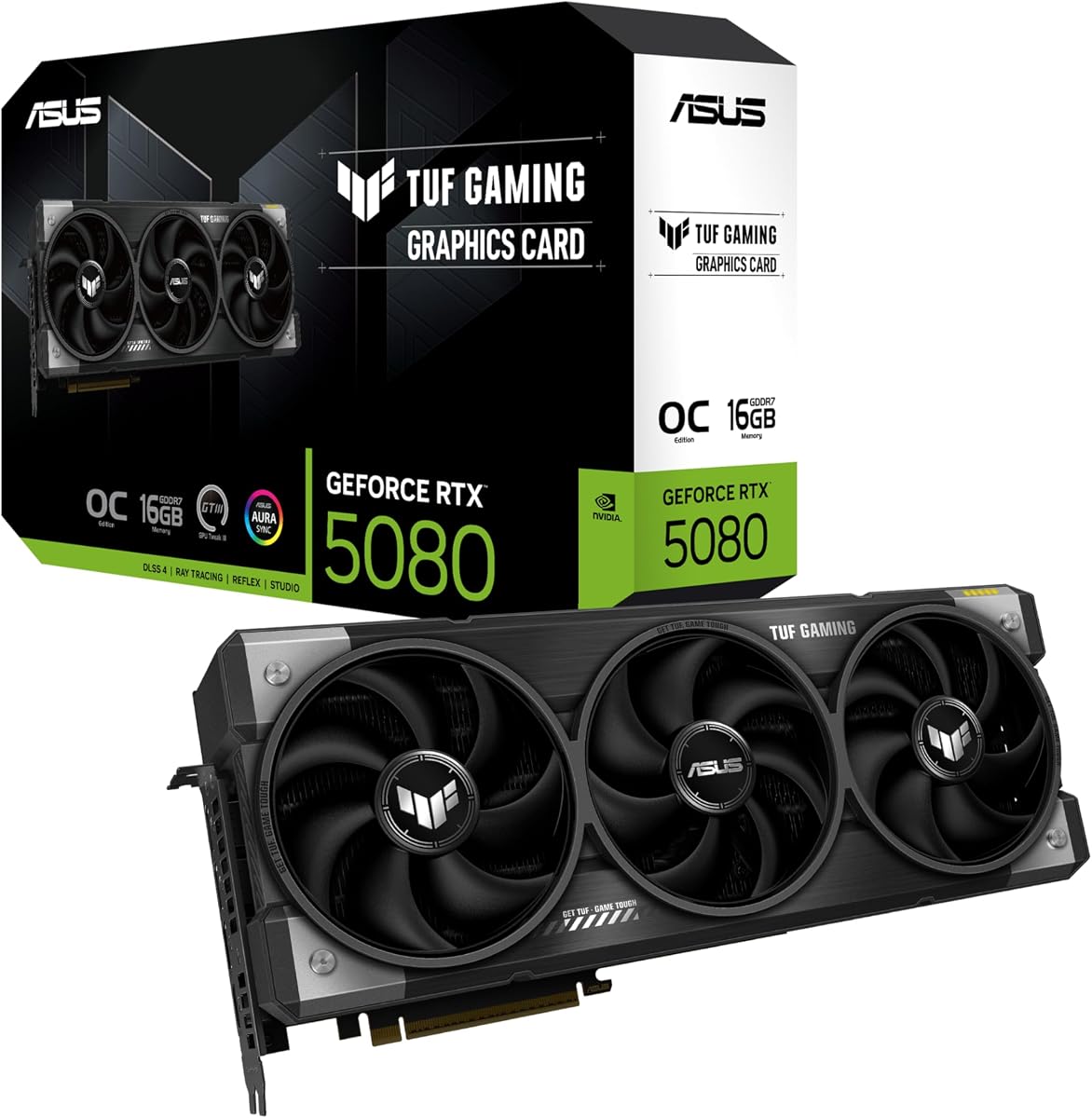
The ASUS TUF Gaming GeForce RTX 5080 is the most complete flagship recommendation in this guide for buyers who want current architecture, strong factory clocks, 16GB of GDDR7 memory, and a robust cooling package. It earns a 4.6 rating and uses NVIDIA Blackwell architecture with DLSS 4, placing it firmly among the most advanced cards in the group.
We may earn a commission when you buy through this link, at no additional cost to you.
The card boosts to 2730MHz in OC mode and 2700MHz by default. Its three Axial-tech fans, large fin array, phase-change GPU thermal pad, and 3.6-slot design are aimed at sustained high-load operation. Military-grade components, protective PCB coating, Auto-Extreme manufacturing, and GPU Tweak III add practical reliability and control features that can matter in an expensive enthusiast build.
Physical size is the clearest caveat. ASUS specifies a length of 348mm, a thickness of 3.6 slots, and a weight of 4.3 pounds. A GPU bracket is included, but owners must still confirm case clearance and the spacing between expansion slots. The card also requires a minimum 850W PSU with a 16-pin 12V-2×6 connector, making the rest of the system part of the buying decision.
The ASUS TUF RTX 5080 is recommended for high-end gamers and creators who want an RTX 5080 without settling for a minimalist cooler. Its specification depth, thermal materials, factory clock rates, and tuning tools make it an especially strong all-around flagship. It is best suited to a large, well-cooled enthusiast chassis with a modern and appropriately sized power supply.
The difference between the 2730MHz OC clock and 2700MHz default clock gives buyers a defined performance mode from the outset. GPU Tweak III then provides additional control for monitoring and refinement.
At 348mm long and 3.6 slots thick, the TUF RTX 5080 demands more space than a compact dual-fan card. Measuring the case and checking adjacent slot clearances before ordering can prevent an expensive installation problem.
We may earn a commission when you buy through this link, at no additional cost to you.
The GIGABYTE Radeon RX 9070 XT Gaming OC 16G is a flagship Radeon card with a 4.7 rating. It combines 16GB of GDDR6 memory, a PCIe 5.0 interface, and the Radeon RX 9070 XT with GIGABYTE's WINDFORCE thermal system. For buyers seeking a capable high-end GPU outside the NVIDIA ecosystem, it offers a clear and competitive specification set.
We may earn a commission when you buy through this link, at no additional cost to you.
The cooling design incorporates GIGABYTE's WINDFORCE system and Hawk fan, both of which are intended to manage heat and airflow under sustained graphics workloads. Server-grade thermal conductive gel is also listed, adding another layer to the card's thermal design. These features are particularly relevant for the RX 9070 XT, a model likely to be used for long rendering sessions and demanding games.
RGB lighting gives the card a distinctive appearance and is useful for builders creating a coordinated system. The supplied information does not list exact boost or game clocks, AI performance figures, or a detailed display-output arrangement, so comparisons with the ASUS Radeon card should focus on the confirmed 16GB memory, PCIe 5.0 support, and the respective cooler implementations.
GIGABYTE's RX 9070 XT Gaming OC is best suited to a gamer who wants a high-end Radeon option, adequate memory, and a modern interface. It also appeals to builders who value GIGABYTE's established cooling and visual design. Confirming case dimensions, power requirements, and the specific display outputs included with the final board is sensible before making a purchase.
Radeon RX 9070 XT and PCIe 5.0 position the card as a contemporary high-end graphics option. Its 16GB memory configuration gives it a useful foundation for modern texture-heavy games and creative workloads.
WINDFORCE cooling, Hawk fans, and server-grade thermal conductive gel form the card's thermal approach. RGB lighting adds a visual element that can complement a transparent or themed gaming setup.
We may earn a commission when you buy through this link, at no additional cost to you.
The ASUS Dual GeForce RTX 5060 Ti 16GB GDDR7 OC Edition stands out as a more compact flagship option. Its 4.7 rating, 16GB of GDDR7 memory, and 2.5-slot design make it attractive for gamers who want modern Blackwell features without the footprint of a large triple-fan card. It is the budget-focused selection among the guide's three leading picks.
We may earn a commission when you buy through this link, at no additional cost to you.
NVIDIA Blackwell architecture and DLSS 4 provide access to the latest generation of graphics and AI-assisted rendering features. The card is rated at 767 AI TOPS, with an OC mode of 2632MHz and a default mode of 2602MHz. This specification mix gives it a useful balance of gaming capability, memory capacity, and computational features for a high-end compact build.
The cooling system uses an Axial-tech fan design with a smaller fan hub, longer blades, and a barrier ring intended to increase downward air pressure. A 2.5-slot chassis improves case compatibility without sacrificing the stated cooling focus. 0dB technology provides quiet operation during lighter gaming, while a dual BIOS allows users to choose between Quiet and Performance profiles.
This card is recommended for builders with limited chassis space, strong interest in efficient operation, or a preference for 16GB memory at a lower tier than the RTX 5080 and RTX 5090. It may also appeal to anyone who wants the Dual series' relatively restrained design. Verify the card's final dimensions and system requirements, but the RTX 5060 Ti Dual is a flexible, modern high-end choice.
The 2.5-slot design is the card's standout physical advantage. It can be easier to install in systems where a 3.5-slot or larger flagship would interfere with expansion slots, storage, or airflow.
The dual BIOS gives users a straightforward way to choose quieter behavior or the performance profile. Combined with 0dB technology, it makes the card adaptable to both focused work and demanding gaming sessions.
We may earn a commission when you buy through this link, at no additional cost to you.
The ASUS TUF Gaming GeForce RTX 5090 is the memory-rich flagship in this collection, with 32GB of GDDR7 memory. It has a 4.4 rating and uses NVIDIA Blackwell architecture with DLSS 4, while the listed AI performance reaches 772 AI TOPS. The unusual combination of top-tier capacity and a relatively restrained 2.5-slot design sets it apart.
We may earn a commission when you buy through this link, at no additional cost to you.
For high-resolution gaming, content creation, AI applications, and other memory-intensive workloads, 32GB offers more breathing room than the 12GB and 16GB alternatives here. The card boosts to 2580MHz in OC mode and 2550MHz by default. Its SFF-Ready Enthusiast positioning may appeal to builders who want large-capability graphics without automatically choosing the broadest possible cooler.
Axial-tech fans, dual-ball fan bearings, a 2.5-slot design, 0dB technology, and a dual BIOS switch form a well-rounded platform. The bearings are listed as lasting up to twice as long as standard sleeve-bearing designs. GPU Tweak III and Auto-Extreme manufacturing add software control and production-quality consistency, respectively.
The RTX 5090 is our premium pick because its 32GB memory is the clearest differentiator in the lineup. It is most appropriate for users who can benefit from the extra capacity rather than merely wanting a faster conventional gaming card. The lower 4.4 rating does not erase that advantage, but buyers should consider the entire system, power requirements, and workload before committing.
A 32GB allocation is the defining feature of this model. It gives demanding applications more room for textures, models, scenes, and other data than the lower-capacity cards in the guide.
The SFF-ready positioning and 2.5-slot thickness make the RTX 5090 easier to accommodate than many large flagship designs. It offers an unusual path to maximum memory for builders who also value chassis compatibility.
We may earn a commission when you buy through this link, at no additional cost to you.
The ASUS Prime Radeon RX 9070 XT 16GB GDDR6 OC Edition is a 4.6-rated high-end Radeon card with a focus on compact construction, cooling, and convenient operating profiles. Its 16GB memory and detailed clock specifications make it easy to compare with the GIGABYTE RX 9070 XT, while its 2.5-slot cooler gives it a distinct physical advantage.
We may earn a commission when you buy through this link, at no additional cost to you.
Factory-oriented clocks are listed at up to 3030MHz boost and up to 2480MHz game clock in OC mode. Default mode reaches up to 3010MHz boost and up to 2460MHz game clock. GPU Tweak III provides access to performance tweaking, thermal controls, and monitoring, allowing buyers to inspect and adjust the card without relying entirely on default behavior.
The cooler uses Axial-tech fans, a phase-change GPU thermal pad, dual-ball fan bearings, and 0dB technology. Dual BIOS profiles let users move between Quiet and Performance configurations. The phase-change pad is designed to improve heat transfer and lower GPU temperatures, while the bearing design is stated to last up to twice as long as conventional sleeve-bearing alternatives.
The ASUS Prime RX 9070 XT is recommended for gamers who prefer the Radeon platform and want a card that is easier to fit than a large triple-fan design. Its combination of 16GB memory, strong stated clock speeds, and useful thermal features makes it a well-rounded high-end option. As always, confirm the final display outputs, physical dimensions, and system power requirements before ordering.
The stated 3030MHz OC boost and 3010MHz default boost clocks give the card a clear performance profile. GPU Tweak III gives users direct control over these settings and access to live thermal information.
The dual BIOS and 0dB technology support a more relaxed computing environment. Owners can select a Quiet profile for lighter tasks and move to Performance when sustained gaming demand increases.
We may earn a commission when you buy through this link, at no additional cost to you.
The ASUS TUF Gaming GeForce RTX 5070 is a 12GB GDDR7 graphics card with a 4.7 rating and a 2640MHz OC boost clock. It uses Blackwell architecture and DLSS 4, offering current-generation NVIDIA features in the TUF line. The card is suited to high-end gamers who value memory speed, cooling construction, and a durable component package.
We may earn a commission when you buy through this link, at no additional cost to you.
Its default boost clock is listed at 2610MHz, creating a clear difference between the standard and overclocked modes. The 12GB GDDR7 allocation is less generous than the 16GB and 32GB cards elsewhere in the guide, so buyers with unusually texture-heavy games or memory-intensive creative applications should consider the capacity carefully.
Thermal engineering is a major strength. A 3.125-slot design, large fin array, and three Axial-tech fans form the cooler, while a phase-change GPU thermal pad is designed to maintain effective heat transfer. Military-grade components, a protective PCB coating, and Auto-Extreme manufacturing add to the durability focus. ASUS GPU Guard and the included bracket help reduce mounting stress and the risk of cracks.
The ASUS TUF RTX 5070 is best for gamers who want DLSS 4 and a high-performance 12GB card without moving to a 16GB configuration. It would suit a well-cooled, adequately powered gaming system where its triple-fan body can be accommodated. GPU Tweak III adds performance tuning, thermal controls, and monitoring for users who want closer control over the card.
Protective PCB coating, military-grade components, and a phase-change thermal pad make the TUF construction particularly practical. These features are intended to support reliability under sustained heavy loads.
ASUS GPU Guard and the supplied bracket work together to reduce strain on the graphics card. Secure mounting is especially valuable for a substantial card housed in a system that may be moved or serviced.
We may earn a commission when you buy through this link, at no additional cost to you.
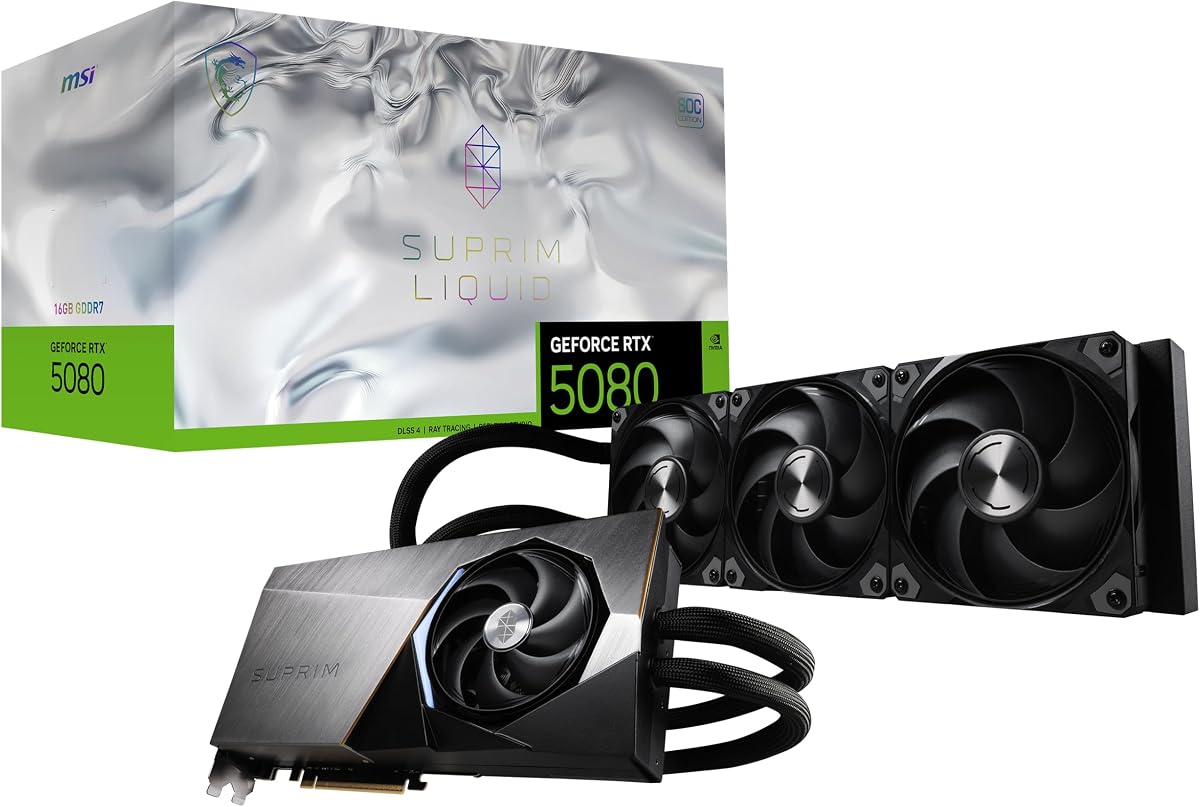
The MSI Gaming RTX 5080 16G SUPRIM Liquid SOC combines NVIDIA Blackwell architecture, 16GB of GDDR7 memory, and a stated extreme-performance clock of 2760MHz. Its 4.7 rating reflects a strong feature set, while the liquid-cooling branding and SUPRIM design position it as a premium enthusiast option for a carefully configured gaming system.
We may earn a commission when you buy through this link, at no additional cost to you.
The graphics memory uses a 256-bit interface, matching the bandwidth-oriented configuration found in the GIGABYTE RTX 5080. The clock figure gives the card one of the most aggressive factory-style specifications in the guide. For gamers targeting high refresh rates and demanding titles, that combination is especially relevant, although actual performance depends on the rest of the system and the game being played.
Display connectivity is a defining feature. The card provides three DisplayPort 2.1a outputs and one HDMI 2.1b output, with a listed digital maximum resolution of 7680 by 4320. This arrangement is well suited to high-end monitor setups, including an ultrawide display or a multi-screen creative workstation. The extensive output selection also provides flexibility when connecting modern displays that use different interfaces.
This MSI card is recommended for builders who want an RTX 5080 with aggressive factory specifications, liquid cooling, and broad display support. Because it uses liquid cooling, buyers should confirm that the complete cooling solution is included, understand the installation process, and ensure the radiator and tubing arrangement fits the case. With those conditions met, it is a feature-rich flagship option.
Three DisplayPort 2.1a ports and one HDMI 2.1b port offer an unusually flexible connection set. The card is particularly appropriate for high-end gaming monitors, ultrawide displays, and multi-monitor creator setups.
The SUPRIM Liquid designation signals a cooling approach intended for a flagship installation. Buyers should verify the supplied cooler components, radiator dimensions, mounting hardware, and available case space before ordering.
We may earn a commission when you buy through this link, at no additional cost to you.
A flagship graphics card should be evaluated as part of a complete computer. Architecture, memory, cooling, dimensions, power delivery, and intended workloads all matter, so the most advanced model is not automatically the most appropriate choice for every system.
The graphics architecture determines which platform features are available and shapes the card's broader performance profile. NVIDIA Blackwell models in this guide provide DLSS 4, while the RTX 4090 uses NVIDIA's earlier RTX architecture with DLSS 3. The Radeon RX 9070 XT cards provide a different ecosystem and should be evaluated according to the software and games you intend to run rather than by assuming one brand is automatically superior.
Choose the architecture that aligns with your software, display setup, and desired technologies. Blackwell is the clear choice for buyers prioritizing the newest NVIDIA feature set, while a mature RTX platform can still satisfy users who value its established capabilities.
The available memory influences which textures, scenes, and creative projects can remain resident without frequent transfers. The list ranges from 12GB in the ASUS TUF RTX 5070 to 32GB in the ASUS TUF RTX 5090, with 16GB being the most common configuration. More memory can help in high-resolution gaming, content creation, AI tools, and multitasking, although capacity alone does not determine overall speed.
Match memory to the workload. Sixteen gigabytes is broadly useful for modern gaming, while thirty-two gigabytes is most meaningful for demanding professional or experimental applications. Check individual game requirements before choosing a twelve-gigabyte model.
Flagship cards generate enough heat to make thermal design a central buying consideration. The featured cards use WINDFORCE, triple Axial-tech fan, dual-fan Axial-tech, phase-change thermal pad, server-grade thermal gel, or liquid-cooling approaches. A larger multi-fan cooler can provide substantial airflow but needs adequate case clearance, while 0dB technology and Quiet BIOS profiles can reduce noise during lighter workloads.
Prioritize cooling that matches the case and your tolerance for fan noise. Confirm that the card's thickness and length leave space for airflow and neighboring components, and check that any liquid-cooling solution is fully supplied.
A card's nominal model does not reveal its exact footprint. The ASUS TUF RTX 5080 is listed at 348mm long and 3.6 slots thick, while several ASUS Dual and Prime models use a 2.5-slot design. The distinction can determine whether a large graphics card fits without blocking storage, expansion slots, or neighboring cooling components.
Measure the case's maximum graphics-card length and available slot space before ordering. Compare those figures with the manufacturer's dimensions, and leave enough clearance for power cables and airflow around the card.
Modern flagship graphics cards can place substantial demands on a power supply. The ASUS RTX 5070 Ti and RTX 5080 listings specify a minimum 850W PSU with a 16-pin 12V-2×6 connector. Every recommendation also requires a complete system review because the processor, memory, drives, fans, and other components contribute to peak electrical demand.
Use a quality power supply with the required wattage and connector type, and avoid mixing incompatible cable designs. Confirm that the cable can reach cleanly and that the case provides suitable cable-management space.
A high-end GPU should be matched to the number and capabilities of your displays. The VIPERA RTX 4090 supports 4K 120Hz HDR, 8K 60Hz HDR, and Variable Refresh Rate through HDMI 2.1a as specified. The MSI RTX 5080 includes three DisplayPort 2.1a outputs, one HDMI 2.1b output, and support for a listed maximum digital resolution of 7680 by 4320.
Count your monitors and check connector types before choosing. Extra outputs offer useful flexibility, but every active display also adds power draw, so the rest of the system should be sized accordingly.
Factory clock specifications provide a direct view of the board's intended performance configuration. Several ASUS models list separate OC and default boost clocks, while GPU Tweak III adds performance tweaking, thermal controls, and monitoring. A higher factory clock can be valuable for enthusiasts who want immediate headroom, but it should be considered alongside cooling, power delivery, and system stability.
Treat the supplied clocks as one part of the evaluation, not an isolated performance score. Choose a model whose thermal and electrical design can sustain its intended setting, and use the available monitoring tools to verify operation.
The board partner's ecosystem can influence the experience beyond the GPU itself. ASUS offers GPU Tweak III, GPU Guard, 0dB technology, and dual BIOS profiles across several models. GIGABYTE emphasizes WINDFORCE cooling, Hawk fans, and RGB lighting, while MSI's SUPRIM Liquid card offers a distinct liquid-cooled design and extensive modern display connectivity. The underlying NVIDIA or Radeon platform may matter more for software and game support.
Choose the brand whose utilities, warranty approach, physical design, and included cooling solution best suit your system. Make the decision within the broader hardware and software ecosystem rather than relying on one feature in isolation.
Install the graphics card in a powered-down system with the power disconnected. Confirm that the case has enough room, that the power supply provides the required wattage and connector, and that any liquid-cooling hardware is correctly installed according to the manufacturer's instructions. Secure the card with the supplied bracket and connect the required power cable without using an incompatible substitute.
After the first system startup, install the latest graphics driver from the appropriate NVIDIA or Radeon software source. Use the card's tuning utility when one is supplied, such as ASUS GPU Tweak III, to review performance, temperatures, fan behavior, and operating profiles. If the product includes Quiet and Performance BIOS modes, begin with the default profile and change modes only after confirming system stability.
Maintain good case airflow and keep the card's intake and exhaust areas clear of dust. Monitor performance during extended sessions rather than judging the card by a short benchmark alone. For liquid-cooled models, check connections and coolant circulation as part of routine maintenance, and use a surge-protected, properly grounded power source for the complete system.
A 32GB card is better when your workload genuinely benefits from the additional memory, such as demanding creative software, AI experimentation, high-resolution asset work, or games with large texture requirements. It does not automatically deliver twice the gaming performance of a 16GB card. For many conventional gaming builds, 16GB remains a strong and more balanced capacity, while 32GB provides additional flexibility.
Some models explicitly require a minimum 850W PSU and a 16-pin 12V-2×6 connector, including the listed ASUS RTX 5070 Ti and RTX 5080. Other cards have their own requirements, so you should check the exact product listing. A suitable power supply also depends on the processor and the rest of the system, not just the graphics card.
A 2.5-slot card is generally easier to fit in a compact case than a 3.5-slot or 3.6-slot model. It can leave more room for storage, expansion cards, and airflow. However, case depth, power-cable clearance, and cooling requirements still matter, so you should measure the complete installation envelope before purchasing.
The decision depends on your games, applications, hardware, and preferred software ecosystem. NVIDIA's RTX models in this guide provide features such as DLSS 4, DLSS 3, Reflex, and the NVIDIA Encoder, while the Radeon RX 9070 XT cards offer a distinct high-end alternative with 16GB of memory. Check support and optimization for the specific titles and creative tools you use.
GDDR7 is the newer memory generation used by several of the RTX cards in this guide, while the Radeon RX 9070 XT models use GDDR6. The newer standard can improve memory-related performance when paired with an appropriate architecture and interface. Memory type should still be considered alongside capacity, bandwidth, game requirements, and the behavior of the complete graphics card.
No. Factory OC modes are already configured by the manufacturer for stronger performance, and the default mode remains a sensible starting point. Additional tuning can help some users, but it also requires careful monitoring of temperatures, stability, and power behavior. GPU Tweak III makes the process more accessible without making manual overclocking necessary for every owner.
You should leave enough space for the card itself, its power connectors, and the airflow it needs to intake and exhaust. Exact clearance depends on the case and product dimensions, so consult the chassis specification rather than relying on a universal number. The 348mm length and 3.6-slot thickness of the ASUS TUF RTX 5080 are particularly important to verify.
Quiet mode is useful for light tasks, media use, and situations where lower fan noise is the priority. Performance mode is better suited to demanding games and sustained graphics work. The available profiles also depend on the card's thermal design, so begin with the standard mode if you are unsure and monitor the result under your usual workload.
The ASUS TUF RTX 5080 is the strongest all-around flagship choice because it combines Blackwell architecture, DLSS 4, 16GB of GDDR7 memory, high factory clocks, and a substantial cooling package. The ASUS Dual RTX 5060 Ti is the value-focused top pick for its compact 2.5-slot design and 16GB configuration, while the ASUS TUF RTX 5090 is the premium selection for buyers who need the guide's largest 32GB memory allocation.
Prioritize the workload before the model number. High-end gaming buyers may place more weight on architecture, clock speeds, cooling, and case fit, while content creators and AI users should consider memory capacity, parallel processing, and software support. Older but capable platforms such as the RTX 4090 can remain attractive when ray tracing, display features, CUDA capability, and creator tools matter.
Before ordering, confirm the current product listing, final dimensions, display outputs, connector requirements, and compatibility with your power supply and case. Market conditions, inventory, and bundle contents can change, so reviewing the live listing and manufacturer guidance is the safest final step before making a flagship graphics card purchase.