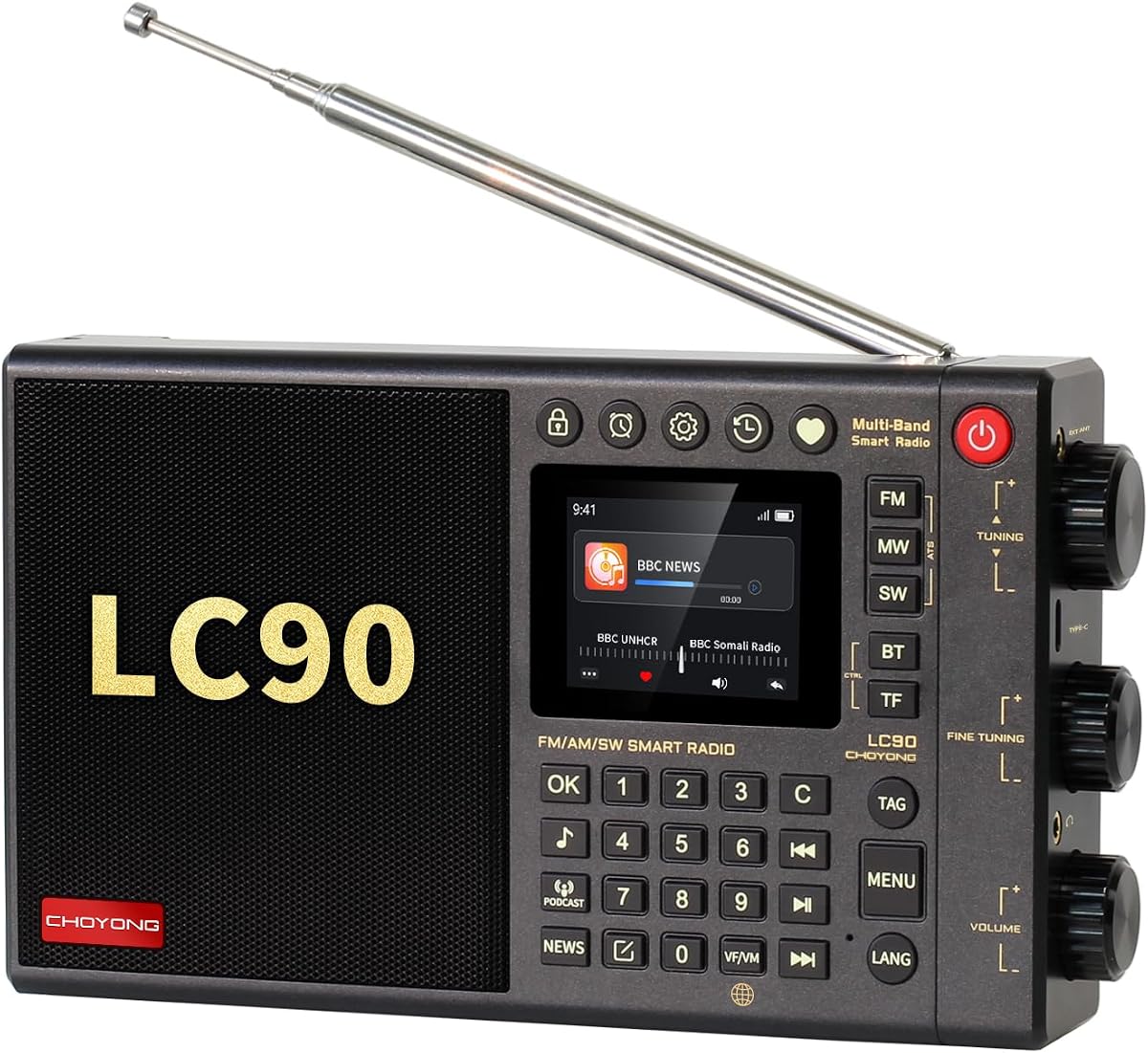
CHOYONG LC90 Multi-Band Smart Internet Radio
3.7Editor score
More than 40,000 internet stations
WiFi and SIM connectivity
Traditional multi-band reception
Discover the best Multiband Portable Radio options for emergency alerts, travel, camping, aviation listening, shortwave reception, and everyday portable audio.
A Multiband Portable Radio combines AM, FM, shortwave, weather, aviation, and sometimes additional bands in a compact receiver. The best model depends on reception needs, emergency planning, battery flexibility, sound quality, portability, and whether traditional broadcasting or internet-connected listening is your priority.
This guide compares ten multiband radios using the supplied specifications, feature lists, customer ratings, power options, band coverage, controls, audio functions, and included accessories. It includes budget entertainment radios, preparedness-focused models, aviation-capable receivers, internet-connected sets, and larger wooden-cabinet models designed for stationary listening.
Each review explains who should consider the radio, why its strengths matter, and where its compromises appear. The top selections range from a feature-rich travel receiver to a highly connected smart radio and a rechargeable NOAA-focused model. Product availability, features, and prices can change, so confirm current listings before purchasing.
3.7Editor score

4.4Editor score

4.1Editor score
The comparison covers reception bands, emergency functions, power flexibility, audio features, portability, and connectivity across all ten radios. It helps distinguish compact travel models, preparedness kits, aviation listeners, smart radios, and higher-powered home or campsite systems.


This pocket-oriented radio combines FM, AM, shortwave, and NOAA weather reception with a customer rating of 4.3. Its defining attraction is the unusually broad set of functions for a relatively compact device: digital tuning, a bright display, a 5W speaker, Bluetooth, TF-card playback, a flashlight, a back clip, and a wrist strap.
We may earn a commission when you buy through this link, at no additional cost to you.
The four supported bands are FM 87–108MHz, AM 520–1710kHz, shortwave 4.75–21.85MHz, and the NOAA weather band from 162.400–162.550MHz. That makes it useful for local news, national broadcasts, shortwave programming, and weather alerts. The advanced DSP chip and stated reception focus should appeal to listeners who want a compact radio with more capability than a simple AM/FM pocket set.
Its internal rechargeable battery is rated at 1250mAh, with up to 10–12 hours of music and news use on a charge. The Type-C charging arrangement is convenient, and the flashlight adds practical emergency value. Bluetooth 5.4 lets it act as a wireless speaker, while the TF slot supports personal playlists. A 3.5mm headphone jack offers quiet listening, and six EQ stereo effects can change the character of recorded music.
The main limitation is that this is not a true aviation-band or single-side-band receiver. Its battery capacity is also smaller than those offered by several rechargeable competitors, so users planning extended trips away from power should consider a model with a larger cell. Even so, it is a strong all-around option for casual listeners, travelers, and campers who value entertainment features and emergency reception in one small package.
The radio does more than receive conventional stations. Bluetooth pairing and TF-card playback let it serve as a compact media speaker, making it useful for picnics, workshops, bedrooms, and travel days when users want more than live radio.
NOAA reception and the built-in flashlight strengthen its preparedness appeal. The rechargeable cell, readable digital display, illuminated controls, back clip, and wrist strap also make it easier to operate outdoors without adding much bulk.
We may earn a commission when you buy through this link, at no additional cost to you.
The C. Crane CC Skywave SSB 2 is among the most specialized radios in this guide, with a 4.4 customer rating and support for AM, FM, NOAA weather and alerts, shortwave, VHF aviation, and single side band. It is designed for listeners who want more technically capable reception than a standard pocket multiband radio can provide.
We may earn a commission when you buy through this link, at no additional cost to you.
The shortwave range extends from 1711–29999kHz and can be tuned with selectable fast or fine tuning. Single-side-band reception is especially valuable for long-distance information when ordinary AM and FM broadcasting is unavailable. The aviation band can be scanned for activity, including 10 dedicated aviation memory locations, while the radio also supports direct frequency entry, automatic scanning, and storage of up to 400 channels.
The included 23-foot reel antenna is one of its most practical features. Connecting it through the shortwave antenna jack can improve shortwave reception, giving the radio an advantage when it is used away from a strong local signal environment. A shortwave wire antenna adapter, earphones, and a faux-leather carry case are also included. The fold-out rear stand is convenient for tabletop listening.
Operation relies on two AA alkaline batteries, with an optional AC adapter available separately. Battery runtime is approximately 70 hours with earbuds or 60 hours with the built-in speaker, and the radio weighs only 6 ounces without batteries. Its compact dimensions make it genuinely portable, although the small illuminated LCD can feel less accommodating than the displays on larger entertainment-oriented models. Overall, it is the most balanced choice here for serious travelers, aviation listeners, and shortwave enthusiasts.
Single side band, aviation coverage, fine tuning, and direct frequency entry give this radio a clear technical advantage. It suits users who understand or are willing to learn shortwave listening rather than only want simple local station selection.
The low weight, rear stand, carry case, earbuds, and external antenna kit create a practical travel package. Long AA battery life also reduces the need to carry multiple sets of batteries.
We may earn a commission when you buy through this link, at no additional cost to you.
This rechargeable radio combines AM, FM, shortwave, and NOAA weather reception with playback from USB devices and microSD cards. Its 4.1 customer rating is not the highest in the guide, but the feature set and large 4000mAh battery make it a noteworthy option for users who prioritize endurance over a broad collection of specialized bands.
We may earn a commission when you buy through this link, at no additional cost to you.
The radio can receive seven NOAA stations and is intended to provide advance notice of hurricanes, rainstorms, tornadoes, and other severe weather. Direct frequency entry makes station selection straightforward, while 40 preset locations provide quick access to favorites. A clear LCD with a backlight helps users adjust frequencies in dim conditions, and a dedicated key-lock function helps prevent accidental changes.
Its main power advantage is the 4000mAh rechargeable battery. The stated runtime reaches up to 18 hours after a roughly five-hour Type-C charge. It can alternatively run with four D-cell batteries, which is valuable during outages or extended camping trips. The sleep timer can be set from 10 to 90 minutes, helping preserve battery life when the radio is left on overnight.
Music playback adds flexibility, and the high and low two-tone modes can alter the perceived brightness of MP3 files. The absence of aviation, VHF, and SSB reception narrows its appeal compared with the C. Crane models, and users should note the stated requirement to charge for 30 minutes before restarting after the battery is exhausted. Even so, it is an attractive rechargeable choice for homes, cars, and campsites where long runtime and familiar controls matter.
The large internal battery is the model’s clearest advantage, particularly for travelers or households that want to keep listening during an outage. D-cell backup provides another level of resilience when recharging is not possible.
Forty presets, one-click digital entry, a backlit display, and a lock key keep the radio approachable. USB and microSD support make it useful for personal music when conventional reception is weak.
We may earn a commission when you buy through this link, at no additional cost to you.
This emergency radio places preparedness ahead of compact entertainment. With a 4.4 rating, it supports NOAA, AM, FM, and shortwave bands, adds a hand crank and solar charging, includes a 120-lumen flashlight and compass, and can serve as an emergency source of power for compatible devices.
We may earn a commission when you buy through this link, at no additional cost to you.
Its built-in 4000mAh battery can be recharged through Type-C, a hand crank, or solar power. The stated playback time reaches up to 32 hours on a full charge, while the alternative charging methods are particularly important when grid power and sunlight are limited. The radio is designed for earthquakes, tsunamis, hurricanes, power failures, and other situations in which normal communication may be unavailable.
The digital search function automatically scans and stores channels across AM, FM, and shortwave. It can retain up to 70 channels on each band, for 210 total, although the supplied information notes that search results depend on local signal conditions. A built-in 5W magnetic speaker, Bluetooth 5.0, a 3.5mm headphone jack, and USB drive or TF-card access provide more entertainment flexibility than a basic emergency receiver.
The package includes the R11 radio, a Type-C cord, user manual, military-style box, and carrying strap. This makes it a more complete field kit than many competing models. Its size and broad emergency feature set may be excessive for ordinary bedroom listening, but for households building an emergency cabinet or campers wanting independent charging, the preparedness logic is strong.
The flashlight, compass, SOS alert, emergency device charging, and carry strap extend usefulness beyond listening. These details matter more in a power outage than they do during routine radio use.
Type-C charging is convenient at home, while the hand crank and solar panel provide fallback options during an emergency. The large internal battery helps bridge periods when none of those sources are readily available.
We may earn a commission when you buy through this link, at no additional cost to you.
This radio is a refined version of the basic pocket multiband category, carrying a 4.3 rating and four reception bands: FM, AM, shortwave, and NOAA weather. It also provides 100 preset locations, Bluetooth and TF-card playback, a 5W speaker, a flashlight, a back clip, and a sleep timer adjustable from 10 to 120 minutes.
We may earn a commission when you buy through this link, at no additional cost to you.
A digital signal-processing chip supports the receiver, while the large illuminated display and clear physical buttons simplify operation. Automatic and manual preset selection are both available, and automatic channel search can save stations with one step. Six EQ stereo effects and a 3.5mm headphone jack make the unit usable for both shared listening and private listening.
Its Type-C rechargeable 1250mAh battery is specified for up to 10–12 hours of music and news. That is sufficient for a day trip or a bedside radio, although it is less generous than the battery capacities offered by the R11 and 4000mAh models. The built-in flashlight adds useful emergency capability, and the back clip and wrist strap support genuinely portable use.
The absence of aviation-band and SSB reception means it is less suitable for specialized hobby listening than the C. Crane radios. Still, the 100 presets, sleep timer, Bluetooth, media playback, and straightforward display form an attractive package for users who want a radio for ordinary broadcasts, music, and weather warnings without a complicated setup.
The generous preset capacity makes it easy to keep favorite local stations, shortwave services, and weather channels close at hand. Automatic saving and manual tuning provide both speed and control.
Bluetooth and TF-card playback extend the radio beyond live broadcasting. The 5W speaker and selectable EQ modes are especially useful for casual music listening around a campsite, patio, or workshop.
We may earn a commission when you buy through this link, at no additional cost to you.
This straightforward transistor radio provides AM, FM, and two shortwave ranges without attempting to be a smart device. Its 4.3 rating reflects a familiar design with a large built-in speaker, a precise tuning knob, a retractable copper telescopic antenna, and a clear display that should be easy for older users or anyone who prefers physical controls.
We may earn a commission when you buy through this link, at no additional cost to you.
The FM range is 87.5–108MHz, AM extends from 520–1710kHz, and shortwave covers 3.5–23MHz. A 3.5mm headphone jack supports private listening, while AUX input expands the options for connected audio sources. The radio is not supplied with digital station presets, recording, Bluetooth, or NOAA reception, so it is better suited to spontaneous tuning than managing a large list of saved stations.
Power flexibility is one of its strongest features. A 120V AC cord is included for indoor use, two D-size batteries can power it when away from an outlet, and the supplied information also notes built-in rechargeable battery support for portable use. That makes the radio adaptable to a bedroom, kitchen, workshop, garage, picnic area, or campsite, although users should verify battery requirements and the state of the internal rechargeable cell before relying on it away from mains power.
Its dimensions are 6.3 by 2.16 by 4.33 inches, larger than most pocket models but still portable. The broad speaker and large knobs favor ease of operation over minimalism. This is a compelling choice for buyers seeking uncomplicated shortwave reception and flexible power, while emergency-focused listeners should choose a model with NOAA and a hand crank.
The large tuning knob, large letters, and separate physical adjustments reduce the learning curve. It is a good option for a kitchen or bedside radio where quick volume and station changes are the priority.
AC operation, D-cell capability, and built-in rechargeable support allow the radio to move between home and outdoor settings. The telescopic antenna supports the broader reception range.
We may earn a commission when you buy through this link, at no additional cost to you.
The CHOYONG LC90 is the guide’s most connected radio, combining conventional AM, FM, longwave, medium-wave, and shortwave SSB reception with WiFi and optional SIM-based internet connectivity. Its 3.7 rating is the lowest among the ten products, but that figure does not capture the fundamental difference between this model and the mostly offline competitors.
We may earn a commission when you buy through this link, at no additional cost to you.
The radio can access more than 40,000 internet stations, organized by location, station type, and popularity. The supplied information also describes access to roughly 10 million podcast episodes, along with Spotify and Apple Podcasts, plus a station-search function that can push discovered services directly to the device. These features turn it into a global audio platform rather than a simple broadcast receiver.
Traditional reception remains important for users who want to operate without internet service. The LC90 offers selectable bandwidth, signal-strength and signal-to-noise displays, and a connection for an external antenna. Bluetooth, microSD playback, a clock, alarm, timer, key backlight, multi-language menu, and a 5000mAh rechargeable battery add to the travel and everyday-use proposition.
Audio is handled by a multi-driver arrangement consisting of a mid-bass speaker, silk-dome tweeter, and low-frequency diaphragm. That is more elaborate than the single-speaker design in most compact radios. The trade-off is complexity: online features require connectivity, the rating trail those of the simpler models, and users dependent on its streaming functions may need consistent WiFi or cellular access. For listeners who want both emergency-style traditional bands and global online media, it remains the most ambitious option.
The internet catalog dwarfs what conventional local-area reception can offer. Geographic organization, favorites, voice or AI-assisted search, and station pushing make it practical for users interested in broadcasts from distant countries.
AM, FM, longwave, medium-wave, and SW SSB preserve the core expectations of a multiband receiver. WiFi and SIM options add online flexibility without eliminating terrestrial reception.
We may earn a commission when you buy through this link, at no additional cost to you.
The ZHIWHIS wooden-box radio is built for listeners who care about sound quality and indoor reception as much as traditional portability. It carries a 4.3 rating and supports FM, AM, shortwave, weather, aviation, and VHF bands, with storage for up to 200 stations on each band.
We may earn a commission when you buy through this link, at no additional cost to you.
The wooden enclosure and dual 5W speakers distinguish it from pocket and travel models. Adjustable bass and six EQ modes allow listeners to shape the output for radio, music, or streamed audio. Bluetooth 5.2, TF-card playback, and a 3.5mm auxiliary input expand its use beyond broadcasts, while a digital LCD, sleep timer, alarm, auto-start behavior, and app-based remote control support home listening.
Its supplied signal repeater is intended to address the common problem of weak AM and shortwave reception indoors. The radio also has a 3.5mm external antenna port for FM and shortwave. These features make it appealing to enthusiasts who want to experiment with reception rather than simply scan local stations.
Power comes from three 2500mAh lithium batteries, with USB Type-C charging. The cabinet and dual-speaker arrangement make it a stationary or semi-portable choice, not a hiking companion. Its broad band list and audio potential are substantial, but the more elaborate design also means it will occupy considerably more space than the smaller digital radios. It is best suited to a desk, bedside table, workshop, or campsite where sound and programmable stations are priorities.
Dual 5W drivers, bass adjustment, multiple EQ modes, and the wooden enclosure create a more home-audio-oriented experience. The result should be especially appealing for long sessions and shared listening.
The included signal repeater targets difficult AM and shortwave conditions indoors. An external antenna connection offers another route to stronger or more stable reception.
We may earn a commission when you buy through this link, at no additional cost to you.
The standard C. Crane CC Skywave 2 is a compact travel radio with a 4.4 customer rating. It covers AM, FM, NOAA weather and alerts, shortwave from 2300–26100kHz, and the VHF aviation band, making it a particularly strong choice for users interested in aviation monitoring alongside conventional broadcasts.
We may earn a commission when you buy through this link, at no additional cost to you.
The digitally tuned receiver offers selectable bandwidth settings and fast or fine tuning on every band except weather. Users can enter a frequency directly, scan and store stations, and access up to 400 memory locations. Ten aviation memories can be scanned for activity, while a clock, selectable 12- or 24-hour display, alarm, rotary volume control, tuning knob, illuminated LCD, headphone jack, and fold-out stand make it a well-rounded travel companion.
A shortwave antenna jack can improve reception when connected to a suitable external antenna. The package includes high-quality CC Buds earphones and a faux-leather carry case. The radio runs on two AA alkaline batteries, although batteries and the optional AC adapter are not included. Stated runtime reaches approximately 70 hours with earbuds and 60 hours with the built-in speaker.
At 4.75 by 3 by 1.1 inches and 6 ounces without batteries, it is easy to pack. Compared with the CC Skywave SSB 2, its main compromise is the lack of single-side-band reception. It may therefore be the better fit for aviation-focused travelers, while dedicated shortwave listeners should consider the SSB version for its additional mode.
A dedicated aviation band, ten scannable aviation memories, and direct frequency entry give aviation listeners more control than a basic shortwave model. The carry case and fold-out stand support mobile use.
The stated 60-hour speaker runtime and 70-hour earbud runtime are highly useful for travel. Two AA cells also make replacement batteries widely accessible when needed.
We may earn a commission when you buy through this link, at no additional cost to you.
This compact radio earns the highest customer rating in the guide at 4.5 while providing an unusually dense feature set. It supports FM, AM, shortwave, VHF, aviation, and NOAA weather bands, and the supplied information describes seven reception bands overall, with 108 presets available on each band.
We may earn a commission when you buy through this link, at no additional cost to you.
The tuning options are varied: users can select channels digitally, tune manually, use a physical knob, or choose saved presets. A bandwidth selector, squelch, digital recording, flashlight, orange backlit buttons, and a 3.5mm external antenna input add practical and hobby-oriented functions. The radio can save broadcasts to a microSD card, which is especially useful for capturing aviation traffic, shortwave programming, or local stations that are only available at certain times.
Audio comes from a 3W speaker with a bass radiator, amplifier, and six equalization options. It can also operate as a Bluetooth speaker, accept PC auxiliary input, play microSD files, and connect to stereo headphones. A 24-inch retractable antenna is included to support reception across the wide frequency range.
At 5.3 by 3.3 by 1.2 inches and 0.55 pounds, it is compact enough for a backpack, glove box, or tackle box. It accepts two AA batteries or an included BL-5C lithium battery, with Type-C charging available. The 3W speaker is smaller than the 5W systems elsewhere in the guide, and the menu may take time to learn. Even so, the combination of high rating, aviation coverage, recording, and flexible tuning makes this a strong all-purpose compact receiver.
Saving broadcasts to microSD is a valuable feature for aviation and shortwave listeners who may miss a transmission. It supports both live listening and later review without requiring a separate recorder.
The seven-band specification, 24-inch antenna, presets, external antenna connection, and multiple tuning methods provide serious flexibility. Its small size still makes it practical for travel and outdoor use.
We may earn a commission when you buy through this link, at no additional cost to you.
The right Multiband Portable Radio depends on which signals you want to hear, how far you travel, how you will power it, and whether emergency readiness matters more than compactness or entertainment features. The following factors help narrow the field before comparing controls and specifications.
AM and FM cover familiar local and regional broadcasting, while shortwave opens the door to international stations, utility services, and hobby transmissions. NOAA weather bands support official forecasts and alerts in the United States, while aviation and VHF bands serve a different listening need. The most complete models add all of these, but every extra band adds complexity, tuning effort, and potentially more internal competition for signal quality.
Local AM and FM stations are usually the easiest broadcasts to receive, but their availability changes by location and terrain. Shortwave behaves differently, often benefiting from an external wire antenna and patient tuning. A radio’s claim of strong reception should be considered alongside antenna quality, bandwidth controls, digital processing, and the listener’s environment. Claiming a strong reception should be considered alongside antenna quality, bandwidth controls, digital processing, and the listener’s environment. A strong receiver in an urban apartment may still be limited by a noisy building, while a simple set with a good outdoor antenna can perform well in a rural setting.
Rechargeable models are convenient for daily use, while AA and D-cell radios are often easier to sustain during extended outages. A large internal battery can support all-day listening, but backup power options can be more valuable than capacity. Look for Type-C charging, replaceable cells, hand cranking, or solar charging depending on the setting. Confirm battery runtime because specifications may refer to radio use, music playback, or use with earbuds under different conditions.
Pocket models prioritize small dimensions, low weight, back clips, wrist straps, and simple controls. Larger tabletop radios may provide stronger speakers, larger displays, more generous controls, and better home acoustics. A radio marketed as portable can still be a good campsite or bedside companion, but the definition of portable varies widely. Consider where the device will spend most of its time and how much space and weight you are willing to carry.
NOAA alerts are useful for weather warnings, but full emergency readiness may also require a flashlight, hand crank, solar charging, device charging, an SOS alarm, or a compass. These features are most meaningful in a household emergency kit, a remote campsite, or a vehicle. They are less relevant for daily listening. A radio with several independent power sources can provide greater resilience than a more advanced model that depends entirely on an internal rechargeable cell.
Direct frequency entry is valuable for aviation and shortwave enthusiasts, while automatic scanning and presets are easier for casual users. Fine tuning gives more control when signals are close together or unstable. Memory capacity matters if you visit many regions, but a smaller radio may be easier to operate simply because fewer options are exposed. Digital displays, illuminated buttons, key locks, large knobs, and sleep timers can materially improve daily usability.
Bluetooth, auxiliary input, microSD or USB playback, and multiple EQ settings can turn a radio into a general-purpose portable speaker. This is useful for camping music or listening to personal libraries when broadcast reception is weak. Speaker wattage alone does not predict overall sound quality, so consider driver size, enclosure design, bass support, headphone output, and whether shared or private listening is more important.
Smart radios add enormous catalogs of internet stations and podcasts, but their online value disappears without a reliable connection. Traditional multiband sets remain useful without internet service and can function entirely from removable batteries. Decide whether global online content is a central requirement or simply an occasional bonus. If a radio includes WiFi, SIM support, apps, or voice search, account for setup complexity, interface learning, and dependence on service providers.
Before relying on a multiband radio, identify its local broadcast frequencies, NOAA channels, aviation sub-bands, and any shortwave stations you want to monitor. Use manual or electronic scanning to find strong local stations, save them to presets, and note how quickly the signal strength display responds. If the radio supports multiple bandwidth settings, use a wider setting for nearby strong signals and a narrower setting when separating distant or crowded shortwave stations.
Improve shortwave reception with the supplied antenna when possible. Extend the telescopic whip fully, place the radio near an open window, and try different orientations away from computers, chargers, and other electronics. For a home radio with an external antenna connection, experiment with wire length and placement rather than assuming every signal will work in the same location. Keep aviation and emergency frequencies for legal listening and avoid transmitting or interfering with operational services.
Care for the device by keeping the charging port dry, using the specified battery type, and avoiding prolonged exposure to extreme heat or moisture. If the radio is used in a vehicle, remove it from direct sun and do not leave a rechargeable cell in a hot compartment. Clean the controls gently, protect the speaker openings from dust, and test the radio, flashlight, and alternative power sources regularly so every emergency function remains usable when needed.
AM and FM deliver local and regional terrestrial broadcasts, with FM generally offering cleaner sound and AM often serving talk, news, and emergency programming. Shortwave can carry international stations and long-distance utility transmissions, often with changing reception conditions. NOAA weather bands provide official forecasts, warnings, and alerts in the United States. A useful radio combines several of these bands rather than assuming one service covers every need.
A NOAA-capable radio is the priority for domestic weather alerts, while local AM and FM stations provide local information. Shortwave adds value when international or utility broadcasting is relevant, but it is not automatically more dependable than local services. A radio with multiple power sources, a flashlight, and replaceable batteries may offer more practical emergency resilience than a shortwave set with only a small rechargeable cell.
SSB is most useful to dedicated shortwave listeners, amateur-radio operators, and people who receive utility or long-distance voice transmissions. It can improve intelligibility where ordinary AM shortwave broadcasts are crowded or noisy. Travelers focused mainly on local broadcasts, NOAA warnings, and aviation frequencies can be well served by a model without SSB, so the extra mode is not essential for every listener.
An external antenna can improve shortwave or FM reception by providing a larger, clearer signal path than a short built-in telescopic antenna. The result varies with frequency, weather, surroundings, and antenna design. It is particularly useful at home, in vehicles, or at campsites where the radio can be positioned near a window or otherwise connected to a longer wire.
Not automatically. A multiband radio is appropriate for NOAA alerts only if its listed specifications include compatible weather-band reception and the activation behavior users understand. It may also need a power source that remains available during an outage. A dedicated emergency radio with hand-crank or solar charging can be more useful for severe-weather readiness, while a broader multiband model is better for everyday listening and travel.
Yes, provided the model also includes conventional AM, FM, shortwave, or other terrestrial reception. Internet-connected models remain functional for local broadcasts when their service is unavailable, but streaming catalogs, podcasts, and remote stations require WiFi or cellular data. Buyers should check exactly which traditional bands remain active offline.
Choose a handheld model for hiking, travel, small spaces, and lightweight packing. A tabletop model is usually better for stronger speakers, larger controls, external antennas, and extended listening in a home, workshop, or campsite. The labels are not absolute because some compact models have multiple power options, while some larger radios can still fit easily in a travel bag.
Test the radio monthly and after any extended storage period. Recharge the internal battery, install spare cells, check the flashlight, scan NOAA channels, and confirm that essential local stations remain receivable. A brief test every few months is also sensible if the device is part of a permanent emergency kit, since rechargeable cells can lose charge and controls or accessories may be moved between locations.
The C. Crane CC Skywave SSB 2 is the strongest all-round recommendation for listeners who value shortwave SSB, aviation coverage, memory storage, accessories, and long battery life. The CHOYONG LC90 stands apart for global internet radio, podcasts, WiFi and SIM connectivity, while the rechargeable 4000mAh radio offers a practical balance of NOAA reception, media playback, and endurance.
Start with the bands and environment that matter most, then choose the appropriate balance of power, portability, and controls. Aviation listeners should prioritize scannable airband memories, shortwave enthusiasts should examine SSB and external antenna support, emergency users should value NOAA plus independent power options, and everyday listeners may prefer Bluetooth and local media playback.
Ratings and product features provide a useful starting point, but they do not replace checking the current listing, included accessories, warranty details, and regional availability. Prices and configurations can change, so compare the latest information for the radio you are considering and avoid selecting solely by the largest number of listed features.