
Samsung Galaxy Tab A11+
4.6Editor score
Bright 11-inch 90Hz display
Expandable storage support
Quad Dolby Atmos speakers
Tablet for Nursing Students buying guide comparing 10 models for note-taking, study apps, portability, battery life, display quality, and daily school use.
A tablet for nursing students must balance clinical coursework, detailed note-taking, research, study apps, and a long clinical shift without becoming burdensome to carry. The most useful models combine a readable screen, responsive stylus input, dependable battery life, enough storage for coursework, and an ecosystem that can move work between a phone, laptop, and classroom.
We compared all ten featured tablets on display size and resolution, memory, storage, processor capability, stylus support, included accessories, battery claims, connectivity, audio, and practical study features. The guide covers Android, Samsung, Lenovo, and renewed Apple options, highlighting the distinctions that matter most in nursing school.
Each pick reveals which learner it best suits, from a portable value model to a premium study tablet and a renewed iPad. Ratings and specifications reflect the supplied listings, while prices and availability can change, so confirm the current listing and accessories before purchasing.
4.6Editor score
4.6Editor score

4.6Editor score
The table below compares all ten tablets by core study hardware, display, connectivity, and the accessories or pen features that can make them more practical for nursing coursework. It is a quick reference; the detailed reviews explain who each model fits best and where compromises appear.


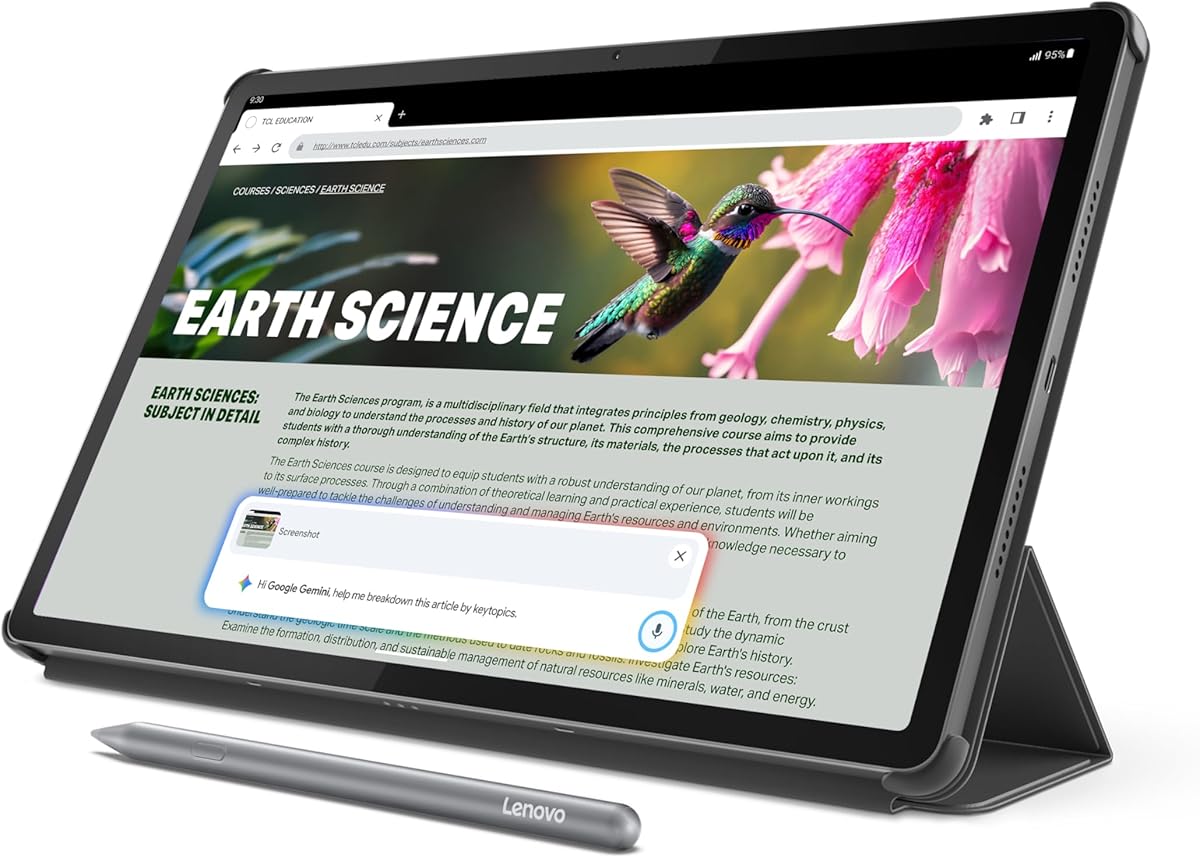
The Lenovo Idea Tab Pro combines a 12.7-inch 3K LCD, 8GB of memory, a MediaTek Dimensity 8300 processor, and an included Tab Pen Plus with a folio case. Its 4.6 rating reflects a strong balance of study features, large-screen usability, and accessories. For nursing students who read diagrams, annotate lecture slides, or work through lengthy case studies, this is the most polished all-around option in the list.
We may earn a commission when you buy through this link, at no additional cost to you.
The high-resolution display is particularly valuable for complex coursework. Its 3K panel provides more room for nursing care plans, pharmacology references, anatomy illustrations, and split-screen research without feeling cramped. Low Blue Light certification, plus switching between monochrome and chromatic modes, can make long reading sessions more comfortable. Quad JBL speakers with Dolby Atmos also give the tablet a distinct advantage for review videos, educational podcasts, and group study.
Performance is another major strength. The Dimensity 8300 is positioned for smooth multitasking, while Wi-Fi 6E supports fast downloads and reliable connections on compatible networks. Google Gemini, Circle to Search, and the included stylus make it possible to circle unfamiliar terms, ask questions, and move from reference material to notes without manually transcribing everything. The 45W charging system and stated 11 hours of unplugged video streaming also suit a demanding school-and-clinical-day schedule.
The main compromise is physical size. A 12.7-inch tablet offers excellent visibility but is less discreet in a backpack or on a crowded clinical floor than a compact 10-inch model. It also remains Android rather than iPadOS, so students committed to Apple accessories may prefer the renewed iPad. Even so, the Idea Tab Pro is an excellent choice for those who prioritize a large, sharp screen, modern performance, and a ready-made note-taking bundle. It is our top overall pick for nursing school.
The 12.7-inch 3K display creates a generous canvas for nursing notes, evidence summaries, medication references, and anatomy diagrams. Its reading modes and low-blue-light hardware are useful for students who spend long periods reviewing PDFs and lecture recordings.
The included Tab Pen Plus and folio case remove the need to buy a basic stylus and protective cover separately. Circle to Search also lets students highlight text or a visual region and start a related search while keeping the source material nearby.
We may earn a commission when you buy through this link, at no additional cost to you.
The Samsung Galaxy Tab A11+ earns a 4.6 rating and delivers a practical combination of an 11-inch display, 6GB of RAM, 128GB of internal storage, and expandable storage support. It is a compelling value choice for nursing students who need a full-size screen for research, lecture playback, and digital notes without moving to the most premium end of the category.
We may earn a commission when you buy through this link, at no additional cost to you.
The display supports refresh rates up to 90Hz, which gives scrolling and on-screen writing a smoother appearance than many conventional 60Hz tablets. Samsung also includes quad speakers with Dolby Atmos, a 5MP front camera for video calls, Google Gemini, and Circle to Search. Those features create a versatile device for attending online sessions, collaborating with classmates, searching a term visible on the screen, or reviewing a recorded lecture.
Storage is an important advantage for nursing coursework. The listed 128GB configuration provides room for lecture recordings, textbooks, applications, and reference files, while expandable storage offers additional flexibility for larger media. Fast charging is also helpful when a student needs to refill the battery between classes, and the long-lasting battery claim supports browsing, streaming, and study throughout the day.
The obvious limitation is that a stylus is not included. Nursing students who spend much of the day handwriting medication lists, care plans, or lecture notes should budget for a compatible S Pen or another supported stylus. Listings also refer to higher memory and storage configurations, so buyers should confirm the exact 6GB and 128GB version. Despite that caveat, the A11+ is easy to recommend as a balanced, economical choice for everyday nursing education.
The 90Hz screen makes a noticeable difference during long reading sessions, annotation, and fast scrolling through clinical resources. Six gigabytes of memory gives the tablet enough headroom for common multitasking patterns, while 128GB starts students with a practical media and document allowance.
The 5MP front camera is suited to online classes and group study calls, while the quad-speaker system makes lecture audio clearer and more immersive. Google Gemini and Circle to Search add useful shortcuts when students need definitions, summaries, or help interpreting something on the display.
We may earn a commission when you buy through this link, at no additional cost to you.
The Samsung Galaxy Tab S10 Lite pairs a 10.9-inch LCD with 6GB of RAM, 128GB of storage, an Exynos 1380 processor, and support for the S Pen. Its 4.6 rating reflects a balanced premium device suited to nursing students who want fluid handwriting, extensive file support, and smooth integration with other Samsung products.
We may earn a commission when you buy through this link, at no additional cost to you.
Pen support is the defining feature. The S Pen is designed for writing, drawing, note-taking, and mathematical work, making the tablet especially appealing for students who prefer to handwrite medication calculations, assessment checklists, and patient-care notes. Circle to Search, note cleanup, equation solving, and the AI Hot Key add ways to interact with class material without manually switching through several apps.
The tablet is also well equipped for a full day of study. Samsung states that the battery can last up to 16 hours and can reach a full charge in about two hours with Super Fast Charging. Storage can be expanded by up to 2TB through a microSD card, which is valuable for large media libraries, recorded lectures, and a growing archive of reference documents.
There are trade-offs. This remains a premium model rather than a budget purchase, and its LCD does not deliver the deeper contrast associated with OLED panels. It also works most smoothly for students already invested in Samsung phones, laptops, and accessories. Despite these limitations, the S10 Lite is the strongest dedicated premium note-taking choice here. Choose it when reliable S Pen support, expandable storage, and seamless Samsung integration outweigh minimizing the purchase cost.
The S Pen turns the tablet into a practical digital notebook for care plans, concept maps, dosage calculations, and lecture annotations. Its close integration with Samsung note features makes it easier to capture and clean up written information during a busy class.
The ability to add up to 2TB through a microSD card is especially helpful as lecture recordings, textbooks, and image-based study materials accumulate. Fast charging helps reduce downtime between study sessions and evening preparation.
We may earn a commission when you buy through this link, at no additional cost to you.
The Lenovo Idea Tab combines an 11-inch 2.5K IPS touchscreen, a 90Hz refresh rate, 4GB of memory, 128GB of storage, and a MediaTek Dimensity 6300 processor. Its 4.3 rating is lower than those of the leading picks, but the included Tab Pen and folio case make it a well-rounded college tablet for nursing students who want a conventional, portable study device.
We may earn a commission when you buy through this link, at no additional cost to you.
The 2.5K resolution offers enough detail for reading drug labels, reviewing patient instructions, and working through electronic documents. Quad Dolby Atmos-tuned speakers support lecture playback and study breaks, while Google Circle to Search allows a student to circle text or an image and begin a search without switching applications. Low Blue Light hardware is another welcome feature for long reading sessions.
Lenovo also bundles four learning-oriented applications: Lenovo AI Note, Squid, Nebo, and MyScript Calculator. Together, they support handwriting, organizing, sketching, and calculation, which covers common needs for a nursing learner. The tablet can also share files with other devices through Smart Connect, reducing the friction of moving notes from class to a laptop or phone.
The 4GB memory configuration is the main limitation, particularly when several demanding applications run at once. Its 72% NTSC color coverage is also less vibrant than the best displays in this roundup. Nevertheless, for students who want a sharp screen, pen support, a case, and educational software without selecting the most premium hardware, this Idea Tab provides a useful and focused package.
The included learning apps cover handwritten notes, visual organization, sketching, and calculations. This makes the package more immediately useful for first-year students who want a ready study environment rather than a bare tablet.
The 11-inch format offers a useful middle ground between a small reading tablet and a large workstation. Low Blue Light hardware, a 90Hz panel, and a stated battery life of up to 12 hours of YouTube support comfortable daily use.
We may earn a commission when you buy through this link, at no additional cost to you.
The Lenovo Idea Tab Plus brings together a 12.1-inch 2.5K IPS display, 8GB of memory, 128GB of storage, and a MediaTek Dimensity 6400 processor. With a 4.6 rating, it stands out as a lightweight large-screen option that weighs just over a pound and includes a Tab Pen and folio case.
We may earn a commission when you buy through this link, at no additional cost to you.
The display can reach up to 800 nits of brightness, making it useful for reading in bright classrooms or reviewing notes in a well-lit study area. TÜV Rheinland Low Blue Light support reduces one potential source of eye fatigue, while 90Hz motion makes writing and scrolling feel fluid. Four Dolby Atmos-tuned speakers provide solid output for audio lectures, educational videos, and study breaks.
The included Lenovo Notepad, Squid, Nebo, and MyScript Calculator applications provide multiple ways to take and organize notes. Circle to Search supports quick research from the display, and the 8GB memory configuration gives the tablet more headroom for simultaneous coursework than the 4GB Idea Tab. The listed battery claim of up to 13 hours of YouTube streaming should help cover a substantial portion of a school day.
The main drawback is the size of a 12.1-inch device. Even though it is light, it still requires more bag space than a compact tablet, and no cellular capability is identified in the supplied information. Overall, this is a strong choice for students who want a large, bright reading surface, generous memory, and a full note-taking bundle without moving to the Idea Tab Pro's higher specification level.
Up to 800 nits of brightness helps the display remain legible in demanding lighting, while Low Blue Light certification supports longer study sessions. The 2.5K resolution adds useful detail to anatomy charts and small text.
The included pen works with Lenovo Notepad, Nebo, Squid, and MyScript Calculator, giving students several ways to write, sketch, calculate, and organize. File sharing without loss of quality makes moving notes between devices straightforward.
We may earn a commission when you buy through this link, at no additional cost to you.
The 13 Inch Android 16 Tablet offers a 13.4-inch 2K display, a Unisoc T615 octa-core processor, 32GB of combined memory, 256GB of storage, and expansion up to 2TB. Its 4.1 rating reflects a broad feature set, but the large screen and substantial accessory package make it particularly interesting for nursing students who want a portable workstation.
We may earn a commission when you buy through this link, at no additional cost to you.
The 1920 by 1200 display gives students plenty of room for split-screen notes, evidence-based research, and lecture playback. Widevine L1 support is listed for HD and Ultra HD services. On-device Gemini integration, predictive text, gesture controls, and adaptive layouts are designed to support repeated daily tasks, while 5G Wi-Fi and Bluetooth 5.0 help maintain fast, stable connections.
The accessory bundle is unusually complete. It includes a keyboard, mouse, stylus, foldable protective case, screen protector, charger, USB-C cable, and manual. That gives buyers the basic materials for a laptop-like setup without needing to source a separate stylus, keyboard, or mouse. The 10000mAh battery and claimed 12-plus hours of continuous video playback also make it suitable for long travel and study days.
The trade-offs are portability and processor pedigree. A 13.4-inch device is cumbersome in a clinical setting, and the Unisoc T615 is a more entry-level platform than the Dimensity 8300 or 8300-class hardware found in the leading Lenovo models. Its 4.1 rating also warrants more caution. Nevertheless, for students working primarily at a desk or dorm and wanting a large, accessory-rich Android tablet, this option provides considerable utility.
The keyboard and mouse convert the tablet into a more conventional computer setup for typing care plans, editing documents, and navigating research. The included stylus and case preserve the option of using it as a handheld notebook.
With 256GB of internal storage and microSD expansion up to 2TB, the tablet can hold a substantial library of textbooks, images, and recorded lectures. The 10000mAh battery and 5G Wi-Fi support are helpful for intensive study sessions.
We may earn a commission when you buy through this link, at no additional cost to you.
This Android 16 Tablet with Keyboard combines a 10-inch 1280 by 800 HD display, 26GB of RAM, 256GB of storage, and Gemini AI integration. It holds a 4.0 rating, but the combination of a compact frame, high listed memory, expandable storage, and a bundled keyboard makes it a practical option for students who need a small study computer.
We may earn a commission when you buy through this link, at no additional cost to you.
The 10-inch display is easy to carry and provides a familiar size for reading, browsing, and video calls. It is less detailed than the 2.5K and 3K panels elsewhere in this list, which may matter when examining small labels, diagrams, or dense clinical tables. Widevine L1 certification supports HD playback on major streaming services, making it adequate for lecture review and educational video.
On-device Gemini features can help summarize content, generate ideas, answer questions, and translate language. The 26GB memory listing gives the tablet ample room for many browser tabs and applications, while 256GB of storage accommodates documents, photos, music, and video. Expansion to 2TB adds flexibility, though the microSD card is not included.
The package includes a keyboard, mouse, stylus, protective case, manual, charger, and Type-C cable. This makes the package ready for both typed assignments and handwritten notes. The 8000mAh battery, 5G Wi-Fi, and Bluetooth 5.0 support mobile study use. Its 4.0 rating and HD screen mean it is not the strongest choice for fine-detail work, but it remains a capable and accessible option for nursing coursework.
The included keyboard and mouse make it easier to type care plans, complete forms, and work through documents. When portability matters more, the 10-inch display remains manageable in a small bag or during a hospital rotation.
Gemini can summarize source material, assist with brainstorming, and support translation. Those functions are useful for navigating unfamiliar topics, but students should still verify clinical information against required textbooks, faculty guidance, and accepted medical references.
We may earn a commission when you buy through this link, at no additional cost to you.
The Android 16 Tablet with Dock offers a 10.1-inch IPS display, an eight-core processor, a listed 36GB of memory, 64GB of storage, and an AI smart speaker dock. Its 3.6 rating is the lowest among the featured products, so buyers should weigh its unusual accessory strengths carefully against the competition.
We may earn a commission when you buy through this link, at no additional cost to you.
The dock is the defining feature. It charges the tablet, functions as a speaker, displays synchronized ambient lights, provides white-noise environments, and can act as a digital clock or photo frame. Magnetic wireless charging means the tablet can remain docked at a dorm or study desk while serving as a convenient information and entertainment hub.
The 10-inch 1280 by 800 IPS display provides wide viewing angles for reading and streaming. Wi-Fi 6, Bluetooth 5.4, and an 8-core processor support everyday connectivity and multitasking, while the 6000mAh battery offers a smaller capacity than some competing models. Storage can be expanded to 1TB through a TF card, although the card is not included and 64GB of internal storage is modest by comparison.
The dock is particularly useful in a dorm, simulation room, or home study area, but it adds a specific use case that many nursing students may not need. The 3.6 rating also suggests that overall customer satisfaction trails the rest of the group. For a student who values a tablet that doubles as a charging speaker and clock, it is distinctive; for anyone prioritizing a stylus, display resolution, or expansive storage, a different model is the safer choice.
The AI speaker dock combines charging, audio, ambient lighting, white noise, a clock display, and a photo frame. It can turn a study desk into a more useful and organized workstation without adding several separate accessories.
The 10.1-inch IPS panel is convenient for bedside study, video review, and casual browsing. Wi-Fi 6 and Bluetooth 5.4 provide modern wireless options, while expandable storage helps offset the smaller internal capacity.
We may earn a commission when you buy through this link, at no additional cost to you.
The renewed Apple iPad 10.9-inch features a Liquid Retina display with True Tone, an A14 Bionic chip, Wi-Fi 6, and 64GB of storage. It carries a 4.5 rating and remains a distinctive choice for nursing students who want a refined note-taking and media experience within the broader Apple ecosystem.
We may earn a commission when you buy through this link, at no additional cost to you.
The 10.9-inch Liquid Retina panel offers a balanced combination of color, clarity, and portability. True Tone adjusts the viewing experience to ambient light, which is useful for reading textbooks, reviewing case studies, or taking notes in changing clinical environments. The A14 Bionic processor provides smooth performance for note-taking, browsing, streaming, and video calls.
The tablet works with the first-generation Apple Pencil and Magic Keyboard Folio, although those accessories are not included in the supplied listing. USB-C simplifies charging and connection to compatible accessories. Its camera arrangement includes a 12MP Ultra Wide rear camera and a landscape 12MP Ultra Wide front camera with Center Stage, making it practical for virtual meetings and collaborative coursework.
As a renewed device, its physical condition and included accessories may vary, so the listing should be checked carefully. The 64GB capacity can also become restrictive for students storing large video libraries, and Apple Pencil support is limited to the first generation. Still, for an Apple-oriented learner, the combination of performance, display quality, and accessory support makes this renewed iPad a compelling option.
Liquid Retina and True Tone create a comfortable display for long-form reading and lecture review. The A14 Bionic chip also supplies enough performance for fluid app switching, browsing, and media use without making the tablet feel oversized.
Compatibility with the first-generation Apple Pencil and Magic Keyboard Folio makes the iPad especially attractive to students who already use a Mac or iPhone. USB-C adds convenient charging and accessory options, though accessories are purchased separately.
We may earn a commission when you buy through this link, at no additional cost to you.
The Tablet N90 pairs a 12-inch 2K display with an octa-core processor, 24GB of RAM, 128GB of storage, and Android 16 with Gemini AI 3.5. Its 4.5 rating and complete accessory bundle make it a noteworthy option for nursing students who want a large, pen-enabled workstation.
We may earn a commission when you buy through this link, at no additional cost to you.
The 2000 by 1200 display offers a generous area for reviewing diagrams, comparing resources, and typing detailed care plans. Its size is particularly useful when working at a dorm desk, although it is less convenient to carry than a 10-inch tablet. The 24GB memory listing and expandable storage provide ample capacity for many applications, browser tabs, and course files.
The mobile office kit includes a keyboard, stylus, stand, and case. This allows the tablet to shift quickly between a propped typing setup, a sketch surface, and a portable presentation device. Gemini AI 3.5 can summarize documents, assist with planning, and support more efficient research, while the 9000mAh battery is designed for extended use between charges.
The main concern is the limited brand-specific information in the supplied listing. Detailed processor specifications, update support, and accessory compatibility are not provided, so buyers should review the current listing and warranty terms carefully. The four-year warranty and 24/7 support are stated advantages. For a student who prioritizes a large 2K canvas and bundled productivity tools, the N90 is a capable but research-intensive choice.
The 12-inch 2K panel gives students enough room to keep notes, references, and a task list visible at the same time. The included stand and keyboard support a more productive desk setup, while the stylus preserves natural handwriting.
A 9000mAh battery supports long study sessions, while Gemini AI 3.5 can help condense reference material and organize early research. The stated four-year warranty provides additional reassurance, although buyers should confirm the coverage terms directly.
We may earn a commission when you buy through this link, at no additional cost to you.
The right nursing tablet depends on how you study, what you already own, and how much you value portability versus screen space. Consider the following factors together rather than focusing on a single specification, because battery life, stylus support, storage, and software compatibility can have a greater day-to-day effect than a headline processor number.
A 10-inch tablet is a practical option for students who carry a device to every class and clinical rotation. It remains easier to hold, fits into more bags, and is less conspicuous in professional settings, but dense charts and split-screen documents can feel crowded. An 11-inch display provides a useful middle ground, while 12-inch and larger models are better for students who mostly study at a desk or value a large digital notebook. Resolution also matters: a 2.5K or 3K panel reveals finer text and detail than a standard HD screen.
Nursing education often benefits from handwriting because students can annotate diagrams, create concept maps, calculate doses, and organize care plans in a familiar format. Look for smooth pen response, low latency, palm rejection, and a note application that fits your preferred workflow. The Lenovo Idea Tab, Idea Tab Pro, Idea Tab Plus, 13 Inch Android tablet, Android 16 tablet with keyboard, and N90 include a stylus. The Galaxy Tab S10 Lite supports the S Pen, while the iPad works with the first-generation Apple Pencil.
Nursing students may keep a video lecture, several browser tabs, a note application, a reference textbook, and communication tools open at once. A capable processor and at least 6GB of memory provide a more comfortable margin, while the models listing 8GB, 24GB, 26GB, 32GB, or 36GB can accommodate heavier parallel use. Processor details still matter: the Dimensity 8300 and 6400 and the Exynos 1380 offer a more advanced platform than the entry-level Unisoc T615, while the A14 Bionic is a proven Apple tablet processor.
Digital textbooks, recorded lectures, PDFs, images, and applications can consume substantial storage. The Galaxy Tab A11+, Galaxy Tab S10 Lite, 13 Inch Android tablet, Android 16 tablet with keyboard, and N90 include expandable storage, while the Lenovo Idea Tab models provide 128GB without a stated card option. Consider how you will move files between the tablet, campus computer, and phone. Lenovo Smart Connect, Galaxy cross-device features, and Android sharing tools can make that process easier.
A nursing student's schedule can include classroom blocks, simulation sessions, library time, and a long commute. Battery claims vary by workload, so treat the listed YouTube or video-playback figures as comparative rather than guaranteed. Models with large batteries, fast charging, or convenient wireless charging are useful for busy days. Keep a charging cable in your bag, learn the school's outlet and locker policy, and avoid relying on a single battery charge for a full clinical rotation.
Before buying, check whether your nursing program requires specific learning platforms, e-textbooks, clinical reference tools, or exam-preparation applications. Android tablets offer broad app flexibility, while the iPad provides access to the iPadOS application ecosystem and works smoothly with other Apple hardware. Some clinical resources may be designed primarily for a laptop or desktop interface, so a keyboard and mouse can be valuable. Gemini and other AI features can help organize material, but they should never replace required references or clinical judgment.
Quad speakers with Dolby Atmos or JBL tuning can make recorded lectures easier to follow, especially in a group setting without external headphones. A capable front camera improves online classes and study calls. Wi-Fi 6 or 6E is useful on modern campus networks, while Bluetooth 5.0 or newer simplifies pairing with earbuds, keyboards, and speakers. If you expect to work from locations without dependable wireless access, verify whether the tablet supports a mobile data option.
A nursing student will carry the same tablet through lecture halls, laboratories, and clinical settings. A protective case, screen protector, and reliable stylus can reduce the consequences of an accidental drop. Some models include a case and pen, while others require separate purchases. Renewed devices may offer lower purchase cost but can vary in condition and battery wear. Also consider manufacturer support, warranty duration, operating-system update expectations, and the availability of replacement accessories before committing.
Begin by configuring the tablet for study rather than leaving every application and notification active. Add your nursing school's learning platform, required reference applications, calendar, secure notes, and backup tool, then organize files into clear course folders. Enable automatic updates and device encryption, create separate accounts where appropriate, and test the microphone, camera, speakers, keyboard, and stylus before the first class. A short setup routine prevents avoidable delays when an assignment or virtual session begins.
Use a structure that matches your study method. For handwritten notes, select a template with space for headings, definitions, nursing processes, and review questions. For source-based research, use bookmarks and folders rather than saving every webpage. During lectures, record only when faculty policy permits, and verify AI-generated summaries against the original course material. When typing, place the tablet on a stable stand and maintain a neutral viewing angle to reduce wrist and neck strain.
Protect the device throughout clinical use. Keep it in its case, avoid placing it where it can be knocked from a workstation, and use a separate labeled sleeve if the screen may be viewed by others. Clean the screen and case with a soft, lint-free cloth and follow the manufacturer's guidance for liquids and disinfectants. Charge the tablet in a dry, ventilated location, inspect cables for damage, and avoid leaving it in a hot vehicle. Periodic backups and a current recovery plan are more valuable than simply owning a long battery claim.
A tablet can be better for handwritten notes, reading annotations, reviewing lectures, and carrying between classes. A laptop remains stronger for extensive typing, complex software, research papers, and required coursework that uses a desktop interface. Many students use both, but a keyboard bundle can make a tablet more versatile.
A stylus is helpful if you learn by handwriting, diagraming care plans, or annotating anatomy and pharmacology materials. It is less essential when your study process mainly involves reading and typing. If the tablet does not include a pen, budget for a compatible stylus and verify that your chosen note application supports it.
At least 128GB is a sensible starting point for applications, notes, and active coursework. Recorded lectures, videos, and downloaded textbooks can consume substantial space, so expandable storage is useful. Keep large media on a drive or cloud service when possible and maintain a backup of important notes.
A 10-inch tablet is portable and works well for lectures, flashcards, reference questions, and handwritten notes. It may feel cramped for dense diagrams, long documents, or split-screen work. An 11-inch tablet is a middle ground, while 12-inch and larger models favor desk-based study.
Many learning platforms and reference applications support Android, but requirements vary by school and course. Check the specific app, website, and clinical resource listed by your program before buying. Also determine whether any assignments, proctored exams, or virtual sessions require a laptop or desktop interface.
An iPad is attractive for Apple users because of its polished note tools, display, and accessory ecosystem. Android models often offer broader hardware choices, built-in styluses, and more aggressive value. The better choice depends on your existing devices, required applications, preferred note app, and budget.
You can use it for studying, reviewing faculty-approved materials, and taking notes, subject to your program's policies. Privacy and security rules are important, so avoid storing patient information unless your school and clinical site explicitly authorize the device and method. Keep the tablet secured and follow facility requirements.
A renewed tablet can be a strong value if it includes a reliable warranty and the device's condition suits your needs. Check battery condition, screen appearance, included cable, and the availability of compatible accessories. Renewed inventory varies, so review the current listing carefully before ordering.
The Lenovo Idea Tab Pro is the strongest overall choice because its sharp 12.7-inch 3K display, capable Dimensity 8300 processor, 8GB of memory, and included pen and folio cover the major needs of nursing study. The Galaxy Tab A11+ provides the best value, while the Galaxy Tab S10 Lite is the premium pen-focused alternative for students who value S Pen integration and extensive storage expansion.
Before choosing, prioritize the tasks you perform every day. Students who handwrite notes should treat stylus quality and software as essential; those who type reports should compare keyboards, memory, and document handling. Screen size, battery life, required nursing applications, and the devices already in your ecosystem may matter more than a minor processor or audio advantage.
Finally, check the current listing, accessory contents, warranty, and current price at the time of purchase. Product configurations, ratings, and promotions can change, and the supplied information reflects the featured listings rather than a permanent guarantee. Choose the tablet that supports your required workflow, then pair it with a protective case, dependable backup, and a realistic charging routine.