
Midland GXT1000VP4
4.4Editor score
50 channels and 142 privacy codes
Dual-power rechargeable battery system
NOAA weather alert scanning
Discover the best long range two way radios for rural areas, comparing coverage, battery life, durability, features, and connectivity.
Long range two way radios for rural areas can keep family members, hunters, farmers, and travelers in contact where cell coverage disappears. The right radio depends on terrain, distance, weather, and whether you prefer direct radio signals or cellular network connectivity.
We compared ten radios based on stated range, frequency technology, battery capability, weather resistance, included accessories, and practical features such as NOAA alerts, GPS, noise cancellation, and group calling. The guide covers traditional FRS and GMRS models alongside 4G LTE push-to-talk options.
Each pick reveals where it is strongest and where buyers should temper expectations. Line-of-sight and terrain can sharply affect conventional radio range, while cellular radios depend on compatible network coverage. Prices and availability change frequently, so confirm current details before purchasing.
4.4Editor score

4.5Editor score

4.6Editor score
The comparison below highlights each radio's connection type, range claim, battery positioning, and best-suited environment. Traditional FRS and GMRS products offer direct connectivity, while LTE models add network-based distance and location features where coverage is available.


The Midland GXT1000VP4 is a conventional GMRS two-pack designed for households, campground groups, road trips, and work sites where users want dependable group communication without depending on a cellular plan. Its 4.4 rating reflects a generally capable package, and the combination of 50 channels, 142 privacy codes, rechargeable batteries, and included headsets makes it unusually versatile for the category.
We may earn a commission when you buy through this link, at no additional cost to you.
The radio's strongest rural benefit is its combination of channel flexibility and built-in NOAA scanning. Users can move among channels, use privacy codes to reduce unrelated interference, and receive weather alerts when dangerous conditions develop. Whisper-clear EVOX hands-free operation also helps drivers, hikers, and workers communicate without repeatedly handling the radio, while the SOS siren, keypad lock, vibration mode, and silent operation broaden its usefulness.
Its dual-power design is practical in remote settings. Rechargeable battery packs are convenient for regular use, while AA battery capability provides a backup when a charging opportunity is limited. The principal limitation is that conventional range is highly conditional: ridges, dense forests, buildings, and the relative positions of both users can matter more than the advertised channel capabilities. GMRS operating rules may also vary across countries and regions.
This is an excellent choice for families, campers, hunters, and small crews seeking one adaptable radio package. It may not be ideal for people expecting continent-wide distance, but within a suitable local area it provides a practical mix of range, emergency features, hands-free operation, and battery flexibility at a modest entry point.
The built-in NOAA scan is particularly valuable in rural areas where incoming storms may develop faster than cellular users expect. It also gives the radio broader utility beyond person-to-person communication.
Switching between rechargeable packs and AA cells helps extend the radio's usefulness where charging is inconvenient. Users should still monitor battery levels because transmission, scanning, and cold weather can increase consumption.
We may earn a commission when you buy through this link, at no additional cost to you.
The Rapid G09 shifts the concept of a rural two-way radio from line-of-sight transmission to nationwide push-to-talk over 4G LTE. Rated 4.5, this two-pack is aimed at travelers, logistics teams, security personnel, and emergency coordinators who value distance and shared location data more than conventional radio independence.
We may earn a commission when you buy through this link, at no additional cost to you.
Its standout feature is real-time GPS tracking, which allows a coordinator to monitor team members' locations while using private one-to-one or group communication. A preinstalled lifetime-free data SIM is described as avoiding contracts, monthly fees, and renewal charges. The radio also includes AI noise cancellation said to filter up to 95 percent of background noise, a meaningful benefit around engines, wind, crowds, and busy industrial spaces.
Physical specifications support outdoor use, with an IP65 rating for dust and light-rain resistance. The stated battery figures are 18 hours of continuous talk time and 72 hours of standby, with Type-C fast charging. These numbers describe use under particular conditions, so heavy transmission, weak signal, or cold weather can reduce real-world runtime. Buyers must also accept that the G09 cannot communicate where its cellular network is unavailable.
The G09 is best for families traveling across a county, supervisors coordinating distributed crews, or anyone who wants broad cellular range and location tracking in one device. It is less appropriate for remote areas with no cellular coverage or for users who need a radio that functions independently of infrastructure.
GPS tracking turns the device into more than a voice terminal. Dispatchers and family members can use the location feature to coordinate movement across a wide area when network coverage is present.
The stated noise-filtering system targets wind, engines, and crowded environments. This makes the radio especially relevant to roadside work, construction, outdoor events, and busy travel routes.
We may earn a commission when you buy through this link, at no additional cost to you.
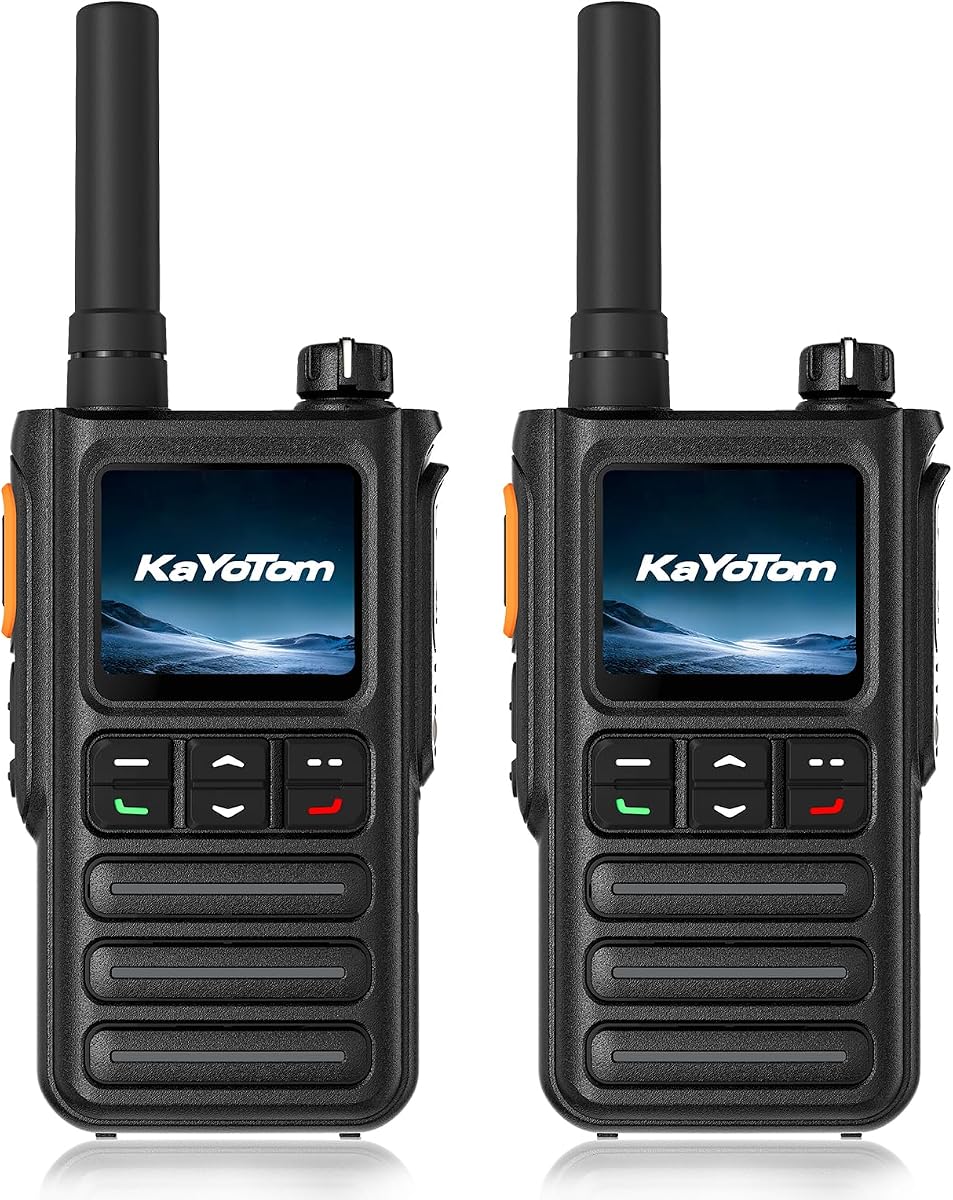
The Kayotom 4G LTE PoC three-pack is designed for groups that need communication over long travel distances and across different regions. Its 4.4 rating, three-radio configuration, and cellular architecture make it particularly relevant to construction teams, truck fleets, and families organizing road trips.
We may earn a commission when you buy through this link, at no additional cost to you.
The product description emphasizes a highly sensitive microphone and noise filtering said to eliminate 95 percent of environmental noise. It also supports group creation and device linking through a professional support process, which is useful for a fleet rather than a single family. A 3000mAh rechargeable battery is stated to provide more than 80 hours and 15 days of standby, while the Type-C port is described as restoring half the charge in 20 minutes.
Durability is another major selling point. The listed triple-proof design addresses dense dust, drops from two meters, and harsh temperatures, while the belt clip, headphone jack, and emergency light improve field convenience. These are manufacturer-stated protections rather than independent findings, and actual performance can change with age, use, and environmental exposure.
Buyers should choose this package when multiple users need a shared cellular radio system and can obtain adequate LTE coverage. It is less suitable for isolated areas without service, where conventional FRS or GMRS equipment would remain functional. The included SIM and stated lifetime-free data service also make the network-dependent nature of this radio especially important to understand before purchase.
Three units provide a ready foundation for work crews, traveling families, or convoy communication. Linking the devices into a common group simplifies one-button contact once setup is complete.
The large rechargeable battery and fast Type-C charging reduce downtime during demanding days. Runtime varies with signal quality, talk time, and environmental conditions, so spare charging access remains sensible.
We may earn a commission when you buy through this link, at no additional cost to you.
The Retevis RB48 FRS combines license-free direct radio communication with unusually serious durability claims. Its 4.5 rating and MIL-STD-810H testing make it a compelling choice for rural users who work outdoors, hike in changing weather, or need equipment that does not depend on mobile coverage.
We may earn a commission when you buy through this link, at no additional cost to you.
The radio is stated to withstand drops, dust, vibration, heat, and cold, with IP67 waterproof and dustproof protection. It passed a listed 1,000-drop test at two meters, although buyers should understand that this represents the manufacturer's stated testing rather than an independent assessment. A 2000mAh battery offers up to 20 hours of use, with USB-C charging and a charge station providing flexible replenishment.
Range is listed at up to 300,000 square feet or 25 floors in suitable conditions. That figure is best viewed as a maximum under favorable circumstances. Forest, hills, buildings, and uneven terrain can reduce actual communication distance. Even so, direct FRS operation can be more dependable in remote areas than cellular radios because it does not require an active data connection.
This RB48 configuration is a strong general recommendation for farms, job sites, hunting parties, and households operating beyond reliable cellular service. Its high-visibility yellow design, covered controls, optional roger beep, and robust enclosure are practical rather than decorative. Choose it when independence, durability, and straightforward push-to-talk operation matter most.
Direct FRS links remain available where LTE service disappears. That makes these radios well suited to remote land, wooded trails, and large outdoor work areas.
The sealed enclosure and drop-resistant construction suit work sites and outdoor recreation. The bright housing also improves visibility when a radio is carried among gear or used in low-light conditions.
We may earn a commission when you buy through this link, at no additional cost to you.
This Retevis RB48 variant emphasizes tested durability and field-friendly operation. With a 4.5 rating, industrial-grade components, a reinforced internal structure, and 19 described environmental tests, it presents a convincing option for users who need a dependable radio for demanding work.
We may earn a commission when you buy through this link, at no additional cost to you.
The listed test program includes temperature shock, rain, salt fog, humidity, sand and dust, vibration, shock, and immersion. A large front PTT button supports operation with gloves, while vibration alerts help users notice calls in noisy work environments. The radio also includes NOAA weather alerts, an important safety feature for crews working in isolated, changing-weather locations.
Its 2000mAh battery is stated to last up to 20 hours, and coverage is listed at up to 300,000 square feet or 25 floors. Those performance figures require appropriate terrain and operating conditions. The model also offers a five-year warranty and 30-day returns, providing additional confidence for long-term ownership.
Compared with a basic household radio, this model costs more but adds meaningful protection and convenience. It is a good match for construction, agriculture, property maintenance, and emergency support teams. Buyers seeking the simplest possible controls can choose a more basic option, but those who regularly expose equipment to dust, rain, vibration, and impacts will appreciate the added construction.
The stated 19-test program gives buyers a more detailed durability proposition than a generic waterproof claim. Exposure to salt fog, immersion, shock, and temperature changes is especially relevant in agricultural and coastal environments.
NOAA alerts and vibration notifications keep users informed without requiring constant attention to the speaker. These features are valuable on noisy job sites where audible calls may otherwise be missed.
We may earn a commission when you buy through this link, at no additional cost to you.
The Rapid Radios G1 is built for organizations that need broad cellular push-to-talk and large talk groups. It carries a 4.2 rating, and its support for private conversations or groups of up to 200 people distinguishes it from radios intended mainly for family or compact work crews.
We may earn a commission when you buy through this link, at no additional cost to you.
Nationwide coverage allows users to remain connected across much of the United States, with optional global upgrades stated. Advanced noise cancellation is designed to improve speech in loud surroundings, while 256-bit AES encryption protects conversations from unauthorized access according to the product description. This combination makes the G1 appealing to event teams, logistics operators, and businesses coordinating people across multiple locations.
Battery life is stated at up to five days, a meaningful advantage for extended operations, but the supplied charger must be used. The manufacturer explicitly advises against third-party chargers and disclaims responsibility for possible battery problems, overheating, or injuries arising from incompatible charging. This instruction is important and should be followed carefully.
The set includes two radios, a charger, belt clip, and battery. Buyers must also account for the service model: one year of service is included per radio, with additional years available for a fee. The G1 is therefore best for users who value large groups and nationwide cellular reach more than independent operation in a communications dead zone.
Talk groups of up to 200 people suit events, campuses, warehouses, and multi-location operations. A single press-to-talk channel can keep a broad group synchronized without relying on a large inventory of conventional channels.
The stated AES encryption is valuable for teams handling private operational information. It should complement, rather than replace, a broader security policy that governs how radio traffic and location information are managed.
We may earn a commission when you buy through this link, at no additional cost to you.
The Rocky Talkie Mountain Radio is purpose-built for hikers, backpackers, hunters, and alpine users who value cold-weather battery life and secure attachment. Its 4.6 rating is the highest among the listed products, and the specialized design explains why it occupies a premium position.
We may earn a commission when you buy through this link, at no additional cost to you.
The radio transmits at the maximum power legally allowed for unlicensed FRS use, with an advertised maximum of more than 35 miles. Importantly, the product description acknowledges that only one to five miles is more typical in backcountry terrain. This realistic framing is useful for buyers because ridges, tree cover, valleys, and the need for line-of-sight can make the maximum figure difficult to achieve.
Its specialized lithium-ion battery is stated to last more than four days, even in very cold conditions. A shatterproof LED screen, thermoplastic protection, climbing-rated carabiner, and metal-reinforced backup leash help protect the radio and keep it accessible. IP56 protection handles splashes and snow, although the radio should not be treated as submersible.
This is the strongest choice for serious backcountry travel and cold-weather activities. The five-button interface and zero-configuration setup make it easy to operate in gloves or changing conditions. Buyers wanting a basic general-purpose radio may find a different model more suitable, but those who value secure attachment, excellent stated battery endurance, and refined outdoor design will find this pair compelling.
The four-day battery claim is among the most useful distinctions for alpine and winter trips. Cold temperatures commonly shorten battery performance in conventional electronics, making the specialized battery design particularly relevant.
The climbing-rated carabiner and reinforced leash reduce the chance of losing the radio during climbing, hiking, or rough transport. The protected screen and outer covering add another layer of impact resistance.
We may earn a commission when you buy through this link, at no additional cost to you.
The Intercom Global LTE two-pack provides cellular push-to-talk for families, logistics teams, and organizations. Its 4.3 rating reflects a solid feature set, with nationwide-style reach, a 5000mAh battery, noise filtering, and a preinstalled SIM forming the core proposition.
We may earn a commission when you buy through this link, at no additional cost to you.
Communication is carried over 4G LTE rather than a conventional local radio frequency. The description cites travel from California to New York, but the practical limitation remains cellular coverage. A radio cannot maintain a cellular connection in terrain or remote locations where the underlying network is unavailable, so buyers should evaluate service maps for their normal operating area.
The product includes lifetime-free data service with no monthly bills or activation charges. It does state that users should share their SIM ID with support when the data cycle ends, which indicates an ongoing operational relationship even in the absence of renewal costs. The 5000mAh battery is listed at one full day of talk time and seven days of standby.
Noise filtering is said to remove up to 95 percent of environmental noise, improving clarity in factories, warehouses, construction areas, and crowded city environments. Devices can be linked into groups through customer support after the buyer supplies each IMEI. This model is a good fit for road trips and distributed teams, provided users accept cellular dependence and the stated service workflow.
The 5000mAh battery supports a stated day of continuous talk time and a week of standby. This is helpful for field operations, though heavy use and poor signal conditions can increase power consumption.
The sensitive microphone and aggressive noise filtering are designed for locations where machinery and traffic compete with speech. This makes the radio more useful around logistics hubs and industrial work zones.
We may earn a commission when you buy through this link, at no additional cost to you.
The Retevis RB48 Two-Way is another highly rated rugged radio, carrying a 4.6 score and a focus on long-term reliability. It shares the RB48 family's MIL-STD-810H orientation, 19 environmental tests, reinforced internal structure, NOAA alerts, and five-year warranty, making it a strong all-around choice for serious outdoor users.
We may earn a commission when you buy through this link, at no additional cost to you.
The construction is designed to resist temperature shock, rain, salt fog, humidity, sand, dust, vibration, shock, and immersion. A large PTT button remains usable with gloves, while vibration alerts help workers notice incoming calls. The 2000mAh battery provides up to 20 hours of use according to the product information, balancing heavier construction with practical endurance.
Coverage is listed at up to 300,000 square feet or 25 floors. As with other conventional radios, users should not treat that as a guaranteed distance across fields or mountains. The direct radio connection remains an advantage in places where cellular coverage is weak, and the absence of a network dependency is valuable for remote work and recreation.
This option makes the most sense for people who prioritize ruggedness, dependable controls, and long warranty support over advanced cellular location features. The five-year warranty and 30-day returns further reduce the perceived risk of ownership. It is well suited to farms, security work, construction, and off-grid activities where the radio will be handled roughly.
A five-year warranty provides useful reassurance for equipment expected to remain in service for years. The stated return period also allows buyers time to evaluate range and durability in their own environment.
Direct communication continues independently of mobile networks. That makes the RB48 a dependable choice for remote jobs, hunting areas, and trail systems where LTE bars may be absent.
We may earn a commission when you buy through this link, at no additional cost to you.
The Retevis RT86 four-pack is designed for high-volume environments such as warehouses, construction sites, campuses, property operations, and security teams. Its 4.3 rating, four included radios, shoulder microphones, and high-gain antennas distinguish it from general-purpose two-packs.
We may earn a commission when you buy through this link, at no additional cost to you.
The radio is claimed to cover up to 700,000 square feet and communicate across as many as 50 floors. Its long-wavelength antennas are intended to improve signal strength and penetration. Actual performance still depends on building materials, floor layouts, obstructions, and radio placement, so buyers with unusually dense or complex facilities should avoid relying on a headline coverage number alone.
A 2600mAh battery is stated to deliver 130 hours of standby and more than 16 hours of continuous use. The charging base uses a USB interface, but fast-charging and high-power adapters such as QC and USB-C PD are not supported. This compatibility note matters for users planning to maintain several radios, particularly on large work shifts.
The orange PTT button is easy to identify and operate with gloves. Local and remote emergency alarms support faster response when activated through the required CHIRP setting, while VOX offers hands-free operation. The included shoulder microphone has a rotating clip and 3.5mm audio jack for headset connectivity. This is a comprehensive workplace package, though it is bulkier and less appropriate for casual hikers.
Four radios reduce the need to source matching units separately. This convenience is valuable for fleet rollouts, event teams, warehouse shifts, and businesses standardizing communication equipment.
The hidden durable display, impact-resistant ABS body, large PTT button, and emergency alarms suit industrial work. The microphone adds a practical way to keep calls private or connect a headset without handling the handheld.
We may earn a commission when you buy through this link, at no additional cost to you.
The right rural radio balances realistic range, reliable power, environmental durability, and the type of coverage available in your area. These factors matter more than headline distance claims when communication must work across fields, trails, farms, and remote work sites.
Conventional FRS and GMRS radios communicate directly between users, making them dependable beyond cellular coverage. Their range depends on terrain, antenna height, obstacles, and line of sight. Cellular LTE radios can connect users across much greater distances, but they depend on compatible network service and remain unusable in dead zones. Buyers working in consistently remote areas may prefer direct radios, while travelers and distributed teams may prefer LTE when coverage maps support them.
A maximum-mileage claim is rarely a guarantee. Mountains, dense forests, rolling ground, buildings, and vehicle bodies can reduce direct radio range. The Rocky Talkie Mountain Radio is unusually candid about this, noting that one to five miles can be more typical in backcountry terrain than its 35-mile maximum. For farms and open country, a high-mounted base station or a vehicle-mounted antenna may extend practical coverage more effectively than carrying a higher-powered handheld.
Battery needs vary by radio type. Conventional units may be used for days, while cellular radios can consume more power while maintaining a network connection. The listed models range from approximately 20 hours of use for the RB48 to more than four days for the Rocky Talkie Mountain Radio. Check charging connector requirements carefully, especially the RT86, which does not support fast-charging adapters. Cold weather, scanning, high transmit power, and weak signals can shorten stated runtime.
Rural radios are exposed to rain, snow, dust, mud, vibration, and accidental drops. IP67 models offer strong water and dust protection, while IP56 radios are designed to withstand splashes and snow but should not be submerged. MIL-STD-810H references indicate a broader series of environmental tests. These ratings are most useful when matched to actual conditions: a farm, coastal road, mountain trail, and warehouse each create different risks.
The Midland GXT1000VP4 provides 50 channels and 142 privacy codes, allowing multiple separated groups to share a channel. LTE models support programmable talk groups and may accommodate much larger teams. Consider how many radios need immediate contact, whether separate groups must remain isolated, and whether users need private one-to-one conversations. Familiar controls and quick channel access can be as important as raw connectivity.
NOAA scanning on the Midland and Retevis RB48 models can deliver weather alerts without a cellular data plan. GPS tracking on the Rapid G09 helps supervisors monitor team locations, but it is useful only where cellular service is available. Vibration alerts, emergency alarms, SOS sirens, call tones, and silent operation can make radios easier to use in noisy or remote work. Prioritize the features that support a concrete safety plan rather than adding complexity for its own sake.
Headsets, speaker microphones, belt clips, charging stations, and carabiners can materially improve daily usability. The Midland package includes headsets, the RT86 includes shoulder microphones, and the Mountain Radio includes climbing-rated attachment hardware. VOX and EVOX permit hands-free transmission while driving or working, but open microphones can also transmit background noise or accidentally interrupt conversations. Test controls with gloves and verify that accessories use the correct connector.
Cellular radios introduce service and support considerations that conventional radios do not. Rapid Radios G1 includes one year of service per radio and charges for additional years. Other LTE listings describe lifetime-free data but may require support contact during a data cycle. Fleet buyers should verify group configuration, device linking, warranty length, and replacement policies before deploying many units. Conventional radio buyers should confirm channel compatibility and local operating rules.
Before the first outing, charge every radio fully, install the correct batteries, and confirm that all units are programmed to matching channels and privacy codes. Test a short call in the area where the radios will be used, then walk or drive between likely communication points. This reveals the effects of hills, buildings, and vegetation before a group depends on the equipment in an emergency.
For LTE radios, confirm that the preinstalled service is active, each device appears in the correct group, and required permissions have been applied. Keep the radios upright with microphones unobstructed, use moderate volume, and avoid pressing the PTT button unless intending to transmit. VOX and EVOX are useful for hands-free work, but users should allow a brief pause before speaking and avoid speaking over another transmission.
Care starts with keeping charging contacts dry and using only compatible power supplies. Follow the manufacturer's battery and charger guidance, replace weakened batteries, and keep connectors free of dirt. After exposure to mud, salt, or dust, wipe the radio with a damp cloth and allow it to dry before charging. Do not open a sealed unit unless the manufacturer authorizes it, and store radios in a dry, temperature-appropriate place during long periods of inactivity.
A conventional FRS or GMRS radio is usually the safest choice where cellular service is unreliable because the units communicate directly without a network. Its practical range still varies with terrain, antenna height, and obstacles. Cellular LTE radios are better for long distances between populated areas, provided the carrier's coverage reaches every user.
The maximum range printed on a listing is an ideal-condition figure, not a guarantee. Open, level terrain can permit much greater distance than steep mountains or dense forests. Rural users should test their exact routes, and vehicle-mounted or elevated antennas may deliver more reliable coverage than handheld radios.
FRS radios are intended for license-free operation in the United States, while GMRS generally requires an appropriate license for users operating above the permitted exception. Rules can differ by country, so travelers should check local requirements. Always follow the instructions and labeling included with the specific product.
No. Ordinary FRS and GMRS radios send voice directly over radio frequencies. Cellular models convert push-to-talk requests into data transmitted through LTE networks. Cellular radios remove many traditional distance barriers but introduce a dependency on network coverage, service activation, and compatible local service.
The Rocky Talkie Mountain Radio is specifically positioned for cold conditions, with a stated battery life of more than four days and a protected, mountable design. Cold still reduces battery performance to some degree, so users should preserve charge and carry a suitable backup for extended winter trips.
Most families or small work groups need one radio per person for reliable participation. Larger teams can share radios, but dedicated units make communication faster and prevent users from taking a shared device out of range. A two-pack suits couples or small teams, while three- and four-packs are better for crews, caravans, and larger households.
Long battery life, dust and water resistance, a glove-friendly PTT button, vibration alerts, and NOAA weather warnings are especially useful. Larger operations may also need emergency alarms, headset support, high-gain antennas, or group management. The right combination depends on whether the team works indoors, outdoors, across multiple buildings, or in a mobile fleet.
Keep the radios and charging contacts clean and dry, use compatible chargers, and avoid charging a wet radio. Protect the microphone port and controls from mud, and inspect cases or mounts before attaching a radio to a vehicle or backpack. After severe weather exposure, dry the equipment fully and check battery performance before returning to normal use.
The Midland GXT1000VP4 is the most versatile budget-oriented package, combining 50 GMRS channels, NOAA alerts, dual-power operation, and included headsets. The Retevis RB48 FRS stands out for rugged direct connectivity, while the Rocky Talkie Mountain Radio offers the strongest specialist design for cold-weather backcountry travel. Each serves a distinct environment rather than claiming to be ideal for every rural user.
The most important decision is matching the technology to the location. Choose FRS or GMRS when working beyond reliable cellular service, and choose LTE when geographic separation matters more and coverage is dependable. Then prioritize battery life, ingress protection, group size, controls, mounting options, and the specific terrain in which the radios will operate.
Product listings, ratings, service terms, and prices can change after publication. Before purchasing, verify the current specifications, local radio regulations, cellular coverage, battery information, included accessories, warranty, and return policy. Those checks will help ensure that the selected pair or fleet is genuinely suitable for the rural area where it will be used.