
Bose TV Speaker
4.3Editor score
Compact 2.0-channel design
Enhanced dialogue mode
HDMI and optical connectivity
A soundbar for karaoke must do more than improve television dialogue. It needs to handle music, backing tracks, microphones, echo control, and room-filling output without making vocal performances sound thin or overwhelmed by bass. The most useful systems combine clear voices, flexible inputs, convenient controls, and enough power for a lively gathering.
We compared the ten products by examining their channel configurations, wireless microphone support, audio technologies, connection options, dialogue enhancement, bass capabilities, and physical design. The list includes a purpose-built karaoke soundbar as well as conventional home-theater models that can serve recordings, music, and live vocals when suitable microphones are added.
Each review shows how the soundbar fits a particular entertainment setup, from compact rooms to fully immersive systems. The featured configuration emphasizes true karaoke convenience, while the others demonstrate alternatives for people whose priorities are cinematic surround, dialogue clarity, expansive bass, or simple everyday use. Prices and configurations can change, so confirm current details before purchasing.
4.3Editor score

4.9Editor score

4.5Editor score
As an Amazon Associate we earn from qualifying purchases.
The table below compares the featured soundbars by their most important characteristics: karaoke readiness, channel layout, bass capability, major audio technologies, and core connectivity. Only the Ankuka model includes microphones, while the remaining products are general audio systems that can potentially support compatible karaoke equipment.




The Ankuka Sound Bar for TV is the only model in this guide explicitly designed as a two-in-one soundbar and wireless karaoke system. It carries a 4.9 rating and stands apart because the package includes two wireless microphones, while the soundbar delivers 80W of power through a 2.0-channel arrangement. That combination makes it the most immediately practical choice for people who want to sing without assembling a separate microphone, mixer, and amplifier setup.
We may earn a commission when you buy through this link, at no additional cost to you.
Its four full-range drivers are designed to create a broad soundstage, with emphasis on strong bass, open mids, and detailed highs. Movie, Music, and News modes allow listeners to adapt the presentation, while the remote handles volume, microphone controls, mode selection, and reverb. Bluetooth 5.3 supports streaming from phones, tablets, and laptops, and HDMI ARC, optical, AUX, and USB provide options for televisions, game systems, computers, and stored media.
The trade-offs are that this is a conventional 2.0-channel bar rather than a full surround package, and its karaoke features depend on the supplied wireless microphones and the source connected to the bar. It also does not offer the specialized voice processors, beam drivers, or multichannel effects found in higher-end home-theater models. Even so, those omissions matter less for straightforward family karaoke than the inclusion of two microphones, dedicated mic and reverb controls, and several accessible sound modes.
This is the strongest recommendation for a household that wants a shared soundbar and karaoke unit in one box. It is particularly useful for small-to-medium gathering spaces where two performers can sing along to songs, movies, sports, or streamed playlists. Buyers who mainly need cinematic surround and already own a karaoke microphone setup may prefer one of the multichannel models, but for uncomplicated plug-and-play singing, this is the most purpose-built option listed.
The included pair of wireless microphones immediately expands the system beyond ordinary television audio. It supports duet-style singing without requiring the buyer to research compatible wireless microphone frequencies or source separate microphone amplification. Remote-accessible mic and reverb controls make it easier to balance vocal performance against the backing track.
Bluetooth 5.3 and four wired or direct input options allow the same bar to handle television audio, music, games, computer media, and USB drives. The three presets make it practical to switch between dialogue-heavy shows, music, and movies, while the slim 31.9-inch profile helps limit visual clutter in a living room.
We may earn a commission when you buy through this link, at no additional cost to you.
The Bose TV Speaker offers a compact, straightforward approach to improving television sound, with a 4.3 rating. It uses two angled full-range drivers to produce a wider and more natural presentation than a typical television speaker. While it does not include microphones or karaoke effects, its dialogue emphasis and Bluetooth music streaming make it a practical platform for casual singing with separately added compatible equipment.
We may earn a commission when you buy through this link, at no additional cost to you.
The included remote activates a dialogue mode for clearer speech and a bass boost for additional depth. HDMI, optical, and AUX inputs allow several source devices to be connected, with the first powered-on device automatically selected. Its dimensions of 2.21 by 23.38 by 4.02 inches make placement in front of a television straightforward, and wall brackets can be purchased separately if a floating installation is preferred.
As a karaoke system, it is less specialized than the Ankuka because the package does not include wireless microphones, microphone inputs, or a documented echo and reverb control. It also lacks a bundled subwoofer, although compatibility with the Bose Bass Module 500 or 700 expands the system's low-frequency capability when the appropriate connection cable is used. Its compact body may also deliver less raw output than larger multichannel systems.
The Bose TV Speaker makes sense for a small room or a buyer who prioritizes simplicity, compact design, and intelligible voices over dedicated karaoke features. It can support a casual party with separately sourced microphones if its input and amplification capabilities align with that plan. For anyone wanting microphones and vocal effects in the box, the Ankuka is more direct, while this Bose remains a refined option for everyday listening.
At just over two inches tall, the speaker is designed to sit in front of a television without dominating the console. Its angled drivers help spread sound across the listening area, and the lack of a standard included subwoofer reduces floor-space requirements while preserving room for optional bass expansion.
The dedicated dialogue mode reflects Bose's focus on intelligible speech, which is also useful when lyrics compete with a television program. Bluetooth adds a straightforward way to stream songs for casual practice, while the remote keeps volume, dialogue, and bass adjustments simple.
We may earn a commission when you buy through this link, at no additional cost to you.
The TCL S55H pairs a soundbar with a wireless subwoofer, and its listed power reaches 220W for room-filling home-theater output. It carries a 4.4 rating and supports Dolby Atmos and DTS:X, making it a more cinematic alternative to compact two-channel systems. Karaoke use would require separate compatible microphones and appropriate source connections because neither is included.
We may earn a commission when you buy through this link, at no additional cost to you.
TCL's AI Sonic Auto Room Calibration adjusts the presentation to the room and listening position through a one-time app-based setup. That feature can be especially useful for a living room whose furniture, walls, and dimensions shape the sound. HDMI eARC or ARC, optical, Bluetooth, and AUX connectivity broadens the system's use with televisions, projectors, games, and mobile devices.
The subwoofer is a clear strength for music, because karaoke backing tracks often sound fuller when the low end has real weight. The trade-off is that a separate subwoofer occupies additional floor space and may be less convenient in a compact apartment. The product also does not document microphone mixing, echo cancellation, or karaoke-specific effects, so it cannot replace a dedicated karaoke console without additional equipment.
This TCL is a good choice for buyers who want one soundbar system to cover movies, music, gaming, and occasional singing. It is especially attractive when deep bass and automatic setup matter more than having microphones immediately available. For dedicated two-person karaoke, choose the Ankuka; for richer cinematic sound with the ability to add microphones, the S55H is a versatile starting point.
The AI Sonic system reduces much of the guesswork involved in balancing a soundbar in an imperfect room. Once configured through the TCL app, it is designed to account for the surrounding space and listening position, useful for a system that must work for both television viewing and music playback.
The included wireless subwoofer handles low frequencies independently of the main bar, helping songs retain impact and definition. A 6.5-inch driver is also a useful feature for a 2.1-channel system that needs to balance vocal tracks, television dialogue, and energetic music.
We may earn a commission when you buy through this link, at no additional cost to you.
The Samsung HW B400F is a 2.0-channel soundbar with a built-in subwoofer, and it carries a 4.0 rating. Its main appeal is convenience: it supplies richer bass than a simple television speaker without requiring a separate subwoofer, while adding surround sound expansion and Voice Enhance mode for clearer dialogue.
We may earn a commission when you buy through this link, at no additional cost to you.
One Remote Control support allows a compatible Samsung television remote to handle key functions such as power, volume, and sound effects. The family-friendly night mode lowers volume and minimizes bass, which is useful in shared living spaces. The product can also connect to a television without the visual clutter associated with multiple wired components, although specific connection details should be confirmed with the user's television.
The hardware is less ambitious than the 5.1-channel TCL, JBL, and Sony systems in this guide. It has no wireless surround speakers, no documented microphone inputs, and no included microphones. Voice Enhance helps spoken words remain intelligible, but it is not equivalent to a dedicated live-vocal processor with independent microphone level, echo, or reverb controls.
The B400F is most suitable for a straightforward living-room setup where one unit must handle television, music, and casual karaoke without a large collection of components. It is a sensible alternative for anyone who values simple one-remote operation and built-in bass. Dedicated duet karaoke still points toward the Ankuka, while buyers seeking rear audio and deeper home-theater immersion should consider a 5.1-channel system.
Integrating the woofer into the main body eliminates the need to position and connect a separate subwoofer. That makes the soundbar easier to move and visually cleaner in apartments, bedrooms, and other modest entertainment spaces where every piece of floor space matters.
The quiet-hours feature reduces bass and lowers the overall volume to minimize disturbance to others. That makes the B400F useful for households where a television is watched late at night, while Voice Enhance helps maintain speech clarity at restrained levels.
We may earn a commission when you buy through this link, at no additional cost to you.
The TCL S65K is a complete 5.1-channel system with a main soundbar, wireless surround speakers, and a wireless subwoofer. Its 4.4 rating reflects a strong feature set that includes Dolby Atmos, DTS:X, a built-in center channel and tweeter, Bluetooth streaming, and AI Sonic Auto Room Calibration. It is built primarily for immersive home cinema, although the additional channels and power can also support a more elaborate music-party setup.
We may earn a commission when you buy through this link, at no additional cost to you.
The wireless surround speakers create a wider soundstage than a soundbar alone, while the 6.5-inch subwoofer and Bass Boost provide deep low-end output. A dedicated center channel supports clear dialogue during busy scenes, and Ray Danz technology is designed to spread sound throughout the room. The subwoofer and surrounds reduce cable clutter between components, although each speaker still needs to be positioned appropriately.
Karaoke readiness is limited by the absence of included microphones and documented live-vocal mixing features. Its surround channels can make a microphone's echo behavior more complex than a simple 2.0 setup, so a singer would need to manage levels carefully and potentially use external processing. The larger number of components also makes this less attractive for a very small room or a user wanting one simple bar with microphones already in the box.
The S65K fits buyers who want a single investment to cover films, concerts, games, and singing. The system is particularly compelling for a medium or large room where rear speakers can be placed behind the listening position. If immediate two-person karaoke is the central goal, the Ankuka is more purpose-built; if surround immersion is the priority, the TCL provides a much more ambitious stage for music and entertainment.
The included wireless surrounds add directional audio behind the audience, making music and film sound more enveloping than a compact all-in-one bar. They also support a more convincing home-theater presentation in which effects can travel around the listening position rather than remaining entirely in front.
A built-in center channel and tweeter are designed to preserve dialogue definition, especially during action-heavy content. The same separation can help a singer remain intelligible when playing a recorded backing track, provided the microphone and source levels are balanced correctly.
We may earn a commission when you buy through this link, at no additional cost to you.
The Sonos Beam Gen 2 is a compact Dolby Atmos soundbar built around connectivity and ecosystem flexibility. It has a 4.4 rating and uses a five-driver array to create a panoramic soundstage, clear dialogue, and vibrant bass. For karaoke, its Bluetooth and streaming capabilities make it useful for playing backing tracks, but it does not include microphones or dedicated live-vocal effects.
We may earn a commission when you buy through this link, at no additional cost to you.
Control is particularly flexible through the Sonos app, a television remote, Apple AirPlay 2, and voice commands. When the television is off, the Beam can stream music, radio, podcasts, and audiobooks from supported services. Trueplay tuning adapts the output to the room, and the product can be expanded over time to create a more complete surround arrangement or participate in a multiroom audio system.
The tradeoff is that the Beam prioritizes connected home audio rather than karaoke hardware. There are no supplied microphones, documented mic-level controls, or included echo cancellation. Although a separate microphone interface or karaoke mixer could be introduced, that would add equipment and setup complexity. The five-driver array is also more focused on cinematic processing than the direct vocal controls found on the purpose-built Ankuka system.
Choose the Beam Gen 2 when the soundbar must also function as a sophisticated music and podcast system, particularly within a Sonos household. It is an excellent choice for shared apartments or multipurpose living spaces where wireless control matters. Dedicated karaoke sessions with two performers are better served by the Ankuka, while this Sonos wins for connectivity, compact form, and gradual expansion.
Sonos app control, AirPlay 2, television remote operation, and voice control make the Beam easy to integrate into an existing connected home. Services for music, radio, podcasts, and audiobooks remain available when the television is off, extending the device beyond conventional home-theaster duties.
The Beam delivers a virtualized Dolby Atmos presentation from a relatively compact enclosure. Sonos expansion options can add compatible surround or bass components over time, giving buyers a gradual path beyond the original soundbar without changing platforms.
We may earn a commission when you buy through this link, at no additional cost to you.
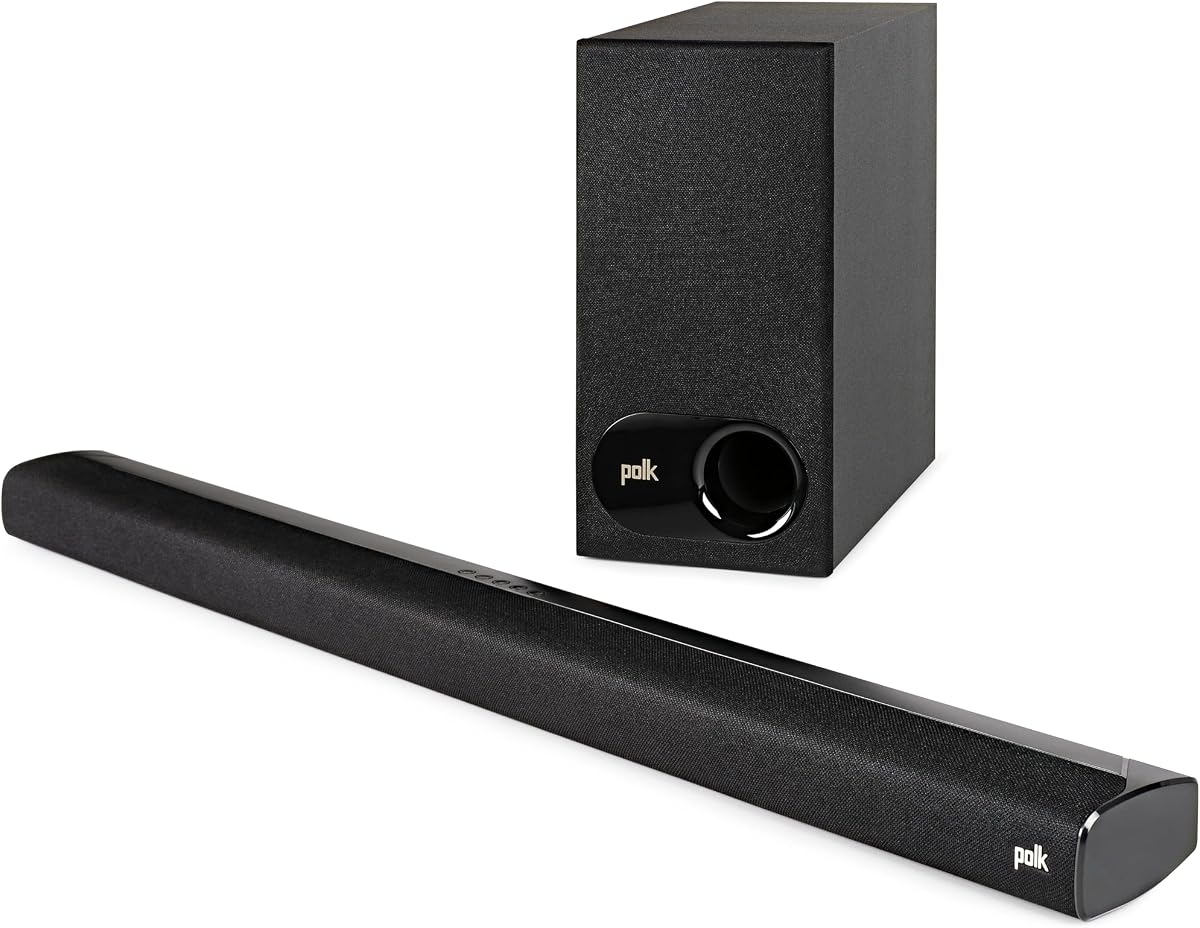
The Polk Audio Signa S2 combines an ultra-slim main bar with a wireless subwoofer, giving it a 4.4 rating and a useful balance of compact placement and bass capability. Five full-range drivers, VoiceAdjust technology, and Dolby Digital decoding support clear music and television audio. It does not include microphones, so it is better viewed as a capable entertainment system that can host externally managed karaoke.
We may earn a commission when you buy through this link, at no additional cost to you.
At just over two inches tall, the main bar can fit beneath many television screens without blocking the lower edge or infrared sensor. HDMI, ARC optical, and AUX inputs support several source types, while Bluetooth enables music streaming from a phone, tablet, or compatible device. The included wireless subwoofer handles the low end without requiring a separate subwoofer purchase.
Compared with newer object-based systems, the Signa S2 does not list Dolby Atmos or DTS:X, and its surround processing is less elaborate than that of the TCL, JBL, or Sony models. It also has no documented microphone mixing, echo control, or karaoke-specific presets. Those are meaningful limitations if the intended use is regular public-style singing, but they do not prevent using a compatible microphone system for informal practice.
The Polk is a good option for a living room where a full-size surround installation is undesirable but music still needs convincing low-frequency output. It also suits buyers who want the main bar to remain visually slim while accepting a separate floor-standing subwoofer. Immediate all-in-one karaoke still favors the Ankuka, whereas the Signa S2 provides a balanced home-theater and music foundation for adding equipment later.
The low-profile main unit avoids occupying much of the television's screen area and can be mounted on a wall when desired. This makes the system more visually discreet than a full 5.1 setup while retaining the benefit of a separate wireless bass speaker.
VoiceAdjust is designed to improve clarity and reduce voice delays, which can be valuable during spoken content and sung passages. It cannot replace proper microphone gain control, but the soundbar can provide a clearer foundation for a separately managed karaoke signal.
We may earn a commission when you buy through this link, at no additional cost to you.
The JBL Bar 500MK2 is a high-output 5.1-channel home-theater system with a 4.5 rating and a listed maximum output of 750W. It includes a large 10-inch wireless subwoofer, Dolby Atmos, MultiBeam 3.0, and PureVoice 2.0 dialogue processing. Those specifications make it the most powerful premium option here, with considerable potential for music, parties, and large-room entertainment.
We may earn a commission when you buy through this link, at no additional cost to you.
MultiBeam 3.0 is designed to produce a broad cinema-style soundstage from the front of the room, while the included subwoofer delivers deep, forceful bass. PureVoice 2.0 automatically raises or optimizes dialogue according to scene conditions and overall volume. Easy sound calibration examines room reflections to help tune the system, and the JBL ONE app provides equalizer controls, setup, service browsing, and software updates.
The system supports AirPlay, Google Cast, Spotify Connect, Tidal Connect, and Roon Ready, as well as HDMI eARC with 4K Dolby Vision passthrough. Compatibility with voice-assistant-enabled speakers allows hands-free control in supported ecosystems. For karaoke, however, microphones are not included and dedicated vocal effects are not documented. Its large sound field and powerful bass would also require careful microphone adjustment to prevent a singer from sounding overwhelmed.
This JBL is the premium recommendation for a large, dedicated entertainment room where cinematic impact, deep bass, and broad streaming compatibility are the main goals. It can support a professionally organized karaoke session through external equipment, but it is not the simplest all-in-one singing solution. Buyers prioritizing ready-to-use microphones should select the Ankuka, while those who want the strongest cinema and music system should favor the Bar 500MK2.
The 750W maximum system rating, 10-inch wireless subwoofer, and wide MultiBeam soundstage are designed for substantial output. That makes the package better suited to larger living rooms, open-plan areas, and parties where a compact bar might seem underpowered.
PureVoice 2.0 adjusts dialogue based on ambient content and the system's volume rather than relying on one fixed setting. During karaoke, equivalent clarity from a microphone system still matters, but the JBL's processing gives the backing track and spoken content a well-articulated foundation.
We may earn a commission when you buy through this link, at no additional cost to you.
The Yamaha SR-B30A combines a Dolby Atmos soundbar with two built-in subwoofers, giving it a 4.4 rating and a distinct one-piece design. Clear Voice technology focuses on dialogue that might otherwise be hidden by music or effects, while Yamaha True Sound and Dolby Atmos create a spacious three-dimensional presentation. It is a capable all-in-one audio product, though not a dedicated karaoke package.
We may earn a commission when you buy through this link, at no additional cost to you.
Unlike conventional 2.1 systems, it does not require a separate subwoofer enclosure, which can simplify placement and reduce visual clutter. HDMI eARC or ARC supports a direct television connection and uncompressed, high-bitrate audio, while Bluetooth multipoint allows convenient switching between two devices. Presets for Movie, Stereo, Standard, and Game modes make it easy to adapt the output to different content.
The primary limitation is the lack of microphones, microphone-level controls, and documented echo or reverb functions. A singer would need a separate karaoke mixer, interface, or other compatible equipment, and the Yamaha's Clear Voice function cannot compensate for poor microphone gain or excessive echo. Its virtual presentation is also less expansive than a system with physical rear speakers.
The SR-B30A is a strong recommendation for people who want Dolby Atmos and substantial bass but dislike the footprint of a separate subwoofer. Its built-in keyholes also provide a straightforward wall-mounting option. For a ready-made vocal party, choose the Ankuka; for a compact home cinema and music system that emphasizes simplicity, the Yamaha offers an appealing balance.
The integrated low-frequency drivers provide music with more weight without requiring another powered box on the floor. This can be especially helpful in apartments or bedrooms where space is limited but a karaoke session still needs enough bass to make the backing track feel complete.
Clear Voice is designed to recover vocal detail masked by background effects. While it cannot replace a karaoke mix, it can make spoken introductions, announcements, and lyrics easier to follow in a one-piece system that prioritizes intelligibility.
We may earn a commission when you buy through this link, at no additional cost to you.
The Sony BRAVIA Theater Bar 5 is a 3.1-channel system with a wireless subwoofer, and it carries a 4.2 rating. It uses Dolby Atmos, DTS:X, a dedicated center speaker, Sony's Vertical Surround Engine, and S-Force Pro to create an immersive presentation without requiring in-ceiling or physically separated rear speakers. The included 160mm subwoofer supplies the low-frequency foundation.
We may earn a commission when you buy through this link, at no additional cost to you.
The center channel is specifically intended to keep dialogue clear, which is useful for television, podcasts, and musical performances. Sony's Vertical Surround Engine produces a sense of overhead sound from the soundbar, while S-Force Pro widens the front sound field. The included remote handles volume, bass, and sound modes, and the BRAVIA CONNECT app provides guided setup, control, troubleshooting, and software updates.
For karaoke, microphones are not included, and no dedicated microphone mixing, echo, or reverb controls are documented. Sony's proprietary algorithm can upmix stereo content to a surround-style presentation, which may make a backing track sound more theatrical. Nevertheless, true vocal performance still requires compatible microphones and careful gain control, particularly because the wireless subwoofer can easily dominate a close-miked voice.
The BRAVIA Theater Bar 5 is best for Sony television owners who value cinematic processing, app-based management, and a compact surround presentation. It is also appropriate for casual karaoke practice when separate vocal equipment is already available. The JBL Bar 500MK2 offers greater output and a 10-inch woofer for larger events, while the Ankuka remains the most direct choice for an included two-microphone experience.
The Vertical Surround Engine creates overhead effects from the main enclosure, and S-Force Pro expands the perceived front soundstage. These processing tools make the system attractive when installing separate height or rear speakers would be impractical.
The BRAVIA CONNECT app supports initial configuration, everyday adjustments, troubleshooting, and software updates. It is particularly convenient for compatible BRAVIA television owners, while the physical remote offers fast access to bass and sound-mode changes during a gathering.
We may earn a commission when you buy through this link, at no additional cost to you.
The right karaoke soundbar depends on whether you want a ready-to-sing package or a flexible entertainment system. Mic support, vocal controls, output, soundstage, connectivity, room size, and ease of use should be considered together rather than judging a model only by its wattage or channel count.
A genuinely convenient karaoke soundbar should either include microphones or clearly support the microphones and mixer you intend to use. The Ankuka is the standout in this group because it includes two wireless microphones and provides remote control over microphone and reverb functions. Most of the home-theater bars do not include microphones, so a buyer interested in regular singing would need to budget for a compatible microphone system and an appropriate way to combine that signal with the backing track.
Karaoke depends on the singer remaining audible over music, effects, and bass. Features such as Clear Voice, Voice Enhance, PureVoice 2.0, VoiceAdjust, and dedicated center channels can improve spoken and vocal clarity. These tools do not automatically correct a poor microphone signal, but they create a clearer audio foundation. A center channel is especially useful in larger surround systems because it anchors voices in the middle of the presentation.
Power helps a system fill a room without sounding strained, but the listed wattage should be considered alongside driver size, channel design, and subwoofer capability. The JBL Bar 500MK2 leads with 750W maximum output and a 10-inch subwoofer, while the TCL S55H offers up to 220W with a wireless subwoofer. The Ankuka's 80W specification and two-channel design make it more naturally suited to small and medium gathering spaces.
A 2.0-channel bar can be ideal for straightforward singing because it reduces complexity and keeps the performance in front of the listener. A 2.1 system adds independent bass, while 3.1, 5.1, or virtual surround systems create a broader cinema-style field. Physical rear speakers provide more directional surround effects, but they require additional placement and may make microphone echo control more demanding. Virtual processing offers a visually simpler alternative.
Backing tracks often sound thin without enough low-frequency support. The Polk Signa S2, TCL S55H, TCL S65K, JBL, and Sony systems include wireless subwoofers, while the Samsung B400F and Yamaha SR-B30A use integrated woofers. The latter approach reduces placement demands, and the Yamaha's two built-in subwoofers provide a notable alternative to a separate floor unit. Karaoke users should keep the vocal level above the bass rather than using excessive subwoofer output to make music feel exciting.
HDMI ARC or eARC is the preferred route for television audio, while optical and AUX inputs provide useful backups for older or varied equipment. Bluetooth makes it easy to stream backing tracks from a phone, tablet, or computer. USB support on the Ankuka adds another direct option. For a party, confirm whether the selected microphone system can accept the soundbar's available inputs and whether a mixer is required to combine the vocal and instrumental signals.
Automatic room calibration can make a large system easier to optimize for imperfect living rooms. The TCL S55H and S65K use AI Sonic calibration, while the JBL offers Easy Sound Calibration and Sonos provides Trueplay. Presets for movies, music, news, stereo, and games are also helpful. For karaoke, a dedicated music mode is convenient, but manually adjustable volume, bass, microphone level, and effects may be even more useful.
App control, voice assistants, streaming services, and multiroom integration can make a soundbar more useful outside karaoke. The Sonos Beam, JBL Bar 500MK2, Sony BRAVIA Theater Bar 5, and TCL S55H offer varying degrees of app or smart-home integration. These features are helpful for parties because they make it easy to start playlists without navigating a television, but they add complexity and may not improve microphone performance directly.
Begin by placing the soundbar at the front of the listening area, ideally near television height and away from enclosed cabinets that could muffle the drivers. Connect it with HDMI ARC or eARC when available, then select the matching source. Position included wireless microphones in an open area and begin with their volume low. If the system includes a separate subwoofer, place it away from walls when possible and follow the manufacturer's guidance for pairing and room calibration.
For a soundbar with dedicated karaoke controls, choose the music-oriented mode, connect the backing track through Bluetooth, HDMI, AUX, optical, or USB as appropriate, and adjust the main volume before raising the microphone level. Sing at a natural distance from the microphone and allow enough separation to reduce direct sound from the speaker. Keep the subwoofer moderate so bass does not overwhelm the voice, and use reverb sparingly because excessive processing can make a room sound muddy.
Care for the system by dusting the grille gently with a soft, dry cloth, avoiding sprays and abrasive materials. Keep microphones away from moisture, direct heat, and dropped surfaces, and store wireless units in their designated holders or a dry case. Read the manual before pairing microphones, changing inputs, or updating software, and perform the calibration process again if furniture or major equipment changes position. Regular firmware updates through the relevant app can also improve stability and features.
Many soundbars can play karaoke backing tracks, but not all can accept microphones. A karaoke-ready unit should provide compatible microphone inputs or a wireless microphone system, along with controls for vocal level, echo, and ideally reverb. The Ankuka in this guide includes two microphones and dedicated controls, while the other models are primarily designed for home theater and music playback.
A subwoofer is not required, but it can make backing tracks sound fuller and more exciting. Integrated-bass models such as the Samsung HW B400F and Yamaha SR-B30A offer a compact alternative to a separate wireless woofer. During singing, keep the bass balanced so it supports the music without making the vocal difficult to hear.
No. Power is only one part of a useful karaoke system, and the room size matters as much as the specification. Clear vocal reproduction, microphone compatibility, low-noise amplification, and effective echo control can be more important than maximum wattage. A moderately powered system with proper controls may be better suited to singing than an excessively powerful model that is difficult to balance.
Place the microphone behind or away from the soundbar's speaker direction, keep it at a consistent distance from the singer, and reduce the volume before making adjustments. Use the soundbar's echo or microphone controls if provided, and keep the subwoofer level moderate. Wireless systems should also be paired according to the manufacturer's instructions to avoid interference.
Most of the featured systems support HDMI connectivity, often through ARC or eARC, although connection naming varies by model. The correct input mode may be called HDMI ARC, eARC, or simply HDMI. Consult the manual for both the television and soundbar because some devices require an additional setting such as audio output or surround-sound control to be enabled.
A 2.0-channel system is usually easier to control and can provide excellent vocal clarity in a modest room. A 5.1-channel system offers a larger cinema soundstage and more impact for parties, but its surround and subwoofer output must be balanced carefully. Consider the room, the complexity of the microphone setup, and whether the broader soundstage is more valuable than straightforward vocal control.
Yes, if both the phone or computer running the backing tracks and the soundbar support compatible Bluetooth audio. The Ankuka, Bose TV Speaker, TCL S55H, TCL S65K, Polk Signa S2, Yamaha SR-B30A, and Sony BRAVIA Theater Bar 5 all list Bluetooth functionality. For the smoothest event, prepare the playlist in advance and check the connection before guests arrive.
It depends on the soundbar. A purpose-built karaoke model with included microphones may handle the essential vocal functions without a separate mixer. Standard home-theater soundbars generally do not provide dedicated microphone mixing, so a compatible karaoke mixer, interface, or microphone system may be necessary to combine voices with the music and manage echo and levels.
The Ankuka Sound Bar with Wireless Mics is the leading choice for immediate karaoke because it includes two microphones, 80W of output, dedicated microphone and reverb controls, and several convenient source options. The Bose TV Speaker is the most compact budget-oriented choice for everyday dialogue and music, although it requires separate vocal equipment. For a premium cinematic experience, the JBL Bar 500MK2 combines high output, a large wireless subwoofer, room calibration, and extensive streaming support.
Prioritize microphones and vocal controls when singing is the primary purpose, then select enough output and bass for the room. Dedicated two-channel and 2.1 systems are generally easier to balance, while 5.1 systems deliver greater immersion for larger spaces. Also verify input types, room calibration, placement requirements, and whether the included vocal equipment meets your needs before making a final selection.
Product details, ratings, and prices can change, and retailer listings may be updated. Review the current description, compatibility information, warranty terms, and accessories before ordering, especially if you plan to add microphones or connect the system to existing equipment.