
4K Astrophotography Smart Telescope
4.6Editor score
Dual-screen observation design
Five-megapixel CMOS sensor
FourK photo and video capture
Our best smart telescope with built in camera guide compares ten models for optics, automation, portability, astrophotography, and battery life in 2026 today.
A smart telescope with a built-in camera combines traditional optics with sensors, motorized controls, companion apps, and automated imaging. That combination makes it easier to identify targets, capture distant subjects, and share observations without managing a separate camera and complicated alignment process.
We compared ten options based on optical design, sensor capabilities, target-finding automation, portability, battery life, storage, and practical imaging features. The list covers compact travel scopes, dual-screen digital telescopes, app-directed instruments, and more specialized systems for deep-space photography.
Each review explains what makes the model distinctive, where it fits best, and which compromises may matter. Ratings and specifications can change, and prices also vary over time, so readers should confirm current product details before purchasing.
4.6Editor score
4.8Editor score

4.0Editor score
The comparison below highlights the major differences among app-controlled, dual-screen, conventional guided, and premium astrophotography telescopes, with particular attention to optics, automation, imaging, and portability.




This digital refractor earns the top position with a 4.8 rating and a feature set that balances astronomy, wildlife observation, and general outdoor photography. Its 80mm objective, 300mm focal length, starlight-level CMOS sensor, and claimed 4K capture capability make it unusually versatile for a scope that can also be aimed at landscapes and animals.
We may earn a commission when you buy through this link, at no additional cost to you.
The dual-screen arrangement is the standout feature. Users can look through an eyepiece with ±4 diopter compensation or unfold a wide-angle external display for easier framing and shared viewing. A built-in sunshade reduces glare during daytime use, while one-touch photo and video controls remove the need to operate a separate camera or phone adapter.
The 4500mAh battery is stated to provide as much as six hours of continuous use, and programmable shutoff timers can reduce wasted power during pauses. Expandable TF card support up to 512GB is another meaningful advantage for photographers who want to retain many high-resolution files. The included adjustable tripod makes the all-in-one design more practical for field use.
Its main limitation is that the automation appears focused on imaging rather than sophisticated sky guidance. There is no described app-based star atlas, motorized GOTO system, or automatic tracking comparable with the DWARFLAB and Seestar models. For buyers who value direct observation, physical controls, a large objective, and high-resolution capture more than guided astrophotography, however, this is an adaptable and well-rounded choice.
The foldable display is useful for showing companions, composing landscapes, or checking a target without crowding the eyepiece, while the adjustable eyepiece retains a more traditional viewing experience. This makes the telescope practical for mixed groups and varied outdoor activities.
Expandable TF card storage avoids the need to transfer every image immediately, and the long claimed runtime gives observers more opportunity to wait for changing sky conditions. Programmable auto-off settings help conserve power during longer outings.
We may earn a commission when you buy through this link, at no additional cost to you.
The DWARFLAB Dwarf Mini is built around portability, weighing just 1.85 pounds and combining a camera, motorized telescope, and app-guided astronomy system in a compact body. Its 4.4 rating reflects an appealing balance of travel-friendly construction and advanced functions, including a built-in sky atlas, auto-GOTO, and full 360-degree movement.
We may earn a commission when you buy through this link, at no additional cost to you.
The Sony IMX662 sensor is specified with a 1/2.8-inch format and 2.9-micrometer pixels, supporting lower-noise capture of faint nebulae and clusters. Equatorial mode enables single-frame exposures of up to 90 seconds, while built-in light-pollution filters help reveal celestial structure under suburban or urban skies.
Integrated cloud processing is intended to improve raw results without requiring a computer or complicated editing workflow. That convenience comes with a dependency: remote enhancement may require an appropriate connection. The supplied accessories are modest but purposeful, consisting of the telescope, a filter, a USB-C charging cable, and a cleaning cloth.
This is a strong option for hikers, campers, and travelers who value small size more than a large physical eyepiece or broad connectivity to other devices. The 90-second exposure and EQ mode also make it more ambitious than a simple point-and-shoot scope. Users willing to learn the app and maintain a stable setup can get considerable imaging capability from a remarkably light instrument.
At 1.85 pounds, the Dwarf Mini is easy to place in a backpack and carry to a remote observing site. Its guided interface and integrated catalog mean less time aligning a conventional telescope before the first observation.
Equatorial mode and 90-second exposures provide a meaningful path beyond quick snapshots. The light-pollution filters can improve faint-target visibility, although stable placement remains important for consistent results.
We may earn a commission when you buy through this link, at no additional cost to you.
The DWARFLAB Dwarf 3 is a three-pound smart telescope designed to bridge astronomy, wildlife, landscape photography, and conventional astrophotography. Its dual-lens system separates telephoto and wide-angle duties, while the 4.4 rating and extensive automation make it one of the most versatile models in this guide.
We may earn a commission when you buy through this link, at no additional cost to you.
The telephoto camera is suited to wildlife, landscapes, and deep-space objects, whereas the wide-angle camera can frame the Milky Way and star trails. Smart auto-tracking is described as following celestial objects as well as moving subjects, providing a potential advantage when the telescope is used beyond astronomy.
Cloud-powered processing through the DWARFLAB app is a major convenience. The stated workflow is to connect, select a target, let the telescope acquire and track, then enhance the captured images without a PC or complex local software. A carrying bag, magnetic filters, filter pouch, cleaning cloth, and USB-C cable are included for mobile use.
The trade-off is reliance on the app and its processing service, especially for users who prefer local control or frequently observe without connectivity. Even with that dependency, the combination of a dual camera, automatic tracking, and a three-pound body is unusually complete. It is particularly compelling for families and beginners who want guided celestial imaging alongside daytime nature photography.
The telephoto and wide-angle lenses provide framing choices that a single-camera telescope may not offer. That makes the Dwarf 3 useful for star trails and wide night landscapes as well as tighter views of planets and animals.
Automatic target acquisition, tracking, and one-touch cloud processing can shorten the path from setup to finished image. The app-based approach is particularly helpful for beginners, though users should maintain the recommended stable placement.
We may earn a commission when you buy through this link, at no additional cost to you.
The Refractor Auto-Focus Smart Telescope offers a 1.0 rating and shares a broad feature concept with the first-ranked model: an 80mm aperture, 300mm focal length, built-in 4K camera, and both eyepiece and external-screen viewing. On paper, it could serve astronomy, birdwatching, moon viewing, and long-distance photography.
We may earn a commission when you buy through this link, at no additional cost to you.
Its diopter adjustment range of ±4 helps accommodate different users, while the foldable screen and integrated sunshade improve comfort and visibility. Photo and video modes are activated directly from the telescope, and supported TF cards up to 512GB provide generous file storage without requiring a separate camera.
The 4500mAh battery is stated to last up to six hours, with one-, three-, five-, and ten-minute auto shutoff options. A tripod is included for steadier operation, and the broad target range makes the design appealing for casual observers who want one device for wildlife and celestial subjects.
The very low rating is the central reason this model does not rank higher. The available information does not explain whether it reflects isolated customer experiences, a broader issue, or differences in expected performance. Because the specifications are appealing but the customer sentiment is weak, cautious buyers should examine recent feedback and confirm the included components before deciding.
The combination of an adjustable eyepiece and a foldable display is accommodating for both individual observation and group viewing. The sunshade makes the external screen more practical in bright outdoor conditions.
Direct photo and video buttons reduce setup complexity, while selectable auto-off timers help manage battery consumption. The absence of described app guidance makes it feel more like a digital spotting scope than a fully guided smart telescope.
We may earn a commission when you buy through this link, at no additional cost to you.
The ZWO Seestar S30 Pro is a 3.64-pound app-controlled astrophotography telescope built around one-tap imaging, automatic GOTO, and dual-camera capture. Its 4.4 rating reflects a polished system for people who want detailed wide-field results without the setup demands of a traditional astrophotography rig.
We may earn a commission when you buy through this link, at no additional cost to you.
Apochromatic optics are intended to reduce color distortion and increase contrast, while built-in light-pollution filters improve the prospect of imaging under bright urban skies. The dual cameras support both deep-sky targets and wide night landscapes, and automatic mosaic stitching expands the possible field coverage.
Intelligent capture modes are described for the Milky Way, star trails, nebulae, galaxies, the Moon, and the Sun. AI processing reduces noise, improves clarity, and separates sky from foreground for more balanced compositions. Anti-dew protection and long-session imaging support also suit extended observing sessions.
One important limitation is explicit: the scope is designed for deep-sky imaging rather than planetary observation. It should also remain stationary during deep-sky imaging for accurate tracking. It is a strong pick for urban astrophotographers and travelers who want sophisticated automation in a compact body, but less suitable for people whose priority is traditional high-magnification planetary viewing.
Apochromatic optics, light-pollution filtering, and AI processing work together to make faint deep-sky objects more attainable from bright locations. These features reduce the need to leave home for a remote dark-sky site.
Automatic targeting, tracking, mosaics, and processing allow users to concentrate on composition and timing. The app and stationary setup requirement make deliberate planning important, particularly for longer integrations.
We may earn a commission when you buy through this link, at no additional cost to you.
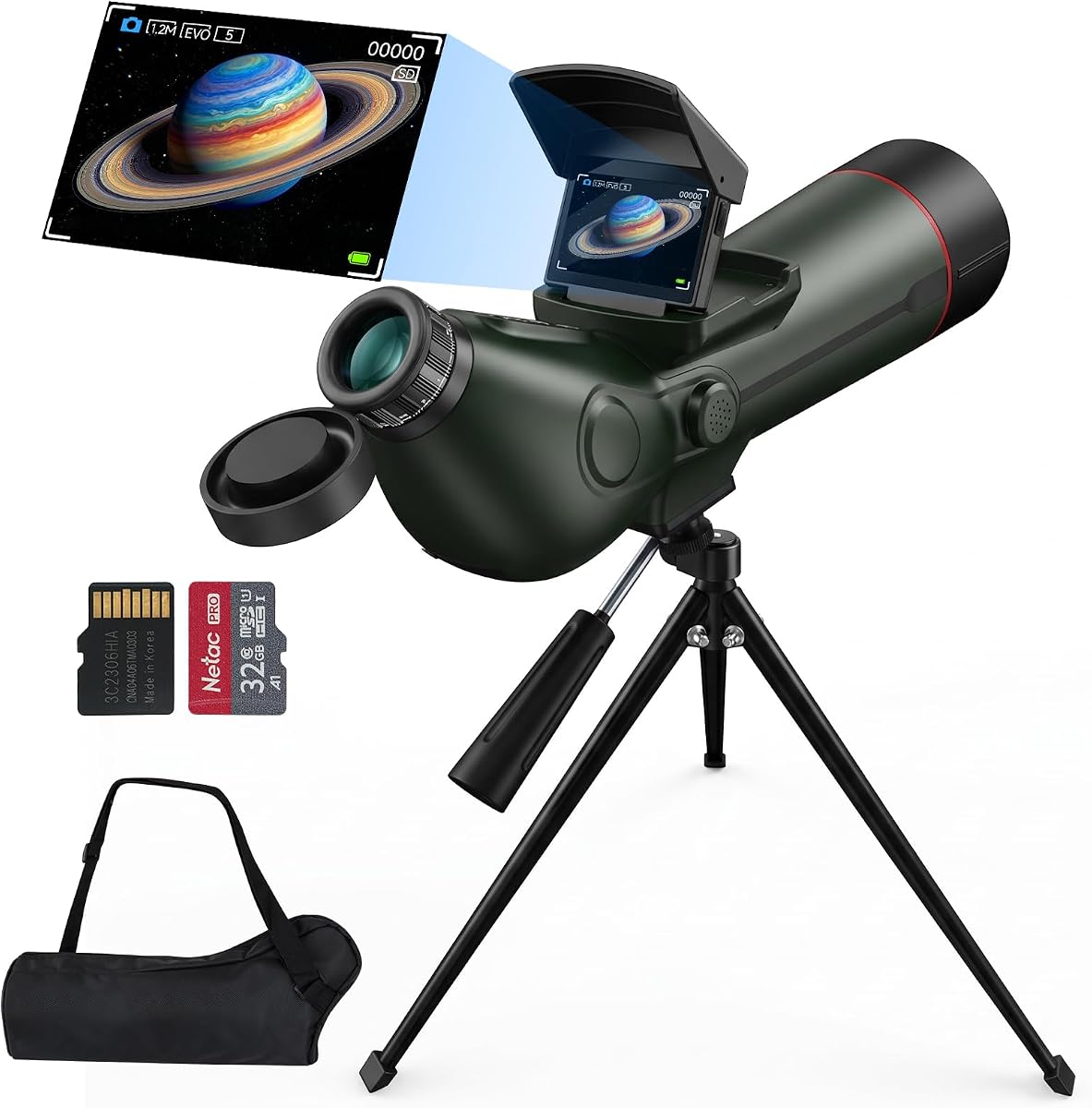
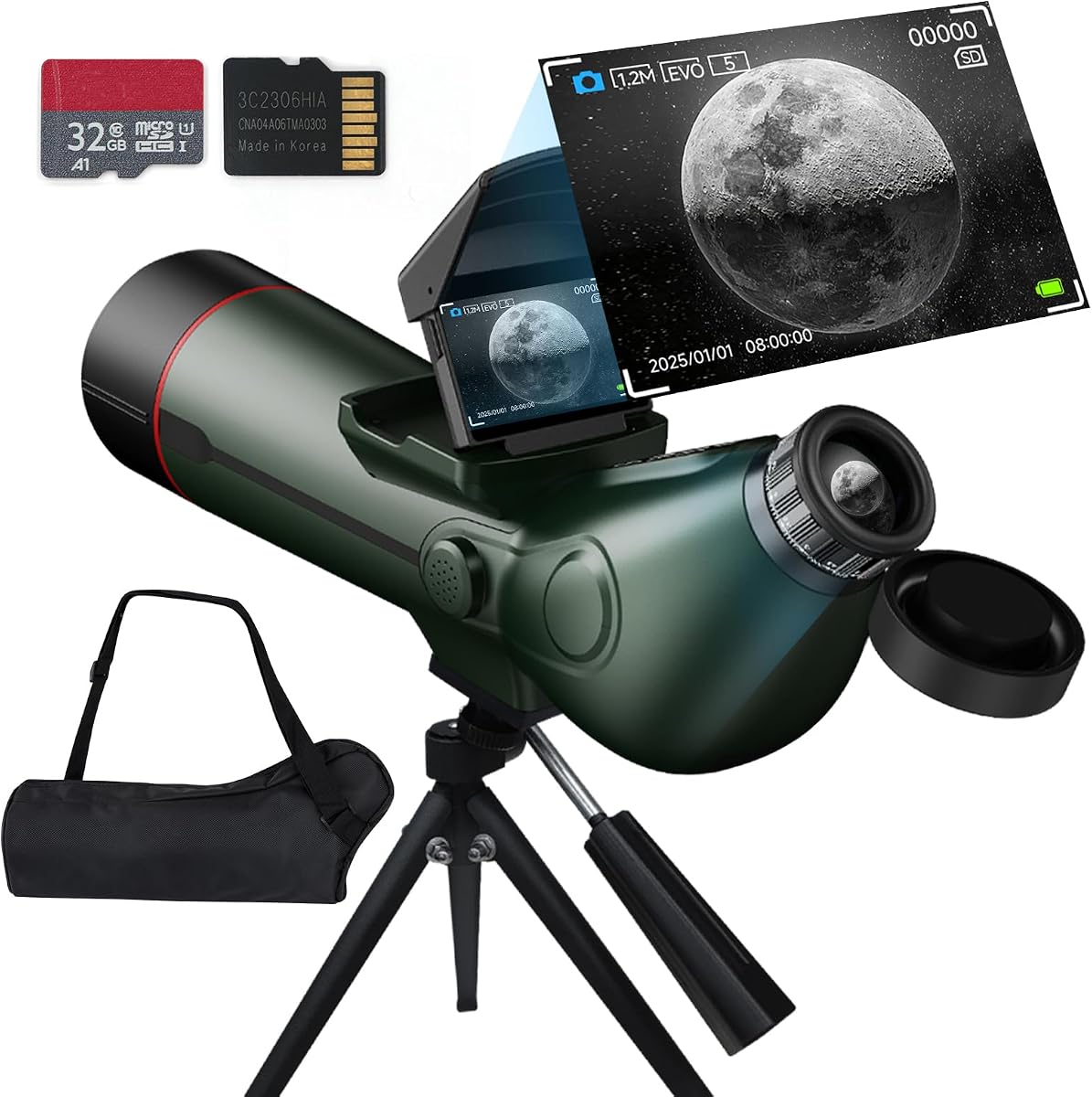
This 4K Astrophotography Smart Telescope combines a five-megapixel starlight-grade CMOS sensor with a 78mm coated objective and 300mm focal length. Its 4.6 rating makes it a compelling value-oriented option for users who want a camera-equipped scope without paying for a sophisticated motorized astrophotography platform.
We may earn a commission when you buy through this link, at no additional cost to you.
A three-inch foldable external display offers a straightforward way to frame subjects, while the eyepiece provides ±4 diopter adjustment for direct observation. Seven brightness levels can help optimize the view, and claimed magnification reaches 350x for long-distance subjects. The built-in sunshade improves screen visibility outdoors.
Simple one-button operation makes the telescope approachable for casual users. A 4500mAh battery is stated to deliver up to six hours of continuous use, and a 32GB memory card is included for immediate photo and video storage. The package also includes a tripod, making it ready for moon viewing, birdwatching, landscapes, and general astronomy.
Unlike the app-guided competitors, this model does not describe automatic GOTO, motorized tracking, or sophisticated stacking. Its five-megapixel sensor also sits below the resolution of larger camera systems. It is therefore best understood as a versatile digital spotting scope and capture tool, especially for buyers who value physical displays, straightforward buttons, and included storage.
Users can move between a traditional eyepiece and a larger foldable screen without attaching another display. Brightness adjustment and the integrated sunshade make the telescope more adaptable to daylight viewing.
The included tripod and memory card reduce the need for immediate extra purchases. The long claimed battery life supports longer nature and astronomy sessions, while one-button capture keeps the workflow approachable.
We may earn a commission when you buy through this link, at no additional cost to you.
The Celestron StarSense Explorer LT 114 is the most traditional telescope in the comparison. It uses a 114mm Newtonian reflector and manual altazimuth mount rather than a built-in camera, but its smartphone guidance makes it a useful option for viewers who want app assistance with visual observing.
We may earn a commission when you buy through this link, at no additional cost to you.
The StarSense app recognizes star patterns overhead and determines the telescope's position. On-screen arrows then guide users toward planets, nebulae, galaxies, and star clusters. A time- and location-based list suggests suitable targets for the current evening, reducing the need to search manually through astronomy apps.
A sliding rod provides smooth altitude adjustment, and the instructions specify waiting until the bullseye turns green before observing. High-reflectivity coatings on the 4.5-inch reflector support views of the Moon, Jupiter, Saturn, the Orion Nebula, and the Andromeda Galaxy.
This model does not meet the literal built-in-camera portion of the keyword, and it lacks motorized tracking, so it is included as a useful alternative for traditional visual astronomy. Its two-year US warranty and access to Celestron support may reassure first-time buyers. The strongest reason to choose it is the desire for a recognizable conventional telescope rather than app-driven image processing.
Instead of requiring polar alignment, the StarSense system identifies the sky and guides the observer toward selected targets. This makes the telescope approachable for newcomers who want more guidance than a basic star chart provides.
The reflector and manual mount provide a conventional telescope experience without a built-in sensor. The trade-off is that photographs generally require a separate camera and equipment the supplied telescope does not directly control.
We may earn a commission when you buy through this link, at no additional cost to you.
The Vaonis Vespera 3 is a sophisticated smart telescope aimed at users who want advanced astrophotography without managing a traditional imaging train. Its 4.0 rating accompanies a premium feature set built around a flat-field apochromatic quadruplet, Sony IMX585 sensor, automatic stacking, and wide mosaics.
We may earn a commission when you buy through this link, at no additional cost to you.
The optical system uses stray-light baffles to support edge-to-edge sharpness and is specified to reach a limiting magnitude of 14. The native 8.3-megapixel sensor can produce mosaics up to 24 megapixels, covering fields as wide as 4.33 by 2.43 degrees. FITS and TIFF export support adds flexibility for users who later want external processing.
The Singularity app automates alignment, tracking, focus, stacking, and sky-color post-processing. Its most unusual capability is resumable multi-night capture: observers can frame a target once and continue accumulating data on later nights. An 11-hour claimed battery, 115GB of storage, auto anti-fog, and a dew shield make it well suited to intensive sessions.
A five-year warranty, construction in France, and the included aluminum tripod support the premium positioning. The principal compromise is that its sophistication is geared toward deep-sky imaging rather than high-power planetary observation, and advanced hardware naturally sits at the upper end of the category. It is most compelling for astrophotographers who value automation and multi-night workflows over manual telescope control.
The flat-field apochromatic quadruplet and internal light baffles are designed to preserve contrast and sharpness across the frame. That optical discipline is especially valuable for wide mosaics, where corner quality can reveal itself strongly.
Preserving stacking progress between nights means faint objects do not have to be completed in one session. This feature can substantially improve the convenience of collecting several hours of integrated light.
We may earn a commission when you buy through this link, at no additional cost to you.
The UNISTELLAR Odyssey PRO distinguishes itself with a Nikon electronic eyepiece, offering a more immersive digital viewing experience than app-only observation. Its 4.4 rating reflects solid overall performance, and the combination of 85mm optics, 320mm focal length, and Multi-Depth Technology supports both planets and distant galaxies.
We may earn a commission when you buy through this link, at no additional cost to you.
Users can view digitally enhanced night-sky images through the electronic eyepiece and then share the experience on a compatible phone or tablet. Stellar Autofocus removes manual focusing, while Smart Star Finder identifies the sky and locates catalog objects. Motorized tracking follows the selected target without polar alignment or manual collimation.
The required UNISTELLAR app supports Android 10+ or iOS 18+. Once the app is downloaded, the telescope can operate over its own Wi-Fi even without an internet connection. Deep Dark Technology is intended to reduce the visual effects of light pollution, and the rechargeable battery is stated to run for up to five hours depending on temperature and use.
At 8.8 pounds for the telescope and 5.5 pounds for the tripod, this is a substantial kit rather than an ultralight backpack option. It is also one of the most specialized systems in the guide because of the Nikon eyepiece. The premium experience is best for observers who prioritize a personal digital eyepiece, automated target acquisition, and a conventional motorized telescope experience.
Viewing enhanced images through a dedicated Nikon eyepiece can feel more immersive than looking only at a phone screen. The same session can be shared with others on a compatible connected device.
Automatic sky recognition, focusing, and tracking handle tasks that normally require patience and experience. The absence of polar alignment makes spontaneous evening sessions considerably more approachable.
We may earn a commission when you buy through this link, at no additional cost to you.
The UNISTELLAR Odyssey offers a streamlined alternative to the Odyssey PRO, using app viewing rather than a Nikon electronic eyepiece. It has a 4.3 rating and retains the established 85mm aperture, 320mm focal length, Multi-Depth Technology, and a motorized altazimuth-style experience centered on the UNISTELLAR app.
We may earn a commission when you buy through this link, at no additional cost to you.
Stellar Autofocus, Smart Star Finder, and motorized tracking automate focus, target location, and object following. Users can select from more than 5,000 catalog objects, while live image stacking builds color and detail as the telescope observes. No polar alignment or manual collimation is required, reducing the setup burden considerably.
Compatible devices must run Android 10+ or iOS 18+. The app is required for operation, but the telescope's Wi-Fi connection allows observing without an internet connection after the app has been downloaded. Deep Dark Technology helps reduce the effects of light pollution, although final image quality still depends on the target, sky conditions, and total light collected.
The telescope weighs 8.8 pounds and the tripod 5.5 pounds, so portability means transporting a complete observatory rather than slipping a miniature scope into a daypack. Compared with the PRO, the standard Odyssey is lighter in features but simpler in operation. It is a strong option for app-oriented beginners who want guided exploration and stacking without a physical eyepiece.
Smart Star Finder reduces the need for manual star hopping, while the large object catalog gives users plenty of choices for a single session. Motorized tracking then keeps a selected target in view.
Images accumulate detail and color while the scope remains on target, making patience part of the experience. The resulting quality naturally improves as observation time and conditions become more favorable.
We may earn a commission when you buy through this link, at no additional cost to you.
The right smart telescope depends on whether the priority is guided deep-space imaging, casual moon observation, wildlife photography, visual astronomy, or compact travel. Optics, sensor performance, automation, app support, and field logistics should be considered together rather than separately.
Aperture determines how much light the telescope can gather, which influences the visibility of faint stars, nebulae, and other deep-sky targets. Focal length also shapes the field of view and magnification: shorter systems tend to frame broad scenes more easily, while longer systems provide tighter views of smaller targets. Models in this guide range from 78mm and 80mm objectives to an 85mm design, with focal lengths commonly around 300mm to 320mm.
Choose an optical system that matches your most common target and field of view, not simply the largest published magnification.
A built-in sensor turns the telescope into a complete imaging system, but resolution alone does not determine performance. Pixel size, sensor format, noise behavior, and the amount of exposure the mount can support all affect the final result. The listed models use sensors ranging from five-megapixel CMOS devices to Sony IMX662 and IMX585 sensors, while some products provide higher-resolution output through mosaics.
Prioritize a low-noise sensor and useful exposure modes if faint deep-space objects are your main interest.
Smart telescopes vary greatly in how they guide users. App-based star atlases, automatic GOTO, sky recognition, and motorized tracking are especially useful for beginners and for capturing faint targets. The DWARFLAB models, Seestar S30 Pro, Vespera 3, and UNISTELLAR Odyssey systems offer varying degrees of this automation. Basic digital scopes may instead depend on manual aiming and physical controls.
More automation is convenient, but check whether the app requires a recent mobile operating system, cloud connectivity, or a stationary setup.
Live stacking combines multiple short observations to increase apparent detail and reduce noise. Some systems also support mosaics, long exposures, equatorial modes, and cloud-based enhancement. These functions can produce more refined astrophotography, but they also add complexity and may require careful setup. The Vespera 3 supports resumable multi-night stacking, while the Dwarf Mini offers exposures of up to 90 seconds in equatorial mode.
Decide whether you want an automated point-and-shoot experience or the flexibility to manage longer integrations.
A built-in screen makes framing and sharing more convenient, while a physical eyepiece preserves a familiar visual experience. Dual-screen telescopes can serve both styles, with an external display for daylight and groups and an adjustable eyepiece for individual viewing. Dedicated electronic eyepieces, such as the one in the UNISTELLAR Odyssey PRO, create a more immersive image-based experience but require a compatible phone or tablet for sharing and control.
Choose the interface that matches whether you expect solitary observation, family use, or app-centered astrophotography.
Weight is one of the clearest differences among these products. The DWARFLAB Dwarf Mini weighs 1.85 pounds, the Dwarf 3 weighs three pounds, and the Seestar S30 Pro weighs 3.64 pounds. At the other end, the UNISTELLAR models use larger eight-point-eight-pound telescope bodies. Battery claims range from as much as five hours for the UNISTELLAR scopes to six hours for several digital telescopes and eleven hours for the Vespera 3.
Include the tripod, charger, filters, and storage in your packing assessment, since telescope weight alone may not show the full field burden.
Image storage can determine whether a session is interrupted by constant file transfers. Options include expandable TF cards, included memory cards, substantial internal storage, and app-based workflows. The Vespera 3 provides 115GB of storage, the 4K Astrophotography Smart Telescope includes a 32GB card, and the top-ranked digital telescope supports expandable TF storage. Filters are also important for city-sky imaging, while anti-dew and dew-shield features help protect optics overnight.
Confirm which storage method is included, how images are transferred, and whether filters or a protective case are supplied.
Some scopes are optimized for wide astrophotography, some for casual moon and wildlife viewing, and some for guided deep-space work. The Seestar S30 Pro is explicitly designed for deep-sky rather than planetary imaging, while the Celestron StarSense is a visual telescope without a built-in camera. The standard digital models can shift between astronomy, birdwatching, landscapes, and close nature subjects.
Select the model that matches your primary activity rather than expecting every telescope to perform equally across every category.
Begin with the manual, fully charge the battery, and install any required companion app before leaving for an observing site. Update the app and telescope firmware if prompted, connect over the specified Wi-Fi network, and confirm that the date, time, and observing location are accurate. For a conventional optical model, allow enough time to align the mount and practice target finding in daylight or under a bright sky before attempting faint deep-sky imaging.
Choose a stable, open location with a clear horizon. For app-guided telescopes, select a target from the built-in catalog and let the device acquire it before beginning a long exposure. For dual-screen digital telescopes, use the external display for framing and the eyepiece for more immersive observation. Keep motorized and equatorial systems stationary during imaging, clean the objective only with the supplied or recommended material, and avoid pointing optical instruments toward the Sun unless the manufacturer explicitly states that solar viewing is safe.
After a session, power the telescope down before disconnecting its battery or storage, remove the SD or TF card if applicable, and protect the lenses with the dust cap or pouch. Keep the instrument and tripod dry, ventilate the optics if condensation formed, and avoid leaving it inside a hot vehicle. Review saved images, back up important files, and follow the manufacturer's guidance for filters, firmware, accessories, and warranty service.
It can replace a conventional telescope for many beginners, particularly when the main goal is guided target selection, image capture, or shared phone viewing. Traditional refractors and reflectors may still provide more familiar controls, broader optical accessories, and a more authentic visual observing experience. A digital spotting scope such as the Celestron StarSense is especially useful for people who want app guidance but prefer a physical eyepiece.
The most approachable models are those that automate finding, focusing, tracking, and image processing. The DWARFLAB Dwarf 3, ZWO Seestar S30 Pro, and Vaonis Vespera 3 all emphasize guided workflows, while the UNISTELLAR Odyssey models reduce setup through automatic focus, sky recognition, and motorized tracking. The best choice still depends on whether the beginner values visual observing, astrophotography, or portability.
They can, although the results depend on the target and the system's filtering and processing features. The Seestar S30 Pro includes light-pollution filters, the DWARFLAB Dwarf Mini includes similar filters and an EQ mode, and the Vespera 3 is specified for city skies with advanced optical control. None eliminates the effects of a bright sky, so darker locations will generally reveal more detail.
A digital telescope primarily adds a camera sensor, display, and direct photo or video controls. A smart telescope usually adds a higher level of software automation, such as sky recognition, target finding, motorized tracking, image stacking, and companion-app processing. Some products overlap heavily, but the degree of guidance and astrophotography automation is the most useful distinction.
Several models can capture the Moon, terrestrial wildlife, and distant scenes, while the Seestar S30 Pro is explicitly designed for deep-sky imaging rather than planetary observation. Camera-equipped models such as the Dwarf 3 and the top-ranked digital refractor support broader imaging uses. Actual planetary detail depends on optics, sensor, atmospheric conditions, magnification, and steadiness.
No. Dual-screen models such as the top-ranked Digital Auto-Focus Smart Telescope and the 4K Astrophotography Smart Telescope provide physical displays and direct controls. App-directed systems, including the DWARFLAB, Seestar, Vespera, and UNISTELLAR models, require compatible software and hardware for some or all of their guided functions, so phone and operating-system requirements should be checked before purchase.
A stable tripod is especially important during long exposures, mosaics, equatorial imaging, and deep-sky stacking because movement can blur stars and interrupt image registration. Short daytime snapshots may be less demanding, but a dedicated stable support is valuable for nearly every serious astrophotography session. Some products include one, while others require a separate compatible tripod.
It depends on the model and the function you want. The UNISTELLAR Odyssey and Odyssey PRO can use their own telescope Wi-Fi after the required app has been downloaded, and several DWARFLAB features also remain local. Cloud image processing and some software updates require internet access, so confirm which functions remain available offline before traveling.
The Digital Auto-Focus Smart Telescope stands out as the most versatile high-rated option, combining an 80mm objective, 4K capture, dual screens, expandable storage, and a long claimed battery. The DWARFLAB Dwarf 3 is ideal for users who want automated astrophotography and daytime subjects, while the Vaonis Vespera 3 is the strongest premium choice for advanced optics, mosaics, and multi-night stacking.
Prioritize the capabilities that match your observing style. Portable observers may favor the 1.85-pound DWARFLAB Dwarf Mini, urban astrophotographers may prefer the Seestar S30 Pro, and app-focused beginners may find the UNISTELLAR Odyssey easier to navigate. Anyone needing maximum physical simplicity may prefer a dual-screen digital scope over a fully motorized smart platform.
Before buying, confirm the telescope's current specifications, included accessories, app compatibility, storage method, and warranty details. Ratings and features can evolve, and prices change across retailers and over time, so checking the latest listing helps ensure the chosen model still offers the features that matter most to you.