
Autel MaxiScope MP608
Four-channel automotive capture
Twelve-bit vertical resolution
Wide vehicle bus decoding
A PC oscilloscope connects measurement hardware to a computer, making it useful for electronics repair, education, signal analysis, and vehicle diagnostics. The strongest choice depends on bandwidth, channel count, vertical resolution, sampling performance, display software, and whether the unit supports protocols such as I2C, SPI, CAN, or LIN.
This guide compares ten PC oscilloscopes ranging from portable low-frequency devices to high-performance mixed-signal and automotive instruments. We evaluated the supplied specifications, feature sets, channel capabilities, waveform resolution, supported functions, and intended applications, while also identifying important differences between a conventional desktop unit and a USB-connected diagnostic scope.
Each pick highlights where the product is strongest and where buyers should be aware of limitations. The list includes a Siglent mixed-signal model for advanced analysis, portable automotive tools, educational kits, and a musician-focused oscilloscope. Product availability and prices can change, so confirm the current listing and accessory requirements before purchasing.
4.8Editor score

4.4Editor score
As an Amazon Associate we earn from qualifying purchases.
The comparison below highlights the major differences among all ten products, including their connection style, channel capacity, bandwidth, sampling rate, vertical resolution, and most appropriate user category.


The Owon VDS1022I is a USB PC oscilloscope that combines a portable body with isolated computer connectivity. Its stated capability of up to 100 MHz bandwidth, maximum real-time sampling rate of 1 GS/s, and 10 million-point record length places it above many entry-level USB scopes. It carries a 4.1 rating, and its main appeal is the combination of measurement performance, protection-focused USB isolation, and a thin enclosure.
We may earn a commission when you buy through this link, at no additional cost to you.
Its analysis features make it useful beyond basic waveform viewing. The supplied specifications list FFT and X-Y views that can be displayed alongside waveform views, giving users access to frequency-oriented inspection and phase-style signal comparison. Edge, video, slope, pulse, and alternate trigger modes provide flexibility when signals are noisy, repetitive, or difficult to stabilize. USB bus powering also supports a streamlined workstation setup, while optional LAN remote control can be useful for longer-distance operation.
The key trade-off is that this is a two-channel instrument. Although up to 100 MHz bandwidth is a strong headline figure, the product's wider usefulness still depends on the bandwidth available in its operating modes, included probes, software behavior, and the needs of the signal being examined. Buyers should also verify exactly which accessories or remote-control options are included, since the supplied information identifies LAN control as optional rather than standard.
The VDS1022I is a compelling recommendation for users who want isolation and flexible triggering in a portable USB design. It is particularly relevant to bench work involving sensitive or unfamiliar circuits, as USB isolation helps reduce signal interference and adds protection for the connected computer. General electronics users, educators, and repair technicians who value analysis views and compact construction will likely find it more useful than a basic two-channel scope without isolation.
USB isolation is a meaningful feature when a scope is connected to a computer and measurements involve live or unfamiliar circuitry. The isolation helps reduce signal inference and adds protection for the PC, making the VDS1022I more appropriate for cautious exploratory work.
FFT, X-Y, and multi-view displays extend the scope beyond basic signal capture, while several trigger modes help isolate edge, pulse, slope, video, and alternating events. This makes the unit suitable for users who need more than a simple trace and trigger control.
We may earn a commission when you buy through this link, at no additional cost to you.
The Siglent SDS1202X-E is a well-balanced two-channel digital oscilloscope with a 4.7 rating. Its 200 MHz bandwidth, real-time sampling rate of up to 1 GS/s, and record length of up to 14 Mpoints provide a strong foundation for electronics development, troubleshooting, and education. It is more specialized than a basic training kit but less physically complex than a full four-channel mixed-signal setup.
We may earn a commission when you buy through this link, at no additional cost to you.
One of its clearest advantages is the range of included serial bus triggering and decoding. The listed protocols include I2C, SPI, UART, RS-232, CAN, and LIN. This means the scope can display decoded information instead of requiring users to interpret every bit manually from raw waveforms. That capability is particularly relevant to embedded development, serial-device troubleshooting, and automotive work involving lower-speed communication systems.
Its two-channel limit is the main constraint. Signals such as three-phase power, four-channel digital systems, or complex timing relationships may require a model with more inputs. Also, 200 MHz bandwidth should be considered alongside sampling rate and record depth: the 1 GS/s maximum and 14 Mpoints provide useful headroom, but bandwidth and channel count still determine how broadly the instrument can serve a particular workflow.
The SDS1202X-E is our Editor's Choice because it combines strong core specifications, broad decoding support, and a well-established feature set without moving into the complexity of a premium automotive platform. It is a particularly sensible choice for makers, students progressing beyond introductory kits, and repair technicians who regularly work with embedded serial buses.
Support for I2C, SPI, UART, RS-232, CAN, and LIN allows users to inspect decoded bus data directly. This is one of the most valuable features for embedded and automotive electronics work because it turns a changing logic trace into identifiable data.
A maximum sampling rate of 1 GS/s and up to 14 Mpoints of memory give the scope more room for detailed and extended captures. These specifications make it a practical step up for users who need better records than a basic educational device can offer.
We may earn a commission when you buy through this link, at no additional cost to you.
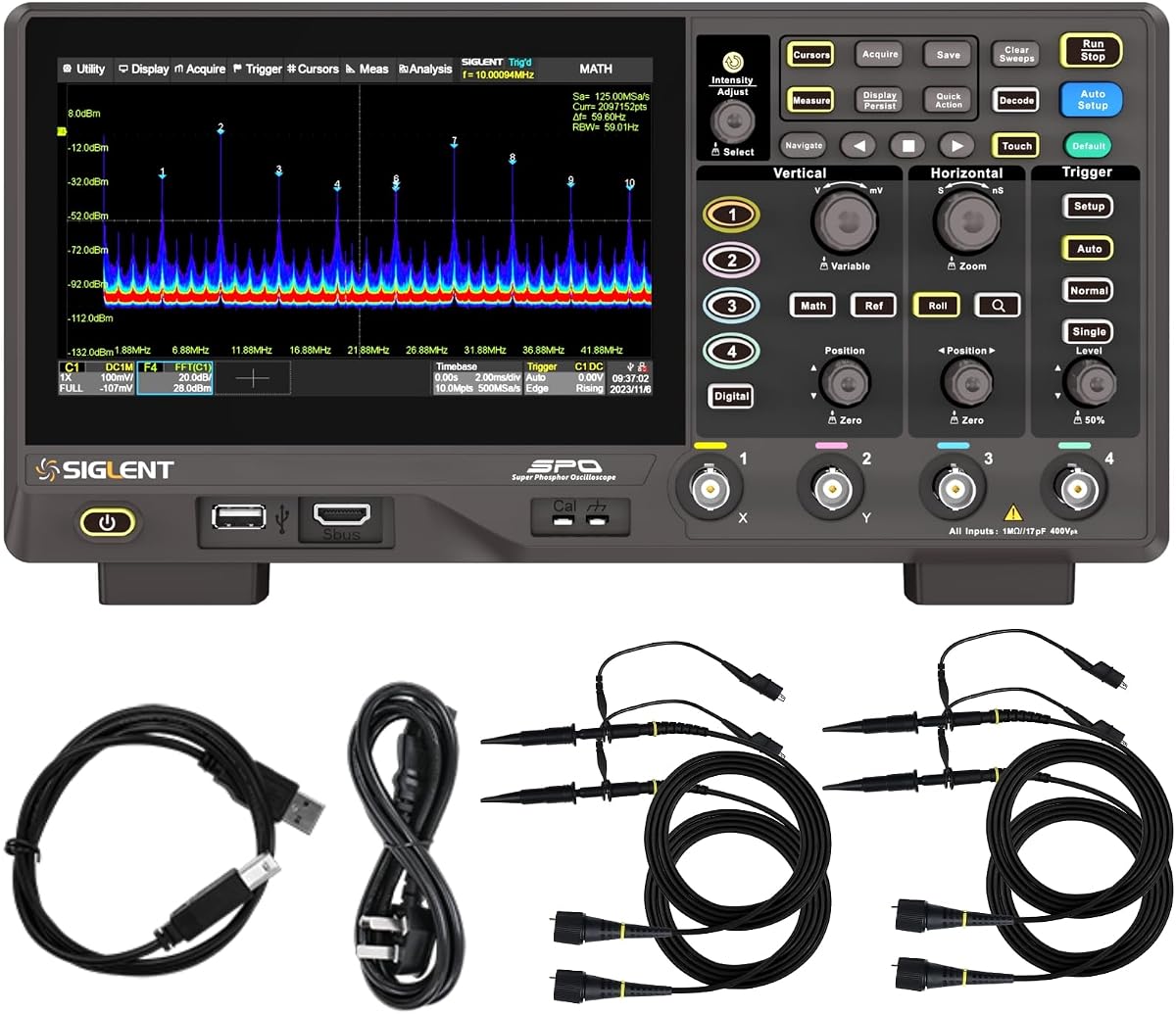
The Siglent SDS814X HD is a sophisticated mixed-signal oscilloscope with a 4.8 rating, four analog channels, 100 MHz bandwidth, 2 GS/s sampling, 12-bit resolution, and up to 50 Mpoints of memory. It is the most specification-dense general-purpose unit in this group and is suited to users who need to examine both analog behavior and digital timing without relying on a separate instrument for every task.
We may earn a commission when you buy through this link, at no additional cost to you.
Its 12-bit analog-to-digital converter is the standout feature. Higher vertical resolution can make small amplitude changes easier to distinguish, which is useful when inspecting noisy, low-amplitude, or nuanced signals. The four analog channels also allow more complex relationships to be observed simultaneously, including clock and data, multiple power rails, or analog control loops paired with digital activity.
The mixed-signal feature requires care because the listed 16 digital channels need the SDS800XHD-16LA option and an SLA1016 logic probe, both sold separately. The display is a 7-inch touchscreen, and normal-mode waveform capture reaches up to 80,000 waveforms per second, while sequence mode can reach 500,000 waveforms per second. Buyers should include those accessory and workflow requirements in the overall decision rather than assuming every mixed-signal function is immediately available.
This is a strong recommendation for advanced educators, embedded engineers, product developers, and serious repair professionals. Its 4.8 rating, high-resolution acquisition, four analog inputs, and deep memory make it the most complete desktop-style choice here. Those who do not need 12-bit sensitivity or four simultaneous analog channels can conserve resources with a simpler model, but for broad mixed-signal work the SDS814X HD is the premium pick.
A 12-bit converter provides more vertical detail than a conventional 8-bit entry-level scope. That extra precision is valuable when small changes, low-level signals, or subtle waveform differences must be distinguished during diagnosis.
Waveform capture rates of up to 80,000 waveforms per second in normal mode and 500,000 in sequence mode improve the chance of displaying brief anomalies. High capture performance is particularly useful for intermittent behavior.
We may earn a commission when you buy through this link, at no additional cost to you.
The Loto OSC482 is a USB and PC oscilloscope designed as a five-in-one test platform. It combines oscilloscope, signal generator, logic analyzer, and data logger roles, with the available configuration depending on optional modules. Its core acquisition specification is 50 MS/s across two channels with 20 MHz bandwidth, while vertical resolution can reach 13 bits in HiRes mode.
We may earn a commission when you buy through this link, at no additional cost to you.
This modular approach is the product's distinguishing feature. The OSC482 can be paired with a signal generator as the OSC482S, a logic analyzer as the OSC482L, or both as the OSC482X. Users can therefore build a setup that matches a particular task rather than paying for every function in a permanently fixed package. The data-logging and virtual-oscilloscope functions also make it useful for longer observations and PC-assisted analysis.
The trade-off is that the product name describes a series rather than one universally equipped configuration. Buyers should confirm whether the listing includes only the base oscilloscope, the OSC482S, OSC482L, or OSC482X package, because the available functions depend on that choice. Its 20 MHz bandwidth is also modest compared with the 100 MHz and 200 MHz models in the guide, and the 50 MS/s sampling rate is most appropriate for low- to mid-frequency signals.
The OSC482 is ideal for technicians and experimenters who want one flexible platform covering measurement, generation, logic inspection, and recording. It can be especially useful for education, embedded development, and electronics experiments where different tasks require different tools. For those needing only a straightforward oscilloscope, the optional-module complexity may be unnecessary, but for a configurable bench the approach is compelling.
Combining oscilloscope, generator, logic analyzer, and data logger functions reduces the need to switch among separate devices. This makes the OSC482 a flexible choice for electronics experimentation and compact workstations.
Vertical resolution reaches 13 bits in HiRes mode, compared with 8-bit normal and peak-detect operation. Buyers can use the higher-resolution setting when examining smaller signal variations rather than treating it as the default for every task.
We may earn a commission when you buy through this link, at no additional cost to you.
The Autel MaxiScope MP608 is a portable, USB-powered four-channel automotive oscilloscope that turns compatible next-generation MaxiSys tablets into diagnostic waveform tools. It combines 12-bit resolution, ±1% measurement accuracy, 20 MHz bandwidth, an 80 MS/s single-channel sampling rate, and 32 MB of shared capture memory. Its diagnostic focus is much more specialized than that of the general-purpose Siglent models.
We may earn a commission when you buy through this link, at no additional cost to you.
Automotive protocol coverage is the major attraction. The MP608 decodes CAN, CAN FD, FlexRay, LIN, UART, and I2C, displaying bus identifiers, DLC, CRC, and acknowledgment data in hexadecimal or binary. A guided test library provides reference waveforms, wiring guidance, and diagnostic tips for sensors, actuators, CAN communication, and starting or charging systems. These resources make the device considerably more than a generic USB screen with probe inputs.
Setup errors can also be reduced through automatic recognition and calibration of supported OEM probes, including 20:1 attenuators, ignition pickups, and current clamps. Advanced trigger modes cover edge, pulse width, window, and distortion, while math functions support channel addition, subtraction, inversion, frequency, duty cycle, pulse width, and custom formulas. These features target intermittent and multi-signal faults that can be difficult to diagnose with a basic meter.
The MP608 is best suited to mobile mechanics, automotive repair shops, and technicians working with compatible Autel tablets. Its 20 MHz bandwidth is modest for general electronics, but that is less important when the central requirement is vehicle signal diagnosis. A technician who already uses the listed MaxiSys platforms should verify exact compatibility, probe requirements, and software support before buying.
Native decoding for CAN, CAN FD, FlexRay, LIN, UART, and I2C supports contemporary vehicle networks. Presenting bus data alongside waveforms gives technicians a clearer view of communication and component behavior.
Preloaded presets, reference waveforms, wiring instructions, and DTC-related guidance make the instrument approachable for systematic testing. This is especially useful when chasing intermittent sensor, actuator, ignition, or network faults.
We may earn a commission when you buy through this link, at no additional cost to you.
The second Autel MaxiScope MP608 listing presents the automotive scope as an upgrade from the older MP408 and emphasizes a complete diagnostic package. It is USB-powered, supports four-channel waveform capture, and uses a 12-bit converter with ±1% DC measurement accuracy. Like the other MP608 listing in this guide, it targets technicians who need vehicle-specific workflows rather than a general-purpose electronics bench.
We may earn a commission when you buy through this link, at no additional cost to you.
Its measurement specifications include 20 MHz bandwidth, an 80 MS/s maximum single-channel sampling rate, and 32 MB of shared buffer memory. Trigger choices include edge, pulse width, window, and distortion modes, allowing users to catch short glitches and other difficult-to-reproduce events. Custom math channels add, subtract, invert, and calculate frequency, duty cycle, pulse width, or user-defined formulas across captured signals.
Protocol decoding covers CAN, CAN FD, FlexRay, LIN, UART, and I2C, with hexadecimal and binary presentation of bus details. The package also supports a guided library covering ignition, sensors, actuators, CAN communication, and starting and charging systems. Automatic probe identification and calibration helps prevent mismatched settings, while the listed accessory kit includes leads, an ignition pickup, probes, attenuators, and a hanging strap.
Compatibility is the deciding factor. The listing names MS906 Pro, MS906 Pro-TS, MS906 Pro2-TS, MS906 MAX, MS909, MS909S2, MS909EV, MS909CV, Ultra ADAS, MS908 S3, MS908S II, and MS908S Pro II, as well as Windows PC. Because software support and included accessories can change by package, buyers should confirm the current contents and verify their exact tablet model. Within that ecosystem, it is a thorough automotive diagnostic platform.
Automatic configuration of supported 20:1 attenuators, ignition pickups, and current clamps helps prevent incorrect attenuation or scaling. This feature is valuable in vehicle work where one bad setup can produce misleading results.
Compatibility with a long list of MaxiSys tablets and Windows computers gives technicians more options for integrating the scope. Buyers should still confirm the exact model, software version, and required connection accessories before purchase.
We may earn a commission when you buy through this link, at no additional cost to you.
The Siglent SDS1104X-E is a four-channel, 100 MHz digital oscilloscope with a 4.8 rating. It is particularly attractive for embedded work because it includes standard decoding for I2C, SPI, UART or RS-232, CAN, and LIN. The four analog inputs provide more simultaneous visibility than the two-channel SDS1202X-E while retaining a straightforward desktop-style workflow.
We may earn a commission when you buy through this link, at no additional cost to you.
The scope supports optional 16 digital channels in the four-channel series, and the supplied information also identifies an optional USB arbitrary waveform generator module. These expansion paths help distinguish it from a fixed two-channel model. However, neither the digital channels nor the waveform generator should be assumed to be included without the relevant option, so buyers need to read the current package description carefully.
A package weight of 4.0 kg suggests a substantial bench instrument rather than a pocket device, which is reasonable for a four-channel scope but relevant when deciding where it will be used. The stated bandwidth is lower than the 200 MHz SDS1202X-E, but for many embedded, power, and general repair applications 100 MHz is a broadly useful ceiling. Four channels also make it easier to compare timing, power rails, sensor outputs, and logic activity.
The SDS1104X-E is an excellent match for users who need four analog channels and serial decoding but may later want mixed-signal capability. It is well suited to students progressing into advanced electronics, embedded developers, and repair technicians handling multi-rail or timing-related circuits. It may be the more balanced choice than the two-channel model, while costing more and requiring more bench space.
Four analog inputs let users compare more than two points in a circuit at once. This is useful for power sequencing, clock-and-data relationships, differential-style comparisons, and troubleshooting involving several rails.
Optional 16-channel mixed-signal capability and an optional USB waveform generator make the platform adaptable. These options are attractive for users who may begin with analog measurements and later need logic or stimulus.
We may earn a commission when you buy through this link, at no additional cost to you.
The DSO 138 DIY Oscilloscope Kit is an educational project rather than a conventional ready-to-use PC scope. Its 3.9 rating reflects a different proposition: users assemble a compact digital instrument around an ARM Cortex-M3 processor and a 2.4-inch color TFT display, learn how oscilloscope hardware works, and observe waveforms across several practical applications.
We may earn a commission when you buy through this link, at no additional cost to you.
The stated uses include audio, video synchronization, low-frequency switching power supply work, and infrared receiving or transmitting. Components support both through-hole and SMD training, making the kit useful for students who want to understand component placement, soldering, signal measurement, and instrument construction. The open nature of the design also allows custom software development and potential changes to its operating role.
Its main limitation is explicit: the kit must be assembled by the user. That introduces skill and time requirements and may be a poor choice for someone who needs a fully functioning instrument immediately. The 1 MSPS sampling rate is also modest, so it should not be confused with a high-performance USB scope. Interpretation of results and probe technique may require careful instruction and practice.
This kit is best for students, educators, hobbyists, and professionals who value the learning process as much as the measurement tool. It offers a distinctive way to understand how a digital oscilloscope is put together and how software interacts with acquired signals. For a quick, ready-to-work bench instrument, buyers should choose a completed scope instead.
Building the device exposes users to the processor, display, probe interface, component placement, and signal-acquisition principles. That makes the kit more educational than a sealed instrument in a similar price and size category.
The basis for custom software development lets users experiment beyond the standard waveform display. Potential modifications include turning the hardware into a millivoltmeter or data recorder, although the user must perform that work.
We may earn a commission when you buy through this link, at no additional cost to you.
The OS-5C is a portable five-channel digital oscilloscope designed for USB and WiFi use with Android or PC software. It can acquire five signals simultaneously, which is unusual in a compact unit and reduces the need to reconnect probes while troubleshooting. Its 4.3-inch color display provides a reasonably large viewing area, with waveform details occupying more than 80 percent of the effective interface area.
We may earn a commission when you buy through this link, at no additional cost to you.
The main limitation is bandwidth. A 1 MHz bandwidth and 3 MS/s sampling rate specialize the device in low-frequency signals such as audio, sensor outputs, and industrial control signals. It is therefore not a general substitute for a 100 MHz or 200 MHz bench scope when investigating fast edges, clock signals, or high-frequency switching details.
Portability is the decisive advantage. At 350 grams, the unit is easy to carry, and its 2,000 mAh battery provides up to three hours of continuous operation. The computer software can record up to 90 hours of waveform data, while the internal storage specification is listed as 8M by five channels. These figures make the OS-5C useful for extended monitoring, field service, and comparative measurements in locations where a bench scope is impractical.
The OS-5C is a good option for field technicians, educators, and electronics experimenters who need multiple channels and portability more than high-frequency performance. Users should verify that the required Android device or PC, application, probes, and wireless workflow suit their environment. For low-voltage, low-frequency work, its channel count and recording capacity can outweigh the lower bandwidth.
Simultaneous five-channel acquisition makes it possible to compare several related signals without physically moving equipment. This is helpful when monitoring multiple sensors or control lines in a field installation.
A 350-gram body and a built-in 2,000 mAh battery support up to three hours of continuous use. These practical characteristics make the scope easier to deploy away from a fixed workbench.
We may earn a commission when you buy through this link, at no additional cost to you.
The Korg Nu:Tekt NTS-2 is a build-your-own oscilloscope kit designed primarily for musicians, audio creators, educators, and curious experimenters. It has a 4.4 rating and distinguishes itself from technical repair scopes by combining four-channel monitoring, a flexible waveform generator, a spectrum analyzer, and a tuner in a compact, approachable package.
We may earn a commission when you buy through this link, at no additional cost to you.
Assembly requires no soldering, making it more accessible than kits that demand advanced component work. The device fits in the palm of a hand and uses a simple, clean interface intended to make signal relationships understandable. Dual stereo inputs, dual stereo THRU/OUT connections, and two separate outputs offer useful routing flexibility for studio, stage, or educational experiments.
Its specialization is both a strength and a limitation. The four channels can monitor control voltages and audio signals, while the spectrum analyzer and tuner help users inspect frequency content and tune instruments. However, the specifications do not position it as a high-bandwidth electronics scope or a serial protocol analyzer. General-purpose repair, embedded timing, and automotive network work would call for one of the Siglent or Autel models in this guide.
The NTS-2 is our Best Budget recommendation because it delivers a broad creative toolkit without requiring a soldering iron or the complexity of a conventional test instrument. It is a particularly good gift for students, musicians, podcast and studio users, and anyone learning how sound and control signals behave. The assembly process itself adds a sense of ownership, while the included generator and analyzer eliminate the need for several separate tools.
A flexible waveform generator lets users create test signals, while the spectrum analyzer and tuner support frequency-focused work. Together, these functions make the kit more versatile than a basic waveform display.
The solder-free build process lowers the barrier for beginners and creators. It provides a hands-on introduction to measurement while producing a compact instrument suitable for studio or live use.
We may earn a commission when you buy through this link, at no additional cost to you.
A useful PC oscilloscope should fit the signals, protocols, workflows, and portability needs of its user. The most important considerations are bandwidth, channel count, vertical resolution, sampling behavior, record depth, decoding, software, and the form of the hardware itself.
Bandwidth indicates the frequency range the scope can measure with useful fidelity. A 200 MHz model such as the Siglent SDS1202X-E offers more headroom for fast signals, while the 100 MHz Siglent models balance higher-frequency work with additional channels or resolution. The 20 MHz Autel and Loto products and the 1 MHz OS-5C are more appropriate for low-frequency, sensor, control, or vehicle applications. Select a bandwidth comfortably above the fastest signal of interest rather than matching it exactly, because harmonics, edges, and transient content can extend beyond a circuit's nominal clock or operating frequency.
Channel count determines how many signals can be viewed at once. Two channels suit basic comparisons, four channels help with multi-rail power, embedded timing, and signal relationships, and five channels improve field monitoring without probe changes. Digital channels are different: the Siglent SDS814X HD requires a specified logic option and probe, while the SDS1104X-E also lists digital channels as an option. Check whether the listing includes the hardware, the probe, and the software entitlement rather than assuming that the phrase mixed signal means every input is supplied.
Vertical resolution determines how finely the scope can distinguish changes in signal amplitude. The 12-bit models provide a higher-resolution alternative to conventional 8-bit hardware, while the Loto OSC482 reaches 13 bits in HiRes mode. This matters when a small ripple, intermittent drop, or subtle sensor transition must be distinguished from noise. Resolution should be considered together with accuracy, probe calibration, bandwidth, and display quality; a high converter resolution does not remove every source of measurement error.
Sampling rate determines how densely the scope samples a waveform, while record length determines how much captured history can be stored. The Siglent SDS1202X-E reaches 1 GS/s with up to 14 Mpoints, the SDS814X HD reaches 2 GS/s with 50 Mpoints, and the Owon VDS1022I reaches 1 GS/s with 10 Mpoints. Deep records help preserve long windows of activity, while high waveform capture rates make intermittent events more likely to appear. Sampling rate alone should not be treated as a complete measure of performance.
Decoding turns a digital waveform into readable protocol data and can save substantial diagnostic time. The Siglent SDS1202X-E and SDS1104X-E support combinations of I2C, SPI, UART, RS-232, CAN, and LIN. The Autel MP608 adds CAN FD, FlexRay, LIN, UART, and I2C for vehicle-focused work. Verify that the exact protocol, electrical standard, baud settings, and triggering behavior are supported. A scope with excellent analog performance can still be poorly matched to a project whose main challenge is decoding a particular bus.
The physical format affects where a scope can be used. The Owon VDS1022I has an ultra-thin portable body, the OS-5C weighs 350 grams and includes a battery, and the Autel MP608 is designed around portable USB-powered operation. Four-channel desktop models may provide a more permanent bench setup but require more space. Consider whether the software must be USB, WiFi, Android, Windows, or compatible with a specific tablet, and whether isolation is desirable when connecting the instrument to a computer.
A training kit, creator tool, embedded scope, and automotive diagnostic instrument serve very different purposes. The DSO 138 is built around assembly and electronics education, the Korg NTS-2 focuses on audio and creative experimentation, and the Autel MP608 provides guided vehicle tests. The general-purpose Siglent products provide a more conventional route into bench measurement. Buying according to the task reduces the risk of paying for advanced triggering, protocol decoding, or optional modules that the intended project will never use.
Begin with the signal path, not the controls. Identify the circuit node, reference ground, expected voltage range, and highest likely frequency, then select probes and settings that can handle those conditions safely. Connect the computer and software before energizing the circuit, confirm that the correct channel and scaling appear, and use a known signal or low-risk point to validate the setup. For automotive tools, follow the guided wiring instructions and probe-identification procedure.
Choose the vertical scale so the trace occupies a useful portion of the display without clipping. Adjust the timebase to show the relevant number of cycles or enough time to investigate an intermittent event, then select a stable trigger mode before relying on measurements. For serial signals, configure the protocol, data rate, polarity, and trigger conditions correctly. Record important waveforms with clear labels so later analysis retains the channel, test condition, and time reference.
Care for the equipment by storing probes and accessories in their intended cases, avoiding pinched or sharply bent cables, and cleaning the display with a soft, nonabrasive material. Do not exceed the voltage and frequency limits of the scope or its probes. For the DSO 138, follow the assembly instructions and inspect every solder joint after the build. For portable and battery-powered models, protect the screen and charging ports, and use USB isolation or diagnostic safeguards where appropriate.
Choose a bandwidth comfortably higher than the highest frequency you expect to measure. Higher bandwidth helps with fast edges, clock signals, switching devices, and harmonics, but it does not automatically improve every low-frequency measurement. The 200 MHz Siglent SDS1202X-E offers the most bandwidth in this list, while the OS-5C and other 20 MHz products are better suited to low-frequency work.
Only models with suitable resolution, triggering, probes, and vehicle protocol decoding are appropriate. The Autel MP608 is explicitly designed for automotive diagnosis and supports CAN, CAN FD, FlexRay, LIN, UART, and I2C, along with guided test procedures. Compatibility with the intended diagnostic tablet or Windows PC should be confirmed before purchase.
Analog channels measure continuously varying voltage levels, while digital channels show logic states as high or low. Analog channels are useful for power rails, sensors, and waveform quality; digital channels help inspect clock, data, and control lines. The Siglent SDS814X HD's 16 digital channels require a separate specified option and SLA1016 logic probe.
A DIY kit is better for learning because it lets the user understand assembly, components, probing, and signal capture from the inside up. A finished scope is better for immediate work because it requires less setup and usually offers more mature measurement specifications. The DSO 138 is therefore strongest for students and builders rather than professionals who need a turnkey instrument.
Not effectively without suitable hardware. The devices here are designed for general electronic signals, low-frequency diagnostics, audio, or specific vehicle protocols rather than general-purpose radio-frequency analysis. The 200 MHz model may observe lower-band signal activity, but bandwidth alone does not provide the frequency range, sensitivity, and front-end performance required for WiFi testing.
USB isolation helps protect the connected computer and reduces the possibility that ground relationships or signal interference will affect the measurement. It is especially useful when exploring unfamiliar or potentially unstable circuits. The Owon VDS1022I includes USB isolation as a defining feature, which is a major reason to consider it for cautious bench work.
Yes. Sampling rate describes how densely a waveform is sampled, while record length determines how much acquired history is retained. A deeper record allows longer windows to be displayed and analyzed, which can reveal slow sequences, repeated bursts, and intermittent behavior. The SDS814X HD provides up to 50 Mpoints, compared with 14 Mpoints for the SDS1202X-E and 10 Mpoints for the Owon.
The Korg Nu:Tekt NTS-2 has a straightforward interface, no-solder assembly, and a focus on approachable audio and creator signals. The Siglent SDS1202X-E is a better choice for learners who want a conventional bench scope and may study embedded protocols. The DSO 138 offers deeper technical education but requires assembly and is less turnkey.
The Siglent SDS814X HD stands out as the most complete general-purpose option, combining four analog channels, 12-bit resolution, 2 GS/s sampling, 50 Mpoints of memory, and fast waveform capture. The Siglent SDS1202X-E offers a simpler but capable two-channel path with 200 MHz bandwidth and broad serial decoding, while the Autel MP608 is the clear choice for compatible vehicle-diagnostic workflows.
For other needs, the Owon VDS1022I emphasizes USB isolation and portable analysis, the Loto OSC482 offers a modular five-in-one platform, and the Siglent SDS1104X-E balances four channels with optional mixed-signal expansion. The OS-5C prioritizes five-channel field portability, the DSO 138 prioritizes education, and the Korg NTS-2 prioritizes accessible audio and creator experimentation. Prioritize bandwidth, channels, resolution, and required protocols over secondary features.
Before ordering, verify the exact package, included probes, optional modules, software compatibility, platform requirements, and current technical specifications. Prices and promotions can change at any time, so check the live listing before making a final purchasing decision.