
AudioControl LC1i
4.7Editor score
Two-channel speaker input
Built-in high-voltage line driver
Selectable ground isolation
Explore the best line driver car audio options, comparing signal quality, voltage, bass control, connectivity, installation features, and overall value.
A line driver car audio device helps installers move low-level audio signals from a factory head unit or amplifier into aftermarket amplifiers, processors, and subwoofers. A strong model improves signal strength, reduces noise, and can provide cleaner gain structure while making complex vehicle audio systems easier to connect and tune.
This guide compares ten line drivers, line output converters, crossovers, equalizers, and bass processors based on their supplied specifications, including output voltage, distortion, signal-to-noise performance, input compatibility, remote functions, dimensions, and intended system role. The selections cover basic factory-radio upgrades as well as advanced multi-channel and bass-focused installations.
Each review identifies the product's strongest use, explains its notable capabilities, and notes practical trade-offs to consider before installation. Ratings and technical details reflect the supplied product information, while current prices can change at any time, so readers should verify the latest cost, availability, and installation requirements before purchasing.
4.7Editor score
4.8Editor score

4.8Editor score
The comparison below shows the core channel flexibility, signal output, processing features, and physical design of each model, making it easier to match a device to a factory-radio upgrade, multi-channel system, or dedicated bass installation.




The AudioControl Matrix Plus 6-Channel High Voltage Car Audio Line Driver is built for installers who need to distribute a high-quality signal across multiple downstream components. Its supplied rating is 4.5, and its standout combination of six balanced channels, 13V peak output, selectable grounding, and exceptionally low distortion makes it well suited to serious multi-amplifier and processor installations.
We may earn a commission when you buy through this link, at no additional cost to you.
Three balanced differential line-level input sets feed three low-impedance line-level output sets, giving an installer several ways to integrate an existing audio system. Maximum output reaches 13V peak, or 9.5V RMS at 14.4V, while the stated total harmonic distortion is below 0.005% across a 10Hz–100kHz frequency range. The signal-to-noise figure of -110dB further emphasizes the design's focus on clean signal transfer.
The trade-offs come from the breadth of its capabilities. This is not merely a basic factory-radio converter; its controls and connection options demand more care during setup. The optional ACR-1 remote is also sold separately, and the integrated 18dB-per-octave subsonic filter may need to be configured carefully to avoid unnecessary limiting of the intended bass range.
Choose this model when a clean, high-voltage signal must reach several amplifiers, subwoofers, or processors without relying on long analog interconnects. It is especially attractive for advanced builds where noise control, flexible grounding, and exact output adjustment matter more than simple plug-and-play convenience. For those needs, it is one of the strongest all-around choices in the guide.
The 13V peak output provides useful headroom when driving downstream amplification, particularly across longer cable runs or multiple signal branches. Balanced differential inputs and low-impedance outputs also give the installer more control over grounding and noise management in a vehicle installation.
Selectable common, ISO, and 200-ohm ground configurations accommodate different factory systems, while LED indicators show the state of each output. The Phoenix-style terminal block and compact enclosure help keep wiring organized, although the optional dash remote adds another installation step.
We may earn a commission when you buy through this link, at no additional cost to you.
The AudioControl LC1i 2-Channel Car Audio Line Output Converter & Line Driver is a focused solution for adding aftermarket amplifiers, subwoofers, or processors to a factory radio. With a 4.7 rating, it combines speaker-level conversion, a built-in line driver, and installation conveniences in a slim 4.8-by-3-by-1-inch chassis.
We may earn a commission when you buy through this link, at no additional cost to you.
Its input section accepts speaker-level signals up to 400W, or 40V, per channel. Selectable 20-ohm, 60-ohm, and 20k-ohm loads help certain modern factory amplifiers continue detecting speaker loads. A Great Turn On signal-sense option automates turn-on, while a remote-out terminal can trigger downstream equipment and a selectable ground isolation switch helps suppress unwanted noise.
The primary limitation is its scope. It is designed around two channels rather than a large balanced distribution network, and it does not retain the factory radio's fader control. Installers who require fader compatibility or multi-channel routing need to consider a more specialized model. The optional ACR-1 dash knob is also not included.
This is a strong selection for a straightforward subwoofer or amplifier addition where a factory head unit supplies the audio. It offers enough flexibility to handle common vehicle electronics while remaining easy to package beneath a seat or inside a trim panel. For a basic high-quality conversion, it delivers a convincing mix of usability and value.
The selectable load settings are especially relevant to vehicles with factory amplifiers that check for connected speaker loads. Correct configuration can help preserve audio passage when aftermarket equipment is introduced without changing the original head unit.
The LC1i's shallow chassis is easy to conceal, and its remote-out terminal removes the need for a separate trigger adapter in many installations. Automatic turn-on and selectable ground isolation simplify two common challenges encountered when adding amplifiers to factory systems.
We may earn a commission when you buy through this link, at no additional cost to you.
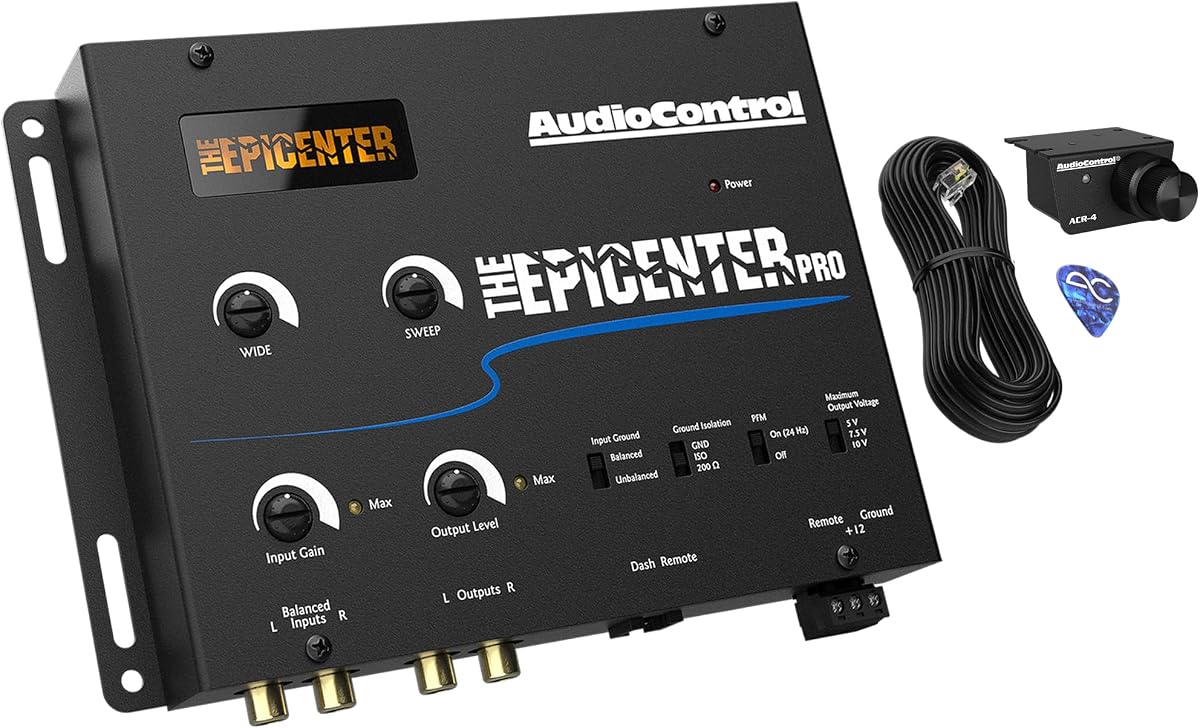
The AudioControl The EPICENTER PRO Bass Restoration Processor & Line Driver goes beyond converting a signal. Its 4.8 rating reflects a product designed specifically to restore low-frequency impact while delivering a clean, high-voltage output to amplifiers, equalizers, crossovers, and subwoofers.
We may earn a commission when you buy through this link, at no additional cost to you.
At the center of the design is a bass restoration circuit that detects upper-range harmonics and synthesizes low-frequency content for recordings with limited bass. The center-frequency control covers 27–63Hz, while separate width adjustment controls the affected bandwidth. These controls allow the processing to be aligned more closely with the vehicle's acoustics instead of applying the same bass profile everywhere.
Signal quality is another major strength. The balanced line-level path is supported by a claimed signal-to-noise ratio above 105dB and total harmonic distortion of 0.03%. Selectable output voltage helps match the processor to an amplifier's input stage, while the programmable frequency-match subsonic filter can reduce wasted amplifier power. The backlit LED display provides real-time visual feedback.
The EPICENTER PRO is not the right choice for every installation because its main value depends on bass-restoration needs. The optional ACR-4 dual knob remote must also be purchased separately. Even so, it offers a compelling package for installers building a serious bass system around an AudioControl ecosystem. Its processing depth, clean output, and precise controls justify the Editor's Choice distinction.
Instead of indiscriminately adding bass, the circuit identifies upper-range harmonics and reconstructs missing low-frequency information. Adjustable center frequency and bandwidth help the installer tailor the effect to the vehicle, subwoofer, and music.
Selectable output voltage supports a cleaner gain structure and reduces sensitivity to noise. The programmable subsonic filter protects the intended operating range and can prevent an amplifier from wasting power on frequencies the subwoofer will not reproduce.
We may earn a commission when you buy through this link, at no additional cost to you.
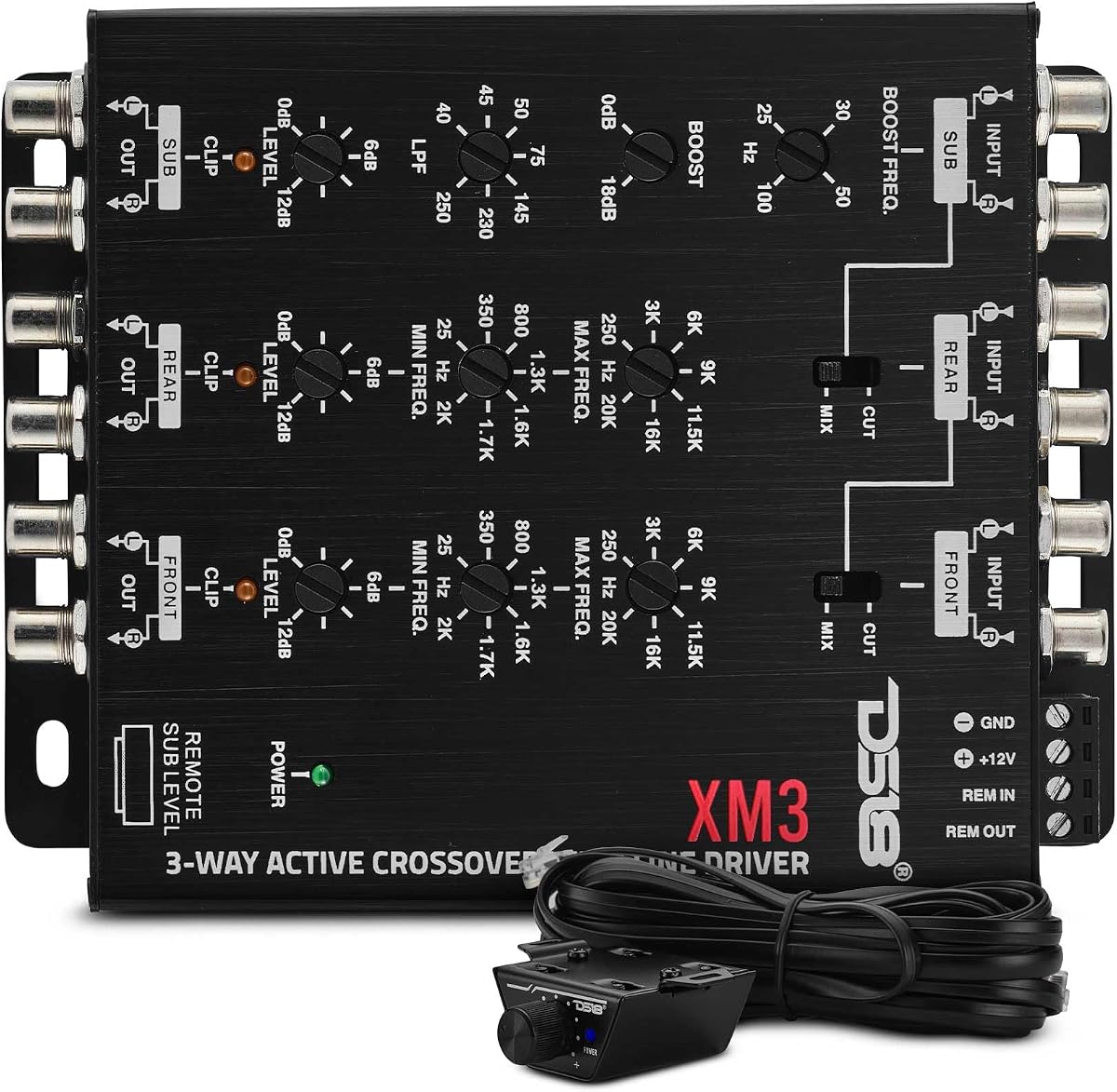
The DS18 XM3 is a three-way active crossover with an integrated line driver, designed to organize front, rear, and subwoofer channels while increasing the voltage available to downstream amplifiers. Its 4.1 rating reflects a broad feature set, although the available information does not indicate the same level of polish as the highest-rated models in this roundup.
We may earn a commission when you buy through this link, at no additional cost to you.
Its built-in line driver can deliver output up to 11V, with stated total harmonic distortion of 0.01%. The active crossover provides independent front, rear, and subwoofer tuning, while a remote subwoofer level controller includes a clip indicator. This combination makes the XM3 useful for installers who want frequency division and signal boosting in one compact unit.
The main installation concern is that multiple overlapping features can make initial setup more involved. Adjustable bass boost of up to 18dB can create distortion or overdrive speakers if used aggressively, especially when combined with a high amplifier gain. The stated high-pass and low-pass filter ranges also indicate that the crossover is optimized for conventional car-audio layouts rather than unrestricted custom voicing.
The XM3 is a strong fit for three-way systems requiring dedicated subwoofer control, active filtering, and a boosted preamp output. It is less suitable for a simple two-channel amplifier addition where those broader controls are unnecessary. Buyers who can follow a disciplined setup process will gain useful flexibility from the combined design.
Independent front, rear, and subwoofer controls allow the installer to divide the frequency spectrum before signals reach separate amplification channels. Compatibility with three-, two-, and one-way layouts adds flexibility for different system configurations.
The included remote gives the driver an immediate way to adjust subwoofer level without reaching into the trunk or cabin electronics area. Its clip indicator helps identify when the chosen gain is approaching the limits of the signal path.
We may earn a commission when you buy through this link, at no additional cost to you.
The Timpano TPT-EQ7 combines a seven-band graphic equalizer, high-voltage line driver, high-level input, crossover, and six-channel RCA output in a slim package. Its 4.6 rating makes it an appealing all-in-one option for installers building a multi-channel system from a factory radio or aftermarket source.
We may earn a commission when you buy through this link, at no additional cost to you.
The equalizer provides seven bands at 50Hz, 125Hz, 320Hz, 750Hz, 2.2kHz, 6kHz, and 16kHz, each adjustable by plus or minus 12dB. This range allows installers to correct broad tonal imbalances, shape a subwoofer output, and compensate for reflections inside the vehicle. Line output can reach 10V, supporting cleaner signal transfer to amplifiers across longer runs.
Because the EQ7 performs several jobs simultaneously, correct planning is important. Its crossover, subwoofer level, and equalization controls should be coordinated rather than adjusted independently, or the tonal result may become difficult to predict. The supplied specifications also do not state a THD or signal-to-noise figure, so performance comparisons should focus on the documented features and intended role.
This model is best suited to a driver who wants a single device for equalization, source conversion, and multi-channel distribution. It is especially useful where a separate line driver and equalizer would consume too much installation space. For simpler one-amplifier systems, however, a dedicated converter may be easier to tune and conceal.
The selected bands cover bass, lower midrange, presence-oriented frequencies, and treble. That makes the EQ7 useful for both factory-system upgrades and aftermarket builds where cabin reflections and speaker limitations need measured compensation.
A built-in speaker-wire-to-RCA converter removes the need for another interface when the source is a factory radio. Six RCA outputs provide room to feed multiple amplifiers, while the high-voltage output helps preserve signal quality.
We may earn a commission when you buy through this link, at no additional cost to you.
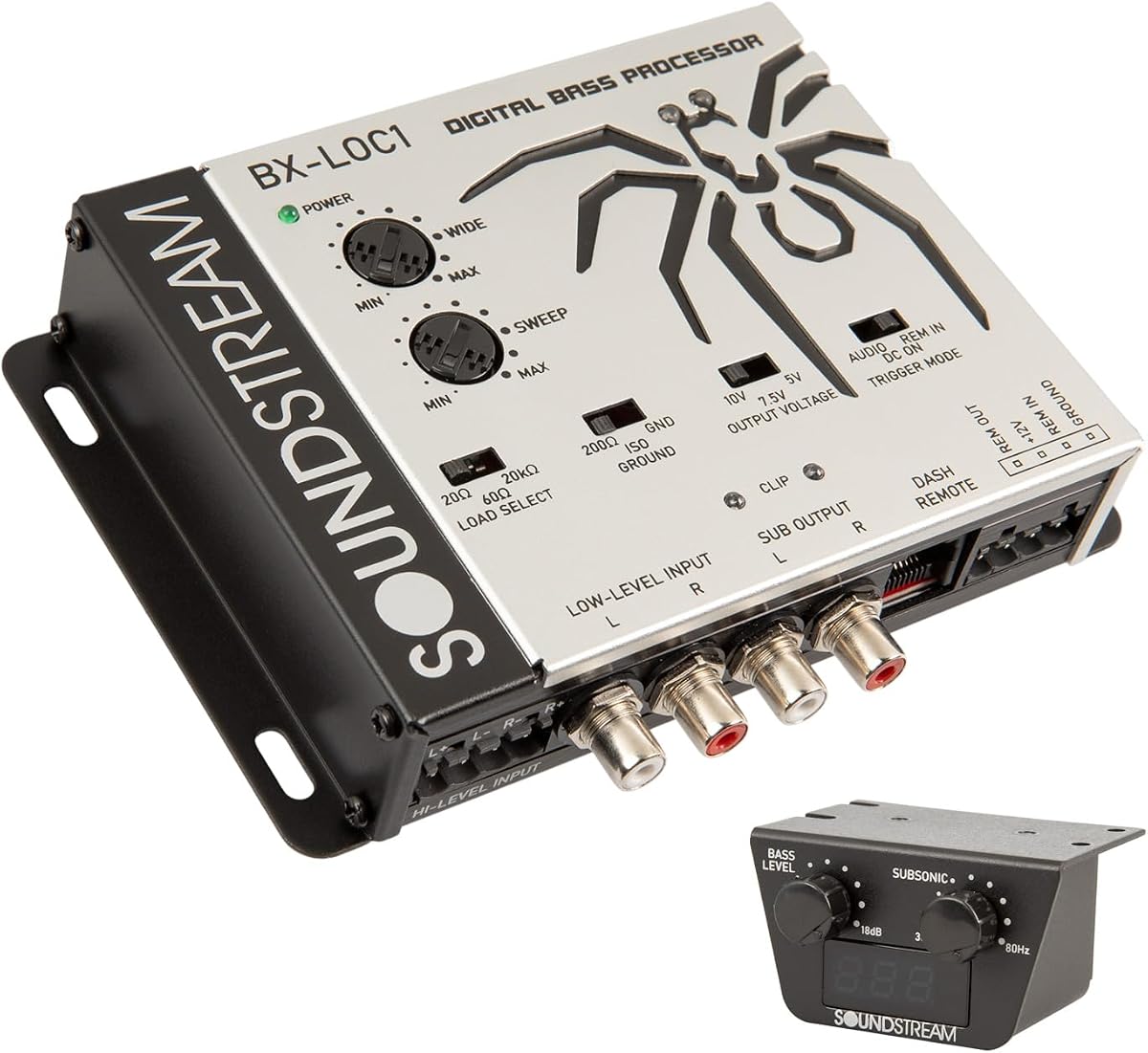
The Soundstream BX-LOC1 is a compact line output converter, line driver, and digital bass processor designed for both factory and aftermarket source integration. Its 4.2 rating reflects a straightforward package of useful features, with the most distinctive element being bass reconstruction for compressed or factory audio that lacks low-end impact.
We may earn a commission when you buy through this link, at no additional cost to you.
The processor accepts either speaker-level or RCA input, which simplifies system design when an installer may work with different source components. Its adjustable line driver can deliver up to 9V, giving downstream amplifiers a stronger signal with additional headroom. Shielding, ground isolation, impedance matching, and an onboard LED clipping indicator support cleaner installation and signal monitoring.
The product is less expansive than several six-channel or heavily featured processors in this list. It is primarily a two-channel solution, and the supplied information does not provide a specific THD or signal-to-noise measurement. Its value therefore rests on the combination of flexible input handling, bass restoration, and practical noise-control features rather than on laboratory-style performance figures.
The BX-LOC1 is a good candidate for a single amplifier or subwoofer installation in a vehicle with a factory stereo. It is also useful when an installer wants a modern amplifier without replacing the original head unit. Choose it for flexible source compatibility and bass recovery; choose a more specialized line driver when multi-channel routing or fine crossover control is the primary requirement.
Speaker-level and RCA inputs make the BX-LOC1 adaptable to factory head units as well as aftermarket sources. That flexibility can simplify wiring and reduce the need for separate conversion hardware in many common installations.
Shielding and ground isolation help manage hiss, hum, and engine noise commonly associated with analog car-audio systems. The clipping indicator gives the installer a visual reference during gain adjustment and system calibration.
We may earn a commission when you buy through this link, at no additional cost to you.
The AudioControl LC2i 2-Channel Line Output Converter with AccuBASS is aimed at factory systems that lose bass as the head-unit volume rises. Its 4.6 rating reflects a well-focused design that combines reliable speaker-level conversion, bass compensation, remote turn-on, and level adjustment in a compact chassis.
We may earn a commission when you buy through this link, at no additional cost to you.
AccuBASS is the defining feature, correcting and restoring bass roll-off caused by increasing the factory radio's volume. The converter accepts speaker-level signals up to 400W per channel and routes preamp output to aftermarket subwoofers, amplifiers, or processors. Great Turn-On signal sensing can automate activation, while the remote-out terminal can trigger up to two additional devices.
Its main limitation concerns factory fader behavior. The product does not retain fader control when multiple amplifiers are used, and AudioControl directs installers seeking that function toward other models in the range. The optional ACR-1 dash remote is also sold separately. Those constraints are more relevant to complex systems than to a typical single-subwoofer upgrade.
The LC2i is a practical choice for drivers seeking more bass from an OEM installation without replacing the head unit. It provides enough control to address the familiar problem of diminished low output while preserving a straightforward two-channel architecture. Its turn-on and remote features also reduce the amount of additional trigger wiring required.
Many factory systems intentionally reduce bass as volume increases. AccuBASS is designed to correct that behavior, helping preserve perceived low-frequency impact when the original head unit is turned up.
Great Turn-On can detect an audio signal and power the converter automatically, while remote-out wiring can activate downstream amps, line drivers, or crossovers. This makes the LC2i practical in systems where manual remote activation would be inconvenient.
We may earn a commission when you buy through this link, at no additional cost to you.
The Wavtech linkDQ is a two-channel line output converter and line driver centered on parametric equalization. With a 4.7 rating, it is a strong option for installers who want more precise tonal correction than a conventional fixed graphic equalizer can provide.
We may earn a commission when you buy through this link, at no additional cost to you.
Its adjustable parametric EQ can use narrow or wide bandwidth settings, allowing the installer to target a specific low-frequency deficiency with either a concentrated correction or a broader tonal adjustment. Auto turn-on supports both DC-offset and audio signal detection, and OEM load detection is included for compatibility with relevant factory amplifier systems.
The remote-capable RJ45 port provides a clean route for adding a remote level control, although that accessory is sold separately. The supplied information is concise and does not quantify output voltage, THD, or signal-to-noise performance. As a result, prospective buyers should confirm the exact electrical specifications they require against the manufacturer's documentation before finalizing an installation.
The linkDQ is most compelling for a two-channel system that benefits from carefully targeted bass or low-mid correction. It does not offer the multi-channel distribution, bass synthesis, or extensive crossover controls found elsewhere in the guide. Within that narrower category, however, its parametric EQ, turn-on options, and factory compatibility create a focused and professional package.
A narrow parametric setting can address a concentrated problem frequency, while a wider setting can make a broader tonal correction. This flexibility is useful when a vehicle's acoustics call for something more targeted than a standard fixed-band equalizer.
The RJ45 connection is intended for an optional remote level controller, keeping the upgrade path clear without requiring a permanently installed large control panel. Automatic turn-on choices also reduce the need for additional trigger wiring in suitable systems.
We may earn a commission when you buy through this link, at no additional cost to you.
The AudioControl Epicenter Micro PRO combines a line output converter, high-voltage line driver, and bass restoration processor in a compact 1-by-8-by-3-inch enclosure. Its 4.8 rating and broad input compatibility make it the premium selection in this guide, particularly for installers who want the EPICENTER platform without the physical footprint of a larger multi-channel unit.
We may earn a commission when you buy through this link, at no additional cost to you.
Both speaker-level and balanced line-level inputs are supported, giving the unit flexibility with factory and aftermarket sources. Load-selection switches offer 20-ohm, 60-ohm, and 20k-ohm settings for relevant factory amplifier systems. The line driver provides selectable output voltage, a claimed signal-to-noise ratio above 105dB, and total harmonic distortion of 0.03%.
Bass restoration is controlled through a 27–63Hz center-frequency sweep and a separate width adjustment, allowing the effect to be focused rather than simply increased. The programmable frequency-match filter can be bypassed for access to more than 10V maximum output, giving experienced installers additional control. Great Turn-On, a coated circuit board, and a recommended 1A fuse support practical integration.
The optional ACR-4 dual-knob remote and specialized processing make this a premium rather than entry-level choice. It is most appropriate for a carefully planned bass system that values clean signal paths, reconstruction, and precise control. Even with those requirements, the combination of speaker-level and balanced inputs makes the unit unusually adaptable.
The patented circuit detects upper-range harmonics and synthesizes missing low-frequency information. A 27–63Hz sweep and adjustable bandwidth let the installer tune the reconstruction to the subwoofer, vehicle, and preferred musical character.
Speaker-level and balanced line-level inputs allow the Epicenter Micro PRO to work with OEM head units and aftermarket signal chains. Selectable output voltage, bypassable filtering, and automatic turn-on add further installation flexibility for advanced builds.
We may earn a commission when you buy through this link, at no additional cost to you.
The AudioControl Matrix Plus 6-Channel Line Driver is a compact multi-channel device intended to provide adjustable gain across a car-audio system. Its 3.6 rating is the lowest among the products reviewed, while the supplied information is also more limited than for the other Matrix Plus model.
We may earn a commission when you buy through this link, at no additional cost to you.
The documented headline specifications include up to 24dB of gain and a 9.5V RMS maximum output. Top-mounted controls are intended to make adjustment easier during installation, and indicator lights show one-, two-, or five-volt output along with a maximized state. These features support a straightforward multi-channel gain setup.
The incomplete published specification set is the central consideration. No input type, channel configuration detail, THD, signal-to-noise figure, grounding arrangement, or remote capability is provided in the supplied data. Buyers should therefore review the current manufacturer documentation and confirm connector compatibility before choosing it for a specific vehicle.
Within a comparison of line drivers, this model still appeals to installers seeking six-channel gain control in a compact unit. Its top-mounted controls and output-state lights are useful, but the more extensively documented AudioControl Matrix Plus 6-Channel High Voltage Car Audio Line Driver offers more clearly defined performance and installation features.
Up to 24dB of available gain provides wide latitude when matching a source to downstream amplification. That range is useful in mixed systems where different devices have varying input sensitivities.
Lights for one-, two-, and five-volt output make it easier to identify the active operating state. A separate maximized indicator provides additional feedback during setup, while top-mounted controls simplify access during installation.
We may earn a commission when you buy through this link, at no additional cost to you.
The right line driver depends on your source, amplifier configuration, signal paths, and tuning priorities. Use the following factors to narrow the field before comparing channel count, output voltage, processing features, and installation requirements.
Begin by identifying where the audio enters the system. A factory head unit or factory amplifier normally provides speaker-level output, while an aftermarket head unit or processor may already offer RCA preamp connections. A product with a high-level input can serve as both a line output converter and line driver, while a model designed only around balanced line-level inputs may be better for a fully aftermarket installation.
Also consider whether the factory system applies bass roll-off, attenuates signals as volume increases, or uses load detection. Those behaviors can influence which correction, isolation, and compatibility features are genuinely useful in the intended vehicle.
A line driver's job is to preserve signal strength and deliver a stable voltage to the next device. Models in this guide offer output capabilities ranging from approximately 9V to 13V peak, along with adjustable gain on several units. Higher voltage can provide greater headroom and help maintain a clean signal over long interconnects, but output must still be matched to the downstream amplifier's input design.
Look for an output-level control and a documented maximum output. Also consider the relationship between signal-to-noise ratio and distortion specifications, since both influence how the line driver performs at practical listening levels. A converter that is appropriate for a short subwoofer lead may be less suitable for a long multi-amplifier network.
A two-channel converter is often enough for a single stereo amplifier or subwoofer installation. Multi-channel systems may need balanced differential inputs and outputs for front, rear, and subwoofer feeds. A six-channel line driver can simplify distribution, but it may also require more wiring and careful gain matching.
Pay attention to whether outputs are RCA, speaker-level, balanced, or a combination. Remote-out and remote-in terminals are also important because a complete signal chain needs reliable turn-on coordination. The ideal routing should minimize unnecessary adapters and make every connection understandable during installation.
Vehicle electrical systems are electrically noisy environments, so ground handling can be as important as raw voltage. Selectable ground isolation can help suppress alternator whine, hum, and buzz. Models with common, ISO, and 200-ohm grounding choices offer additional flexibility when dealing with different factory electronics.
Shielded construction, short ground paths, and properly terminated connections all contribute to clean results. Installation should follow the vehicle manufacturer's wiring guidance and the line driver's power and fuse recommendations. A feature alone will not guarantee silent operation if the underlying connections are poor.
A line driver is not automatically a bass processor. Some products simply convert and boost the signal, while others add harmonic bass restoration, digital low-frequency reconstruction, parametric equalization, or conventional graphic EQ. These features can compensate for compressed recordings, factory bass roll-off, and cabin acoustics, but they also add complexity.
Consider the width and frequency controls offered by bass-restoration devices. A narrow adjustment can target a specific problem, while a broad setting changes more of the musical spectrum. Graphic equalizers with seven bands are convenient for broad tonal shaping, whereas parametric EQ offers more surgical correction. Choose processing only when the vehicle and source genuinely need it.
A crossover determines which frequencies reach each speaker set, while a subwoofer level control lets the driver adjust bass after the system is installed. Some line drivers include both, while others require a separate processor. A combined unit can save space and simplify wiring, but it may be less flexible than separate components.
Look for the available filter ranges, system configurations, and remote-control options. Confirm that the unit supports the number of channels in your system and that the adjustment ranges suit the intended speakers. Bass boost should be used cautiously because excessive boost can expose clipping and place unnecessary strain on an amplifier or subwoofer.
Automatic turn-on functions can simplify an installation by detecting an audio or DC signal and activating the processor when needed. Selectable modes are useful because head units and amplifiers use different trigger conventions. A remote-out terminal can then pass that activation command to downstream devices, sometimes eliminating a separate relay.
Dashboard remotes improve daily usability, especially for subwoofer level or processor effect control. However, most remotes in this category are optional purchases. Check whether the connector type is compatible, whether the required cable is included, and whether manual turn-on remains necessary for the chosen vehicle.
The smallest chassis is not always the easiest to install, and the largest is not automatically the most capable. Measure the intended mounting area before purchase, including space required for connectors, bend radius, and access to adjustment controls. The supplied dimensions range from slim modules a few inches wide to larger six-channel enclosures.
Also consider whether controls should be top-mounted, whether RCA connectors will remain accessible, and whether the circuit board is protected from moisture and temperature changes. A vehicle installation should be planned around serviceability as well as concealment, especially when several settings may need adjustment after the system is calibrated.
Begin by identifying every input and output connection, then map the signal path from the head unit or factory amplifier through the line driver to the amplifiers, processors, crossovers, and subwoofers. Confirm that channel assignments match before tightening connectors. Power the unit off while wiring, check polarity, and use the manufacturer's recommended fuse and power-wire gauge.
Start with the line driver's gain or output-voltage controls at a conservative position. Set the downstream amplifier gain correctly for its input sensitivity, then use the line driver to establish a clean source level. If the unit includes an equalizer, crossover, or bass restoration, make small adjustments one at a time while listening to familiar material and checking for clipping.
For daily care, keep the enclosure and connectors protected from moisture, direct heat, and physical impact. Do not unplug or alter wiring while the vehicle is running. If noise, clipping, unstable turn-on, or reduced bass appears, recheck ground connections, load settings, grounding mode, and source compatibility before changing tone controls.
A line driver strengthens and stabilizes an audio signal between a source and downstream equipment. It is commonly used to convert speaker-level output from a factory radio into preamp-level RCA signals while reducing the chance that noise or low voltage will compromise downstream amplification.
The terms overlap, but they are not always identical. A line output converter primarily changes speaker-level signals into RCA line-level signals, while a line driver specifically boosts voltage to drive downstream components reliably. Some products in this guide perform both jobs, while others add crossover, EQ, or bass-restoration functions.
Usually not for basic signal routing, because aftermarket head units commonly provide RCA preamp outputs. A line driver can still be valuable when a long cable run, unusual input sensitivity, multiple downstream devices, or additional processing requires a stronger and more controlled signal.
Some modern factory amplifiers electronically detect connected speaker loads and may stop passing audio when they see an incorrect load. Models with 20-ohm, 60-ohm, and 20k-ohm selection can address this issue, but the installer should follow the vehicle and converter instructions carefully.
A line driver with dedicated bass compensation can help counter some forms of factory bass roll-off. AccuBASS and bass-restoration circuits are designed for that purpose, but they are not substitutes for correctly configured speakers, crossovers, amplifier gain, and subwoofer integration.
Not automatically. Greater voltage can improve headroom and help preserve signal quality over demanding signal paths, but the output must be matched to the downstream amplifier's input. Excessive gain, mismatched impedance, or poor grounding can create distortion rather than cleaner sound.
Use RCA line-level connections when the source provides a clean preamp output, and use speaker-level inputs when working with a factory radio or amplifier that lacks RCA outputs. A compatible line output converter can bridge those two systems while providing RCA outputs for aftermarket amplifiers.
Choose a dry, protected location near the main signal path but away from moving components, excessive heat, and moisture. Leave enough room for connectors and controls, use the recommended fuse, and ensure that remote and power cables are routed safely through the vehicle.
The AudioControl The EPICENTER PRO stands out for advanced bass restoration and precise output control, while the LC1i offers an approachable two-channel factory-radio solution. The Epicenter Micro PRO provides the most premium combination of flexible inputs, bass processing, selectable output, and compact construction for carefully planned installations.
For the remaining systems, prioritize the signal path rather than the longest feature list. A basic subwoofer installation may need only a dependable converter, while a multi-amplifier build benefits from balanced outputs, selectable grounding, remote triggering, and sufficient channel capacity. Match the unit to the source, amplifier inputs, cable lengths, and required tuning functions.
Before ordering, confirm the exact connector layout, load settings, power requirements, remote accessories, and physical dimensions with current product information. Current prices can change, so compare the final cost with the installation effort and the signal benefits the device is expected to deliver.