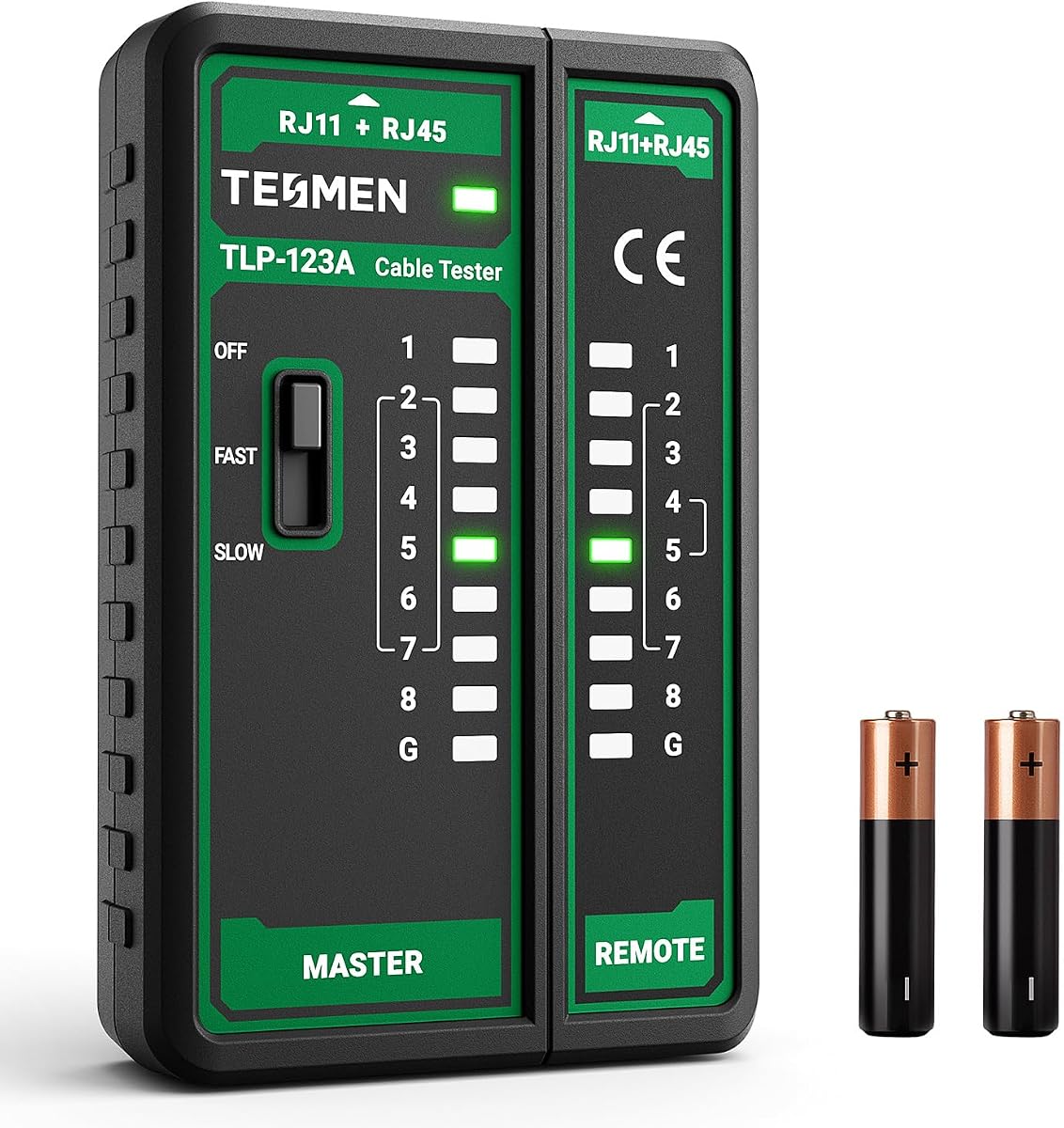
TESMEN TLP-123A Network Cable Tester for RJ11 RJ45
4.5Editor score
One-button continuity testing
Supports RJ11 and RJ45
Checks shielding and common faults
Detachable main and remote units
Includes batteries and manual
Discover the best Ethernet Cable Tester options for home and professional work, with comparisons of wire mapping, fault detection, PoE, tracing, and cable
An Ethernet Cable Tester helps installers, IT professionals, and homeowners verify whether network cables are wired correctly, detect common faults, and identify individual runs. A useful unit balances clear results, supported connector types, and practical features such as wire mapping, length measurement, cable tracing, and PoE testing.
We compared ten cable testers across RJ45, RJ11, RJ12, coax, and fiber-related capabilities, considering fault detection, shielding checks, remote identification, display readability, tracing functions, and power options. The guide includes budget continuity testers, advanced verifiers, and professional kits for installation, maintenance, and troubleshooting.
Each pick highlights the functions that distinguish it from the alternatives and explains the compromises involved. Ratings and product details reflect the supplied listings, while availability and prices change frequently, so readers should confirm the current listing and full package contents before purchasing.
4.5Editor score

4.8Editor score

4.7Editor score
The table below compares all ten testers by their principal connection support, diagnostic capabilities, cable-management functions, and practical limitations, making it easier to identify the right model for a home repair, routine maintenance, or professional installation workflow.


The Klein Tools VDV526-200 LAN Scout Jr is the strongest all-around choice in this guide, combining a 4.8 rating with a feature set aimed at real cable troubleshooting. Its main attraction is the large backlit LCD, which presents pin-to-pin wire mapping more clearly than a row of basic status lights and remains useful in dim closets, utility rooms, and unfinished network spaces.
We may earn a commission when you buy through this link, at no additional cost to you.
The fault coverage is particularly strong for a tester in this category. It can identify opens, shorts, miswires, split pairs, cross-overs, and shield problems in RJ45-terminated data cables and patch cords. Its three-button interface is designed to keep operation straightforward, while the tone generator can target one wire, a wire pair, or all eight conductors using solid or warble styles.
There are two qualifications to consider. The tone generator requires the Klein Tools VDV500-123 analog probe, which is sold separately, and this model concentrates on RJ45 data cables rather than the wider voice and coax coverage found in larger Klein Tools kits. Those limitations make it less comprehensive as a mixed-media installation tool, but they are reasonable for users whose priority is fast Ethernet wire-map diagnosis.
This is the pick for network technicians, installers, and serious home users who want more diagnostic detail than a simple continuity tester without moving to a large professional kit. The readable display, broad fault reporting, shielding checks, and flexible tracing modes make it the most balanced recommendation here.
The backlit LCD makes wire maps and fault results easier to interpret than simple LED patterns. This is valuable when testing behind furniture, inside wall boxes, or in network cabinets where lighting is inconsistent.
Tone output can be applied to a single conductor, a pair, or all eight conductors. Adding the separately sold analog probe turns the tester into a practical cable-tracing tool for following cables through bundled pathways.
We may earn a commission when you buy through this link, at no additional cost to you.
The Klein Tools VDV501-851 Scout Pro 3 Starter Set earns a 4.7 rating and serves as a well-rounded professional tester for mixed cabling environments. It handles voice cables with RJ11 or RJ12 connectors, data cables with RJ45 connectors, and coax connections using an F connector, making it more versatile than a dedicated Ethernet-only unit.
We may earn a commission when you buy through this link, at no additional cost to you.
Its backlit screen combines cable length, wire map, cable ID, and test results. The listed measurement range reaches 2,000 feet, which is valuable for office drops, building runs, and structured cabling. It also identifies opens, shorts, miswires, and split-pair faults, giving users a more useful diagnosis than a pass-or-fail continuity result.
Cable tracing uses a multiple-style tone generator, but the required VDV500-123 analog probe is not included. More importantly, the product is intended for unenergized Ethernet cables and is not designed to test PoE. Users working with live powered connections should choose a model with explicit live or PoE testing support instead.
Despite those caveats, this is a strong starter set for technicians who work across voice, data, and coax and need length measurement in addition to wire-map testing. Its broad connector support and professional display make it a smart choice when one compact tester must cover several cable types.
RJ11, RJ12, RJ45, and F-connector support reduces the need to carry separate tools for telephone, network, and coax troubleshooting. The additional range is particularly useful in buildings where legacy and modern services coexist.
Length measurement up to 2,000 feet helps verify long permanent runs, not merely short patch cords. Combined with wire-map and fault information, it gives installers a broader view of cable condition.
We may earn a commission when you buy through this link, at no additional cost to you.
The Klein Tools VDV526-100 Network LAN Cable Tester is a straightforward 4.7-rated option for users who need quick continuity and wiring checks without a large display or advanced cable-management functions. It tests RJ11, RJ12, and RJ45 terminated voice and data cables using a single button, reducing the learning curve considerably.
We may earn a commission when you buy through this link, at no additional cost to you.
Compatibility extends across CAT3, CAT5e, and CAT6 or CAT6A cables. LED indicators report pass, miswire, open fault, short fault, and shield status, so the tester can quickly distinguish a healthy run from a common installation problem. A low-battery warning and automatic power-off help prevent a dead unit during a job.
Its limitations are substantial when compared with the advanced models in the list. There is no listed cable-length measurement or tone generator, so it is better suited to verifying patch cords and installed runs than tracing unknown bundles or measuring permanent cable lengths. Users needing those functions should move up to a Scout Pro model.
The compact body and remote that stores securely inside the main unit make this ideal for mobile technicians, installers, and homeowners who want a simple tester in a toolbox. It is also a sensible choice for basic troubleshooting where a pass, fault type, or shield result is enough to guide the next step.
Single-button operation and clear LED fault labels make the tester approachable for beginners. It can be handed to a technician or homeowner without a lengthy explanation of menus or operating modes.
The remote fits inside the tester body, reducing the chance of leaving a vital component behind. The included nine-volt battery allows immediate use, while the low-battery indicator helps avoid interrupted testing.
We may earn a commission when you buy through this link, at no additional cost to you.
The TESMEN TLP-123A offers an approachable way to test Ethernet and telephone wiring, earning a 4.5 rating and earning the Best Budget distinction. It supports RJ45 and RJ11 cables and can identify line continuity, short circuits, open circuits, miswiring, and shielding status, covering the most common problems encountered in residential and office cabling.
We may earn a commission when you buy through this link, at no additional cost to you.
A one-button workflow and clear LED indicators keep the device easy to use. The main unit also includes a test-speed adjustment, which gives users some control over scanning. Its detachable remote can be used independently at the other end of a long cable, making it useful for wall-mounted ports and structured cabling systems.
The unit supports CAT5, CAT5e, CAT6, CAT6A, and CAT7 cables in both UTP and STP configurations. However, the listed features do not include length measurement, PoE analysis, port flashing, or tone-based tracing. It is therefore a continuity and wiring tester rather than a full cable-management platform.
The package includes the tester, a user manual, and two AAA batteries. This makes it a practical choice for homeowners, DIY network installers, and field technicians who want dependable basic fault detection without spending on a display-heavy or multi-function model.
The combination of continuity, fault, and shielding checks addresses the problems most likely to disrupt basic LAN or telephone connections. It is especially helpful after crimping, patching, or moving a cable.
Separating the remote from the main unit makes it possible to test both ends of a long installed cable. That flexibility is valuable where the connection points are far apart or concealed.
We may earn a commission when you buy through this link, at no additional cost to you.
The HT812A Network Cable Tester is a 4.6-rated continuity tool suited to homes, offices, and field repair kits. It supports RJ45 cables from CAT5 through CAT7 as well as RJ11 telephone cables, allowing one device to cover several common everyday wiring tasks.
We may earn a commission when you buy through this link, at no additional cost to you.
Its distinguishing feature is the choice between fast and slow scan speeds. LED indicators on both the main and remote units show wire order, helping users identify open pairs, misaligned pins, continuity problems, short circuits, and miswiring. A dedicated G light indicates whether a cable is shielded or unshielded, adding useful context when working with FTP or STP wiring.
The two units detach so they can be placed at opposite ends of a long cable. This is useful for permanent runs that terminate in distant wall ports or network cabinets. Its one-button operation and lightweight ABS housing also make it easy to carry and use in confined spaces.
This is a solid basic diagnostic pick for users who want more guidance than a simple pass or fail signal. It does not list cable-length measurement, port flash, or detailed PoE testing, so those requirements call for a more specialized model. For routine installation checks and home network repair, however, it provides a useful and understandable feature set.
Fast and slow modes let users move quickly through routine checks or slow the process when examining a questionable connection. This adds flexibility without requiring menu-driven controls.
The G indicator provides a quick visual distinction between shielded and unshielded wiring. That information can help resolve compatibility questions or confirm that the cable type matches expectations.
We may earn a commission when you buy through this link, at no additional cost to you.
The Klein Tools VDV501-852 is the most comprehensive professional package in this guide, combining a 4.7 rating with testing, mapping, identification, and PoE capabilities. It handles RJ11 or RJ12 voice cables, RJ45 data cables, and F-connector coax connections, giving technicians a single platform for common low-voltage cabling.
We may earn a commission when you buy through this link, at no additional cost to you.
Its self-storing Test and Map Remote can test, map, and identify a run in one step. The kit includes 18 RJ45 locator remotes and 18 F-coax locator remotes, allowing users to label or identify multiple cable runs rather than tracing every line one at a time. PoE testing displays wire and voltage information, an important distinction for installers working with powered Ethernet.
Cable length measurement reaches 2,000 feet, and the tone generator can trace cables, pairs, or individual conductors when paired with the separately sold VDV500-123 analog probe. The package also includes coax barrel adapters, short RJ45, RJ11, and RJ12 jumper cables, a carrying case, and a nine-volt battery.
This kit is best suited to network installers, facilities teams, and cable technicians who regularly work across many runs. Its size and accessory count can feel excessive for a simple patch-cord check, but for professional installation and maintenance, the mapping and identification tools are unusually valuable.
The set of labeled LAN and coax remotes supports organized, repeatable identification across large installations. This is more useful than a basic remote when many similar cables need to be distinguished.
Displaying PoE wire and voltage information helps technicians verify powered Ethernet rather than treating it as ordinary passive data cabling. That visibility supports safer installation and troubleshooting decisions.
We may earn a commission when you buy through this link, at no additional cost to you.
The NOYAFA NF-8209 is a feature-rich troubleshooting kit with a 4.3 rating. It combines continuity testing, fault detection, cable tracing, length measurement, port flashing, link testing, PoE analysis, and non-contact AC voltage detection, making it appealing to technicians who want one instrument for several stages of a network repair.
We may earn a commission when you buy through this link, at no additional cost to you.
Its digital decoding offers normal, anti-interference, and PoE tracing modes, with live cable tracing listed up to 600 meters. Pairing the transmitter with the remote adapter allows 1-to-1 testing of shielded and unshielded RJ45 cables, including eight-pin network and nine-pin shielded configurations. Length readings cover 2.5 to 200 meters and can be displayed in meters, feet, or yards.
PoE testing is more detailed than on many competing models. The tester supports standard and non-standard DC power from 5 to 60 volts, identifies IEEE 802.3af and 802.3at, and displays the power method, voltage, and polarity. It also supports 10M, 100M, and 1000M port flash and link testing.
The package includes a rechargeable transmitter, receiver, remote adapter, cable set, tool bag, nine-volt battery, and Type-C cable. The receiver's nine-volt battery and the number of included components add complexity, but the NF-8209 is a strong choice for advanced troubleshooting where PoE and tracing are priorities.
Showing power method, voltage, and polarity gives installers more context than a simple yes-or-no PoE result. This can help distinguish configuration or power-delivery issues from ordinary wiring faults.
Normal and anti-interference modes provide options when tracing in busy cable pathways. The listed live tracing distance makes the tool relevant to larger offices, campuses, and building runs.
We may earn a commission when you buy through this link, at no additional cost to you.
The NOYAFA NF-468CS combines a 4.7 rating with a broad set of copper-cable testing functions. It supports RJ45, RJ11, and RJ12 connections, including CAT3 phone configurations and CAT5 through CAT7 network standards. That makes it a flexible option for homes and offices that still contain a mixture of telephone and Ethernet wiring.
We may earn a commission when you buy through this link, at no additional cost to you.
A single-button workflow reports opens, crossed pairs, straight-through connections, shorts, and crimping problems. The master and remote arrangement allows one person to view results at the remote end, while the listed maximum test distance reaches 1,000 meters. UTP and STP shielded cable checks add another useful layer during installation.
PoE testing can examine a power supply up to 60 volts, determine the power-supply type and state, and indicate battery and low-voltage status through visual LEDs. The unit uses a lithium battery with Type-C charging, avoiding routine disposable-battery replacement, although the charging cable must be available when the tool is needed.
The NF-468CS is a good fit for users who need broad copper-cable compatibility and rechargeable power without moving into fiber testing or advanced port-flash workflows. It is particularly useful for installation verification, structured-cabling repair, and PoE-aware troubleshooting.
A lithium battery and Type-C charging make repeated field use more convenient than managing disposable cells. Automatic shutdown after inactivity also helps preserve charge between jobs.
RJ11 and RJ12 support broadens the tool beyond Ethernet-only testing. It can therefore handle common voice connections as well as CAT5 through CAT7 data cables.
We may earn a commission when you buy through this link, at no additional cost to you.
The NOYAFA NF-8508 is the most specialized tester in the guide, combining copper-cable diagnostics with fiber-optic power measurement. Its 4.2 rating reflects a feature set that extends well beyond basic Ethernet continuity testing, making it most relevant to technicians who maintain both metallic and fiber network infrastructure.
We may earn a commission when you buy through this link, at no additional cost to you.
The optical power meter measures seven standard wavelengths: 850, 1300, 1310, 1490, 1550, 1625, and 1650 nanometers. Its stated range extends from -70 to +10 dBm, and it supports FC, SC, and ST connectors. A built-in visual fault locator uses a 650-nanometer laser with fast and slow flashing modes to help locate fiber breakpoints, poor connections, or damaged sections.
For copper cabling, the unit offers continuity testing, cable scanning, port flashing, length measurement, PoE testing, QC testing, cable tracking, short-circuit checks, and interruption checks. It measures cable length up to 200 meters and works with network cables, phone lines, and BNC cables. The PoE function checks mapping polarity and voltage, while the port display provides operating speed, duplex mode, and negotiation information.
A 1,500mAh lithium battery provides up to ten hours of operation and supports Type-C charging. The NF-8508 is overkill for a homeowner checking one patch cord, but for network engineers and installation teams handling fiber alongside copper, consolidating these measurements into one device can be highly valuable.
Combining optical power measurement and visual fault location with copper-cable scanning reduces tool changes. It is a practical configuration for technicians who regularly service mixed network environments.
The port flashing function and on-screen operating-speed, duplex, and negotiation details provide context for diagnosing a link. This goes beyond merely confirming that a cable carries a signal.
We may earn a commission when you buy through this link, at no additional cost to you.
The Fluke Networks MS2-100 MicroScanner2 is a professional copper cable verifier with a 4.5 rating. It is designed to troubleshoot RJ11, RJ45, and coax connections and supports testing for 10, 100, and 1000Base-T networks as well as VoIP, giving it broad relevance across established voice and data installations.
We may earn a commission when you buy through this link, at no additional cost to you.
Its display brings together cable length, wire map, cable ID, and distance to fault on one screen. That consolidated view is useful because a technician can move from identifying a bad connection to understanding its approximate location and wiring pattern without switching between several separate displays.
The built-in IntelliTone functionality adds cable and port identification without relying on an external tone generator. Compared with the larger Klein Tools kits, however, this listing provides less information about the accessories and remote-ID assortment, and the MS2-100 is the most costly product in the group.
The MicroScanner2 is best for network professionals who value a focused copper-verification workflow and established professional positioning. For a homeowner or basic installer, its capabilities may exceed what the task requires, but for service technicians, the combined screen and integrated toning are compelling reasons to consider it.
Combining length, wire map, cable ID, and distance to fault reduces the need to move through separate diagnostic screens. The consolidated output helps technicians prioritize the next troubleshooting action.
Built-in IntelliTone support adds identification capabilities directly to the verifier. For professional cable tracing, that integration can make a field workflow more concise.
We may earn a commission when you buy through this link, at no additional cost to you.
The right tester depends on the cable types you work with, the faults you need to diagnose, and whether basic continuity is enough or advanced measurements are essential.
Begin by matching the tester to the connectors and cable categories found in your installation. RJ45 is essential for Ethernet, while RJ11 and RJ12 cover many telephone cables. Some models also accept coax through an F connector, and a few combine copper testing with fiber-optic functions. Checking supported categories such as CAT5e, CAT6, CAT6A, CAT7, UTP, and STP prevents purchasing a unit that cannot verify the exact wiring in your walls or network rack.
Basic pass-and-fail indicators are enough for quick patch-cord checks, but valuable testers identify why a cable failed. Look for open-wire, short-circuit, miswire, cross-pair, and split-pair reporting. Shield testing matters when a installation includes screened or shielded cable. A model with a detailed wire map can reveal pin-to-pin mismatches that a single pass light would conceal, making it much easier to diagnose a crimp or termination error.
LEDs are fast and simple for basic continuity, but an LCD becomes increasingly valuable as cable runs get longer or diagnostics become more complex. A backlit display is especially useful in dim closets and under desks. Look for readable wire maps, visible length values, cable identification, and clear fault messages. A large screen can save time because the technician can interpret the result without moving close to the tool or memorizing an LED sequence.
Length measurement can help verify a permanent run and estimate the distance to a break. The listed maximum ranges vary substantially, from 200 meters in some multi-function models to 2,000 feet in Klein Tools professional units. Consider not only the headline range but also the minimum measurement level. A tester that measures very short patch cords accurately is just as important for everyday bench work as one that can estimate a long building run.
Modern networks may use Power over Ethernet, so explicit PoE support can be important. Basic PoE indicators show whether power is present, while advanced models may report voltage, polarity, power method, and IEEE standards. Port flash and link testing can help identify an active connection or verify speed and negotiation. Because some general-purpose cable testers are intended only for unenergized cables, confirm the model's limitations before testing a live or powered circuit.
Tracing becomes necessary when you need to follow a cable through a wall, ceiling, or crowded pathway. Tone generators may target all conductors, a pair, or an individual wire, and some kits include analog probes while others require one separately. For identifying many permanent runs, locator remotes can be more useful than basic tone output. Consider how many cables you routinely manage and whether the required probe or remote is included in the package.
Consider whether the tester uses disposable batteries, a rechargeable lithium battery, or both. Rechargeable models are convenient for frequent field use, while included cells make a basic tester ready to operate immediately. Automatic power-off, low-battery warnings, backlight timeouts, and compact storage improve practical endurance. A self-storing remote is especially useful for technicians who move between sites and need to avoid leaving essential parts behind.
Most Ethernet cable testers focus on copper, but technicians supporting modern building networks may also need optical power measurement and visual fault location. A fiber-capable model can measure signal strength across multiple wavelengths and help locate breaks or poor connections. These functions add value in mixed installations, yet they also increase complexity and require the appropriate FC, SC, or ST connectors. Copper-only users should avoid paying for fiber functions they will never use.
Before testing, inspect both cable ends and the tester connectors for bent pins, debris, damaged latches, or loose modular plugs. Connect the main unit to one end and the remote to the other, then power on the tester and select the appropriate connector or cable standard. Make sure the cable is de-energized unless the manual explicitly confirms that live or PoE testing is safe.
Run the basic wire-map or continuity test first. Review the displayed pin order and fault type, then change the scan speed or use a more detailed mode if the result is ambiguous. For length or distance-to-fault measurements, keep the remote connected and avoid sharply bending the cable. When tracing or identifying a run, use the lowest effective tone and connect the compatible probe or mapping remote as specified.
After the job, disconnect the cable before changing adapters or accessories. Remove disposable batteries if the tester will be stored for a long period, recharge lithium models as directed, and clean the housing with a dry or lightly damp cloth rather than aggressive solvents. Store remotes and probes with the main unit, and periodically test a known-good patch cord to confirm that the tester is still giving normal results.
An Ethernet Cable Tester checks whether a network cable or patch cord has continuous, correctly arranged connections. It can identify opens, shorts, miswires, cross-connections, and split pairs, while more advanced models add length measurement, shielding checks, PoE testing, cable tracing, and remote identification. It is useful during installation, repair, and troubleshooting.
A basic tester is inexpensive insurance for anyone who frequently crimps cables, moves equipment, or troubleshoots a home LAN. It can distinguish a wiring problem from a router, switch, or configuration issue. If your installed cables were professionally terminated and rarely changed, the advanced features of a professional model may not be necessary.
Continuity testing establishes whether conductors connect as expected and may show a general pass or fail. Wire mapping shows the exact relationship among all pins, making it easier to identify crossed wires, incorrect pin assignments, opens, and shorts. Wire mapping is generally more informative when diagnosing a cable that has failed a basic test.
No. Some models are designed exclusively for unenergized Ethernet cables, while others include dedicated PoE testing and can display voltage, polarity, or power-method information. Check the product description carefully and disconnect power unless the manual clearly states that the specific test is safe for live circuits.
A tone generator is valuable when you need to follow a cable through a wall or identify the far end of an unknown run. Some models require a separate analog probe, while others include compatible accessories. Check the package contents because tone-generator support on the main unit does not necessarily mean the probe is included.
They are usually sufficient for common continuity, open, short, and miswire checks, especially for patch cords. A display-based model becomes more useful for long runs, shielded wiring, PoE, precise fault location, and distinguishing multiple cable problems. The best choice depends more on required diagnostics than on screen technology alone.
Most do not directly certify bandwidth or performance under standardized conditions. They verify wiring, faults, length, shielding, PoE, ports, or traces as listed for the model. A separate certification tester is needed for standards-based qualification of installed cabling and its ability to support particular network rates.
Keep the tester and its remote together, protect connectors from dust and damage, and avoid extreme heat or moisture. Remove disposable batteries during long-term storage and recharge lithium models according to the instructions. Running a known-good cable periodically helps confirm that the tester itself remains reliable.
The Klein Tools VDV526-200 is the best overall choice because it combines a readable backlit display, detailed Ethernet fault reporting, shielding checks, and flexible tone generation in a focused package. The TESMEN TLP-123A is the best budget option for basic continuity work, while the Klein Tools VDV501-852 is the most complete professional kit for cable mapping, PoE testing, and multi-run identification.
Prioritize the capabilities your actual troubleshooting process requires. A simple LED tester is enough for occasional patch-cord checks, but installed cabling benefits from detailed wire maps, length measurement, tracing, and remote identification. PoE-aware models are preferable for modern powered networks, and mixed infrastructure technicians may need the NF-8508's fiber optical functions.
Before ordering, confirm connector support, category compatibility, included accessories, and whether the tester is safe for energized lines. Prices and package contents can change, so check the current listing and compare the final configuration before making a purchase.