
WG-026 Test Lead Set
4.7Editor score
Ten color-coded test leads
Twenty nickel-plated steel clips
Flexible 22 AWG copper wire
Our Electrical Alligator Clips with Wires guide compares ten options for length, wire gauge, clip strength, insulation, voltage, current, and testing needs.
Electrical alligator clips with wires are useful for temporary circuit connections, multimeter testing, troubleshooting, prototyping, and hands-free work. A dependable set should combine secure jaws, flexible insulated leads, solid electrical contact, and enough length to reach awkward test points without creating unnecessary clutter.
This guide compares ten sets using the specifications listed in their product information. The comparison considers wire gauge, lead length, clip construction, color coding, voltage and current ratings, insulation, and practical suitability for electronics, laboratories, automotive diagnostics, and general electrical maintenance.
Each review identifies the configuration that makes a particular set most useful, from color-organized bench leads to heavy-duty 14 AWG cables and longer double-ended test leads. Ratings reflect the supplied customer feedback, while current availability and prices may change, so check the latest listing before purchasing.
4.7Editor score

4.7Editor score
4.8Editor score
The table below compares all ten sets by configuration, reach, conductor size, and stated electrical limits, making it easier to identify the right combination for bench testing, prototyping, or diagnostic work.


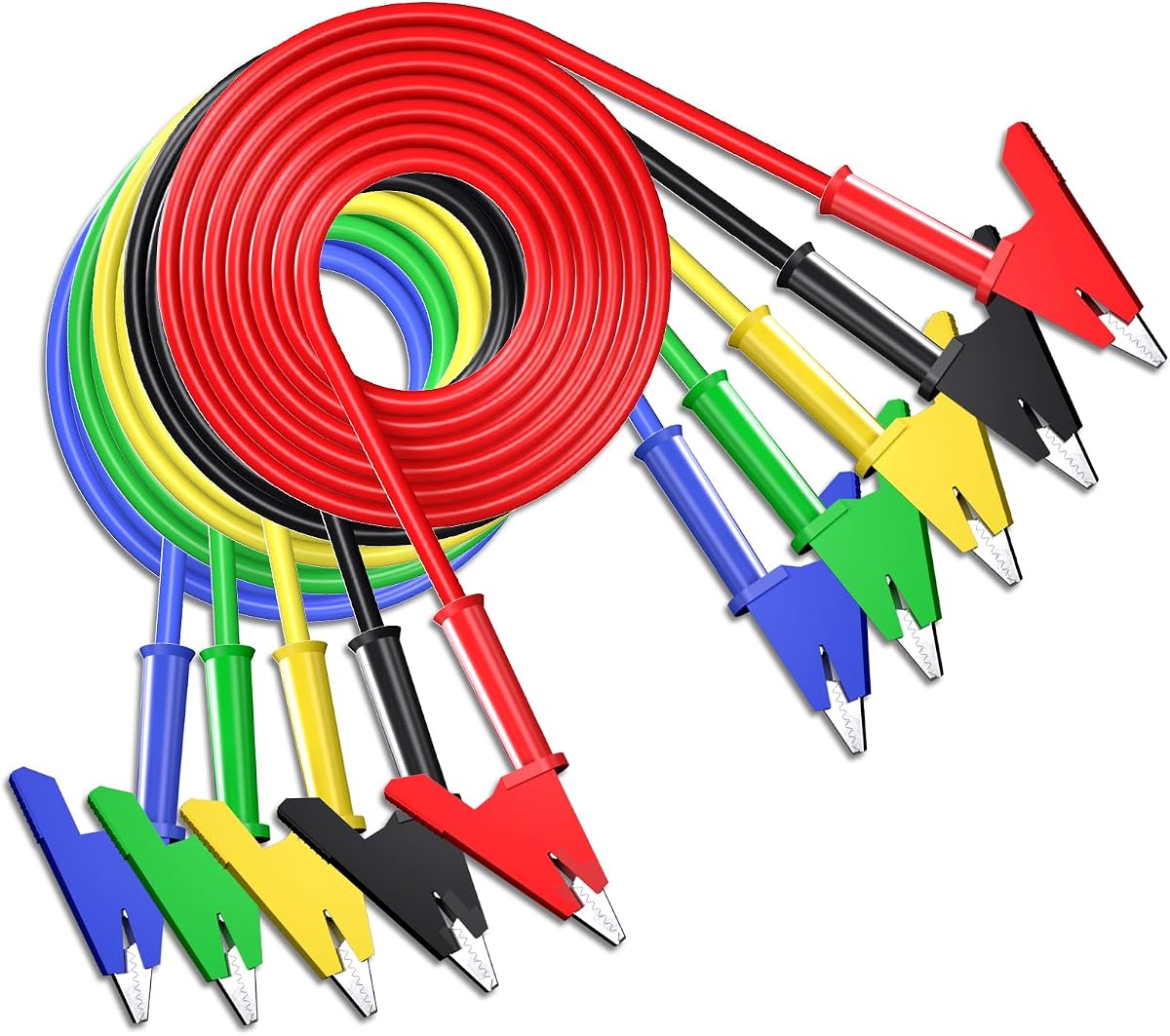
The WG-026 is a well-rounded starter set for anyone who needs a large assortment of clip leads for electronics work. Its supplied rating is 4.7, and the most immediately useful feature is its organization: ten leads are divided across red, black, yellow, green, and white, giving each pair a distinct identity on a crowded workbench.
We may earn a commission when you buy through this link, at no additional cost to you.
Each 20.5-inch lead uses flexible 22 AWG copper wire with PVC insulation. The clip itself is 1.6 inches long, and the package includes 20 nickel-plated steel alligator clips in total. The clips feature strong springs and insulating coverings, while the described soldered and stamped attachment supports dependable conductivity and a longer service life.
The primary limitation is that these are relatively light single-ended leads rather than double-ended test cables. Twenty-two AWG wire is appropriate for lightweight electronics, prototyping, breadboards, and troubleshooting, but it is not the natural choice when a test involves sustained high current or heavy automotive loads. The 20.5-inch length also offers less reach than the meter-length options in this list.
This set is best for students, electronics hobbyists, technicians who frequently need color identification, and users assembling a compact general-purpose lead collection. It combines useful quantities, clear organization, and manageable cable dimensions without taking on the bulk of thicker test leads. For most low-voltage bench tasks, it is an easy recommendation.
Two leads in each of five colors make it easier to separate channels, polarity groups, or signal paths without writing labels on every cable. This is particularly helpful during repeated troubleshooting sessions where several temporary connections may be active at once.
At 20.5 inches, the wires are short enough to keep a breadboard or prototype tidy while remaining long enough to reach common test points. Their 22 AWG copper construction is well matched to low-voltage electronics and light diagnostic tasks.
We may earn a commission when you buy through this link, at no additional cost to you.
The SWANLAKE pair stands out as a focused solution for hands-free electrical testing. Its supplied rating is 4.7, and both cables terminate in alligator clips, allowing a connection to remain in place while the operator works with a multimeter, probe, battery, or circuit board elsewhere on the bench.
We may earn a commission when you buy through this link, at no additional cost to you.
The leads measure 3.5 feet, or roughly one meter, which gives them enough reach to reach into equipment cabinets and around larger assemblies. Copper clip contacts support conductivity, while the insulated cables are described as suitable for up to 1000V and 15A. The strong jaws are intended to hold firmly on suitable test points without repeated manual assistance.
Only two cables are included, so this is not a color-coded assortment for a complex multi-channel project. It is instead a compact pair for direct testing, temporary bridging, and applications where having a clip at both ends is more useful than owning a large collection of individual leads. The stated electrical ratings should also be treated as limits rather than targets.
Choose this set when a reliable, meter-length pair of double-ended leads will be used repeatedly. It suits multimeter work, circuit boards, batteries, electrical experiments, and situations where hands-free stability matters more than having many colors or individual clip choices.
A clip at each end removes the need to hold a probe or terminal while the circuit is under test. This is useful for continuity checks, monitoring a reading over time, and making temporary connections around crowded equipment.
The stated 1000V and 15A capability makes the leads suitable for a broad range of general testing work. Always match the actual circuit conditions, test equipment, and appropriate protective measures to the manufacturer limits.
We may earn a commission when you buy through this link, at no additional cost to you.
This EDGELEC set is built around color organization and a larger wire size than the WG-026. Its supplied rating is 4.5, and the twelve-piece package includes six colors, giving users more ways to separate circuits than a standard red-and-black arrangement.
We may earn a commission when you buy through this link, at no additional cost to you.
The leads use UL 1015, 18 AWG tinned copper wire with PVC insulation. Each 1.77-inch nickel-plated steel clip has a non-slip rubber sleeve and a maximum opening of 0.67 inches. The total lead-and-clip length is 23.5 inches, and the clips are soldered and stamped to the wires for a robust connection.
Because the set uses single-ended leads, it is best suited to systems where one side is installed on a device or board and the other side receives a probe or additional wire. It does not offer the immediate bilateral convenience of a double-ended lead, but its multiple colors can make complex temporary setups much easier to interpret.
This is a compelling choice for electronics experiments, breadboard prototyping, troubleshooting, and users who value visual organization. The larger 18 AWG conductor is more robust than 22 AWG, while the six-color scheme adds flexibility that basic red-and-black sets cannot match.
Six colors let a technician distinguish separate branches or test stages at a glance. This reduces the chance of swapping leads when several temporary connections share the same workspace.
The stated maximum jaw opening of 0.67 inches can accommodate terminals that are too broad for narrower clips. Check the actual test point dimensions and surface condition before relying on the grip.
We may earn a commission when you buy through this link, at no additional cost to you.
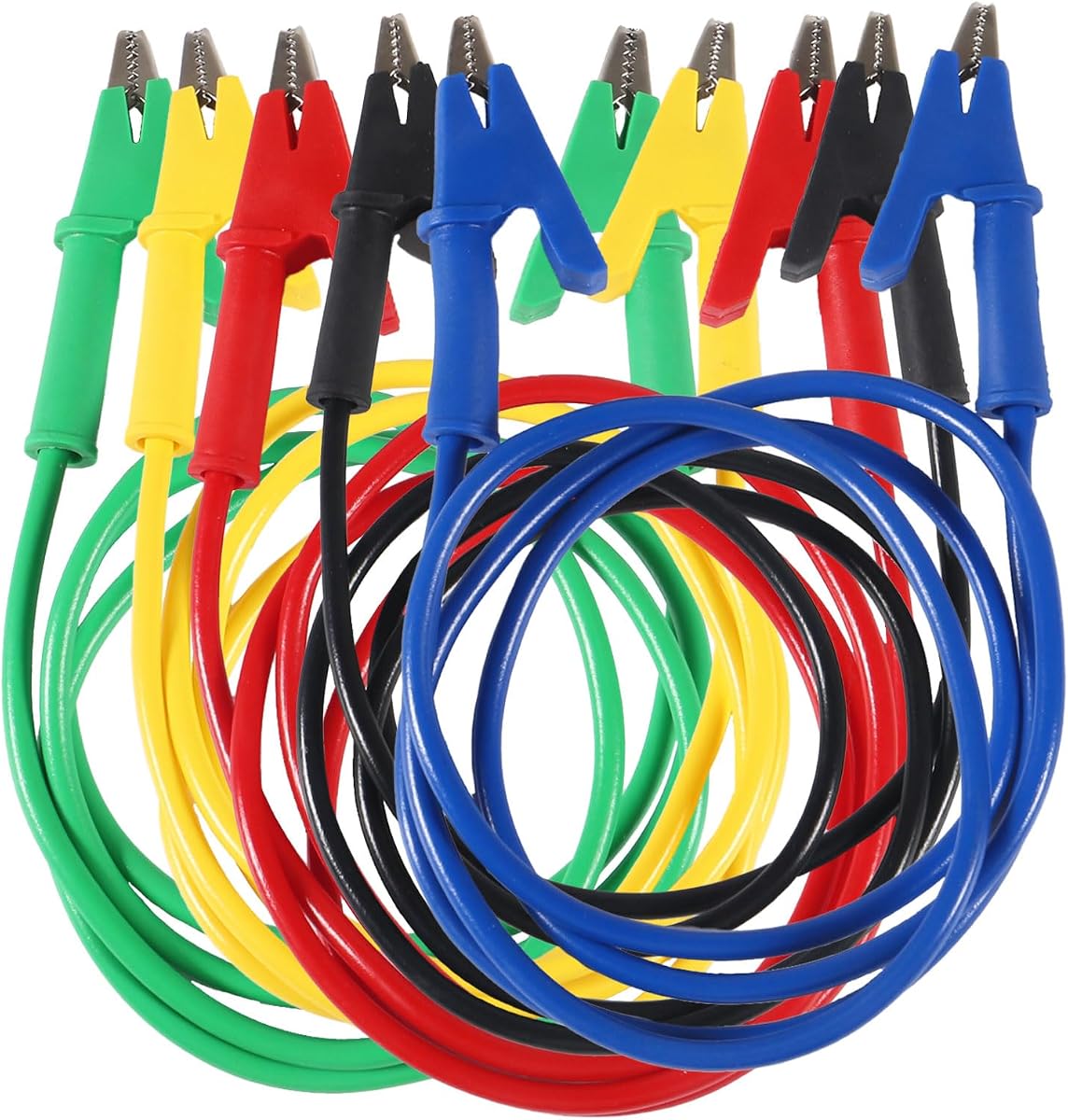
The Twenty-Piece Crocodile Kit offers the broadest assortment in this roundup, with 20 clip leads divided among five colors. Its supplied rating is 4.3, and the generous count makes it attractive for users who often need several separate connections rather than one or two reusable test cables.
We may earn a commission when you buy through this link, at no additional cost to you.
Each lead is approximately 21.7 inches long, and the clip terminal is specified at 1.38 inches, or 35 mm. The cable uses PVC material, while the metal clip is intended to provide firm contact and resist slipping from the test point. The listing also describes a detachable design for rapid changes between terminals.
The important caveat is that the supplied information does not provide a voltage or current rating. The metal terminal is exposed, and the listing explicitly warns not to use it above a rated voltage. That makes this set better suited to lower-energy electronics, prototyping, and temporary connections than to demanding power-system work.
Choose it for the quantity and five-color organization rather than for high-current capability. It is a practical option for electric experiments, prototyping, temporary circuit connections, and testing electronic appliances or digital products where multiple leads reduce the need to repeatedly reposition the same clips.
Twenty leads make it possible to build temporary connections across several points without constantly removing and reusing the same cable. Five colors add another layer of organization for larger experimental arrangements.
The clip end is metal, so it requires careful handling and appropriate isolation from conductive surfaces. Because no explicit electrical rating is supplied, use it only within conditions you can confidently evaluate.
We may earn a commission when you buy through this link, at no additional cost to you.
The EDGELEC 14 AWG Heavy-Duty Pair is the strongest choice in the guide for conductor thickness. Its supplied rating is 4.6, and the use of 14 AWG tinned copper wire gives it greater current-handling potential than the lighter 18 AWG and 22 AWG alternatives listed here.
We may earn a commission when you buy through this link, at no additional cost to you.
Silicone insulation makes these leads suitable for a broad testing range, while the nickel-plated copper clips measure 2.2 inches and open to a maximum of 10 mm. The total length is 3.86 feet, and each clip is soldered and stamped to its lead. The package includes red and black wires along with cable ties for storage.
With a stated capacity of 1500V and 15A, this pair is designed for experiments and diagnostic work, including automotive and motorcycle inspection and maintenance. The trade-off is bulk and a smaller maximum jaw opening than some lighter sets. It also includes only two leads, so it is less suitable for users who want a large, color-coded assortment.
This is the option to favor for higher-current temporary connections, thicker test points, and mobile or automotive troubleshooting where flexible heavy-gauge leads are more useful than having many small cables. Even with a robust set, appropriate circuit protection and safe working practices remain essential.
Fourteen AWG is substantially heavier than the wire used by most lighter kits in this comparison. That construction is valuable when a temporary connection must carry more current or resist damage from repeated handling.
Flexible silicone insulation is easier to route around components and less likely to stiffen noticeably during ordinary handling. The included cable ties also help keep the pair from tangling during storage.
We may earn a commission when you buy through this link, at no additional cost to you.
This four-group set fills a useful middle ground between a basic two-lead cable and a large collection of individual clips. Its supplied rating is 4.4, and every lead in the set has alligator clips at both ends, making it convenient for immediate temporary connections.
We may earn a commission when you buy through this link, at no additional cost to you.
The one-meter length provides useful distance when the test point is located away from the meter or breadboard. Nickel-plated steel clips use strong springs for conduction, and their insulated sleeves can slide to adjust the exposed clip length. Red and black coloring helps separate the two directions of a basic test arrangement.
No numerical voltage or current rating is included in the supplied specifications, so users should not infer heavy-duty capacity from the construction alone. The two-color arrangement is also less expressive than the six- or five-color sets, although the four groups still offer enough leads for parallel temporary arrangements.
Choose this package for laboratories, schools, electronics workbenches, prototyping, and routine troubleshooting where a meter-long double-ended lead is preferred. It is particularly useful for users who want more than a single pair without carrying a much larger assortment.
Having four double-ended groups provides more connection options immediately, without requiring users to match individual probes and leads. It is a practical way to maintain several temporary test points.
The insulated sleeves can slide back and forth to vary exposed metal length. This can help balance grip and insulation for a particular test point, although users should inspect the adjustment carefully.
We may earn a commission when you buy through this link, at no additional cost to you.
The Goupchn Five-Piece Test Leads combine a strong supplied rating of 4.8 with a balanced set of five double-ended cables. That makes this one of the most versatile premium options for users who need several channels without moving up to an oversized assortment.
We may earn a commission when you buy through this link, at no additional cost to you.
Each lead measures 3.3 feet and has pure copper alligator clips at both ends. The maximum clip opening is 10 mm, and the leads are rated for 1000V and 15A. The package includes five colors for easy distinction, while a firm rubber insulation layer and robust spring help the clips remain secure during use.
The supplied description notes that automotive applications should use circuits protected by a fuse of 15A or smaller. It also does not identify the wire gauge, which limits detailed comparison with the 14 AWG and 18 AWG alternatives. Even so, the stated electrical rating and copper contacts support broad general testing use.
Choose this set for circuit testing, electronic projects, automotive accessories, vintage vehicles, trucks, motorcycles, and experiments. It is particularly appealing when five color-coded, double-ended leads provide the right balance of reach, contact, organization, and stated electrical capacity.
Distinct colors make it easier to follow separate connections through a complex test. The combination of five leads and bilateral clips supports both quick diagnostics and longer-lived temporary setups.
Pure copper contacts are designed to support effective electrical transfer. A firm rubber covering and strong spring help the clip remain attached without allowing the insulated portion to slide.
We may earn a commission when you buy through this link, at no additional cost to you.
The EBOOT Four-Piece Test Set is a straightforward option for common electrical testing and circuit-connection tasks. Its supplied rating is 4.4, and the set includes four double-ended leads, giving users more immediate connections than a single cable without the complexity of a large multi-color kit.
We may earn a commission when you buy through this link, at no additional cost to you.
Each one-meter lead uses copper wire with a PVC insulated sleeve and vinyl-covered alligator clips. The clips use strong springs and are described as easy to install and secure. Red and black color coding helps organize polarity or paired connections and reduces crossed wiring.
The specification does not state a numerical voltage or current rating, so suitability should be judged from the actual task and local safety requirements. The set is also limited to two colors, which may be less convenient when several signals must be distinguished in a dense setup.
This set works well for low-voltage electrical or laboratory testing, connecting components to wires, and temporary circuit experiments. It is a practical pick for learners and technicians who primarily need basic double-ended leads with generous length and secure clip contacts.
Four leads are enough for common paired tests and several temporary circuit connections. The set provides a middle option between a two-lead pair and a workshop-sized assortment.
Red and black make it easier to preserve consistent identification for paired connections. This is helpful in basic meter testing, although additional colors would help when tracking more than two channels.
We may earn a commission when you buy through this link, at no additional cost to you.
The DROK pair is designed for users who want a heavy conductor without carrying meter-length cables across the bench. Its supplied rating is 4.6, and the set includes two 50-centimeter alligator-clip leads using reinforced 14 AWG copper wire.
We may earn a commission when you buy through this link, at no additional cost to you.
The clips receive a copper-nickel plating intended to resist corrosion, while the cable has durable PVC insulation. The listing states that the wires can withstand a maximum current of 19A, which makes the pair notably higher in stated current capacity than most competing products in this guide.
The shorter 50-centimeter length is the defining compromise. It works well for adjacent components, compact diagnostic setups, and portable kits, but it may not reach distant test points without an extension. Only two leads are included, and no numerical voltage rating appears in the supplied specifications.
This is the pick for technicians who prioritize conductor thickness and current capacity over long reach or a large assortment. It is suitable for electrical testing, laboratory experiments, automotive diagnostics, and DIY electronics when the connection points are close together.
The stated 19A maximum makes this one of the stronger choices for current-oriented testing. That rating should still be respected as an upper limit and considered alongside the circuit, load, and connection condition.
At 50 centimeters, the cables are easy to carry and quick to arrange. They work especially well when testing parts mounted near one another rather than across a large cabinet or vehicle.
We may earn a commission when you buy through this link, at no additional cost to you.
The Five-Piece Copper Jumper Set is a versatile collection for experiments, breadboarding, prototyping, and troubleshooting. Its supplied rating is 4.7, and the package includes five 3.3-foot leads with alligator clips at both ends for quick temporary connections.
We may earn a commission when you buy through this link, at no additional cost to you.
Pure copper contacts provide the primary electrical connection, while the clips open to a maximum width of 10 mm. The stated limits are 1000V and 15A. A rubber insulation layer helps each clip grip the wire firmly, and the robust spring is designed to withstand ordinary wear without deforming.
The flexible silicone-style cable is promoted as smooth, kink-free, easy to coil, and capable of retaining flexibility in cold weather. These properties are valuable for transport and repeated repositioning. As with several other sets in this guide, the wire gauge is not stated, so the product cannot be compared by conductor thickness from the available information.
Choose it when five meter-scale double-ended leads and a stated general electrical rating are more important than exact gauge details. It is appropriate for laboratories, shops, schools, homes, and industrial work involving temporary connections, provided the user's safety procedures match the test conditions.
The flexible cable is intended to resist kinking and remain easy to coil. That makes the set convenient to store in a toolbox, carry to a service call, or deploy repeatedly on a crowded workbench.
Five complete double-ended cables allow multiple temporary links to remain in place. This is useful when tracing more than one point, maintaining a reference connection, or working through several branches of a prototype.
We may earn a commission when you buy through this link, at no additional cost to you.
The most useful set depends on the circuit, conductor demand, working distance, and the number of simultaneous connections. Compare these factors before focusing on package size or appearance.
Wire gauge determines how much current a lead can carry without becoming unsuitable for the test. The roundup includes 18 AWG, 19 AWG in stated current terms, 22 AWG, and 14 AWG examples. Heavy 14 AWG leads are the logical choice for higher-current diagnostic work, while lighter 18 AWG and 22 AWG wires are generally better suited to electronics and low-current bench tasks. The stated current rating of the whole lead also matters because it may be limited by the clips, terminations, insulation, or weak points rather than the wire alone.
Length determines whether the clips can reach between a multimeter and a distant test point without excess cable getting in the way. Short 20- to 23.5-inch leads work well on a bench or breadboard, while 50-centimeter and one-meter cables are easier to route around equipment. Three-and-a-half-foot leads provide a middle ground, and the four-group and four-piece sets reach one meter. Longer access should be balanced against tangling, wider cable loops, and the extra space required for storage.
Jaw opening determines the largest terminal or component lead the clip can grasp. Several sets specify a 10 mm maximum, while the EDGELEC twelve-piece set offers a wider 0.67-inch opening and the Twenty-Piece Crocodile Kit uses a 35 mm clip body. Small jaws suit pin headers and narrow terminals, whereas broader openings can accommodate screw heads, battery posts, or larger component leads. Strong springs and non-slip sleeves also influence whether a clip stays attached without damaging the contact surface.
Single-ended leads provide a clip on one side and typically work well with probes or equipment leads. Double-ended leads are self-contained: both ends terminate in clips, allowing a temporary bridge to be made without holding anything in place. The WG-026 and twelve-piece EDGELEC set are single-ended, while most premium sets in the guide are double-ended. Double-ended cables are especially convenient for hands-free testing, but they may be less convenient when one end must plug into a multimeter socket.
A stated rating gives a clearer limit for safe planning, while an absent rating leaves more uncertainty. Several products specify 1000V and 15A, the EDGELEC heavy-duty pair states 1500V and 15A, and the DROK pair states 19A maximum current. These figures describe maximum conditions, not a recommendation to operate continuously at the limit. Actual safety depends on the weakest component, ambient conditions, circuit protection, and correct working practices. For unrated leads, restrict use to applications you can independently assess.
Insulation protects the conductor, the operator, and nearby components from accidental contact. PVC is common among the listed options, while silicone appears in the EDGELEC 14 AWG pair and the flexible leads described in the final set. Silicone is noted for remaining flexible in cold weather and is often convenient around moving or frequently repositioned test setups. Insulation does not eliminate the need to inspect for cuts, pinholes, pinching, or heat damage, particularly around automotive and workshop environments.
Color coding helps distinguish circuits, polarity groups, and signal paths. The WG-026 uses five colors, the twelve-piece EDGELEC set uses six, and the Twenty-Piece Crocodile Kit uses five. The Goupchn set includes five colors, while several meter-lead options use red and black for straightforward paired testing. More colors are useful when several connections are active, but a smaller set may be easier to manage for simple repetitive tasks. Color should reinforce clear circuit documentation rather than replace it.
Package size affects how easily a set can be stored and how many connections can remain active. Large single-ended assortments support experiments involving many separate points, while three- or five-piece double-ended sets suit temporary testing and circuit bridging. Consider not only the number of cables but also their physical bulk, included storage ties, and whether a compact toolkit or a bench assortment better matches the intended environment. The right quantity is the smallest set that comfortably supports the work.
Before testing, confirm that the circuit is in the expected condition, your equipment is suitable for the task, and the lead voltage and current ratings cover the intended use. Disconnect power when the test procedure permits, then inspect each cable and clip for cuts, exposed conductors, loose terminations, corrosion, or damaged insulation. Connect the leads to the correct test equipment and verify polarity before attaching clips to a live test point.
Attach clips to clean, dry, sufficiently large test points. Do not force a narrow terminal into a jaw that is too small, and avoid clipping onto conductors that are not intended as test points. For hands-free diagnostics, position the cable so it does not pull the clip sideways or place strain on the soldered termination. When a measurement is complete, remove the clip before changing circuit connections or restoring power.
Store the leads loosely coiled or in a bag with the cable ties included by some sets. Avoid sharp bends, crushing, vehicle heat, moisture, and contact with corrosive chemicals. Periodically clean the jaws with an appropriate tool, keep the spring mechanism free of debris, and retire any cable whose insulation, contact surface, or attachment has degraded. Always follow the safety procedures required by the equipment and circuit under test.
Some sets are explicitly described for automotive or motorcycle inspection, but suitability depends on wire size, insulation, voltage and current limits, and the vehicle's electrical demands. Use a lead set with ratings appropriate for the circuit and follow vehicle-specific testing procedures. Never assume a general electronics lead can safely carry starter-level or other sustained high current.
The 14 AWG conductor is physically heavier and generally suited to greater current demand than 22 AWG. The 22 AWG sets in this guide are more appropriate for lightweight electronics, prototyping, and low-current testing. Cable suitability also depends on the clips, terminations, and stated overall rating, so the whole lead specification should guide the decision.
They can provide temporary or hands-free connections, but they do not provide every advantage of a pointed probe. Clips are better for holding onto terminals, posts, and component leads, while probes are often easier for contacting small pads or pins. Many test leads combine one clip end with another connection method to serve both purposes.
Double-ended leads are convenient because they can bridge two accessible terminals without requiring a separate probe. They are especially useful for continuity checks, temporary power connections, and readings that need to remain in place. A single-ended lead may be better when the opposite end needs to connect to a meter socket, probe, or adapter.
The useful count depends on how many connections must remain active at once. Two or three double-ended leads cover many routine tests, while larger color-coded collections help with experiments and multi-point diagnostics. For the listed single-ended sets, count the total clips rather than only the cables because each cable may include one or two alligator ends.
Only if the complete lead is explicitly rated for the voltage and current involved and your training, equipment, and procedures support that work. A stated 1000V or 1500V limit is a maximum specification, not permission to work without appropriate safeguards. For unrated products, restrict use to low-energy applications you can confidently assess.
Color coding helps users distinguish channels, polarity groups, or separate connections at a glance. Red and black are convenient for paired or polarity-oriented work, while five- and six-color sets are better when several branches or signals are active. Labels or a circuit diagram remain important because color alone may not fully describe the test.
Loosely coil the cables and keep them away from sharp edges, excessive heat, moisture, and chemicals. Use the included cable ties when available, and avoid winding the cable tightly around itself. Inspect the insulation and clips before returning a set to storage or reusing it on another project.
The WG-026 offers the best general-purpose value for light electronics work, with ten color-coded leads and twenty clips. The SWANLAKE pair excels when hands-free, double-ended meter-length testing is the priority, while the Goupchn five-piece set provides the strongest balance of customer feedback, color organization, copper contacts, and stated 1000V and 15A capability.
For heavier current or automotive-style diagnostics, prioritize a clearly rated, thick-conductor set such as the EDGELEC 14 AWG pair or the DROK leads. For electronics and breadboarding, prioritize compact dimensions, multiple colors, and easy probe compatibility. The right choice should reflect circuit demands, test-point size, reach, and the number of simultaneous connections rather than package count alone.
Specifications and availability can change, so review the current listing before buying and confirm the wire type, length, electrical ratings, and included accessories. Never operate a lead beyond its stated limits, inspect damaged insulation, and use appropriate circuit protection and safe testing procedures.