
HP 14-inch HD Chromebook
4.4Editor score
Quad-core Intel processor
Anti-glare 14-inch display
Up to 14-hour battery life
Chromebooks for kids must balance schoolwork, browsing, video calls, creative projects, and entertainment without becoming overwhelming to use. A suitable model should feel dependable, be easy to carry, and provide a screen and keyboard that suit a child’s age, while also offering enough power for everyday learning.
We compared these ten Chromebooks using processor performance, memory, storage, display quality, connectivity, portability, battery claims, convertible designs, and child-friendly features such as webcams, privacy shutters, and touchscreens. The list includes traditional laptops, smaller touchscreen models, renewe devices, and flexible 2-in-1 designs.
Each review explains who the model suits, which features stand out, and where compromises may arise. Ratings and technical information reflect the supplied listings, while availability and prices can change, so shoppers should verify the current configuration, condition, warranty, and accessories before buying.
4.4Editor score

4.4Editor score

4.2Editor score
As an Amazon Associate we earn from qualifying purchases.
The comparison below highlights the main differences in screen size, processor, memory, storage, connectivity, and form factor, making it easier to identify the Chromebook that best matches a child’s schoolwork and daily routine.



The HP 14-inch HD Chromebook earns a 4.4 rating and stands out as a practical choice for children who need a conventional laptop without paying for a premium device. Its Intel Celeron N4120 has four cores and threads, while 4GB of LPDDR4x memory and 64GB of eMMC storage cover the core needs of web-based learning, Google Classroom assignments, documents, and communication.
We may earn a commission when you buy through this link, at no additional cost to you.
The 14-inch anti-glare display is useful in classrooms, where reflections can distract from a conventional glossy panel. Its 1366-by-768 resolution provides a large workspace for writing and browsing without making the laptop excessively bulky. The listing also notes a webcam, HDMI output, two USB-A ports, one USB-C port, and a headphone jack, giving children access to common classroom peripherals.
Chrome OS provides a straightforward environment centered on the browser, Android apps, automatic updates, and cloud-oriented tools. The claimed battery life of up to 14 hours is particularly useful for a child moving between classes, libraries, or home. The main compromises are the basic HD resolution and modest amount of memory, which may become noticeable if many demanding browser tabs remain open at once.
This is a strong recommendation for elementary and middle-school students whose routine centers on web research, writing, video calls, and Google Workspace. Families should establish sensible limits on tab use and keep larger files in cloud storage. For a child who mainly needs web-based schoolwork, the balance of portability, battery life, and practical ports makes this an appealing first Chromebook.
The four-core processor and Chrome OS environment are well matched to browser-based lessons, online quizzes, presentations, and shared documents. A full-size-looking 14-inch format also leaves useful room for side-by-side research and writing.
USB-A, USB-C, HDMI, and audio connectivity reduce the need for adapters, while the advertised 14-hour battery claim supports a full school day. Actual runtime will vary with screen brightness, Wi-Fi use, video calls, and the applications a child leaves running.
We may earn a commission when you buy through this link, at no additional cost to you.
The HP Chromebook 14 has a 4.3 rating and resembles the first model in the guide in its core platform: an Intel Celeron N4120, 4GB of memory, and 64GB of eMMC storage. That familiar configuration makes it suitable for standard school platforms, browsing, document editing, video communication, and media playback.
We may earn a commission when you buy through this link, at no additional cost to you.
Its thin, portable design and 14-inch anti-glare display suit children who regularly carry a computer between classrooms or work at shared family spaces. The listing highlights custom-tuned stereo speakers, Intel UHD Graphics 600, 4K content support, an 802.11ac Wi-Fi and Bluetooth combination, and a multi-touch touchpad with four-finger gestures.
Battery life is listed at up to 14 hours, and HP Fast Charge can reportedly take the device from zero to 50% in around 45 minutes. This helps reduce downtime between lessons. The ENERGY STAR certification and EPEAT Silver registration also make the environmental profile more transparent, although parents should still consider device longevity and repairability when making a purchase.
The HP Chromebook 14 is a sensible option for a child whose priority is portability, familiar Chrome OS functions, and long advertised battery life. It may not satisfy a student who needs a sharper display, more storage, or heavier multitasking performance. Within those limits, it remains a polished and practical everyday learner.
The thin chassis and 14-inch footprint balance screen space with manageable portability. The anti-glare surface is especially valuable for children studying under bright classroom lights or near windows.
Fast charging helps recover useful battery time between activities. A multi-touch touchpad also encourages gesture-based navigation, though children accustomed to a touchscreen may still prefer a convertible alternative.
We may earn a commission when you buy through this link, at no additional cost to you.
The Lenovo 14-inch Full HD Touchscreen combines one of the strongest display specifications in the group with an octa-core MediaTek Kompanio 520. Its 4.4 rating reflects a well-rounded proposition for students who move between reading, writing, video calls, and interactive browser-based lessons.
We may earn a commission when you buy through this link, at no additional cost to you.
The 1920-by-1080 IPS touchscreen offers noticeably more detail than the HD models in the list, while wide viewing angles make it easier for a child to share the screen during group work. A 720p webcam with a privacy shutter and a dual-array microphone support online classes and calls. The included 64GB memory card adds portable storage to the 64GB eMMC configuration.
The Kompanio 520 uses four A73 and four A53 cores at 2.0GHz, providing a substantial core count compared with the dual-core and older quad-core alternatives. Wi-Fi 6 and Bluetooth 5.1 also make this one of the better-equipped models for newer wireless networks. The accessory bundle includes a six-in-one USB-C hub, HDMI and USB cables, mouse pad, wireless mouse, and storage card.
This is the most balanced recommendation for a child who wants a larger, sharper screen and touch interaction without moving to a premium convertible. The 4GB memory is not generous for heavy multitasking, but the processor and Full HD panel compensate well for ordinary educational use. It is especially compelling for students working in Google Classroom, joining video meetings, and collaborating on visual projects.
Full HD resolution gives text, diagrams, and video calls greater clarity, while the IPS panel supports comfortable viewing from different positions. Touch input can make math, drawing, and reading activities feel more natural.
Wi-Fi 6 and Bluetooth 5.1 suit connected homes and schools, while the added memory card and hub make it easier to carry files or connect accessories. Families who do not need the bundle can still benefit from the core Chromebook configuration.
We may earn a commission when you buy through this link, at no additional cost to you.
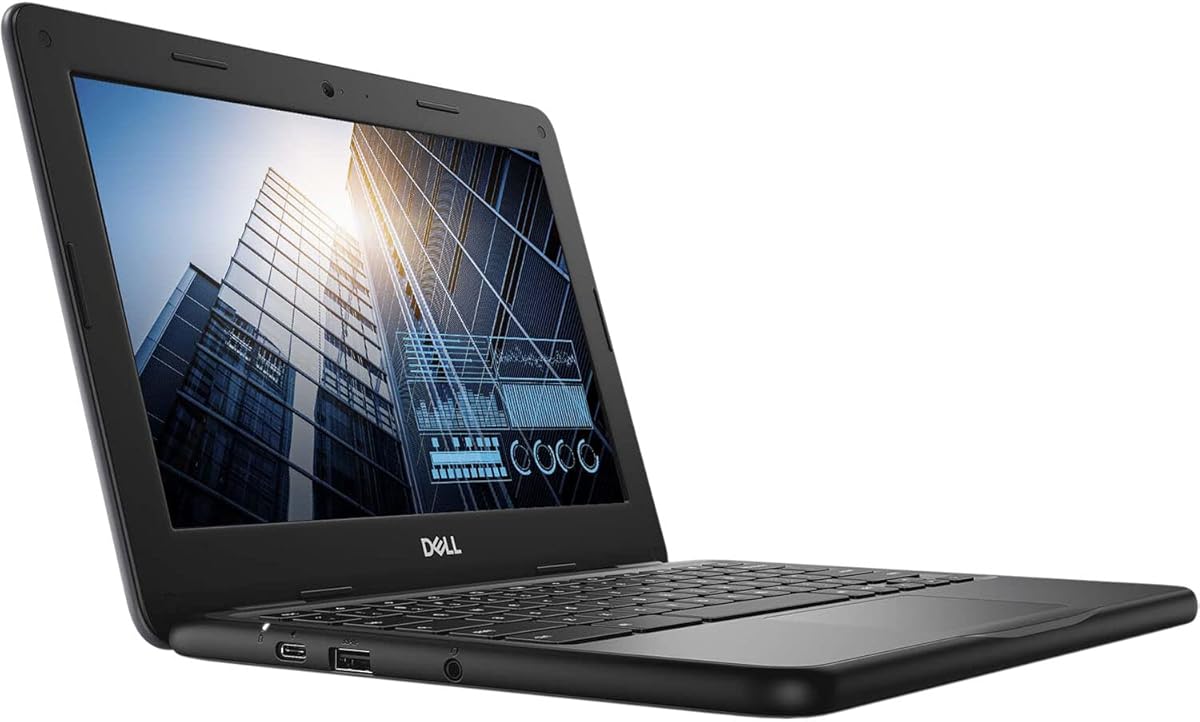
The Dell Chromebook 11 3100 is a renewed, compact 2-in-1 with an 11.6-inch HD touchscreen. Its 4.3 rating suggests a capable option for younger students or anyone seeking a smaller, flexible device for writing, web-based coursework, media, and communication.
We may earn a commission when you buy through this link, at no additional cost to you.
An Intel Celeron N4020 dual-core processor, 4GB of RAM, and 32GB of flash memory provide a straightforward Chrome OS platform. The smaller storage capacity is the most important limitation: families should rely primarily on cloud storage and keep large downloaded videos, projects, and offline applications to a minimum.
The supplied information identifies a power adapter, 65-watt rating, Bluetooth, and USB Type-C connectivity. Its 2-in-1 format gives children more ways to interact with a lesson, such as using the touchscreen for navigation or placing the device in a different position for reading and viewing.
This renewed model is best for buyers who accept cosmetic or condition-related uncertainty in exchange for a more affordable route into a compact convertible Chromebook. The limited memory and storage, along with an older processor, make it less suitable for advanced software or intensive multitasking. For web-based schoolwork, it remains a practical choice.
The 11.6-inch display is easier to carry and usually easier for a child to position comfortably. Its touchscreen can make direct manipulation of educational content more intuitive.
A renewed device may provide a lower-cost entry point, but the buyer should review its condition, included power adapter, warranty coverage, and cosmetic details. The compact screen and modest storage remain the defining constraints.
We may earn a commission when you buy through this link, at no additional cost to you.
The Lenovo Slim 3 Touchscreen has the highest listed rating in this guide at 4.5. Its octa-core MediaTek Kompanio 520, Full HD touchscreen, and Wi-Fi 6 support make it an attractive all-round model for students who want smooth everyday performance.
We may earn a commission when you buy through this link, at no additional cost to you.
The 14-inch 1920-by-1080 IPS panel provides clear visuals, useful viewing angles, and an energy-efficient LED backlight. Touch navigation makes it easier to work directly with diagrams, forms, and interactive lessons. A 720p HD webcam, privacy shutter, and dual-array microphone cover the requirements of online classes, Google Classroom, and remote learning.
The processor is described as an upgrade for everyday Chromebook activity, with four A73 and four A53 cores operating at 2.0GHz. That is a more substantial core count than several other choices. However, the system still has 4GB of memory and 64GB of eMMC storage, so active browser discipline and cloud storage remain sensible practices.
This is a strong recommendation for a child whose schoolwork includes browser-based research, video calls, Google Docs, and interactive touch tasks. The supplied accessory set includes an HDMI cable, USB extension cord, and mouse pad. It is less ideal for students who keep large media libraries or advanced applications on the device, but for typical learning it delivers an effective balance of speed and visual quality.
The octa-core Kompanio 520 is well suited to browsing, documents, classes, and media used throughout a typical school day. It provides a responsive foundation without requiring a premium Chromebook design.
The Full HD IPS touchscreen is crisp enough for reading, writing, and presenting. Wide viewing angles also help when a child turns the screen toward a teacher or study partner.
We may earn a commission when you buy through this link, at no additional cost to you.
The HP Chromebook x360 14 is designed for students and children who want a touchscreen laptop that can also become a tablet. Its 4.0 rating reflects a promising feature set, particularly the 360-degree hinge, included stylus, Full HD display, backlit keyboard, and webcam privacy shutter.
We may earn a commission when you buy through this link, at no additional cost to you.
The x360 hinge supports laptop, tablet, tent, and stand modes. Those positions can be useful for handwriting, drawing, reading, watching lessons, or presenting work. The 14-inch Full HD IPS screen adds useful detail, while the included pen gives a child a more natural way to annotate notes and complete touchscreen activities.
The supplied listing contains a notable configuration discrepancy: its title identifies an Intel N100, 4GB RAM, and 64GB SSD, while the descriptive information mentions an Intel i3 N305, 8GB RAM, and 256GB SSD. Buyers should verify the exact processor, memory, and storage shown at checkout rather than assuming every stated detail applies to the same configuration.
Wi-Fi 6E, USB-C, fast charging, long claimed battery life, and an FHD webcam privacy shutter make this a compelling family option. It is best for students who actively use touch, handwriting, or presentation modes and for parents willing to confirm the final hardware configuration before purchase.
Tent and stand modes are useful for video lessons and group work, while tablet mode supports direct touch input. The included stylus adds a practical way to write, sketch, and annotate.
Because the listing title and details present different component combinations, careful review of the current product page is essential. Confirm the processor, RAM, storage, and included accessories before purchasing.
We may earn a commission when you buy through this link, at no additional cost to you.
The Acer Chromebook Spin 311 is a renewed 11.6-inch touchscreen convertible built around an AMD A6-9220C, 4GB of RAM, and 32GB of flash storage. Its 4.0 rating makes it most relevant as an affordable option for elementary learning, light homework, and browsing.
We may earn a commission when you buy through this link, at no additional cost to you.
The AMD processor has a listed base speed of 1.80GHz and maximum turbo speed of 2.70GHz, with Radeon R5 graphics. These specifications place the device behind newer Chromebooks in raw processing capability, so families should set expectations around simultaneous apps and heavier web experiences. The 2-in-1 display adds flexibility that a traditional laptop cannot provide.
Its 1366-by-768 screen is compact and suitable for basic reading, assignments, and video calls. The 32GB storage limit is the most restrictive specification, making cloud-based file management essential. Families may also want to use a microSD card or another approved storage method where supported and configured appropriately.
The Spin 311 can be a sensible entry Chromebook for a young child or a backup machine for occasional work. Its renewed status may help reduce acquisition cost, but condition and warranty should be checked. The old processor and minimal storage limit long-term flexibility, so it is better suited to focused, browser-based tasks than demanding creative software.
The small touchscreen can be used in tent or tablet-style positions for lessons, drawings, and reading. That flexibility can make a modest device feel more engaging for younger users.
The model is best treated as a focused learning computer rather than a high-capacity workstation. Keeping documents in the cloud and limiting unnecessary background applications will help maintain a smooth experience.
We may earn a commission when you buy through this link, at no additional cost to you.
The HP Chromebook x360 Plus is the most feature-oriented premium entry in this guide. Its 4.2 rating, Intel N150 processor, LPDDR5 memory, 128GB of UFS storage, WUXGA touchscreen, and 360-degree hinge make it a strong choice for a child who wants a durable, flexible school device.
We may earn a commission when you buy through this link, at no additional cost to you.
Its 1920-by-1200 touchscreen has narrow bezels, 300-nit brightness, and an anti-glare coating. That combination provides detailed text and useful outdoor or classroom visibility while reducing reflections. The hinge allows laptop, tent, stand, and tablet modes, and the listing says the device has passed MIL-STD-810H testing for dependable performance in varied environments.
Modern connectivity includes Wi-Fi 6, Bluetooth 5.4, USB-C, USB-A, and a combination audio jack. The FHD camera includes temporal noise reduction for video calls, while Chrome OS includes cloud backup, Google Assistant support, and an automatic update expiration date of November 2026.
This is a compelling premium recommendation for students who need a sharp screen, flexible modes, modern wireless standards, and a device designed to tolerate changing environments. The 4GB memory is modest by premium standards, and 128GB remains limited for offline media, so cloud usage remains important. It is best suited to families prioritizing display quality, versatility, and durability.
The WUXGA anti-glare touchscreen offers more working detail than standard HD models. Combined with four display modes, it supports reading, writing, drawing, presenting, and ordinary keyboard-based coursework.
MIL-STD-810H testing supports the model’s positioning as a dependable option for travel, school, and home. The anti-glare display and flexible chassis are useful for children who use computers in varied spaces.
We may earn a commission when you buy through this link, at no additional cost to you.
The Acer Gateway Chromebook 314 pairs a 14-inch Full HD display with 4GB of LPDDR4X memory and 64GB of eMMC storage. Its 4.0 rating and Chrome OS foundation make it a practical option for students who prioritize a sharp, conventional laptop over a convertible design.
We may earn a commission when you buy through this link, at no additional cost to you.
The Intel Celeron N4500 is a dual-core processor capable of boosting up to 2.8GHz. It is adequate for Google Workspace, browsing, research, communication, and ordinary media use, though it is less compelling for intensive multitasking than the octa-core Lenovo options. Intel UHD Graphics support everyday visual workloads.
The 1920-by-1080 widescreen display gives text and multimedia more detail than the HD alternatives. The model also includes a 720p webcam, dual stereo speakers, Wi-Fi 5 with dual-band 2×2 MU-MIMO, Bluetooth 5.0, and a claimed battery life of up to 10.5 hours.
Chrome OS adds built-in protection, the Titan C2 security chip, automatic updates, and applications such as Gmail, Docs, Photos, YouTube, and Gemini. It is a solid pick for a child who mainly needs a large, detailed screen for reading and assignments. Families should plan around 64GB of storage and avoid expecting Wi-Fi 6 performance from Wi-Fi 5.
Full HD resolution is a meaningful advantage for long documents, web research, and school presentations. The conventional laptop format also provides a stable keyboard surface for fast typing.
The Titan C2 security chip, built-in protections, and automatic background updates create a reassuring environment for a child’s browsing. Families can supplement this with supervision tools and sensible account settings.
We may earn a commission when you buy through this link, at no additional cost to you.
The Acer 15-inch FHD IPS Chromebook is a large-screen option for children who prefer more workspace for documents, research, and creative work. Its 4.1 rating reflects a capable specification set that includes 4GB of DDR5 memory, 64GB of storage, Wi-Fi 6, and a full complement of ports.
We may earn a commission when you buy through this link, at no additional cost to you.
The Intel Celeron processor is listed at up to 2.78GHz, with Intel graphics handling everyday visual tasks. DDR5 memory is a welcome improvement over older configurations, although 4GB remains a modest allocation for a large number of concurrent applications. The 64GB storage capacity reinforces the importance of using Google Drive and other cloud services.
A 15-inch IPS panel gives children a large canvas for reading, writing, and viewing lessons. The tradeoff is portability, as the device will generally be heavier and bulkier than an 11.6-inch model. Two USB-C ports, two USB-A ports, a combination headphone and microphone jack, an HD webcam, and an included charger cover common needs.
This renewed Acer is most suitable for a child who works at a desk and values screen area over maximum mobility. Its distinctive Dale Purple finish gives a personal option, while the renewed format may make it more affordable. Buyers should inspect the condition and warranty and confirm the full processor specification before ordering.
The 15-inch IPS display is useful for lengthy documents, research, presentations, and split-screen tasks. It can reduce eye strain by presenting more information, although children may need to adjust viewing distance and posture.
Two USB-C and two USB-A ports provide good accessory flexibility, while Wi-Fi 6 helps with performance on compatible networks. The included charger is convenient for a first-time Chromebook setup.
We may earn a commission when you buy through this link, at no additional cost to you.
The best Chromebook for a child is the one that comfortably handles school platforms, has an appropriate screen and keyboard, and is simple enough to use without technical support. Processor generation, memory, storage, connectivity, and physical design should be weighed against the child’s age and workload.
A processor determines how comfortably a Chromebook handles browser tabs, video calls, documents, and interactive educational applications. The newer octa-core MediaTek Kompanio 520 models offer a strong performance foundation, while the Intel N150 and Celeron N4120 are suitable for conventional schoolwork. Older AMD A6 and dual-core Celeron configurations are better viewed as light-duty options, particularly for younger children whose workloads focus on browsing and assignments.
Choose a newer or higher-core-count processor when the student expects to multitask, use Android applications, or keep a video call active while researching. Match the processor to the workload rather than assuming every Chromebook will behave identically.
RAM matters because Chrome OS keeps webpages and applications open in the background. The 4GB memory included throughout this list is workable for carefully managed school use, but fewer simultaneous tabs and applications will help maintain responsiveness. The HP x360 listing also references 8GB, though its title states 4GB, making verification important.
For typical use, 4GB can support a child handling Google Classroom, Docs, and several research tabs. Families should close unused applications regularly and consider whether future assignments will become more demanding.
Internal storage ranges from 32GB to 128GB in this roundup, with some configurations adding a memory card. Cloud storage reduces pressure on built-in storage, but children should still understand which files are available offline and how to organize assignments, videos, and downloaded media.
Prefer at least 64GB when possible, especially for a child who downloads school videos or works outside strong Wi-Fi coverage. Check the exact storage configuration, particularly on renewed listings whose descriptions may differ from their titles.
Screen size affects both comfort and portability. An 11.6-inch model is easier to carry and may suit younger children, while a 14-inch screen provides a more mature writing area. A 15-inch display is ideal for desk use but is less convenient in a backpack. Full HD resolution offers clearer text than the 1366-by-768 screens found on several models.
A touchscreen can make reading, drawing, and lesson interaction more engaging. Choose a traditional laptop for typing-heavy assignments or a 2-in-1 when the child will actively use touch, tent mode, or a stylus.
Battery claims range from up to 10.5 hours on the Acer Gateway to as much as 14 hours on the HP models. Real runtime depends on brightness, Wi-Fi, video calls, and background applications. A child who carries a device between classes should prioritize both battery life and a manageable weight.
For home use, charging access may matter more than all-day endurance. For travel and school, select a model that comfortably fits the child’s bag and can last through several lessons without requiring an outlet.
Wi-Fi 6 and Wi-Fi 6E offer stronger foundations on compatible home and school networks, while Wi-Fi 5 remains acceptable for ordinary browsing. Bluetooth is useful for headphones, keyboards, mice, and other peripherals. USB-A, USB-C, HDMI, and microSD support determine how easily a child can connect a projector, storage device, or classroom equipment.
Look for the connectors the child will actually use rather than paying for a large bundled accessory package. A webcam with a privacy shutter and a microphone that performs well in noisy rooms can matter more during remote learning.
Children’s devices are dropped, carried, crowded into bags, and opened many times a day. Convertible hinges and reinforced designs can be advantageous, and the HP x360 Plus cites MIL-STD-810H testing. Traditional laptops may be simpler and less likely to flex when moved between positions.
For renewed products, inspect the condition, included charger, warranty, battery expectations, and return policy. A renewed device can be a sensible value choice, but the buyer should understand that cosmetic wear and component variation may apply.
Chrome OS is designed around web-based tools, Android apps, automatic security updates, and cloud integration. That makes it approachable for students, but families should still configure parental controls, content filters, account recovery, and device-management settings before handing over the computer.
Confirm that the school’s required applications and workflows run well on Chrome OS. Most classroom platforms are designed for the ecosystem, but specialized desktop software can narrow compatibility and should be checked before purchase.
Start by signing in with the child’s school or personal Google account, completing software updates, and connecting the Chromebook to the home Wi-Fi network. Review installed applications, browser permissions, and extensions, then create separate profiles or supervised accounts where appropriate. Teach the child how to save important work to the cloud, download it for offline access when needed, and avoid signing out of accounts they cannot access independently.
Establish simple routines for charging, cleaning, and storing the device. Charge it near an adult when using the long power cord, avoid leaving it on soft bedding, and keep liquids away from the keyboard and ports. Clean the screen with a soft microfiber cloth, and do not use harsh liquids directly on the display. A padded case can reduce impact damage, while a label or protective sticker may help identify the device at school.
Use Chrome OS’s built-in protections together with family controls, and discuss what information should never be entered into websites or shared with strangers. Monitor battery condition, storage, and account activity periodically without turning every learning task into surveillance. Periodically review installed apps, browser history appropriate to the child’s age, and account security, then back up or transfer documents that must be retained outside the cloud.
Yes, Chromebooks are well suited to browser-based schoolwork, Google Classroom, Google Docs, research, presentations, and video calls. Their simple design, automatic updates, and cloud integration make them approachable for students. The best model depends on the number of applications used, the required storage, and whether the child needs a touchscreen or stylus.
The 4GB models in this guide can handle standard school tasks, provided children keep unnecessary tabs and applications closed. More memory is helpful for heavier multitasking, several Android apps, video calls, and demanding web applications. Always verify the actual configuration because one listing includes conflicting memory details.
A touchscreen can make reading, drawing, math, and interactive lessons more engaging. It is particularly useful for younger children or students using a stylus. Children who primarily type long assignments may be equally comfortable with a traditional laptop, which can also be lighter and less expensive.
An 11.6-inch screen is easy to carry, while a 14-inch display offers a better balance of workspace and portability. A 15-inch screen is useful at a desk but may be cumbersome in a backpack. Full HD resolution is also worth considering because it presents text and diagrams with more detail than a standard HD panel.
Renewed Chromebooks can be suitable when the device has been properly inspected and includes a functioning charger and warranty. Check the listing for condition, battery wear, ports, screen quality, and included accessories. Keep the operating system updated and follow the same account and parental-control practices used on a new device.
Most school documents can be stored in the cloud, making 64GB a reasonable baseline. Models with 32GB are best for light users who keep downloads limited. Larger media libraries, offline videos, and installed applications require more space, and families should check how much usable storage remains after Chrome OS and other preinstalled items are accounted for.
A child can use a Chromebook safely with appropriate setup, supervision, and clear household rules. Parents should configure parental controls, review browser permissions, use supervised accounts where available, and discuss personal information and stranger interactions. The computer should be kept in a shared family space when possible, particularly for younger pupils.
A stylus is helpful for handwriting, drawing, annotation, and touch-based activities, but it is not essential for ordinary research and typing. Some models include a pen, while others require one to be purchased separately. Check the exact bundle before ordering and confirm that the pen is compatible with the display.
The HP 14-inch HD Chromebook is the best budget-oriented choice for families prioritizing a conventional design, useful ports, and strong claimed battery life. The Lenovo 14-inch Full HD Touchscreen is the editor’s choice because its sharper IPS screen, octa-core processor, Wi-Fi 6, privacy shutter, and expanded storage create the most balanced learning package.
For families willing to spend more, the HP Chromebook x360 Plus offers a premium WUXGA touchscreen, modern LPDDR5 memory, flexible 360-degree positioning, and modern wireless connectivity. When comparing any model, prioritize the screen the child will use every day, sufficient processing power, comfortable portability, and the software used by the school.
Ratings, configurations, availability, and prices can change, so check the current product listing before making a final decision. Confirm the processor, memory, storage, screen resolution, connectivity, included accessories, condition, and warranty, especially for renewed or bundle-based Chromebook listings.