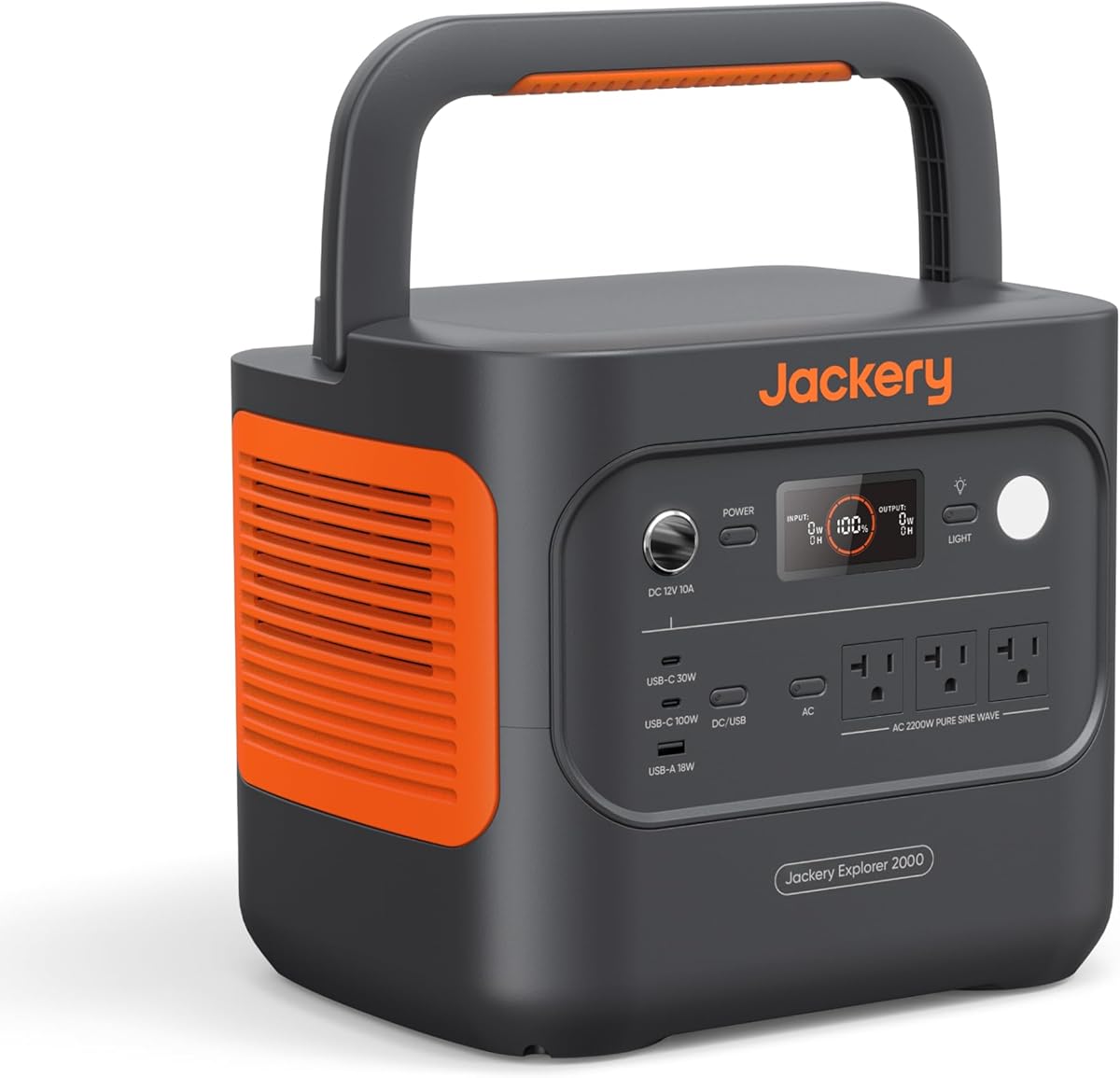
Jackery Explorer 2000 v2 Portable Power Station
4.5Editor score
2,042Wh battery capacity
2,200W continuous output
Silent mode below 30dB
20ms UPS switching
Our Tailgating Generator for TV guide compares 10 portable power stations and gas generators for powering TVs, speakers, electronics, and game-day setups
A dependable tailgating generator for TV setups should deliver clean, steady power without disrupting the atmosphere around your game-day gathering. Beyond raw output, the most useful models offer quiet operation, flexible outlets, manageable weight, and safety features suited to outdoor entertaining. The right choice depends on whether your priority is quiet electronics-only power or stronger support for larger displays and equipment.
We compared all 10 products on output, capacity, charging options, noise-related features, outlet selection, portability, safety systems, and suitability for powering televisions and connected electronics. The list includes battery-powered stations as well as gasoline and dual-fuel inverter generators, giving readers practical options for short tailgates, extended outdoor events, and flexible backup-power needs.
Each review explains the standouts, limitations, and ideal buyer for its featured product, while the comparison table makes the core specifications easier to scan. Rankings reflect how well each unit aligns with the tailgating use case rather than a single technical specification. Prices and availability can change, so verify current listings, included accessories, and operating requirements before purchasing.
4.5Editor score

4.7Editor score

4.8Editor score
This side-by-side comparison highlights the power capacity, output, fuel or charging approach, and tailgating-relevant features of all 10 products, helping you choose between a quiet battery station and a more powerful gas generator.




The Jackery HomePower 3600 Plus is a high-capacity portable power station built for situations where a tailgate setup needs more than a few small charging ports. It combines a 3,584Wh battery with 3,600W of continuous AC output, giving it enough scale to support a television, streaming boxes, speakers, receivers, and other household electronics. Its 4.6 rating also reflects a generally favorable balance of power, expandability, and portability within the home-backup category.
We may earn a commission when you buy through this link, at no additional cost to you.
The standout benefit is flexibility. It can deliver 7,200W when two compatible units are operated in parallel, and its capacity can expand as large as 21kWh per unit or 43kWh with multiple units. That scale may be unnecessary for a television alone, but it is valuable when a group adds a sizable display, projector, sound system, cooking equipment, or multiple charging stations. Dual 120V and 240V support in parallel further broadens the types of equipment it can serve.
Recharging is equally versatile, with hybrid AC and DC, wall AC, solar, and gas-generator charging listed among the four options. The luggage-style enclosure, wheels, and telescopic handle improve handling, although the capacity still makes this a substantial home-backup unit rather than a casual one-bag tailgate accessory. The stated battery cells are designed for 6,000 cycles and a 10-year lifespan, while ceramic membrane construction and high-temperature testing address heat-related safety concerns.
This is a strong choice for buyers who want one power system to cover television viewing, event electronics, and occasional household essentials. It is less attractive than a smaller station for carrying into a stadium or serving a compact tailgate, but its capacity and output make it convincing for a full parking-lot entertainment setup. Choose it when silence, flexible recharging, and room for substantial expansion matter more than minimal size.
A 3,600W continuous output rating provides ample room for a television and the many small devices that accompany it. It also creates a useful foundation if you plan to add a projector, powered speakers, or other higher-draw entertainment equipment.
Large expansion options let owners increase stored energy as their event setup changes, while AC, solar, car-based, and generator recharging provide several ways to restore power between outings.
We may earn a commission when you buy through this link, at no additional cost to you.
The Jackery HomePower 3600 Plus and 2x200W Solar Panels bundle combines a capable 3,584Wh power station with solar charging hardware. It is a particularly relevant option for tailgaters who want to recharge away from a wall outlet or who regularly use the same station for camping and travel. The included panels make the package more complete than a bare power station, though the full set naturally takes up more vehicle space.
We may earn a commission when you buy through this link, at no additional cost to you.
The power station itself provides 3,600W of continuous output, 7,200W in parallel with a second compatible unit, and 120V and 240V support when expanded. Those specifications make it more than a simple television battery. It can serve a sound system, projector, game console, cooler, and numerous personal devices without relying on noisy engine power, which helps preserve the atmosphere of a tailgate and avoids placing combustion equipment near spectators.
The main trade-off is portability. The panels, their cables, and the large wheeled station require more packing space than a compact battery and generator combination would. Solar charging is also dependent on sunlight and positioning, so the panels should be treated as a valuable recharging option rather than the only way to restore the battery. Wall, hybrid AC and DC, and gas-generator charging provide useful alternatives.
Buy this bundle if a parking-lot television setup is only one part of a broader off-grid power plan. It is especially appealing for users who value quiet operation and want solar capability from the outset. For a small tailgate centered on one compact screen and several phones, a lighter station may offer easier handling with less equipment to organize.
Two 200W solar panels let the station draw renewable energy during daylight, making the package better suited to events where vehicle charging or wall access is uncertain.
Battery operation means no exhaust fumes, engine idling, or fuel consumption while the television and entertainment equipment are running.
We may earn a commission when you buy through this link, at no additional cost to you.
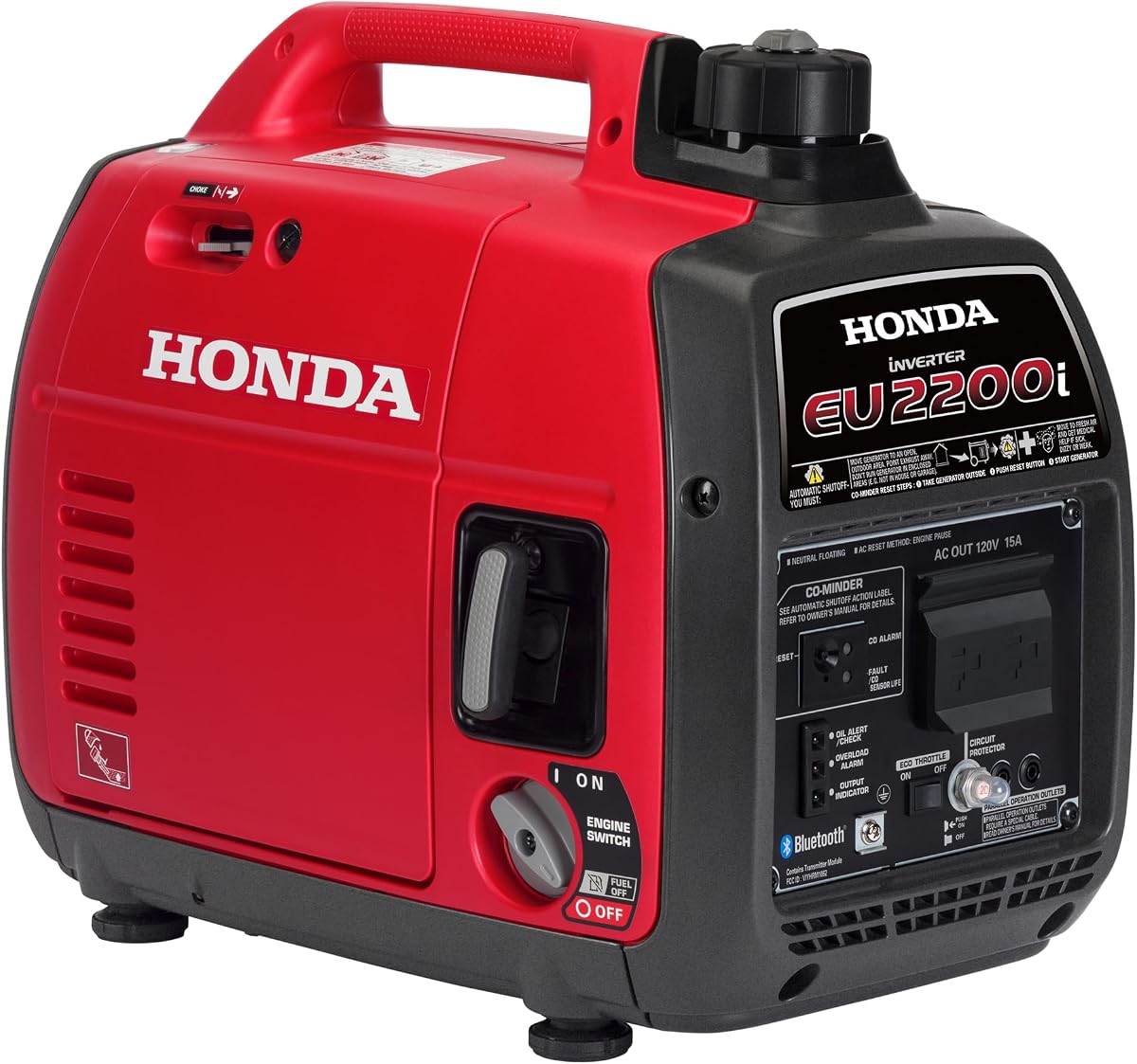
The Honda EU2200i is a compact gasoline inverter generator whose 2,200-watt output makes it well suited to televisions, streaming devices, speakers, and other sensitive electronics. It earns a 4.7 rating and stands out for refined noise control, an Eco Throttle System, and inverter technology intended to provide reliable power for computers and modern entertainment devices.
We may earn a commission when you buy through this link, at no additional cost to you.
Its operating range of 48 to 57 dB(A) is particularly important at a tailgate, where an unnecessarily loud engine can undermine the experience. The generator weighs just over 47 pounds and includes a fuel tank holding 0.95 gallon, with a listed runtime of 3.2 to 8.1 hours depending on the operating condition. Remote operation and monitoring through the My Generator app add convenience, including wireless stop and service reminders over Bluetooth.
CO-MINDER is one of its most meaningful safety advantages. It continually monitors carbon monoxide and shuts the unit down if levels become dangerously high near a home or camper. That protection does not replace correct placement, however, and the generator must still be operated outdoors according to its manual and local safety guidance. The listed three-year residential warranty also provides useful ownership coverage.
This generator is a compelling choice for buyers who want gasoline-fueled runtime without aggressive engine noise. It is less convenient than a battery station because it needs fuel, produces exhaust, and requires outdoor setup. It is also unavailable in California, where the product information directs buyers to other models. Outside that restriction, it is a refined and balanced option for television-centered tailgating.
The inverter design is a better match than conventional motor-generator output for televisions, game systems, laptops, and other devices that benefit from stable electrical delivery.
Bluetooth app support allows users to check status, receive service reminders, and use wireless stop functions without walking directly to the generator.
We may earn a commission when you buy through this link, at no additional cost to you.
The Anker SOLIX C2000 Gen 2 combines a 2,048Wh battery with 2,400W of rated output, creating a balanced portable station for a television, streaming devices, speakers, and several smaller appliances. Its 4.7 rating reflects a strong feature set, and the headline 58-minute full recharge makes it convenient for users who need to replenish power between outings rather than wait through a long charging cycle.
We may earn a commission when you buy through this link, at no additional cost to you.
Peak output reaches 4,000W, giving connected equipment access to a temporary surge allowance when startup loads require it. An expansion battery can increase the configuration to 4kWh. The station also offers AC and solar recharging, along with 800W UltraFast alternator charging that can bring it to full charge from a vehicle in three hours. That flexibility makes the unit practical for weekend travel as well as event use.
Its 41.7-pound weight and dimensions of 18.1 by 9.8 by 10.1 inches keep it more manageable than many high-capacity home-backup stations, although it remains a substantial load for one person. The listed package includes an AC charging cable, quick start guide, safety manual, and warranty card. Standby consumption of only 9W and a claimed ability to run a dual-door refrigerator for up to 32 hours demonstrate an emphasis on efficient standby and longer-duration use.
This is an excellent middle ground for tailgaters who want more capacity than a small power bank but less bulk than a 3kWh or 3.6kWh home system. It is especially helpful for users who repeatedly travel between sites and can recharge at home or from a vehicle. For very brief events, however, the full capacity may be more than necessary.
A 58-minute AC-and-solar full-charge claim reduces downtime, while vehicle charging provides another practical way to prepare for a long day away from an outlet.
The listed 41.7-pound weight and relatively compact dimensions make this easier to position near a tailgate than the largest home-backup batteries in the comparison.
We may earn a commission when you buy through this link, at no additional cost to you.
The EcoFlow DELTA 3 is a compact 1,024Wh portable power station rated at 1,800W, making it a practical option for a modest television setup with streaming equipment, speakers, and charging devices. Its 4.7 rating and fast-charging design make it especially appealing to people who want a smaller unit than the 2kWh and 3kWh alternatives in this guide.
We may earn a commission when you buy through this link, at no additional cost to you.
Charging speed is the defining advantage. The unit can reach a full charge in 56 minutes using a combination of 500W solar input and up to 1,500W AC input, while an 80% charge is listed at 30 minutes. It supports expansion with DELTA 3, DELTA Pro 3, and DELTA 2 Max battery packs, allowing owners to scale the system as their entertainment setup or travel requirements grow.
The LiFePO4 cells are rated for 4,000 cycles to 80% capacity and a 10-year lifespan, while the expansion battery carries IP65 protection against dust, splashes, and oil. A broad interface selection allows up to 13 appliances to operate simultaneously, and X-Boost supports higher-demand resistive appliances beyond the continuous 1,800W rating. The trade-off is that the base unit has less stored energy than larger stations and cannot cover every ambitious load without expansion.
The DELTA 3 is best for a focused tailgate where the television, media player, and modest audio equipment are the main loads. Its fast turnaround and expandable design make it more versatile than a basic power bank without requiring a home-backup-sized unit. Buyers planning high-wattage appliances or all-day events may prefer one of the larger stations with greater starting capacity.
The ability to reach 80% in 30 minutes makes top-ups more practical when the station is needed repeatedly or charged only during short breaks.
Compatibility with several expansion batteries lets owners increase stored energy without replacing the core unit when their setup becomes more demanding.
We may earn a commission when you buy through this link, at no additional cost to you.
The Generac GP2500i is a portable gasoline inverter generator aimed at camping, outdoor events, short-duration home backup, and tailgating. It produces 2,200 running watts and 2,500 starting watts from a 46.6-pound enclosure. Its 4.0 rating places it behind several higher-rated options, but the core electrical and safety features remain relevant to buyers seeking a straightforward gas generator.
We may earn a commission when you buy through this link, at no additional cost to you.
TruePower Technology supplies a stable sine wave with less than 3% total harmonic distortion, making the unit suitable for televisions, laptops, tablets, CPAP machines, and other sensitive electronics. Economy Mode adjusts engine speed to the load, helping extend runtime and reduce noise. At quarter load, the listed operating level is 53 dB(A), and runtime reaches up to eight hours on the 0.95-gallon tank at 25% load.
Cosense technology continuously monitors carbon monoxide concentration and shuts the unit down before dangerous levels build. That is especially useful around tents, vehicles, or partially enclosed outdoor spaces, although correct placement remains essential. Two 120V 20A household outlets and one USB-A port cover common tailgate connections, while a separately sold parallel kit can double running output to 4,400 watts with a matching unit.
The GP2500i makes sense for buyers who prefer the familiarity and extended runtime potential of gasoline over a battery-first approach. Its drawbacks are the need to carry fuel, manage exhaust, and operate the generator outdoors, as well as a noise floor that may be more noticeable than the quietest battery stations. For a television and modest electronics, the clean output and CO detection provide a compelling safety-and-performance balance.
The sub-3% total harmonic distortion specification is a meaningful advantage when the generator will power a modern television, game console, laptop, or medical device alongside conventional outlets.
Economy Mode allows the engine to slow when demand is light, improving fuel efficiency and helping keep conversations and game-day audio from being overwhelmed by unnecessary engine output.
We may earn a commission when you buy through this link, at no additional cost to you.
The Jackery HomePower 3000 solar bundle combines a 3,072Wh battery, 3,600W continuous output, and two 200W solar panels. Its UPS function switches in 20 milliseconds or less, helping maintain power to compatible electronics during outages. That feature gives it broader relevance than a tailgate battery alone because it can also support selected home essentials such as a refrigerator, fan, Wi-Fi router, lights, security cameras, and medical refrigerators.
We may earn a commission when you buy through this link, at no additional cost to you.
The included solar panels are a major convenience for extended outdoor use, while the station can fully recharge in 1.7 hours through hybrid AC and DC or 2.2 hours through AC. The package is also listed as reaching 80% charge in nine hours with the two SolarSaga 200W panels. Additional charging options include a 12V car charger and a gas generator, giving users several ways to restore capacity.
Output is well suited to a multimedia tailgate. AC, USB-C, USB-A, and DC connections support a wide range of equipment, dual 100W PD ports can handle phones, tablets, and drones, and the TT-30 RV port is useful for compatible setups. The LiFePO4 battery is rated for 4,000 cycles while retaining 70% capacity, and the UPS is UL-certified according to the product information.
The trade-off is bulk: a 3,072Wh station plus two folding panels is a sizable collection of equipment to transport. Buyers should also ensure that they have enough sunlight and a safe placement for the panels. Even so, the bundle is attractive for people who want a ready-made power platform for television viewing, camping, travel, and limited backup use rather than a small event-only accessory.
Fast switching makes the station more than a tailgate accessory, allowing it to keep supported electronics running during short grid interruptions when configured appropriately.
AC, USB, USB-C, DC, and RV connections reduce the need for separate adapters when setting up displays, speakers, game systems, and personal devices.
We may earn a commission when you buy through this link, at no additional cost to you.
The Jackery Explorer 2000 v2 provides a balanced mix of capacity, output, and portability for tailgating. Its 2,042Wh battery and 2,200W AC output are sufficient for a television, streaming equipment, speakers, and several charging devices, while its 39.5-pound weight is manageable for a portable power station in this class. The 4.5 rating indicates a well-rounded option without requiring one of the largest systems.
We may earn a commission when you buy through this link, at no additional cost to you.
Three AC outlets reduce adapter competition, and a 100W USB-C PD port can charge compatible electronics directly. AC Fast Charging takes the battery from zero to 80% in 66 minutes, while Emergency Super Charging through the app can reach a full charge in 102 minutes. Silent Charging mode offers a full charge in five hours at a listed 30dB, which is useful when the tailgate happens near sleeping quarters or a hotel.
Its LiFePO4 battery is described as lasting up to 10 years, and the enclosure uses Cell-to-Body technology associated with electric vehicles to improve structural efficiency. The product information lists the unit as 41% lighter and 34% smaller than typical 2kWh LiFePO4 stations. A 20ms UPS switching time helps maintain compatible electronics through brief power changes, adding a useful emergency-support dimension.
This is the best-value fit in the guide for a straightforward television tailgate where quiet operation, reasonable weight, and multiple AC outlets matter. It does not offer the same starting capacity as the larger Jackery models, and its solar charging option requires suitable panels. Even without them, wall and vehicle charging options make it versatile enough for repeated outings and emergency use.
A 2,042Wh battery is large enough for a complete entertainment core, while the listed 39.5-pound weight remains more approachable than many 3kWh home-backup systems.
The 30dB silent charging mode allows the battery to be replenished without the constant noise of a running engine, which is especially useful at evening events or quiet outdoor settings.
We may earn a commission when you buy through this link, at no additional cost to you.
The Dual Fuel Inverter Gas/Propane Generator 6500W is the most powerful option in this comparison, with a 5,300W rated output and maximum outputs of 6,500W on gasoline and 5,900W on propane. Its 4.8 rating is the highest among the listed products, and its ability to switch between two fuel types gives tailgaters and campers valuable operating flexibility.
We may earn a commission when you buy through this link, at no additional cost to you.
The inverter produces clean, stable 120V and 240V 60Hz sine-wave power intended to protect sensitive electronics. This makes it suitable for a television setup that also includes projectors, larger audio systems, computers, and other devices. The control panel includes a 5-20R duplex receptacle, an L5-30R outlet, an L14-30R outlet, and USB and Type-C fast-charging ports, all covered by weather-resistant covers for outdoor use.
Its obvious drawback is weight. The unit weighs approximately 93 pounds and measures 26.38 by 18.11 by 24.02 inches, so loading, unloading, and positioning require more effort than with a compact battery station. It also produces exhaust and must be operated outdoors away from people, buildings, and openings. The 12-liter tank and Eco mode are intended to help manage fuel use and noise, but the machine remains a substantial piece of equipment.
The bundle includes an LPG hose and regulator, a spark plug wrench, force rod, screwdriver, wrench, funnel, and oil bottle. It is EPA3 certified and supports parallel operation with a second compatible unit. Choose it when the tailgate includes a large entertainment system, demanding appliances, or users who want gasoline and propane options with ample household-style connections.
The ability to operate on gasoline or propane lets owners use the fuel that is most practical for their trip, storage preferences, and available refueling options.
L5-30R and L14-30R receptacles, 240V capability, and parallel ports provide a more substantial electrical platform than the smaller tailgating generators in the guide.
We may earn a commission when you buy through this link, at no additional cost to you.
The EcoFlow DELTA Pro is a 3,600Wh portable power station with 3,600W of AC output, combining home-backup scale with outdoor portability. Its 4.6 rating reflects a broad feature set that includes extensive expansion, numerous charging options, fast recharging, and app-based control. For a tailgate where the television is joined by speakers, charging stations, and other entertainment devices, that capacity offers comfortable headroom.
We may earn a commission when you buy through this link, at no additional cost to you.
The station can expand from 3.6kWh to as much as 25kWh when paired with DELTA Pro Extra Batteries or Smart Generators. Two units can be combined for 7,200W of output. Within a single unit, X-Boost can raise the available output to 4,500W for compatible loads. Fifteen output methods, including five AC outlets, multiple USB connections, 100W USB-C ports, DC outlets, a car socket, and an Anderson port, simplify a varied event setup.
Charging flexibility is another strength. The battery can fully recharge in 1.8 hours from a 240V 3kW outlet, 2.7 hours from a 1,800W wall outlet, and 2.8 hours with four 400W solar panels. EV-station, solar, wall, smart-generator, and car charging create multiple ways to prepare for a long event. Wi-Fi and Bluetooth app control allows users to monitor charge level, temperature, charging activity, input, output, and customizable settings.
The largest compromise is its size relative to a typical tailgate kit. A 3.6kWh system is better viewed as a mobile power platform than a lightweight accessory, and buyers may need a vehicle with appropriate cargo room. Even so, it offers an attractive combination of silence, substantial capacity, fast recovery, and extensive expansion. It is a strong selection for large groups, elaborate audiovisual setups, and buyers who want one unit to serve both outdoor events and home backup needs.
The ability to scale a 3.6kWh base configuration as high as 25kWh gives owners room to increase runtime as their event setup or backup requirements grow.
App-based status checks and settings management make it easier to track energy use and confirm how the station is charging or distributing power during an event.
We may earn a commission when you buy through this link, at no additional cost to you.
The best tailgating generator for TV use should match the size of your screen, connected equipment, event length, and tolerance for noise, fuel, and carrying weight. Start with continuous and starting output, then compare battery capacity, charging flexibility, safety features, and the practical limits of each power type.
Begin with continuous output rather than the largest headline number. A television and streaming box generally need far less power than a projector, powered speakers, refrigerator, cooking equipment, or gaming setup, but adding several loads can change the requirement quickly. Continuous output is the level the unit can sustain, while starting or peak output covers temporary surges from motors, compressors, and other demanding equipment. Products such as the Honda EU2200i, Generac GP2500i, and dual-fuel generator emphasize inverter output for sensitive electronics, while the Jackery and EcoFlow stations provide 1,800W to 3,600W of continuous AC power. The Anker C2000 Gen 2 also offers a higher 4,000W peak figure, but that is not equivalent to continuous capacity.
In short, choose a unit whose continuous rating comfortably covers the connected equipment you expect to use at the same time.
Battery capacity determines how long a station can run before it must be recharged. A compact unit with around 1,024Wh is reasonable for a smaller television, media player, and a limited set of charging devices. Units in the 2,048Wh to 2,042Wh range offer more comfortable margins, while 3,072Wh and 3,600Wh models are better for larger displays, projectors, audio systems, extended gatherings, or several hours of active use. The EcoFlow DELTA 3, EcoFlow DELTA Pro, and Jackery HomePower models also support expansion batteries, allowing owners to increase runtime when necessary. Capacity should be weighed against portability because larger batteries require more space and effort to move.
Match stored capacity to the event rather than buying solely for the largest advertised figure, since unused capacity adds weight without improving the experience.
Noise matters because a generator that is technically powerful can still be unpleasant beside a television or group of spectators. Battery stations have no engine noise while powering equipment, and some offer a dedicated silent charging mode. The Jackery Explorer 2000 v2 lists silent charging below 30dB, while the HomePower 3000 can charge in 1.7 hours through hybrid AC and DC without running an engine. Among gas models, the Honda EU2200i operates at 48 to 57dB(A), the Generac GP2500i is listed at 53dB(A) under quarter load, and the dual-fuel model uses Eco mode to adjust engine speed. Lower noise is especially helpful at evening games, campsites, and residential areas.
Prioritize quieter operation when conversation, commentary, or music is central to the gathering, and use load-responsive modes to avoid unnecessary engine speed.
Recharging options determine whether a portable station stays ready for repeated use. Wall charging is convenient at home, while car charging is useful when the tailgate is away from mains power. Solar can extend outdoor independence but depends on suitable weather and panel placement. Several models in this guide also accept gas-generator charging, creating a useful bridge between battery and combustion power. Fast wall recharging is valuable for someone who uses the unit every weekend, whereas fast vehicle charging helps travelers replenish between longer drives. The included panels in the Jackery solar bundles make that approach more accessible, although the panels and station together require more storage space.
Choose the charging mix you can realistically use, rather than selecting a product based on the largest input rating that may not match your available equipment.
A tailgating power source must be moved from a vehicle to the setup area and positioned where cables can reach safely. The Jackery Explorer 2000 v2 weighs 39.5 pounds, the Anker SOLIX C2000 Gen 2 weighs 41.7 pounds, and the Generac GP2500i weighs 46.6 pounds. These figures place them in a more manageable range than high-capacity systems, although wheels and handles can still make a substantial difference. The dual-fuel generator weighs approximately 93 pounds and is clearly intended for users who value power and fuel flexibility over easy handling. Solar bundles also require panel storage and adequate sunlight. Before buying, check the dimensions of the power station, panels, cables, and any fuel containers together with the available cargo space in your vehicle.
Balance output and runtime against the real effort of carrying everything from the trunk to the tailgate, especially if one person handles setup alone.
Battery and gas generators require different safety considerations. Battery stations avoid engine exhaust but still need protection from excessive heat, moisture, and physical damage. Gas generators must be operated outdoors, away from people, vehicles, tents, doors, and windows, even when carbon monoxide detection is present. The Honda includes CO-MINDER, the Generac includes Cosense technology, and the dual-fuel model is EPA3 certified. Each of those features supports safer operation but does not eliminate the need for correct placement. Look for covered outdoor outlets, stable handles, automatic shutdown features, and clear manufacturer instructions. For a tailgate crowded with vehicles and spectators, choosing a location with open air and appropriate cable routing is as important as selecting a powerful model.
Never assume an automatic shutdown sensor makes indoor operation safe, and follow the manual, local rules, and event-site requirements every time.
The output panel should match the way your entertainment system is wired. AC outlets are essential for most televisions, while USB-A and USB-C ports simplify phone, tablet, and accessory charging. DC and RV connections can make a station more useful for campers and mobile installations, while dedicated 30A and 50A receptacles support larger loads on capable generators. The EcoFlow DELTA Pro offers the broadest selection, with 15 output methods. The Jackery HomePower 3000 combines AC, USB-C, USB-A, DC, and a TT-30 RV port, whereas the Anker C2000 Gen 2 emphasizes AC and high-speed charging. Count the number and type of adapters you need before deciding that a larger outlet panel is better than a more compact design.
Choose the connection mix that eliminates adapter clutter and supports the exact equipment you already own, rather than paying for unused high-power connections.
Cycle life, battery chemistry, and enclosure design affect long-term ownership. Several products use LiFePO4 cells and advertise 4,000 cycles or more, while the Jackery HomePower 3600 Plus lists 6,000 cycles and a 10-year lifespan. Expansion batteries may also have their own environmental ratings, such as the IP65 protection listed for the EcoFlow DELTA 3 battery. Cell-to-Body construction on the Jackery Explorer 2000 v2 is designed to improve structural security and space efficiency. Buyers who expect to store the unit for long periods, operate it in varied weather, or use it for more than occasional tailgates should review these specifications carefully. Warranty terms and manufacturer support remain useful complements to technical claims.
Look for durable chemistry, credible cycle ratings, and clear warranty coverage, especially if the unit will be a regular part of your travel equipment.
Before the event, calculate the combined running wattage of the television, streaming device, speakers, receiver, and every other powered device. Add a reasonable margin, verify the selected generator or station has sufficient continuous output, and inspect cables for damage. Fully charge the battery before leaving home or bring enough approved fuel for the expected runtime. For a gas generator, check oil and fuel levels, ensure the unit is stable, and position it outdoors before starting it.
For battery systems, connect the television directly to an appropriate AC outlet and use compatible USB connections for smaller devices. Avoid using extension cords or power strips in ways that exceed their ratings, and keep ventilation paths around the unit unobstructed. For gasoline or propane models, operate the engine outdoors and away from spectators, vehicles, tents, and building openings. Route cables to prevent trip hazards, protect connections from weather, and never move a running generator.
After use, switch off and unplug the equipment, allow a gas generator to cool, and store it according to the manual. Keep battery stations in a dry, temperature-appropriate location and follow the manufacturer's guidance for long-term storage. Inspect cords, connectors, and fuel components regularly, and address damage or abnormal noises promptly. Periodic testing also helps confirm that the television, outlets, UPS behavior, and safety features are working as expected before the next gathering.
The correct size depends on the television, connected equipment, and starting loads rather than screen size alone. Add the running wattage of the television, streaming box, receiver, speakers, and chargers, then select a unit with comfortable continuous-output headroom. A compact inverter generator or a 1kWh-to-2kWh power station may cover a modest setup, while projectors, larger audio systems, and appliances justify more capacity.
A portable power station is quieter, produces no engine exhaust, and generally requires less ongoing attention, making it convenient for television viewing and sensitive electronics. A gas generator offers potentially longer runtime and can handle larger loads, but it must be operated outdoors and produces noticeable sound and fumes. The best choice depends on event length, available fuel, local rules, and how much equipment you plan to operate.
Yes, when the unit has suitable continuous output, stable electrical output, and correctly rated connections. Inverter generators and quality portable power stations are well suited to televisions, game systems, laptops, and streaming devices. Check startup requirements, keep loads within the rated output, and use outdoor-rated cords. For gas equipment, proper placement away from people and openings is essential.
A smaller entertainment setup may operate well from a station around 1,024Wh, while 2,000Wh-class units provide a useful margin for a television, speakers, streaming equipment, and device charging. Larger 3,000Wh-class systems suit extended gatherings, projectors, or multiple screens. Actual runtime depends on device consumption, display brightness, audio volume, battery age, and whether the power station is also charging other devices.
Only where event rules and local regulations allow it. Gas generators must be operated outdoors in an open area away from spectators, vehicles, tents, doors, and windows, and many venues restrict fuel-powered equipment. Battery stations avoid exhaust and are generally easier to use in occupied areas, but organizers may still impose rules about cords, power strips, fire hazards, and placement. Confirm the venue policy before arriving.
Solar panels are useful when the event is away from a wall outlet or vehicle and you want to recharge during daylight. They are less useful if you can fully charge the station at home, use vehicle charging, or need dependable recharging after sunset. Panels also add bulk and depend on sunlight, so buyers should consider whether their event timing and storage space justify them.
Rated or running output is the sustained power a unit can provide. Peak output is a temporary allowance intended for startup surges and should not be treated as a continuous capacity. Compare the combined running requirements of all connected equipment with the rated output, while also checking that startup loads do not exceed the unit's surge capability. This prevents unexpected shutdowns when several devices start together.
Battery power is quiet, clean, and simple but depends on available charging and has finite stored energy. Gasoline is widely available and supports long operation, while propane reduces some fuel-handling concerns but may be less convenient to find. High-output gas generators are useful for demanding equipment, whereas batteries are often more appropriate for televisions and electronics in quiet or crowded settings.
The Jackery HomePower 3600 Plus stands out for high output and expandable capacity, while the EcoFlow DELTA Pro offers extensive connections and smart monitoring. The Jackery Explorer 2000 v2 is the best-value pick for a focused television setup, and the Anker SOLIX C2000 Gen 2 combines compactness with rapid recharging. For buyers seeking maximum electrical capability and fuel flexibility, the dual-fuel generator provides 120V and 240V output, heavy-duty receptacles, and the highest rating in the group.
Prioritize continuous output, total connected load, event duration, and handling before focusing on a single headline specification. Quiet battery stations are often the most pleasant for television viewing, while gas inverters make sense when runtime, larger equipment, or prolonged operation outweigh noise and exhaust concerns. Capacity, expansion, outlet variety, safety systems, and the availability of reliable charging should be weighed together rather than treated as isolated features.
Current prices, promotions, bundles, and availability can change, so review the latest listing and included accessories before purchasing. Also verify warranty terms, compatibility with your television and other devices, local event restrictions, and the proper safety setup for the selected power type. With those checks completed, the right generator can keep a game-day television, audio system, and personal devices running reliably throughout the event.