
12V DC RV Air Conditioner with Voice & APP Control
4.7Editor score
10000 BTU cooling capacity
32dB indoor noise level
Bluetooth app and voice controls
Intelligent battery cutoff
Our best low wattage 12V air conditioner for RV guide compares cooling, power draw, noise, fit, controls, and off-grid runtime for every top model.
A low wattage 12V air conditioner for RV can make hot-weather travel far more comfortable without requiring a large generator or a shore-power connection. The right unit should balance cooling capacity, battery consumption, low-profile installation, quiet operation, and dependable controls while operating directly from a typical RV electrical system.
We compared all ten models using the supplied specifications and customer ratings, focusing on cooling output, electrical draw, noise levels, physical dimensions, installation requirements, battery features, heating functions, and remote or app-based controls. The list includes compact rooftop units, standard rooftop models, and installations intended for campers, vans, trucks, and trailers.
Each review explains the model's strongest attributes, practical limitations, and ideal use case, while the comparison table provides a quick side-by-side overview. Product ratings and configurations may change over time, and current pricing should always be checked on the linked retailer page before making a final purchase decision.
4.7Editor score

5.0Editor score

5.0Editor score
This side-by-side comparison highlights cooling capacity, electrical characteristics, noise, controls, and installation considerations for each 12V RV air conditioner, helping campers narrow the field before checking current availability.

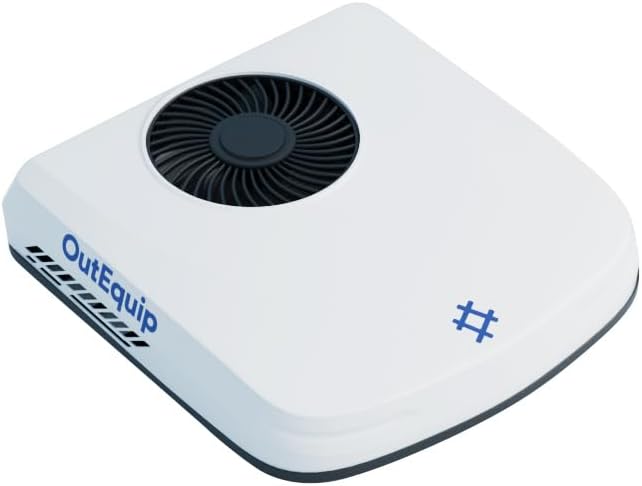


The Ultra-Slim Low-Profile 12V RV Air Conditioner with PTC Heating combines 10,000 BTU of cooling with a compact 5.5-inch body and a customer rating of 4.2. Its most immediately useful trait for RV owners is the balance between rooftop clearance, direct 12V operation, and relatively low 39dB noise in Eco Mode.
We may earn a commission when you buy through this link, at no additional cost to you.
Cooling is powered by a 12V DC system that operates without the power loss associated with converting battery energy through an inverter. The listed specification says performance remains at 80% of standard output when outdoor temperatures exceed 113°F, while the optimized airflow is intended to distribute cooling throughout an RV, van, truck, boat, or trailer cabin.
Battery-conscious campers receive especially useful power management. The manufacturer states that Eco Mode can operate for more than 12 hours with a 12V 400Ah LFP battery when connected to an appropriate solar setup. That figure depends heavily on battery condition, solar input, ambient temperature, ventilation, and how often the compressor cycles, but it makes the unit more realistic for prolonged off-grid use than a conventional high-load system.
The trade-off is that heating performance is not described with the same clarity as cooling, and the 4.2 rating is lower than those of the leading choices. Nevertheless, this model is a strong fit for travelers who value a low-profile installation, quiet operation, and efficient 12V cooling more than elaborate smart controls or a larger heating function.
Direct 12V DC operation avoids the extra conversion stage required by many conventional air conditioners. Combined with Eco Mode and compatible solar charging, that architecture can reduce generator use and make full-time or boondocking more practical.
The reinforced ABS enclosure is only 5.5 inches thick and is designed for a standard 14.1-by-14.1-inch opening. Its low wind resistance is particularly useful on camper vans and RVs with height-sensitive storage or parking concerns.
We may earn a commission when you buy through this link, at no additional cost to you.
This 12V 10000 BTU Rooftop Air Conditioner carries a 4.6 customer rating and offers one of the clearest dual-purpose specifications in this group. It pairs 10,000 BTU of cooling with 4,500 BTU of PTC heating, making it useful for mild-weather trips where some warmth is needed without relying entirely on a separate space heater.
We may earn a commission when you buy through this link, at no additional cost to you.
The cooling system is advertised as capable of reducing the temperature in approximately 15 minutes. Brushless copper motor fans, spring-supported mounts, and a directional duct are designed to limit vibration and noise, while Eco, Sleep, and Turbo modes give users useful control over the balance between output, sound, and energy use.
Its outdoor construction uses UV-stabilized ABS, an EPDM foam gasket, and a zinc-coated condenser, all of which are sensible choices for exposure to sunlight, moisture, and road vibration. The main limitation is that the PTC heater is intended only for supplementary warmth in mild conditions or smaller spaces, not as a primary heat source during extreme cold.
This is a versatile pick for RVs, trucks, vans, campers, and tractors that need both cooling and light heating. Buyers who need clearly documented electrical draw or precise roof-opening dimensions should verify those details with the seller, but the combination of cooling performance, remote operation, and 4.6 rating is compelling.
The 4,500 BTU PTC heater can take the chill out of a small or medium cabin during spring and autumn travel. It should not be evaluated as a replacement for a furnace, so users in genuinely cold conditions will still need an appropriate primary heating system.
Eco and Sleep modes are appropriate for quiet evening use, while Turbo mode provides a faster response during the hottest part of the day. The remote also includes temperature monitoring, reducing the need to reach the interior panel repeatedly.
We may earn a commission when you buy through this link, at no additional cost to you.
The 12000 BTU 12V DC RV Air Conditioner combines the highest stated cooling capacity in the group with inverter technology, three operating modes, and a 5.0 customer rating. It is the strongest general recommendation for campers who need rapid cooling and value flexible control over a direct battery-powered system.
We may earn a commission when you buy through this link, at no additional cost to you.
The manufacturer states that the unit can cool a space rapidly within three minutes and maintain a stable temperature. Average nighttime consumption is listed at approximately 360 watts in 30°C ambient conditions, representing about 60% less energy use than traditional air conditioners according to the supplied information.
Control is unusually flexible: the unit supports a Bluetooth smartphone app, an infrared remote, and physical panel buttons. Users can adjust temperature, set timers, switch between Celsius and Fahrenheit, and choose Turbo, Eco, or Sleep modes. At 54 pounds, it remains lighter than many rooftop air conditioners, though it is not the lightest option here.
The principal limitation is that this is a cooling-only model, so it will not meet the needs of travelers seeking year-round heating. Even so, its documented draw, 12,000 BTU output, broad controls, low sleep noise, and top rating make it an excellent balance of performance and electrical efficiency.
Inverter technology appears to allow the compressor output to adjust rather than simply cycle at full capacity. The stated average consumption of approximately 360 watts during nighttime operation gives campers a more realistic basis for comparing battery and solar requirements.
Bluetooth app access is convenient for adjusting settings from inside the cabin, while the remote and physical panel remain useful when the phone is unavailable or charging. Programmable timers can also reduce unnecessary compressor runtime.
We may earn a commission when you buy through this link, at no additional cost to you.
This 11000 BTU 12V rooftop unit is designed for exceptionally broad use, ranging from camper vans and travel trailers to semi-trucks, food trucks, excavators, agricultural vehicles, engineering vehicles, and buses. The supplied listing does not include a numerical customer rating, so its appeal must be assessed primarily through its detailed specifications.
We may earn a commission when you buy through this link, at no additional cost to you.
Its professional-grade electric scroll compressor provides 11,000 BTU of cooling and is described as reducing cabin temperature in three to five minutes. Variable-frequency control is intended to moderate energy use, while the listed operating power spans 200 to 750 watts depending on operating demand.
One important consideration is current draw. At a rated 32 to 58 amps on a 12V system, this appliance places a meaningful load on wiring, connectors, fusing, and battery capacity. Short-circuit, leakage, overvoltage, and low-voltage protections add useful safeguards, but campers still need to use appropriately rated components.
The model is also exceptionally thin, with the outdoor unit listed at 5.5 inches and a minimum opening of 13.8 by 9.8 inches. Its broad compatibility, LED display, remote control, and stated overnight Eco runtime make it practical for builders who need a cooling-only system for a nonstandard vehicle.
The smallest listed opening differs from the common square rooftop cutout, offering flexibility for vans and specialty vehicles. Buyers should compare the minimum opening, interior panel dimensions, and roof structure before assuming installation compatibility.
A high-current 12V appliance should be connected using appropriately sized cables, protection, and grounding appropriate to the installation. Low-voltage protection is helpful, but it does not replace careful electrical planning.
We may earn a commission when you buy through this link, at no additional cost to you.
The 12V DC RV Air Conditioner with Voice & APP Control is a premium-oriented model with a 4.7 customer rating, a dual-rotor compressor, and one of the quietest operating profiles in the collection. Its 10,000 BTU cooling capacity is paired with Bluetooth app access and hands-free voice commands.
We may earn a commission when you buy through this link, at no additional cost to you.
The unit's strongest differentiator is low noise. The supplied specification lists indoor sound as low as 32dB and outdoor noise at 40dB, making it a strong candidate for light sleepers. A dual-rotor compressor is said to bring the cabin to 75°F to 79°F within three minutes and maintain output at ambient temperatures as high as 122°F.
Intelligent low-voltage cutoff protects the connected battery from excessive discharge, while the manufacturer states that a 315Ah lithium battery can support more than 11 hours of overnight operation. A six-inch housing fits an industry-standard 14-by-14-inch roof cutout, and reinforced anti-vibration construction is intended to improve stability over rough roads.
Heating is not advertised, and app or voice functionality requires a compatible phone or assistant setup. Even so, this is the most sophisticated option in the group, offering excellent sound control, smart operation, and thoughtful battery protection for owners who want their RV climate system to integrate into a connected lifestyle.
The 32dB indoor figure is among the lowest published in this roundup. It is particularly relevant for campers who sleep in the cab, use the air conditioner through the night, or simply prefer less mechanical noise during travel.
Bluetooth and voice operation make temperature adjustment more convenient, while the low-voltage cutoff helps prevent deep discharge. Users should still confirm battery compatibility and establish a safe discharge threshold for their own power system.
We may earn a commission when you buy through this link, at no additional cost to you.
This 12V RV Air Conditioner combines 11,000 BTU of cooling, 4,500 BTU of PTC heating, a low 43-pound weight, and a 3.9 customer rating. It targets RV owners who prioritize easy handling, compact installation, and flexible air distribution over app-based smart features.
We may earn a commission when you buy through this link, at no additional cost to you.
An integrated soft start is designed to reduce startup surge by 70%, which can benefit battery life, wiring, and compressor longevity. Eco Mode is stated to provide 12 hours of cooling with a 400Ah battery, although actual duration will vary with ambient conditions and battery capacity.
The operating noise level is listed at 35dB, while a stable scroll compressor and 360-degree adjustable vents promote gentler airflow. The digital LED panel includes a reading light, and the remote provides Cool, Eco, Sleep, and Fan modes with six fan speeds.
At 6.1 inches tall and 43 pounds, the unit is easier to lift and position than many competing rooftop models. It fits a standard 14-by-14-inch opening and is listed for roof thicknesses from 1.5 to 3.9 inches. The lower rating and vague power figure are worth considering, but the installation-focused design remains attractive.
Soft-start technology is valuable in an RV because the compressor can create a noticeable surge when it begins operating. Reducing that surge can make the installation gentler on battery and power components.
The 43-pound weight and universal mounting hardware make this one of the more approachable rooftop units to install. It is also compatible with both ducted and non-ducted arrangements, depending on the vehicle's interior layout.
We may earn a commission when you buy through this link, at no additional cost to you.
The 12V RV Air Conditioner with PTC Heating and Remote Control has a 5.0 customer rating and a straightforward direct-power design. It runs from a 12V vehicle battery while parked or driving, avoiding the need to idle an engine simply to operate the climate appliance.
We may earn a commission when you buy through this link, at no additional cost to you.
Cooling comes from a scroll compressor, while PTC resistance heating supplies warmth through a separate electric function. The remote and clear display allow users to adjust temperature, fan speed, and operating modes without repeatedly accessing the indoor controls.
Its seven-blade fan and large condenser are designed to move heat away efficiently and maintain steadier cooling during long drives. Adjustable outlets let the user redirect airflow within the cabin, and the ABS and aluminum alloy construction is intended to resist deformation and age.
The biggest drawback is incomplete published performance information. No BTU rating, exact power consumption, roof-cutout dimensions, or battery-runtime estimate is provided. It is best viewed as an appealing simple option for users who already know their roof opening and have a modest cooling requirement, rather than a model for precise capacity calculations.
Direct 12V operation allows the system to function from the vehicle's electrical system in either circumstance. This makes it potentially useful for a cab, work compartment, or compact living area where generator use would be inconvenient.
The remote provides direct access to temperature and fan speed, and the adjustable outlets let users reduce direct blowing. That combination is practical for sensitive sleepers and passengers seated in different parts of the cabin.
We may earn a commission when you buy through this link, at no additional cost to you.
This 9000 BTU 12V RV AC Unit offers a 5.0 customer rating, cooling and PTC heating, remote operation, and a broadly practical feature set. It is positioned as a cost-conscious all-rounder for RVs, campers, trucks, cranes, and commercial vehicles.
We may earn a commission when you buy through this link, at no additional cost to you.
Cooling is rated at 9000 BTU, and the scroll compressor is paired with 1500W PTC heating. The supplied listing states that the system can maintain a temperature range from 60.8°F to 78.8°F, although no test conditions beyond that statement are provided.
An integrated smart chip is designed to regulate voltage and protect against fluctuations. Noise is listed at 50dB, which is acceptable for many users but not as discreet as the 32dB to 40dB models elsewhere in the guide. Rotatable outlets and remote or panel controls provide practical adjustment.
This unit is a strong budget-oriented choice when a 9000 BTU capacity, integrated heating, and five-star rating matter more than maximum output or app connectivity. The absence of a published battery-runtime estimate and a relatively high listed cooling power should be considered during electrical planning.
The 1500W PTC heater adds a modest heating function for cool mornings and mild days. Like the other PTC-equipped products here, it is best understood as supplemental comfort rather than a substitute for a high-output cold-weather heater.
Voltage regulation can help the unit respond more consistently when the battery voltage changes. The protection system is a useful feature, but proper cable sizing and installation remain the camper's responsibility.
We may earn a commission when you buy through this link, at no additional cost to you.
The second 9000 BTU 12V RV AC Unit in this guide shares the same core specifications as the preceding model and also has a 5.0 customer rating. It combines a scroll compressor, 1500W PTC heating, remote operation, adjustable outlets, and a clear onboard panel.
We may earn a commission when you buy through this link, at no additional cost to you.
Its listed 9000 BTU cooling capacity makes it suitable for smaller cabins where maximum output is less important than manageable power requirements. The construction combines high-grade ABS with aluminum alloy to resist deformation and aging during travel.
The 50dB noise level and voltage-regulation chip are useful additions, while the included accessories and English manual are intended to simplify installation. However, the listing does not provide a quantified off-grid runtime or a detailed roof-opening specification.
This model remains a solid choice for a camper van, truck, crane, or compact RV that needs both cooling and light heating. Because its headline specifications mirror another listing in the guide, buyers should compare enclosure dimensions, current availability, warranty information, and included installation components before deciding between them.
A 9000 BTU capacity is suited to many small and medium RV spaces, and the combination of cooling and heating extends usability beyond midsummer. Users should still match the system to cabin size and solar or battery capacity.
The remote is convenient for changing settings while traveling, and the onboard panel provides a backup when the remote is unavailable. Rotatable outlets help distribute air across the occupied area.
We may earn a commission when you buy through this link, at no additional cost to you.
The Treeligo 12V Rooftop DC Air Conditioner offers 10,000 BTU of cooling, heat-and-cool operation, below-50dB operation, and a 4.0 customer rating. Its clearest distinguishing feature is the stated FCC and UL certification, which can be reassuring for buyers concerned about safety and electromagnetic compatibility.
We may earn a commission when you buy through this link, at no additional cost to you.
The unit is advertised as lowering the RV temperature in approximately eight minutes. Frequency-adjusting technology is used to manage noise and energy use, while the listed operating level below 50dB is suitable for normal conversation and many sleeping environments.
Its outdoor unit measures 28.35 by 25.98 by 7.09 inches, and the required minimum roof opening is 12.59 by 9.45 inches. Those dimensions may suit some nonstandard roofs, but buyers need to verify both the opening and the larger 23.62-by-19.69-inch indoor panel.
The main limitation is that exact electrical draw and off-grid runtime are not published in the supplied information. Nevertheless, the certified construction, clear capacity, rapid cooling claim, and compact design make this a credible option for campers who prioritize recognized safety standards and straightforward heat-and-cool capability.
FCC certification addresses electromagnetic interference concerns, while UL certification relates to product safety evaluation. These claims are meaningful differentiators, but buyers should still inspect the actual unit, installation, and wiring.
The stated minimum opening is smaller than the common square rooftop cutout, potentially simplifying installation in selected vehicles. The indoor panel remains sizeable, so adequate interior mounting space must also be confirmed.
We may earn a commission when you buy through this link, at no additional cost to you.
Selecting a 12V RV air conditioner requires balancing cabin cooling needs against electrical limits, installation geometry, noise, battery strategy, and the value of heating and smart controls. The following factors help narrow the most relevant specifications for your RV.
Choose enough capacity for the cabin and conditions, but do not overlook electrical and installation demands. Match the model to your RV's size and typical travel environment.
Compare measured or rated power, startup behavior, and battery safeguards. Use proper 12V wiring and size solar and storage for sustained operation.
Use published runtime as a planning reference, not a guarantee. Preserve a battery reserve and verify real consumption under expected conditions.
Measure the opening, roof thickness, and internal panel area before ordering. Also account for nearby roof equipment and the unit's full external footprint.
For sleeping comfort, prioritize models with a verified indoor or sleep-mode figure. Lower noise is especially valuable when the compressor runs for hours.
Treat PTC heating as an extra comfort layer for mild weather. Cold-weather travelers still need a properly sized primary heater.
Choose controls that remain practical for your routine. App convenience is useful, but retain access to a panel or remote for reliable operation.
Look for weather-resistant materials, documented safety protections, and complete mounting hardware. Professional installation is sensible when wiring or roof work is outside your experience.
Before installation, disconnect the vehicle battery or shut down the relevant power circuit, measure the roof opening, verify roof thickness, and inspect every included component. Install the sealing material, mounting hardware, support components, and power cable according to the manufacturer's instructions, taking care not to pinch wiring or obstruct drainage. Confirm that the indoor panel and airflow outlets are securely mounted and that the unit has the stated clearance from nearby roof equipment.
Once installed, test the controls before a trip. Check cooling, heating if included, every fan speed, sleep or eco settings, timers, remote signals, and app connectivity. Let the system run long enough to verify stable electrical current and monitor the battery for unexpected voltage drops. Begin with a moderate setpoint rather than the maximum cooling setting, and allow the compressor to cycle naturally instead of repeatedly switching modes during initial use.
During routine care, keep the outdoor condenser clear of leaves, dust, bird nests, and roof debris, and check that water can drain away from the unit. Inspect seals, wiring, mounting points, and vibration isolation periodically, especially after severe weather or long rough-road travel. Clean the indoor filter or accessible vents according to the manual, avoid directing water into electrical controls, and have a qualified technician investigate unusual noise, leakage, voltage alarms, or declining cooling performance.
Yes, provided the battery bank, wiring, fusing, and connectors are sized for the unit's operating current. Many of these models connect directly to a 12V DC system without an inverter. Even a lower-wattage rooftop air conditioner can draw substantial current, so compare the model's rated amperage with your battery's continuous output and inverter or converter capacity.
Runtime depends on measured power draw, battery capacity, temperature, insulation, and compressor cycling. Listed examples range from approximately eight to 12 hours under specified conditions, but those are not universal guarantees. Preserve a reserve for essential systems and add solar or a generator when uninterrupted all-day cooling is required.
A well-designed 12V system can reduce generator runtime and eliminate conversion losses associated with powering a conventional compressor through an inverter. The total energy required to remove heat still depends on cabin size, outdoor temperature, and insulation. Direct battery operation is most efficient when the battery bank and solar array are appropriately sized.
Usually not as a sole heat source. PTC heating is best for mild temperatures, cool mornings, and supplemental cabin warmth. Travelers expecting sustained heating in severe cold should use a properly sized furnace or another heating system designed for those conditions.
Not always, because most products target a common rooftop cutout, but the dimensions are not completely standardized. Measure both the roof opening and its depth, then compare them with the outdoor housing, indoor panel, and stated roof-thickness range. Some models fit unusual rectangular openings that may be useful for nonstandard installations.
The Voice and App 12V DC RV Air Conditioner lists an indoor noise level as low as 32dB, making it the quietest published figure in the roundup. The 35dB mini unit and 39dB eco-mode model are also strong options for sleep-sensitive travelers, although real noise depends on mode, installation quality, and ambient conditions.
Experienced RV owners may be able to complete some installations, but the work involves roof penetration, sealing, mounting, high-current wiring, and sometimes cutting an opening. Follow the included instructions, verify electrical protection, and avoid working on live electrical systems. Professional installation is advisable if the roof structure, wiring, or system integration is unfamiliar.
A 9000 BTU unit may be adequate for many compact, well-insulated camper vans, but cabin volume and heat gain remain decisive. Larger or poorly insulated spaces benefit from 10,000 to 12,000 BTU models. Measure the interior, account for solar gain, and confirm that the electrical system can support the selected unit's rated draw.
The 12000 BTU 12V DC RV Air Conditioner stands out as the strongest all-around recommendation because it combines the highest stated cooling output with inverter efficiency, approximately 360W average nighttime consumption, three control methods, and a 5.0 customer rating. The Voice and App 12V DC RV Air Conditioner is the premium choice for smart controls and exceptionally low indoor noise, while the 9000 BTU 12V RV AC Unit offers an approachable combination of cooling, heating, remote operation, and a 5.0 rating.
Your priority should determine which features matter most. Choose a higher-capacity inverter model for demanding heat, a quiet low-profile unit for sleeping or height-sensitive vehicles, and a cooling-only design when summer performance is the sole objective. Verify the roof opening, roof thickness, current draw, battery capacity, and complete installation hardware before ordering, because no headline specification can compensate for an installation mismatch.
Ratings, product configurations, availability, and pricing can change, so review the current listing and manufacturer information before purchasing. Compare the linked models against your RV's size, electrical architecture, and typical travel conditions, then select the unit that offers the most useful balance rather than simply choosing the highest rated figure.