
Televes 8-Bay BOSS Mix
4.3Editor score
Rotating dual-panel configuration
Integrated intelligent preamplifier
Dedicated High VHF elements
Our Deep Fringe TV Antenna guide compares ten outdoor and indoor antennas, highlighting range, signal control, filtering, mounting, and ease of setup for users.
A deep fringe TV antenna is built to pull weak over-the-air broadcasts from distant towers, difficult terrain, or locations where walls and foliage weaken signals. The right model combines sufficient gain, selective filtering, controllable amplification, and a mounting approach that gives you a clear view of transmitters.
We compared all ten antennas by examining their advertised reception distance, supported broadcast bands, amplification design, interference filtering, directional capabilities, installation requirements, and intended mounting location. The guide covers premium outdoor models, compact indoor options, amplified designs, and budget-friendly alternatives for different reception needs.
Each review explains the antenna's strongest features, practical limitations, and ideal installation scenario. Our top picks represent the best balance of gain, control, versatility, and convenience, while the full comparison helps narrow the field. Product listings, availability, and current pricing can change after publication.
4.3Editor score

4.6Editor score
4.1Editor score
This side-by-side comparison highlights each antenna's reception approach, amplification, filtering, installation, and physical format so readers can find the most appropriate option for their location and viewing setup.


The Stellar Labs HDTV 80 Mile Deep Fringe Bowtie Television Antenna is a purpose-built option for viewers trying to receive broadcasts beyond the easier reach of a standard indoor antenna. Its 4.2 rating reflects a generally favorable reception-focused design, while the bowtie format and advertised 80-mile capability distinguish it from flat indoor panels.
We may earn a commission when you buy through this link, at no additional cost to you.
Its primary strength is the combination of directional focus and a compact outdoor-oriented structure. A bowtie antenna concentrates its reception pattern toward broadcast transmitters, which can be useful where the desired stations occupy a similar direction. It is a sensible candidate for attic, rooftop, or mast installation where the antenna can be positioned away from household electronics and obstructions.
The main trade-off is the limited amount of published technical information compared with the premium Televes models. The supplied data does not identify automatic gain control, detailed filtering, exact element composition, or a passive operating mode. Those omissions do not make it unsuitable, but they may make it harder for technically inclined buyers to compare fine-grained performance.
This antenna is best for a shopper who wants a straightforward, deep-fringe bowtie with a long advertised range and a relatively conventional outdoor installation. It is less compelling for buyers who require adjustable amplification, explicit LTE or FM filtering, or a supplied multi-output power system.
The bowtie configuration is designed to emphasize signals arriving from the direction of the antenna's face. Placing it on a rooftop, mast, or suitable attic position can therefore be more useful than simply putting it near a television.
Its advertised 80-mile range and outdoor suitability position it as a middle ground between compact indoor devices and more elaborate premium antennas. Exact channel availability still depends on tower distance, terrain, and obstructions.
We may earn a commission when you buy through this link, at no additional cost to you.
The GE Outdoor HD Digital TV Antenna, Long Range Smart TV Antenna combines a 70-plus-mile advertised range with broad compatibility and a 4.4 rating. It is designed for local HDTV, future-ready 4K and 8K performance where supported, and standard coax connections used by televisions and converter boxes.
We may earn a commission when you buy through this link, at no additional cost to you.
A major advantage is its installation flexibility. The weather-resistant housing is suitable for attic, roof, or mast placement, allowing users to move the antenna away from interior obstructions. Its support for ATSC 3.0 over-the-air broadcasts where available also makes it relevant for viewers building a system for current and emerging broadcast standards.
Unlike the Televes models, the supplied specifications do not describe band-specific gain control, passive fallback, or integrated cellular filtering. The focus instead falls on straightforward outdoor operation, universal coax compatibility, and support. That simplicity may appeal to buyers who want a familiar antenna without managing several operating modes.
The GE antenna is a good fit for suburban or moderately difficult reception areas where a rooftop or attic antenna can obtain a clearer path to local transmitters. It is also attractive for households with converter boxes or multiple TV brands, since it works with standard coax connections.
Attic and outdoor mounting provide more placement choices than a conventional indoor panel. The ability to move the unit higher or farther from household structures can matter as much as its nominal range.
ATSC 3.0 support provides forward-looking compatibility where the service is available, while the stated HDTV and high-resolution broadcast support helps the antenna serve modern smart televisions and conventional tuner boxes.
We may earn a commission when you buy through this link, at no additional cost to you.
The Televes DAT BOSS Mix LR 149884 is one of the most technically sophisticated antennas in this guide. Its 4.6 rating, 100-mile advertised range, and built-in TForce amplifier target rural, fringe, and challenging long-distance reception rather than simple indoor reception.
We may earn a commission when you buy through this link, at no additional cost to you.
Its most distinctive feature is the TForce intelligent gain system, which adjusts amplification independently for High VHF and UHF. That matters because the two bands can arrive at very different strengths. Automatic control helps preserve stable output, while the directional triple-boom construction provides substantial gain and reduces reception from unwanted directions.
Integrated FM and LTE, 4G, and 5G filtering can be valuable in developed areas where cellular transmitters and FM radio create interference. The antenna also offers a dual operation mode: it works as an amplified antenna when powered and continues passing signals passively if power is unavailable. The included power inserter, mast clamps, wrench, and weather boot support a professional-style installation.
This is our Editor's Choice for readers who want advanced signal management in a genuinely difficult reception environment. It suits technically confident users willing to aim the antenna and provide proper outdoor mounting. The gain and filtering sophistication may be unnecessary for homes with strong nearby broadcasts.
Independent High VHF and UHF adjustment is particularly valuable when one band arrives strongly and another remains weak. The system is designed to respond to changing signal conditions without forcing the operator to manage a single manual gain setting.
The stacked triple-boom design focuses reception toward the intended tower direction. Its stated front-to-back ratios can reduce multipath interference and unwanted signals arriving from behind the antenna.
We may earn a commission when you buy through this link, at no additional cost to you.
The Televes Ellipse Mix 148883 pairs a 4.6 rating with a directional triple-boom design and a more compact physical footprint than many outdoor Yagi-style antennas. Its advertised 75-mile range and built-in TForce preamp make it a premium option for suburban, rural, and fringe locations.
We may earn a commission when you buy through this link, at no additional cost to you.
Automatic gain control operates separately across High VHF and UHF, helping the antenna adapt to different band strengths. Integrated FM and cellular filtering improves signal cleanliness, while curved reflectors concentrate the directional pattern. The dual operating mode also allows passive signal passage if the supplied power source is unavailable.
The installation kit includes a 12V dual-output power inserter and mast clamp. Its stated tool-free assembly in under 60 seconds simplifies setup, although assembly speed should not be confused with the complete alignment process. The antenna must still be mounted securely and aimed toward the correct transmitters.
The Ellipse Mix is a strong choice for viewers who want premium Televes electronics without choosing the largest or longest-range design in the category. Its compact dimensions, flexible placement options, and automatic gain features make it especially suitable for suburban properties where roof, wall, balcony, or attic mounting is possible.
At 38.8 by 34 by 27 inches, the antenna offers a comparatively compact directional format. That can help owners find a suitable mounting point without accommodating the footprint of a much larger array.
The included mast clamp and stated tool-free setup reduce the initial assembly burden. Compatibility with common mast diameters and support for rooftop, balcony, wall, or attic placement make it adaptable to different homes.
We may earn a commission when you buy through this link, at no additional cost to you.
The Televes 108381 8-Bay BOSS Mix stands apart through its rotating dual-panel design. Its 4.3 rating reflects a distinctive premium approach, while two independently adjustable panels give installers more flexibility when broadcast towers lie in different directions.
We may earn a commission when you buy through this link, at no additional cost to you.
Each panel contains four stacked dipoles and flat reflectors. Users can align both panels toward the same transmitter for maximum concentration or direct one panel toward a separate broadcast direction. This multi-directional capability is useful where stations occupy separate markets or are obstructed by terrain.
Built-in TForce preamplification controls High VHF and UHF gain separately, and integrated LTE, 4G, and 5G filtering helps reject common sources of interference. The antenna also operates passively when power is unavailable. Its power inserter and mounting hardware are included, but a mast is not.
This is the Best Premium pick for a shopper whose signals arrive from more than one direction. It is less suitable for someone wanting a minimal installation or a single compact panel. Proper alignment, adequate mast support, and weather-safe placement remain essential to realize its potential.
The adjustable panels can focus on one cluster of stations or be divided between different directions. That flexibility is especially useful in markets where the strongest transmitters are not grouped in one compass bearing.
The TForce system adjusts gain by band, helping maintain a stable result when channel groups arrive at different strengths. Dedicated High VHF elements broaden support beyond UHF-only installations.
We may earn a commission when you buy through this link, at no additional cost to you.
The Ophirs 7500+ Mile Digital Antenna is a flexible kit designed for indoor use, exterior mounting, and travel-oriented installations. It includes an amplifier, booster, USB power adapter, 52-foot coaxial cable, mounting accessories, and instructions, making it unusually complete for a non-directional panel system.
We may earn a commission when you buy through this link, at no additional cost to you.
Its amplifier offers short-range and long-range settings, while the built-in smart IC and filtering are intended to improve signal stability and reduce cellular and FM interference. The panel can be placed horizontally or vertically on a wall, window, cabinet, exterior railing, or other suitable surface. Its moisture-resistant cover supports indoor and outdoor placement.
The extraordinary advertised range should be interpreted carefully. Tower distance, terrain, obstructions, and broadcast power determine real reception, and no antenna specification can guarantee that every listed local channel will be available. Its 3.7 rating is the lowest among these products, making careful expectation-setting especially important.
This antenna is most appropriate for a renter, RV owner, or apartment resident who cannot mount a large outdoor array. It may also serve as an adjustable indoor solution when towers are moderately distant. Buyers seeking premium directional control for severe fringe conditions may prefer a more specialized model.
The short- and long-range switch allows users to begin with the less aggressive setting and increase amplification only when needed. This is a more adaptable approach than relying on maximum boost immediately.
The long cable, mounting hardware, reversible orientation, and weather-resistant cover make the antenna convenient for temporary or permanent placement. The USB adapter also simplifies powered setups where conventional outlets are inconvenient.
We may earn a commission when you buy through this link, at no additional cost to you.
The Five Star 200-Mile Yagi is a complete outdoor package built around an extended directional element design. Its 4.3 rating and advertised 200-mile reach make it appealing for distant broadcast locations, while the included 40-foot coax cable and 20-inch mounting pole simplify procurement.
We may earn a commission when you buy through this link, at no additional cost to you.
The Yagi structure is intended to concentrate signals from a particular direction. It supports VHF and UHF television reception as well as compatible radio and FM use, and the listing identifies support for 4K, 1080p, 1080i, and 720p broadcasts. Weather-oriented construction and lightning protection are additional outdoor considerations.
The largest trade-off is that the product requires some assembly, although several parts arrive preassembled. The advertised distance is also highly conditional: the listing explicitly notes that tower distance and obstructions affect reception. As with all directional antennas, the direction of the towers matters.
The Five Star is a good option for buyers who want a complete Yagi package with mounting essentials included. It is particularly useful where a roof, attic, chimney, eave, or mast location offers a direct view toward transmitters and where maximum directional concentration is preferred over compact indoor convenience.
A Yagi array concentrates reception toward its front, helping separate desired broadcasts from signals arriving elsewhere. The extended element arrangement is designed to improve stability and gain compared with a basic indoor panel.
The package includes both coax and a short mounting pole, reducing the need for extra essentials. Buyers can still select a taller pole or more specialized mounting hardware when roof height and local conditions require it.
We may earn a commission when you buy through this link, at no additional cost to you.
The Antennas Direct ClearStream 4V is a compact outdoor antenna with a 4.4 rating and a design centered on four patented loops. It uses dedicated High VHF and UHF elements, giving it broader broadcast-band coverage than many UHF-focused alternatives.
We may earn a commission when you buy through this link, at no additional cost to you.
Its reflectors increase forward gain and focus the antenna's reception toward the intended direction. A stated 43-degree horizontal pattern provides broad capture across multiple transmitters without requiring the extreme narrowness of some Yagi arrays. The product can be installed indoors, in an attic, or outdoors in suburban and rural settings.
The complete package includes reflectors, a High VHF kit, a 20-inch mast with pivoting base, mounting hardware, an adjustable mast clamp, and instructions. It also includes a manufacturer lifetime warranty. These details make it appealing for buyers who want a coordinated outdoor package rather than assembling a collection of separate components.
The ClearStream 4V is a strong middle-ground choice for viewers with several stations in a broad area. It lacks a stated integrated preamplifier and may not match the raw control of premium automatic-gain systems, but its multi-element design, dedicated VHF support, and complete hardware package are meaningful advantages.
Separate UHF and High VHF elements help the antenna collect both lower-band and upper-band broadcasts. This is important in markets where valuable stations are spread across both portions of the spectrum.
The included mast, pivot, clamps, reflectors, and mounting hardware simplify installation. The stated lifetime warranty also adds long-term reassurance for an outdoor product exposed to weather and seasonal movement.
We may earn a commission when you buy through this link, at no additional cost to you.
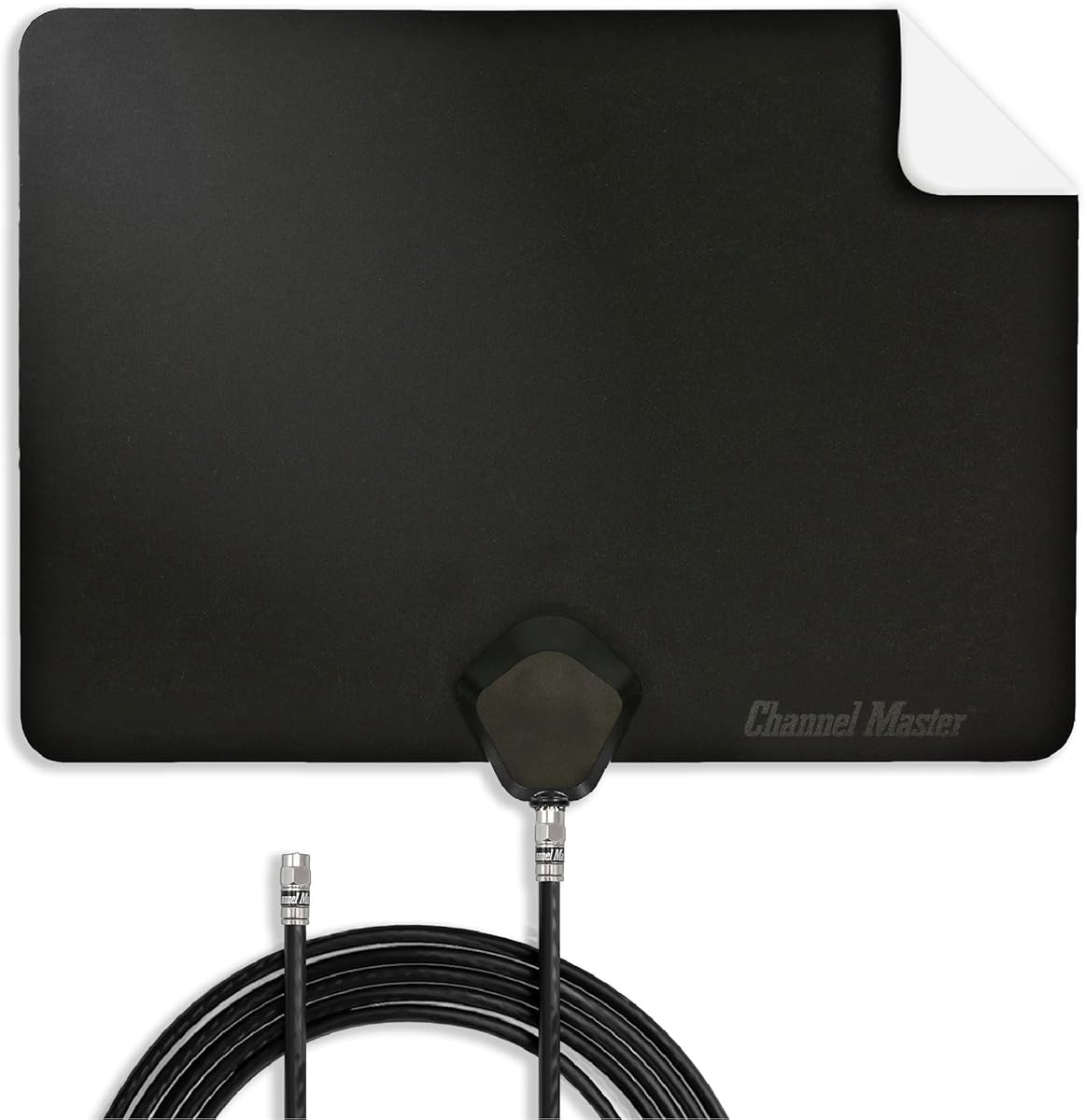
The Channel Master FLATenna is the Best Budget pick for viewers who need a straightforward indoor antenna rather than a complex outdoor installation. Its 4.1 rating, reversible flat panel, and 12-foot RG6 cable make it simple to position around a room.
We may earn a commission when you buy through this link, at no additional cost to you.
The antenna is designed to capture HD and digital broadcasts with an advertised 35-mile range. It supports local networks such as ABC, CBS, FOX, NBC, PBS, Univision, and Telemundo when those stations are available in the user's area. Support for ATSC 3.0 NextGen TV and 4K broadcasts is also stated.
Its principal limitation is the absence of an amplified gain system, which distinguishes it from most deep-fringe alternatives. A modest 35-mile claim also places it well below the outdoor models in this comparison. It is better suited to urban and suburban homes with reasonably accessible towers than to remote locations with severe obstructions.
The FLATenna is an appealing choice for renters, apartment residents, and anyone wanting a low-friction second television. Its wall, window, or tabletop placement and cable length make repositioning easy, while its modern broadcast compatibility prevents it from being limited to older tuner standards.
The lightweight, reversible panel can be moved between a window, wall, and tabletop as needed. This flexibility is useful because even a modest change in orientation can materially affect indoor broadcast reception.
ATSC 3.0 and 4K support make the antenna compatible with current broadcast expectations. Its shielded RG6 cable helps maintain signal integrity over the twelve-foot run to the television.
We may earn a commission when you buy through this link, at no additional cost to you.
The PBD Amplified Outdoor TV Antenna offers a practical combination of motorized positioning, amplification, and two-output flexibility. Its 4.3 rating and advertised 150-mile range target homes where the antenna can be mounted outside and aimed at distant broadcast clusters.
We may earn a commission when you buy through this link, at no additional cost to you.
The wireless remote allows users to rotate the antenna through 360 degrees without physically climbing to the roof. A built-in high-gain, low-noise amplifier supports weak signal reception, while the weather-resistant construction is designed for year-round outdoor use. This is particularly useful when a home has several possible transmission directions.
The dual TV outputs allow two screens to receive the antenna feed without requiring an additional splitter, although the listed package does not specify the necessary output cable for every connection. The included 40-foot RG6 cable, mounting hardware, and guide make the installation package fairly complete.
This antenna suits homeowners who want remote aiming after initial setup but do not need the sophisticated band-by-band gain management of premium Televes models. Motorized movement is especially valuable during setup because signal strength can be checked while remaining safely away from the antenna.
Rotating the antenna by remote control makes it easier to compare directions and identify stronger tower clusters. Once optimized, the motorized feature can be helpful as reception conditions change over time.
The dual television output can serve two compatible screens, reducing the need for an extra distribution device. Buyers should still confirm the required hookup cables and any limitations associated with simultaneous use.
We may earn a commission when you buy through this link, at no additional cost to you.
Choosing a deep fringe TV antenna means balancing signal strength, directional control, available space, and installation effort. The following factors are more meaningful than a headline range number alone.
Begin by identifying the broadcast towers serving your address and the direction of those towers. Distance is only one factor, but it establishes whether a compact indoor panel has a realistic chance or whether an outdoor directional antenna is more appropriate. Terrain, hills, trees, buildings, and metal roofing can block or distort signals even when towers are relatively close.
Check local channel availability and tower locations before choosing. Do not rely on a manufacturer's maximum distance as a guarantee; it is a best-case figure that cannot account for every obstruction.
A useful antenna must receive both High VHF and UHF channels because stations are distributed across both bands. Some models emphasize UHF, while others include dedicated High VHF elements. Choosing full-band coverage gives you more opportunities to receive local affiliates, public television stations, and other broadcasts in your area.
Prioritize an antenna explicitly designed for High VHF and UHF reception, especially if your local channel lineup includes stations carried on lower channels.
Amplification strengthens the signal traveling through the coax, which can help with weak or long cable runs. However, excessive amplification cannot create a signal and may overload a receiver when a nearby tower is strong. Automatic or band-specific gain control is valuable because it can adjust amplification as conditions change.
Choose automatic control when available, especially for an outdoor system. If using a manual amplifier, begin with modest gain and increase it only after checking signal quality.
Directional antennas concentrate reception toward one area and can pull weak distant stations from noise. Multi-directional or broad-pattern designs are better when stations are scattered across several directions. Very narrow directional units can perform exceptionally well for a tower cluster but require more accurate alignment than a wider pattern.
Consider where your towers sit relative to the building. If most stations share one direction, a directional antenna is efficient; if they are spread widely, a broader or multi-panel system may be more practical.
Strong LTE, 4G, and 5G cellular transmissions can disrupt weaker television signals, especially in urban and suburban areas. FM filtering can also reduce unwanted radio energy entering the antenna system. Integrated filtering is more predictable than hoping the television's internal tuner will reject all interference.
Models with explicit FM and cellular filtering offer an advantage in densely developed areas. It is particularly important for long-range outdoor installations that sit near cellular towers.
Outdoor placement usually provides better access to broadcast signals than an indoor location, but it requires secure mounting and weather-resistant construction. Rooftop, attic, balcony, wall, and mast installations each present different access and alignment challenges. Indoor antennas are easier to install but more exposed to walls, furniture, wiring, and neighboring structures.
Match the product to the space you can safely use. Verify the included mast, clamps, cable length, and hardware before installation, and avoid unsupported placements that could create safety or weather problems.
An antenna may require coax, a power inserter, mast clamps, a power adapter, mounting hardware, or a separate amplifier. Some packages include nearly everything, while others provide only the antenna and basic fittings. Checking the box contents prevents an otherwise successful antenna from becoming an incomplete installation.
Confirm the supported television connections, required cable lengths, included power supply, and whether an ATSC 3.0 tuner is needed for NextGen TV reception.
An antenna receives unencrypted over-the-air broadcast stations; it does not provide subscription cable channels. Even a highly capable antenna may not receive every affiliate in a market, especially when transmitters share a direction or low-power stations sit behind obstructions. The best measure of performance is the number of watchable stations and their stability, not the range printed on the box.
Plan to rescan after moving the antenna. A small change in position or direction can produce a meaningful difference in the final channel list.
Start by connecting the antenna through the required coax cable and power inserter. If the model includes a power adapter, place the inserter close to the television so the amplifier is not degraded by a long powered cable run. Follow the product guide for the correct sequence, and do not connect the antenna to an incompatible output.
Place the antenna as high and as unobstructed as practical. Start with a position that faces the general direction of the local towers, then scan for channels. Adjust the position in small increments and rescan after each meaningful change. For motorized or rotating models, use the remote during setup to identify the strongest and most stable direction before securing the final position.
For outdoor equipment, inspect mounting points and cable connections periodically, especially after severe weather. Keep the antenna away from trees that may grow into the signal path. Clean accessible surfaces with a damp cloth, avoid abrasive cleaners, and check that the coax has not been pinched, sharply bent, or exposed to damage. Rescan whenever channels change or the antenna is repositioned.
The advertised range is a best-case estimate, not a guarantee. Tower power, terrain, tree cover, buildings, antenna direction, and interference all influence the result. A directional outdoor antenna near a clear line of sight may perform well at substantial distances, while a weaker indoor panel may receive fewer stations even in the same market.
No. Amplification helps preserve weak signals and can compensate for long cable runs, but it cannot recover a broadcast that never reaches the antenna. Over-amplification can also overload a tuner, particularly when a strong station is nearby. Automatic gain control and careful adjustment are generally more useful than simply selecting the highest possible boost.
Outdoor mounting is usually preferable because it reduces interference from walls, appliances, wiring, and indoor furniture. It also makes directional alignment easier. An indoor antenna can work when towers are close, the signal is strong, or the home has a favorable upper-floor location, but challenging fringe conditions generally call for an outdoor or attic-mounted unit.
No. These antennas receive unencrypted over-the-air television broadcasts available from local transmitters. They do not provide subscription streaming services, premium cable networks, or channels carried exclusively by a cable or satellite provider. The channels you can watch depend on your market and the antenna's reception performance.
A model supporting both High VHF and UHF gives you broader access to local stations. Low-numbered channels often use High VHF, while many higher-numbered stations use UHF, though assignments vary by market. If your area has stations on both bands, full VHF/UHF coverage is the safer choice.
Use a local broadcast coverage map to identify the towers serving your address and note their compass directions. Point the antenna's receiving face toward those transmitters, then scan channels and make small adjustments. If signals come from different directions, consider a broad-pattern or independently adjustable multi-panel antenna rather than forcing one direction.
Yes. Channel scans reassess which broadcasts are available and their current reception quality. Moving the antenna can change both the number of stations found and their stability, so a fresh scan is important after any substantial change in position, direction, mounting, or connection.
Start with the towers serving your address rather than the largest headline range. A shorter-range antenna positioned with a clear line of sight can outperform a higher-range model aimed in the wrong direction. Frequency coverage, gain control, filtering, pattern width, and mounting quality are more meaningful than maximum distance alone.
The Televes DAT BOSS Mix LR is the strongest all-around choice for severe reception conditions because it combines long advertised range, independent band gain, directional triple-boom construction, integrated filtering, and passive fallback operation. The Televes 8-Bay BOSS Mix is the premium alternative for viewers whose stations arrive from multiple directions, while the Channel Master FLATenna is the budget-friendly indoor option for close or moderately distant towers.
Prioritize the layout of your local transmitters, the unobstructed direction to those towers, and the antenna's actual frequency coverage. Weak VHF and UHF signals benefit from a full-band directional design, but careful placement matters just as much as amplification. Filtering, automatic gain, and a complete installation kit can make a demanding setup much easier to manage.
Before purchasing, verify the listed specifications, included mounting hardware, connection requirements, and current product listing. Product details, availability, and pricing can change, so check the current information and use a local coverage map to confirm that the selected antenna suits your address.