
2 Pack Faraday Bags
4.4Editor score
Double-layer shielding fabric
Phone and key-fob storage
Waterproof fireproof construction
EMF protection for vehicles can take several forms, including whole-car neutralizers, electrical surge protectors, signal-blocking pouches, shielding fabric, and adhesive device stickers. The right choice depends on whether the priority is blocking radio signals, protecting electronics from power surges, or reducing electromagnetic-field exposure inside the cabin.
We compared the ten products using their stated construction, installation method, shielding approach, device compatibility, portability, and intended use. This list includes dedicated car electronics protectors along with multipurpose privacy products that can be used during driving, travel, parking, and everyday device storage.
Each review explains what the product is designed to do, where it fits best, and where its limitations matter. Ratings reflect the available customer feedback, while technical performance claims come from the supplied product information. Prices and availability can change, so check the current listing before buying.
4.4Editor score
5.0Editor score

4.1Editor score
As an Amazon Associate we earn from qualifying purchases.
The table below compares all ten products by protection approach, installation needs, primary vehicle use, and portability. It includes dedicated EMP and surge devices as well as pouches, fabric, neutralizers, and stickers designed for more specific electromagnetic and wireless-privacy concerns.


The Whole Car EMF Neutralizer is a dedicated vehicle-focused product designed to interact with a car's electronic and electrical systems. It has a 4.1 customer rating and distinguishes itself from signal pouches by taking a broad, vehicle-wide approach. The manufacturer says it addresses electromagnetic fields associated with automotive electronics, cellular service, WiFi, Bluetooth, and 5G.
We may earn a commission when you buy through this link, at no additional cost to you.
Its central mechanism involves emitting a subtle energy field that interacts with the vehicle's wiring. According to the supplied information, the product is intended to retune chaotic coherent waveforms into natural incoherent waveforms and to alter the bio-electrical patterns associated with man-made fields. That approach makes it more relevant to a driver seeking continuous cabin-wide coverage than to someone who only wants to isolate a phone while parked.
The principal trade-off is installation. This is not a pouch, sticker, or simple USB accessory; it is presented as a permanent whole-car system intended to interact with the electrical installation. Its performance claims also depend on accepting the manufacturer's stated technology, so buyers should understand exactly what is being offered and what independent evidence they require before purchase.
This is a strong candidate for owners who want a dedicated automotive solution rather than a general-purpose shield. It is best suited to drivers concerned with the combined electromagnetic environment generated by modern vehicle electronics and connected devices. For straightforward key-fob privacy or lightning surge protection, one of the more specialized alternatives may be easier to evaluate and use.
The principal advantage is scope. Rather than requiring a phone, wallet, or key fob to be placed in a shielding container, the neutralizer is designed to operate throughout the car. That convenience makes it relevant to occupants carrying several connected devices during a long drive.
Unlike adhesive products intended for a particular device housing, this unit uses an approach tied directly to vehicle wiring and electronics. That vehicle-specific positioning is its defining feature and its main reason to choose it over a general travel pouch.
We may earn a commission when you buy through this link, at no additional cost to you.
The Simket two-pack combines signal-blocking storage for phones and car keys with travel-oriented physical protection. It carries a 4.4 rating and uses upgraded double-layer reinforced metal-fiber shielding fabric. The stated shielding effectiveness is more than 80dB across WiFi, Bluetooth, RFID, GPS, NFC, cellular, and car-key-fob signals.
We may earn a commission when you buy through this link, at no additional cost to you.
Its practical strength is versatility. Each pouch measures 8.2 by 4.7 inches and can hold most smartphones, key fobs, GPS devices, walkie-talkies, and smaller electronics. The product information also describes the outer construction as fireproof, waterproof, and shockproof, making it useful for commutes, road trips, outdoor activities, and periods when a phone must remain out of ordinary radio communication.
A Faraday pouch is a containment product rather than a whole-vehicle installation. It protects only the items enclosed and requires the opening to be fully closed for the shielding layer to work as intended. It also does not equal an electrical surge protector: its value lies in radio-frequency isolation, privacy, and reducing key-fob relay exposure rather than protecting vehicle computers from lightning or power spikes.
This is an attractive choice for drivers who want two portable pouches for separating a phone and key fob. It is particularly useful for parked-car security, travel, and low-distraction driving. Buyers should confirm that their devices fit comfortably and use the included self-test method to confirm signal isolation.
Keeping a keyless-entry fob inside a closed shielding pouch can reduce the opportunity for relay-style signal amplification. The benefit is most relevant when the key is stored in or near the vehicle and is not being actively used for remote access.
The two-pack allows a phone and key fob to be stored separately, preventing both from sitting beside the same electronics. That arrangement is useful for travel, work, or periods when the vehicle will remain unattended for an extended time.
We may earn a commission when you buy through this link, at no additional cost to you.
The 43-by-118-inch Faraday Fabric Kit is intended for buyers who want to build their own shielding solutions rather than purchase a fixed pouch. It has a 4.2 rating and is made from copper-nickel material listed as 62% polyester, 25% copper, and 13% nickel. The manufacturer states that the cloth provides 70–80dB shielding and blocks RFID, EMF, and RF signals.
We may earn a commission when you buy through this link, at no additional cost to you.
The large format gives substantial material for creating key-fob pouches, electronic-device sleeves, wallet liners, privacy screens, or vehicle-specific compartments. Shielding tape and a user manual are included, and the instructions recommend securing cut edges with tape or sewing them to create a complete seal. The maker also notes that double-layer construction can improve results.
This DIY format requires more effort and care than a finished bag. Seams, openings, fasteners, and improperly connected edges can reduce shielding effectiveness. The cloth should not be washed, scrubbed, or stained and must be kept away from direct sunlight; gloves are recommended for people with metal sensitivity.
The kit is best for a driver or maker who wants a tailored solution and is comfortable constructing and sealing protective covers. It may be the right choice for a larger in-vehicle organizer or a purpose-built phone and key enclosure. For immediate use without assembly, a finished Faraday pouch is more convenient.
The generous sheet size allows users to size components for their own storage system rather than accept a fixed pouch dimension. It is especially useful when the goal is to shield several small items stored together in a vehicle.
Shielding is only as continuous as the finished enclosure. Properly connected conductive tape and secure seams are central to achieving the stated performance, making construction quality more important than fabric area alone.
We may earn a commission when you buy through this link, at no additional cost to you.
The Car Harmonizer is a compact USB-powered accessory intended for cars and trucks. No customer rating is available in the supplied data, so its feedback strength cannot be evaluated in the same way as the rated products. Its stated purpose is to reduce driver fatigue and sickness during long-distance driving while addressing electromagnetic radiation associated with a vehicle's electrical system.
We may earn a commission when you buy through this link, at no additional cost to you.
Installation is one of the strongest features. It plugs into a compatible USB port and requires no tools, permanent wiring, or modification of the vehicle's electronics. That makes it far less involved than a whole-car neutralizer and convenient for users who move between vehicles or want an unobtrusive addition to the cabin.
Its limitations are equally important. It is not presented as a signal-blocking bag, shielding enclosure, or surge protector, so it should not be expected to perform those functions. The supplied information offers broad claims about noxious energies and a more harmonious traveling environment without providing specific laboratory measurements or a clearly defined shielding specification.
This product is best for drivers who want a simple in-car wellness accessory and who are comfortable with its general energy-based positioning. It is less suitable for someone needing a measurable signal-isolation method, key-fob defense, or electrical surge suppression. Those shoppers should choose a product whose stated specification directly matches the protection they require.
A USB connection removes the need for tools, vehicle modifications, or permanent placement. The device can therefore be moved easily and is convenient for people who share a vehicle or alternate between cars and trucks.
The product is positioned around fatigue and travel comfort rather than measurable wireless shielding. Drivers seeking a specific privacy or surge-protection mechanism should examine more technically defined alternatives.
We may earn a commission when you buy through this link, at no additional cost to you.
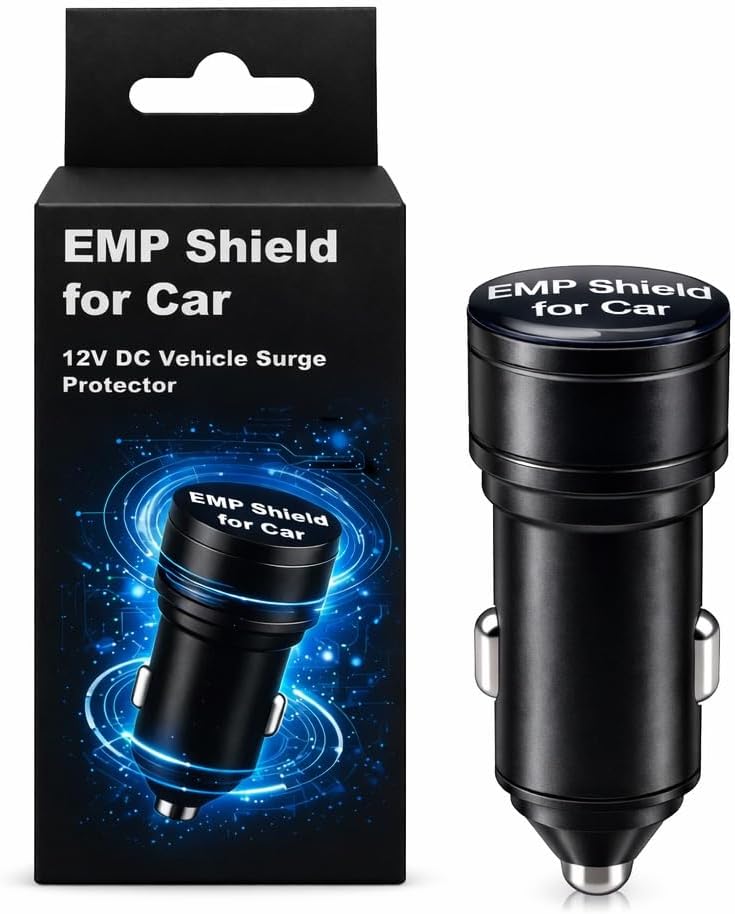
The EMP Car Shield is a dedicated 12-to-24-volt DC protection device for vehicles, with a 5.0 customer rating. Its stated function is to divert and suppress transient energy associated with electromagnetic pulses, lightning, solar activity, voltage spikes, and interference before those disturbances reach sensitive vehicle electronics.
We may earn a commission when you buy through this link, at no additional cost to you.
The product directly addresses cars, trucks, SUVs, RVs, boats, and motorcycles with standard 12-to-24-volt DC outlets. Installation requires only inserting it into a cigarette-lighter-style outlet, so there are no tools, wiring changes, or complex setup steps. According to the product information, the protection circuitry operates continuously while the device is plugged in.
This is a narrow but clearly defined use case. It is intended to support vehicle computers, sensors, and electrical systems against sudden electrical events, not to block WiFi, cellular calls, GPS, or keyless-entry signals. It also cannot help a vehicle that has already sustained physical or electrical damage, and its actual performance will depend on correct compatibility and installation.
The EMP Car Shield is our top choice for buyers whose main concern is protecting vehicle electronics from lightning-related spikes and other transient electrical disturbances. It combines the strongest available customer feedback in the group with a broadly stated vehicle compatibility range and uncomplicated installation.
The device is built around suppression and diversion of transient energy. That makes it relevant for owners concerned about voltage spikes reaching computers, sensors, or other sensitive electronics during lightning or other electrical disturbances.
Plugging the protector into a standard vehicle outlet keeps setup straightforward. It can remain connected during normal operation, according to the supplied description, without requiring a permanent alteration to the vehicle.
We may earn a commission when you buy through this link, at no additional cost to you.
These EMF shield stickers provide a targeted option for wireless earbuds rather than whole-vehicle protection. They have a 4.7 rating, are made in the USA, and are marketed for AirPods generations two through four as well as most wireless earbuds with a 5-to-8-millimeter cavity. The supplied information says the patented stickers underwent third-party testing.
We may earn a commission when you buy through this link, at no additional cost to you.
The product's slim adhesive design is intended to avoid bulk and interference with Bluetooth connections or charging. Application is straightforward: the sticker is positioned inside the compatible earbud cavity, where it can cover the device area without changing the visible exterior. The manufacturer also states that substantial research and testing investment supports the design.
Fit is the central constraint. The stickers are not intended to protect a phone, dashboard, key fob, or entire vehicle, and they may not fit earbuds whose dimensions or internal construction differ from the supported range. Although the description uses the term lab tested, consumers should examine the available documentation to understand what was evaluated.
This is a good choice for drivers and passengers who spend significant time using wireless earbuds and want a device-specific accessory. It is not a substitute for an in-car signal pouch or an electronics surge protector, but it provides a focused way to address electromagnetic emissions associated with frequently used listening devices.
Placing the sticker inside the earbud cavity preserves the device's normal appearance and charging arrangement. It is a discreet option for users who want targeted protection without carrying a larger external accessory.
The stated 5-to-8-millimeter range and named AirPods generations simplify the initial fit check. Measuring the earbud cavity before ordering can prevent frustration and help ensure that the adhesive sits in the intended location.
We may earn a commission when you buy through this link, at no additional cost to you.
The XH-Carpet set includes six adhesive protection stickers for phones, tablets, laptops, computers, monitors, and other electronic devices. It has a 4.0 customer rating and emphasizes a low-burden design that does not add meaningful weight to a device or interfere with cellular reception or wireless charging.
We may earn a commission when you buy through this link, at no additional cost to you.
The suggested placement is near the device antenna, such as by the camera area on a phone. The stickers use a strong self-adhesive backing and are described as non-magnetic, which makes them suitable for a range of surfaces and device housings. Installation requires cleaning the surface, removing the protective film, and pressing the sticker into position.
Unlike a Faraday enclosure, the stickers do not create a complete conductive environment around the device. Their value is therefore tied to the manufacturer's claimed neutralization and shielding approach, and the supplied information does not include specific attenuation figures or test methods. Users should consider those claims separately from the practical convenience of the product.
This set is most appropriate for people who want a simple adhesive accessory across multiple personal electronics, including devices carried in the car. It is convenient for broad household use but does not protect vehicle wiring, dashboard systems, key fobs, or the cabin as a whole. Those requiring an enclosure should select a pouch or fabric-based solution.
Six stickers allow use across more than one device or replacement after normal wear. The set is especially convenient for people who routinely place a phone, tablet, or laptop in a vehicle.
The product information specifically recommends positioning the sticker near the antenna area. Following that guidance is important because the protection is intended to interact with the device at a particular location rather than cover an entire electronic environment.
We may earn a commission when you buy through this link, at no additional cost to you.
The Zuomeng EMP Protector is designed to protect vehicle electronic components from lightning, solar-flare-related disturbances, and power surges. It has a 4.2 customer rating and uses a compact, low-power design that connects to a vehicle's cigarette-lighter outlet. The supplied information states that activation occurs in less than one picosecond.
We may earn a commission when you buy through this link, at no additional cost to you.
The product information also states that the device can suppress power levels up to 5,000 watts and includes a replaceable fuse. Its low consumption is intended to reduce battery drain, while continuous protection is claimed whether the vehicle is powered on or off. These are useful features for a permanent or semi-permanent addition to a car or truck.
As with all surge products, the stated response time and suppression capability are manufacturer claims rather than independently verified results in the supplied information. The protector is also specific to transient electrical threats. It does not isolate radio-frequency emissions, shield a key fob, or create a quiet environment for passengers.
This protector is a sensible alternative for owners who want a dedicated electrical defense and value the replaceable fuse. It is particularly relevant to vehicles with extensive electronic systems, although it should be evaluated separately from personal EMF exposure products. Confirm outlet voltage and fit before installation.
The advertised sub-picosecond response distinguishes this model within the list. That figure suggests an emphasis on reacting quickly to brief disturbances, though buyers should rely on documentation and their own research to evaluate the claim.
A replaceable fuse can make a failed component easier to address without replacing the entire protector. This practical detail may be valuable to owners who intend to keep the unit installed over time.
We may earn a commission when you buy through this link, at no additional cost to you.
The Two-Pack Faraday Pouches are designed especially for phones and keyless-entry fobs, with a 4.4 customer rating. The product information says the inner shield blocks 2G, 3G, 4G, 5G, WiFi, and GPS signals, while the waterproof outer fabric is designed for daily durability and travel use.
We may earn a commission when you buy through this link, at no additional cost to you.
Their most relevant automotive benefit is key-fob relay mitigation. Keeping the fob inside the pouch when it is not needed can make it more difficult for another party to capture or relay its wireless signal. The pouches also provide a simple place to isolate a phone, reducing distractions during driving and limiting location tracking or unwanted communication while the device is stored.
Users must fully close the Velcro opening, and only items inside the shielding area benefit from the protection. These bags do not guard vehicle wiring or electronics against lightning and power surges. They are also compact containment tools, so their effectiveness should not be confused with the broader field coverage claimed by a whole-car neutralizer.
This two-pack is a good value-oriented choice for drivers who need basic key-fob protection and a phone pouch. It is easy to carry, easy to use, and useful in multiple vehicles. The two separate covers also allow the phone and keys to be isolated without placing them together in one crowded sleeve.
The pouch's primary automotive role is to isolate the wireless signal from a keyless-entry remote. This is especially relevant to cars where the fob may otherwise remain active and close to the vehicle for extended periods.
The phone pouch can support focused travel or driving periods by blocking incoming communication and location signals when closed. It gives users control over when their phone is exposed to radio networks.
We may earn a commission when you buy through this link, at no additional cost to you.
The Large Faraday Bag uses three layers of shielding fabric and is shaped to accommodate a phone and car key together. It has a 4.4 customer rating and takes a practical approach to everyday privacy by offering a roomier horizontal interior than narrow pouches. A wrist strap makes it easy to carry during commuting, travel, and parking.
We may earn a commission when you buy through this link, at no additional cost to you.
The bag is advertised as helping block RFID, cellular, WiFi, GPS, and Bluetooth signals. That makes it relevant to drivers who want to reduce tracking exposure or isolate a key fob while their phone is stored. Its larger format is particularly useful for phones that already have a protective case, since users do not need to remove the case before placing the device inside.
The outer material is described as fire-resistant and water-resistant, providing everyday durability without implying that the bag can be submerged. As with other pouches, its shielding applies to enclosed items and depends on a proper closure. It offers no protection for vehicle electronics and does not address key-fob relay risk unless the fob is actually kept inside.
This bag is a useful choice for people who want one roomy pouch that holds both a phone and key. It is particularly convenient for parking, travel, and privacy-conscious daily carry. Its straightforward construction and multi-signal coverage make it more approachable for general users than a DIY fabric kit.
The wider shape reduces the need to remove a phone case and allows a key to remain alongside the phone. That convenience can encourage consistent use, which matters when a privacy pouch is intended to become part of a daily routine.
The use of three shielding layers gives the product a more substantial construction than a basic single-cover pouch. It remains important to close the opening fully so the layers can continue enclosing the devices as intended.
We may earn a commission when you buy through this link, at no additional cost to you.
The phrase EMF blocker covers several distinct product categories, so the first step is identifying the threat or exposure you want to address. A vehicle may need radio-signal isolation, protection from electrical transients, broader cabin coverage, or simply a place to store a key fob securely.
Start by separating personal wireless exposure from electronics protection. Faraday bags and fabric block or contain radio-frequency signals from phones, GPS devices, Bluetooth accessories, and key fobs. Vehicle surge protectors address transient electrical energy, lightning-related spikes, and interference that could affect computers or sensors. Whole-car neutralizers take a different approach centered on the vehicle's wiring and broader electromagnetic environment. Adhesive stickers are designed for individual devices rather than the entire cabin. Choosing without this distinction can produce an expensive disappointment, because a key pouch will not function as a lightning protector and a surge device will not stop a phone from communicating with a cellular network.
For any protector that draws power from the vehicle, confirm the supported voltage and connector. The dedicated EMP devices in this guide are described for 12-to-24-volt DC applications, with installation through a standard vehicle outlet. Vehicle electrical systems can vary, especially in trucks, RVs, boats, and modified cars, so checking the owner's manual is important. A protected outlet should also be inspected for wear, heat damage, or loose fit. If an accessory repeatedly disconnects or draws unusual power, it should be removed and the socket checked rather than relying on continued operation.
When radio isolation is the goal, look at the specific frequencies named by the manufacturer. Relevant vehicle-related signals can include cellular service, WiFi, Bluetooth, GPS, NFC, RFID, and keyless-entry transmissions. A product that addresses only one or two of these may be suitable for a narrow need but incomplete for a broader privacy strategy. Pay attention to the word used to describe performance: blocking, shielding, isolation, or neutralization can represent different technical approaches. Also distinguish an entire car from a single enclosed pouch, because containment products work only on the items placed inside them.
Convenience depends on how often the vehicle changes, how much space is available, and whether you want a permanent installation. Plug-in protectors can remain connected and are easy to transfer, while whole-car neutralizers may require more involved placement and interaction with vehicle wiring. Adhesive stickers take seconds to apply but need a clean surface and the correct location. DIY fabric projects require cutting, sealing, and sewing, which adds time but allows a tailored shape. Before choosing, compare the learning curve and maintenance demands with the convenience you actually want during daily commutes and longer journeys.
Small electronics do not always fit comfortably in a shielding product. Check the listed pouch dimensions against the size of your phone, including its case, and ensure that the key fob can sit fully inside without forcing the closure. For adhesive earbud products, measure the device cavity and compare it with the supported range. For fabric, think about seam allowance, tape needed around edges, and whether the project should use one layer or two. A snug but incomplete closure can be inconvenient and may reduce the intended shielding performance, so physical fit deserves as much attention as the feature list.
Look for materials and construction details that match the environment. Conductive fabric should have continuous shielding layers, while finished pouches should include secure closures and reinforced outer materials. Water resistance and waterproofing are different claims, and fire-resistant material should not automatically be treated as fireproof unless the listing specifically says so. For vehicle use, consider heat, abrasion, UV exposure, and repeated opening. Fabric-based DIY materials often have stricter care instructions, including avoiding washing, scrubbing, staining, and direct sunlight. Proper storage helps preserve both the physical material and its intended electrical properties.
Evidence quality varies across this category. Products may state shielding effectiveness in decibels, describe third-party laboratory testing, provide an attenuation percentage, or use broad language about energy and harmful effects. These claims are not interchangeable, and a higher number does not automatically translate into better real-world vehicle protection. Review the available test information, identify what was measured, and check whether the result applies to the same direction, frequency range, and installation condition as the intended use. For surge protectors, compatibility with the vehicle's electronics and correct outlet voltage are equally important as marketing terminology.
The most effective product is one you will use correctly and consistently. A vehicle-wide device should be installed according to its instructions, a pouch should be closed completely, and a DIY enclosure should have properly sealed seams. Adhesive solutions need a clean application surface and may eventually show wear from removal or daily handling. Powered protectors should be checked periodically for secure connection, visible damage, and correct placement. Create a routine that fits your driving pattern, and periodically verify that key pouches still contain the fob fully and that any fabric project has not separated at its seams.
Install powered vehicle protectors with the vehicle safely parked and the accessory compatible with the outlet and electrical system. Read the supplied instructions, connect the unit to the correct 12-to-24-volt DC outlet, and confirm that it is seated without forcing the socket. Do not use a protector with a damaged connector, exposed wiring, or an outlet that heats excessively. For permanent neutralizer installations, follow the manufacturer's placement and wiring guidance rather than improvising connections, and have questionable electrical work checked by a qualified technician.
For finished Faraday pouches, place the phone, key fob, or other intended item completely inside and close the opening before relying on the shielding. The supplied Simket product includes a simple self-test method involving a call from another device, which can provide a basic indication that signals are being blocked. For DIY fabric projects, cut the material to the required size and use the included conductive tape or suitable stitching to form a continuous seam. Double layers can improve the result, but every opening and connection must be sealed carefully.
Care for the product according to its materials. Keep conductive fabric in a cool, dry place away from direct sunlight, and do not scrub, wash, or stain it. Do not use a key pouch while its closure is partly open, and inspect adhesive stickers for lifting or residue around device antennas. Periodically check vehicle plugs, replaceable fuses, and outlet fit where applicable. Treat all shielding and protection products as supplements to sound vehicle maintenance, responsible key handling, and prudent electronic-device security rather than as substitutes for professional advice.
An EMF blocker generally addresses radio-frequency or electromagnetic exposure from connected devices, while an EMP protector is intended to suppress sudden electrical transients that could affect vehicle electronics. A Faraday pouch isolates a phone or key fob, whereas a vehicle surge protector is connected to the electrical system. They solve different problems and are not interchangeable.
A properly closed Faraday pouch can reduce the fob's exposed wireless signal, making it harder for another party to capture and relay it. It is most useful when the fob is not being used to access or operate the vehicle. No pouch guarantees that a vehicle cannot be stolen, so the fob should also be stored securely and used according to the automaker's guidance.
Only products specifically designed as surge or transient-energy protectors address lightning-related electrical spikes. A pouch, sticker, or general EMF neutralizer does not provide the same protection for computers, sensors, or wiring. Even a dedicated protector cannot guarantee that every component will survive a direct strike, so proper vehicle care and avoidance of severe weather remain important.
It depends on the product. A closed Faraday pouch deliberately isolates the enclosed phone from signals, while a vehicle-wide neutralizer or adhesive sticker is not necessarily intended to interrupt communication. Some sticker listings explicitly state that signal and wireless-charging functions are unaffected, but buyers should confirm the intended behavior of the specific product before installation.
It can be useful when the project is folded, cut, and sealed correctly. The fabric is offered for key-fob pouches, device sleeves, wallet liners, curtains, and similar products. Shielding can decline at unsealed seams, so conductive tape, suitable stitching, and continuous coverage are essential. Check the material-care instructions and avoid washing, staining, or exposing it to direct sunlight.
No single product in this list is described as a universal solution for every form of electromagnetic exposure, radio-frequency signal, key-fob threat, and electrical transient. Some products cover a whole vehicle, while others protect one device, one stored object, or vehicle electronics. A layered strategy may address several concerns, but each accessory should be selected for a defined purpose.
Not automatically. A quoted figure is meaningful only when the manufacturer identifies the test conditions, frequency range, and configuration. Real-world performance can also be affected by seams, closure quality, distance, orientation, and installation. The most meaningful comparison is between products tested under similar conditions and used as intended.
Follow the instructions supplied with the chosen product. Plug-in protectors are generally designed for normal vehicle operation, but installation and maintenance should be performed with the vehicle safely parked. Any damaged wiring, loose socket, unusual heat, or incompatible voltage should be addressed before use.
The top recommendations depend on the job. The EMP Car Shield is the most practical selection for transient electrical protection, the Simket Faraday pouches provide flexible multi-signal privacy for phones and key fobs, and the Whole Car EMF Neutralizer offers the broadest vehicle-focused approach. Each targets a different layer of the vehicle's electromagnetic environment.
Prioritize specificity before making a purchase. Signal-blocking products work on enclosed or targeted items, surge protectors guard electrical systems, and adhesive solutions belong on individual devices. Check voltage, dimensions, signal coverage, installation requirements, care requirements, and the credibility of the stated specifications before committing to a permanent installation.
Prices, ratings, and availability can change, so review the current product listing and recent customer feedback at the time of purchase. The Amazon links in this guide lead to the relevant listings, where you can confirm current specifications, compatibility, and purchasing options before making your final choice.