
OYPSX 1500W Power Inverter
4.3Editor score
1500W continuous output
3000W peak power
Five-meter wired controller
LCD monitoring display
Comprehensive protection suite
Explore the best 1500W pure sine wave inverter options for RVs, trucks, solar, camping, and backup power, compared for output, ports, displays, and protection.
A 1500W pure sine wave inverter converts 12V battery power into clean 110V or 120V household AC, making it a practical option for RVs, trucks, camping, solar systems, and temporary home backup. The best unit balances steady output, useful controls, safe connections, and enough capacity for common appliances.
The products in this guide were compared using the information listed for continuous and surge output, AC outlets, USB charging, remote displays, battery compatibility, cooling, and built-in protections. The list includes general-purpose inverters, remote-controlled models, GFCI-equipped options, and a higher-end industrial design for buyers with different installation needs.
Each review explains the features that distinguish one model from another, along with practical trade-offs that may affect RV, mobile, solar, or emergency use. Ratings and product details reflect the supplied listings, while availability and prices can change, so shoppers should confirm the latest specifications before purchasing.
4.3Editor score

4.5Editor score
4.0Editor score
This side-by-side comparison highlights the principal differences among 10 pure sine wave inverters, including continuous power, surge capability, AC and USB connections, remote monitoring, battery support, and safety features.



The 1500W Pure Sine Wave Inverter 12V DC to 120V AC Converter with LCD Remote provides 1500W of continuous output and up to 3000W of peak power. Its 4.4 rating reflects a broadly capable unit, while the combination of four AC outlets, USB and Type-C connections, and a 14.76-foot wired remote makes it particularly flexible for installations where several devices need access to AC power.
We may earn a commission when you buy through this link, at no additional cost to you.
The strongest feature is its output flexibility. Four AC outlets can serve multiple household devices without requiring several basic inverter boxes, while the USB and Type-C ports add convenient charging options. The remote can report battery voltage, AC output voltage, and load wattage, giving users a practical way to monitor a system when the inverter is mounted in a cabinet, truck cabin, or other less accessible location. The listed compatibility with lithium, AGM, deep-cycle, and lead-acid batteries broadens its appeal for mixed power systems.
The safety package is also notably comprehensive, covering overload, over-voltage, low voltage, over-temperature, and short circuits. Two intelligent cooling fans are included to manage heat, although a four-outlet design may be unnecessary for buyers who only need one or two appliances. The wired remote also needs to be routed deliberately, and the included battery cables add installation requirements that should be considered before purchase.
This is a strong match for RV owners, contractors, truck drivers, and solar users who want extensive outlet selection and remote diagnostics in a single unit. It is particularly compelling for a mobile installation that powers several smaller loads at once. Buyers should confirm their battery voltage and planned load total, then install the inverter in a ventilated, accessible location with adequate cable protection.
Four AC outlets make this inverter easier to use as a shared power hub for an RV, work vehicle, or backup installation. USB and Type-C ports provide an additional path for charging smaller devices without occupying the AC receptacles.
The wired LCD remote reports battery voltage, output voltage, and load wattage. That information is useful when the inverter is installed out of reach or when operators need to verify system status without opening an enclosure.
We may earn a commission when you buy through this link, at no additional cost to you.
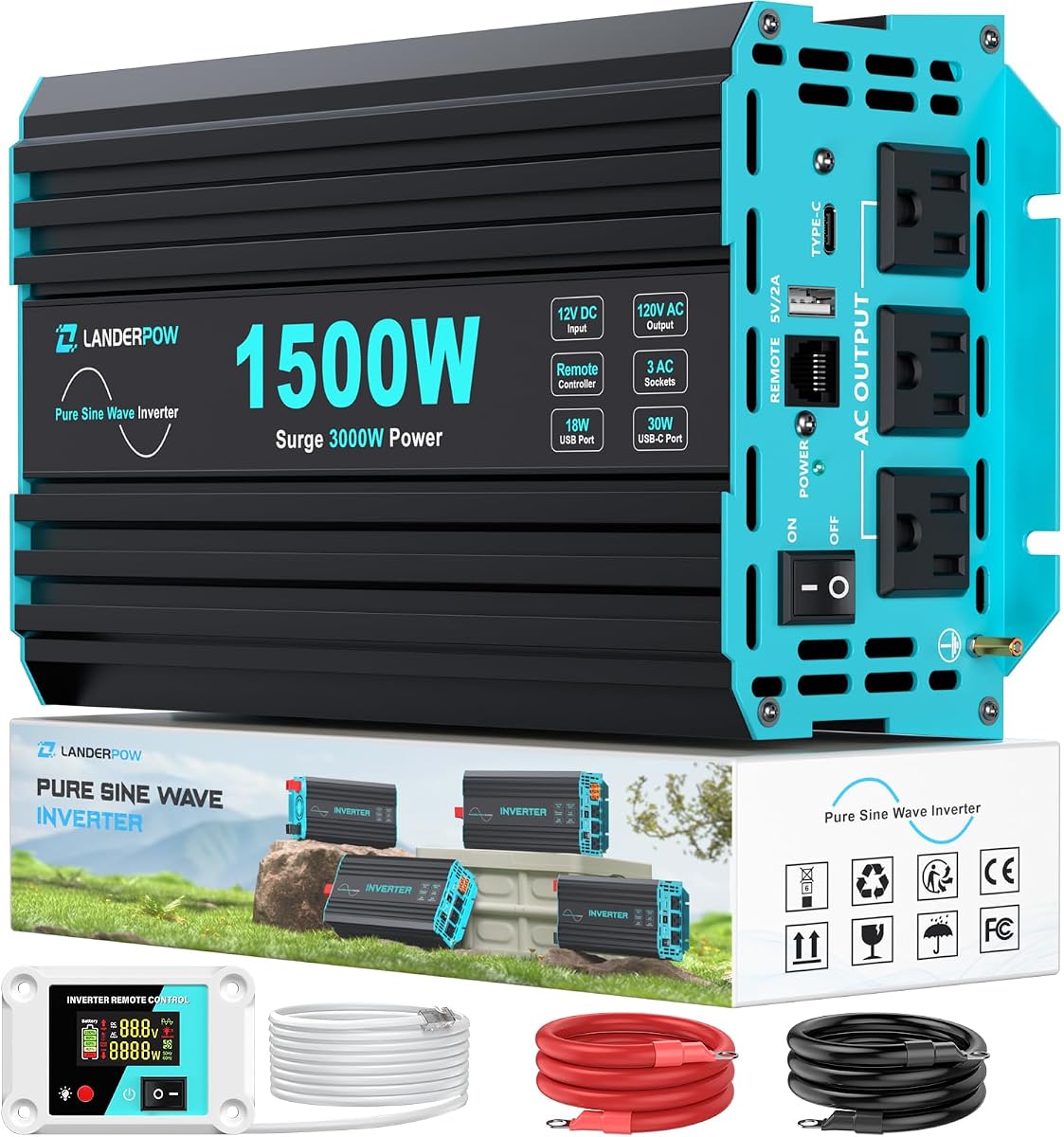
The LANDERPOW 1500 Watt Inverter 12V DC to 120V AC Pure Sine Wave Converter combines 1500W continuous output, 3000W surge capability, and an efficiency rating above 91%. Its 4.4 rating places it among the stronger all-around options, particularly for users who want clean power for sensitive electronics and heavier startup loads without giving up several AC connections.
We may earn a commission when you buy through this link, at no additional cost to you.
Three AC outlets support a mix of household equipment, while USB and USB-C ports handle charging. The product information specifically calls out kettles, power tools, home theaters, car audio, computers, laptops, and CPAP devices, illustrating the range of loads it is designed to address. A 15-foot LED remote can display battery level, output information, and errors, which makes the unit more convenient for RVs, trucks, job sites, and fixed installations.
Protection against undervoltage, overvoltage, overload, overheating, short circuits, and reverse connection helps reduce operational risks. The full metal shell is designed for heat dissipation and durability, though the two-foot battery cables may need to be replaced for a larger battery installation. Buyers should not treat the listed surge rating as a continuous capacity and should confirm that appliance startup demands remain within the supported range.
The LANDERPOW is a well-rounded choice for buyers who want efficiency, remote monitoring, and a broad port selection in one package. It is well suited to everyday travel use, emergency planning, and solar projects, provided the installer supplies appropriate battery connections and observes the product’s ventilation and load guidance.
The stated efficiency above 91% is relevant to battery users because lower conversion loss can leave more usable energy for the connected load. Actual runtime still depends on battery condition, cable losses, the inverter’s input draw, and the amount of power the appliances actually consume.
The 15-foot remote is long enough to place the display near a driver, campsite, or work area while the inverter remains safely mounted elsewhere. Its status and error display can help users check conditions before adding another load or changing the battery configuration.
We may earn a commission when you buy through this link, at no additional cost to you.
The Power Inverter 1500Watt Pure Sine Wave Inverter 12V to 110V 120V AC offers 1500W of continuous power and a 4.4 rating. Its three AC outlets, two USB ports, and 15-foot remote make it a straightforward option for emergency use, camping, or a vehicle-based power supply where essential appliances need reliable 120V output.
We may earn a commission when you buy through this link, at no additional cost to you.
One useful detail is the intelligent cooling fan. According to the product information, it does not run at startup and activates only when the inverter reaches 104 degrees Fahrenheit or the load exceeds 800W. That approach can reduce unnecessary fan noise during lighter use while helping prevent overheating under more demanding conditions. The aluminum housing is also positioned as a durable enclosure for mobile environments.
The remote uses an RJ10-style four-pin connection, and the listing notes that users can make longer DIY cables. Protection includes short-circuit, input over- and undervoltage, output short-circuit, overload, overcurrent, and over-temperature functions. The main uncertainty is surge capacity, which is not clearly specified in the supplied details, so users with motors or other high-startup appliances should verify compatibility before buying.
This inverter fits buyers who value a simple display, physical remote, and established accessory package over premium extras. It is appropriate for refrigerators, TVs, phones, cameras, small vacuums, and similar equipment during outages or travel. Confirm startup requirements, confirm the battery is 12V, and keep the cooling fan’s airflow unobstructed for dependable use.
The temperature- and load-controlled cooling fan is designed to remain off during startup and at lower operating levels. This can make the inverter less noticeable during lighter camping, travel, or household backup use.
A wired 15-foot controller allows power to be managed without reaching the inverter directly. The RJ10-style connection also gives technically capable users the option of extending the control cable when the remote needs to sit farther from the unit.
We may earn a commission when you buy through this link, at no additional cost to you.
The Jlouneo 1500 Watt Pure Sine Wave Inverter, 12V DC to 110V/120V AC, combines 1500W continuous output, 3000W peak power, and a 4.5 rating. It stands out for its two monitoring displays, a broad collection of protections, and a connection mix that suits RVs, trucks, backup power, and off-grid living.
We may earn a commission when you buy through this link, at no additional cost to you.
One display is built into the inverter and another is included on the remote, giving users two ways to inspect input voltage, output voltage, load level, and fan status. The remote can also present alerts for overload, overheating, and short circuits. Three AC outlets, a 5V/3.1A USB port, and a 30W USB-C port make the unit convenient for a mixed collection of appliances and charging devices. Stated conversion efficiency reaches 91%, while included 4AWG copper cables are intended to support stable current flow.
The enclosure is described as durable aluminum with reinforced housing, while the product information states compatibility with AGM, GEL, and lithium batteries. One point requiring attention is the stated standby current of 0.3A plus or minus 0.3A, a relatively wide range that can affect long-term battery drain. As with every inverter, the output claim is only useful if the connected load, ventilation, and wiring are appropriate.
This is the most balanced pick for buyers who want substantial output, remote visibility, and several convenient ports without moving to a specialized premium design. It works particularly well in an RV or truck where a local display and a remote display are both valuable. Buyers should verify battery type before purchase, provide proper ventilation, and size the installation around the actual load.
The built-in screen gives quick access to operating data, while the remote repeats important information from a more convenient location. This is particularly useful in mobile installations where one person may need to check load status without approaching a secured or difficult-to-reach inverter.
Three AC outlets provide room for household equipment, while the USB-A and USB-C ports support smaller device charging. This makes the inverter practical for users who want one box to handle both AC appliances and modern personal electronics.
We may earn a commission when you buy through this link, at no additional cost to you.
The GIANDEL 1500 Watt Pure Sine Wave Power Inverter delivers 1500W continuously and carries a 4.5 rating. Its most distinctive features are 20A GFCI outlets, selectable battery types, a large status display, a 36W USB-C port, and a two-second 3100W surge capability for demanding appliances.
We may earn a commission when you buy through this link, at no additional cost to you.
The GFCI receptacles add a layer of ground-fault protection that is especially relevant in RV, vehicle, and outdoor power environments. The LCD reports input voltage, output voltage, load power, frequency, battery status, warnings, and protection modes. GIANDEL also allows users to select among lithium, LiFePO4, lead-acid, AGM, and GEL batteries through the power button, with the low-voltage protection threshold adjustable from 9.5V to 11V.
The 3100W surge rating is specified for two seconds, which gives compatible motors, pumps, refrigerators, and microwaves room to start. However, surge handling should not be confused with continuous capacity. The programmable shutdown timer can run from 1 to 100 hours, and an audible protection alarm shuts off after one minute to limit noise. Buyers using it as a permanent installation may prefer a longer, more complex enclosure to preserve active cooling and create wiring space.
This is a strong choice for RVs, campers, boats, emergency kits, and solar setups where ground-fault protection and battery compatibility matter. It also suits buyers who want to fine-tune low-voltage behavior. Users should select the correct battery profile, confirm the desired cutoff voltage, and keep the inverter’s ventilation area unobstructed.
The listed 20A GFCI outlets are designed to interrupt power when a ground fault is detected. This feature is relevant in vehicles, recreational equipment, and other installations where damp conditions or damaged wiring can create additional safety risks.
Selectable battery profiles and an adjustable low-voltage cutoff are valuable for mixed power systems. The correct setting helps the inverter interpret battery conditions appropriately, while manual adjustment gives installers more control over shallow discharge behavior.
We may earn a commission when you buy through this link, at no additional cost to you.
The 1500Watt Pure Sine Wave Inverter 12V DC to 110V 120V AC Power Inverter provides 1500W of continuous output and holds a 4.5 rating. Its familiar feature set—three AC outlets, two USB ports, an LCD, and a 15-foot remote—makes it suitable for essential equipment during outages and for routine use in cars, RVs, and travel setups.
We may earn a commission when you buy through this link, at no additional cost to you.
The LCD supplies the core operating information that users need: battery status, input voltage, output voltage, and protection codes. A built-in cooling fan helps manage temperature, and the aluminum housing is designed to withstand bumps and drops better than a lightweight enclosure. The supplied accessories include a remote, manual, and red and black battery cables, reducing the need to source those basic items separately.
Protection functions cover short circuits, input over- and undervoltage, output short circuits, overload, overcurrent, and over-temperature conditions. The primary limitation is that the supplied listing does not clearly state a surge rating. As a result, users planning to operate refrigerators, compressors, pumps, or other high-startup loads should not assume the inverter can support them without first checking the manufacturer’s specifications.
For buyers prioritizing a familiar, uncomplicated design, this model remains a practical option. It can support televisions, phones, cameras, game consoles, refrigerators, and other devices listed for the product. The 18-month warranty also provides coverage beyond many shorter plans in this roundup, although buyers should confirm the current terms directly with the seller.
The integrated LCD keeps the most relevant battery and output information visible without requiring a separate meter. Protection codes are also useful for identifying why a sensitive load disconnected or why the unit did not start.
Three AC outlets and USB charging provide enough flexibility for several essential devices. The product is best suited to loads whose startup requirements are clearly within the inverter’s documented operating envelope.
We may earn a commission when you buy through this link, at no additional cost to you.
The 1500W Pure Sine Wave Inverter 12V to 110V-120V Converter provides 1500W continuous output, 3000W surge power, and efficiency above 93%. Its 4.5 rating and two-year warranty make it an attractive option for campers, truckers, van users, and solar builders who want efficient conversion in a durable enclosure.
We may earn a commission when you buy through this link, at no additional cost to you.
The efficiency figure is the standout specification. Lower conversion loss can improve the usable energy available from a battery, making the inverter more practical for longer trips or off-grid use. A wired 14.76-foot remote with an LCD tracks battery level, output, and error messages. The remote also provides one-touch shutdown and restart, which is convenient when the inverter is positioned near a battery compartment.
Two AC outlets are supplemented by one USB port rated up to 18W and one Type-C port rated up to 22W. The aluminum-alloy shell supports heat dissipation, and the temperature-controlled fan starts above 45 degrees Celsius and stops after temperatures fall. Protection covers undervoltage, overvoltage, overload, overheating, short circuit, and isolated input and output. The lower USB-C ceiling than some competing models is a minor limitation for modern charging needs.
This inverter is best for users who prioritize efficiency, strong surge headroom, cooling, and warranty coverage over having a large number of AC receptacles. It suits sensitive electronics and common mobile loads, including laptops, CPAP machines, cameras, lights, game consoles, and a mini fridge. Users should still match the actual appliance draw and startup demand to the documented limits.
An efficiency above 93% can make a meaningful difference in a battery-limited installation. It does not create extra battery capacity, but it reduces the amount of stored energy lost during DC-to-AC conversion.
The aluminum-alloy enclosure is designed to dissipate heat, while the temperature-controlled fan limits unnecessary noise. These features are useful in enclosed RV cabinets, work vans, and other spaces where sustained high-load operation must be balanced with airflow.
We may earn a commission when you buy through this link, at no additional cost to you.
The Pure Sine Wave Inverter 1500 Watt 12V to 110V 120V AC, 3100W Max for 2S combines 1500W continuous output with a 3100W surge peak for two seconds. Its 4.5 rating and emphasis on high-inductive loads make it relevant to users operating compatible air conditioners, refrigerators, water pumps, microwaves, and power tools.
We may earn a commission when you buy through this link, at no additional cost to you.
The adjustable input-voltage function is a notable feature for lithium battery systems. It allows users to customize the input setting according to the manual, which can improve battery compatibility and help preserve battery health when the battery chemistry or operating profile differs. The LCD tracks battery status, DC input, AC output, load watts, and protection codes, and automatically rests the screen after one minute without operation.
The connection set is unusually flexible. Three AC outlets cover normal plug-in equipment, while a 40A hardwire terminal supports high-power appliances. A 15-foot RJ10 remote provides remote power control and battery monitoring. The 36W USB-C and 3.6A USB-A ports support phones, tablets, laptops, floodlights, televisions, and Starlink devices. Protection includes reverse polarity, input over- and undervoltage, output short circuit, overload, over-temperature, low-input alarm, and low-output voltage protection.
This model is well suited to installers who want both flexible connections and a stronger short-duration surge allowance. The trade-off is that adjustable electrical settings and a hardwire terminal demand more careful installation than a basic plug-in setup. Users should consult the manual, use properly rated wiring, and avoid assuming a two-second surge rating can support repeated high-startup cycles.
The 3100W peak for two seconds gives compatible motors and compressors more room during startup than the continuous rating alone would suggest. It remains a short-duration allowance, not permission to operate a 3100W load continuously.
A 40A hardwire terminal expands the installation options beyond ordinary wall receptacles. It is particularly relevant for a fixed RV, van, shed, or solar system where wiring quality and load planning are more important than maximum portability.
We may earn a commission when you buy through this link, at no additional cost to you.
The OYPSX 1500W Power Inverter provides 1500W of continuous output, 3000W of peak power, and a 4.3 rating. It is a budget-focused option for RV, truck, camping, and off-grid users who value a long remote lead, an LCD, and AC, USB, and Type-C connections in one package.
We may earn a commission when you buy through this link, at no additional cost to you.
Its most notable convenience is the five-meter wired controller. That length gives users considerable freedom to place the display in a truck cab, RV living area, or nearby workspace while the inverter itself is mounted elsewhere. The controller and LCD provide real-time input voltage, output voltage, output power, and fault codes, making it easier to check the system before connecting a load or troubleshooting an error.
The intelligent protection system includes overvoltage, undervoltage, overload, short circuit, over-temperature, overcurrent, reverse polarity, and leakage protection. A temperature-controlled fan is included to support stable operation. The supplied information gives less detail about the housing, battery cable gauge, cooling behavior, and warranty than the other listings, so buyers seeking a permanent installation may want more technical documentation before deciding.
The OYPSX is best for value-conscious buyers who need straightforward 12V-to-120V conversion and useful remote visibility. The product information lists fans, washing machines, computers, phones, coffee makers, refrigerators, air conditioners, and kettles among possible uses, but appliance startup requirements can vary widely. Users should follow the instruction to match the battery voltage with the inverter input and verify the load specifications.
The five-meter controller is longer than the leads supplied with most products in the roundup. It is useful in installations where the inverter is deep in a storage compartment and the display needs to remain accessible from a living or working area.
Reverse polarity and leakage protection are useful safeguards in vehicle and off-grid installations where wiring errors or environmental exposure can create problems. Protection functions reduce risk, but they do not replace correct polarity checks and sound cable installation.
We may earn a commission when you buy through this link, at no additional cost to you.
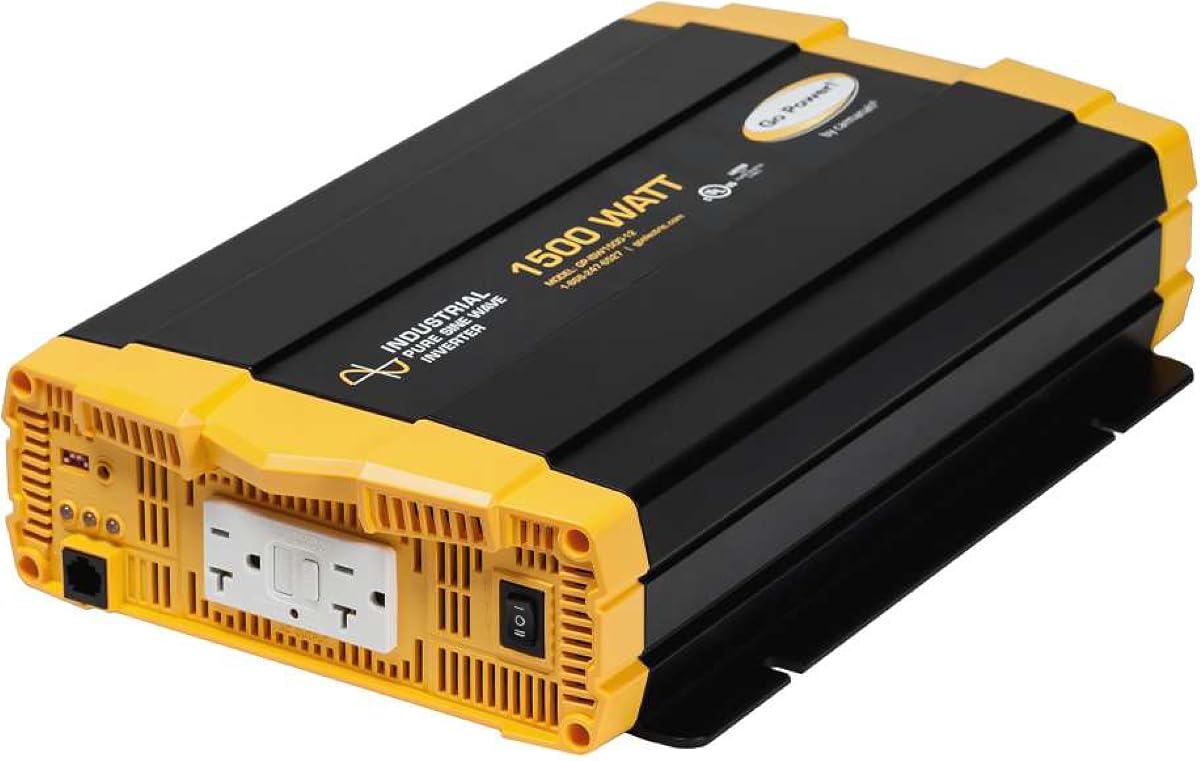
The Go Power 1500 Watt Industrial Pure Sine Wave Inverter, 12V to 120V AC, offers 1500W of continuous capacity and up to 3000W of maximum surge. Its 4.0 rating is the lowest in the group, but the industrial positioning, GFCI outlets, low-profile rugged build, and PowerSave mode give it a distinct appeal for buyers who prioritize enclosure design and established functionality.
We may earn a commission when you buy through this link, at no additional cost to you.
Pure sine wave output is intended for sensitive electronics such as computers, televisions, stereos, and microwaves, helping reduce interference compared with lower-quality waveforms. The dual GFCI outlets add ground-fault protection in mobile or potentially damp installations. PowerSave mode can reduce standby consumption, an important consideration when the inverter remains connected to a battery for extended periods.
The durable, compact design is intended to withstand demanding environments while using relatively little space. Two-year coverage is included, and the product’s simpler connection layout avoids the larger number of USB, LCD, and remote features found on some competitors. Conversely, buyers who want extensive charging ports or a sophisticated remote display may find the offering less flexible.
This is the premium choice in this roundup for buyers seeking an industrial-style inverter with GFCI protection and low standby demand. It fits backup, vehicle, and off-grid use where the enclosure and fault protection matter more than extra charging features. Confirm the required connections, ventilation, and load requirements before installation, and purchase the appropriate battery cables for the intended system.
The compact rugged enclosure is designed for demanding environments and to consume less installation space than a large cabinet-style inverter. That makes it relevant to mobile users who need power hardware without dedicating substantial room to the unit.
PowerSave mode is designed to conserve energy when the inverter is not actively serving a large load. For battery-backed vehicles and emergency kits, limiting unnecessary standby draw can help preserve stored power between uses.
We may earn a commission when you buy through this link, at no additional cost to you.
The right 1500W pure sine wave inverter depends on battery type, intended loads, installation space, remote visibility, and the protection features that matter in your vehicle, home, or off-grid system.
A 1500W continuous rating describes the output the inverter can sustain, while surge or peak output covers brief startup events. Motors, compressors, pumps, and some appliances can draw much more power momentarily than their normal running load. Several products listed here provide 3000W of peak output, while the GIANDEL and the B0DFW45TB3 model specify 3100W for two seconds. Compare appliance startup requirements with the inverter’s surge specification and avoid treating surge capacity as a continuous allowance.
Choose a continuous rating that covers the combined running load with sensible headroom, and verify that each appliance’s startup demand is supported. Higher headroom also helps when several devices begin operating at the same time.
All products in this guide are described as 12V models intended for a 12V DC battery or power system. The GIANDEL provides selectable profiles for lithium, LiFePO4, lead-acid, AGM, and GEL batteries, while the Jlouneo model lists AGM, GEL, and lithium compatibility. A correct nominal voltage is only the first step: battery chemistry affects charging, low-voltage behavior, and the cutoff setting. Some models offer adjustable low-voltage or input-voltage functions, but these should be changed only with reference to the manual.
Verify the battery type, nominal voltage, state of charge, and connection requirements before operating the inverter. Use the specified battery cables or suitably rated wiring, and never assume a 12V inverter is suitable for a different battery system.
AC outlet count ranges from two to four among the listed models. The rank-one product offers four AC outlets, most of the middle-ranked options provide three, and the B0GC4HVQW2 model has two. More outlets are convenient for shared power hubs, while high-output loads may require a hardwire terminal. The B0DFW45TB3 includes a 40A hardwire connection, which is useful for fixed or more advanced installations. USB and Type-C ports add charging flexibility, although their wattage varies considerably.
Count the number of AC devices you intend to run, then add charging devices and any hardwired equipment. Choose a layout that matches the installation rather than paying for unused ports or discovering too few connections later.
A wired LCD remote is valuable when the inverter is installed in a truck bed, RV compartment, cabinet, or fixed solar enclosure. Remote lengths range from 14.76 feet to 16.4 feet across the listings, with the OYPSX offering a five-meter lead. Displays can show battery status, input and output voltage, load wattage, fan condition, and fault codes. Two models also place an LCD directly on the inverter, allowing local and remote checks.
Choose a remote long enough to place the display where you can see it comfortably, while keeping the control cable away from heat, moving components, and moisture. Confirm the connector type if you plan to extend it and use a cable appropriate for the installation.
Every model in the roundup lists protection for common electrical faults, but the details differ. Common functions include overload, over-temperature, short circuit, overvoltage, undervoltage, and overcurrent. Some products add reverse polarity, leakage, low-output voltage, and low-input alarms. GFCI outlets add ground-fault interruption at the receptacle. Cooling systems also differ: some use temperature-controlled fans, one states that its fan starts only at a specified temperature or above an 800W load, and others use two intelligent fans.
Prioritize the protections that match the installation, especially reverse polarity, ground-fault protection, and low-voltage behavior. Confirm that the manufacturer’s required airflow is available and that the inverter is not enclosed in a space where heat can accumulate.
Portable users may favor a compact enclosure and a long remote, while fixed installers may care more about terminal access, ventilation, and a rugged housing. The Go Power unit emphasizes an industrial, low-profile design. The GIANDEL is described as longer than other 1500W inverters, which may require more space but can provide room for wiring and cooling. The LANDERPOW and B0GC4HVQW2 products use full metal shells intended for heat dissipation and durability.
Measure the intended space before buying and include room for cable bend radius, terminals, airflow, and service access. A slightly larger enclosure may be easier to install safely than a compact unit that crowds its connections.
Inverter efficiency affects how much stored battery energy reaches the load, but runtime also depends on battery capacity, battery age, cable losses, standby draw, and the appliance’s actual consumption. Listed efficiency figures include more than 91%, over 91%, up to 91%, and over 93%. The Go Power model includes a PowerSave mode, while the Jlouneo model lists a standby-current range of 0.3A plus or minus 0.3A. These details can be more important than small differences in conversion efficiency for a battery that sits unused for long periods.
Estimate total connected load and expected operating time, then account for inverter overhead. For emergency systems, select a battery with enough usable capacity and confirm that low-voltage protection will behave as intended before the battery becomes deeply discharged.
The package contents vary, but most options include a manual, remote, and red and black battery cables. The LANDERPOW supplies two 4AWG, two-foot cables, the Jlouneo product lists 4AWG copper cables, and the B0GC4HVQW2 package includes a 14.76-foot patch cable and fuses. Warranty and support details also differ, from 12-month support to two-year coverage and an 18-month warranty on several listings. Buyers should verify current terms with the seller because support policies can change.
Check the box contents before installation and replace undersized or unsuitable cables for the battery distance. Confirm the warranty, return process, and availability of replacement fuses or remote controls before relying on the inverter for critical backup service.
Before connecting anything, identify the inverter’s input voltage and confirm that the battery system matches. Inspect the battery, cables, connectors, and inverter for damage, then verify correct red and black polarity. Connect the inverter with the load switched off, position the power controls where they remain accessible, and read the battery or protection indication before attempting to start it.
Turn on the inverter and check the LCD or remote for input voltage, output voltage, load information, and fault codes. Add important equipment one at a time so an overload or startup surge is easier to identify. Use appropriately rated extensions and appliances, keep the unit dry and well ventilated, and do not exceed the continuous or surge limits shown in the current product documentation.
For long-term care, periodically inspect cable insulation, terminal tightness, fan airflow, and the condition of the battery. Clean dust from vents without opening an energized unit, and do not block the cooling system. If the remote shows an abnormal voltage, the protection system activates, or the inverter smells unusual, turn off connected loads, switch off the inverter, and investigate the battery and wiring before reusing it.
A 1500W pure sine wave inverter converts 12V DC battery power into approximately 120V AC power, with a continuous output capacity of 1500W. Pure sine wave output closely resembles utility power and is generally suitable for sensitive electronics, household appliances, and inductive loads. Actual performance still depends on the connected load, battery condition, wiring, ventilation, and surge requirements.
A refrigerator can often run from a 1500W inverter because its running draw is normally below the continuous capacity, but its compressor may require a significant startup surge. Check the refrigerator’s running and startup requirements against the inverter’s 1500W continuous rating and documented surge allowance. Allow several minutes for the compressor to stabilize, and avoid adding other high-startup loads at the same time.
Pure sine wave output is generally the safer choice for computers, medical equipment, audio systems, LED lighting, and other sensitive devices because it reduces electrical noise and irregular waveforms. It also tends to support motors and heating equipment more smoothly. The inverter still needs to be sized correctly, properly grounded, and connected with suitable battery cables.
There is no single battery size because the appropriate capacity depends on load, battery type, inverter efficiency, and how long power must last. For planning, compare the inverter’s input current draw with the battery’s continuous current capability and allow additional capacity for aging, cold conditions, and conversion losses. Use battery cables with the correct wire gauge and protective fusing.
A microwave rated at or below the inverter’s continuous capacity may run, but the listed examples do not guarantee that every microwave will operate acceptably. Some microwaves draw close to 1500W while running, leaving little headroom for other loads. Review the appliance’s nameplate power requirement and startup behavior, and avoid using a high-power microwave with additional appliances on the same inverter.
Continuous power is the amount an inverter can supply consistently over an extended period. Surge power is a short-duration allowance intended to help motors, compressors, and other loads start. Because surge capacity is temporary, an inverter should not be treated as a continuous 3000W or 3100W source, and repeated startups may reduce available capacity.
The products are designed for 12V battery systems, but the battery chemistry still matters. AGM, GEL, lead-acid, lithium, and LiFePO4 batteries can have different voltage curves and low-voltage behavior. Select the correct battery profile where one is available, use the manual to configure the cutoff, and verify that the inverter and charging system are compatible with the battery.
Install it in a dry, ventilated location with access to the controls and enough clearance for its cooling system. In a vehicle or RV, secure the inverter away from moving parts, direct sun, water, and combustible materials, while routing heavy-gauge battery cables appropriately. In a home, do not assume an inverter can replace a transfer switch or utility-approved wiring; follow applicable electrical requirements.
The OYPSX B0FXRB7XXX stands out as the budget-focused choice with a long wired controller, LCD monitoring, several ports, and broad protection. The Jlouneo B0FW56YVGT is the strongest all-around recommendation because it combines 1500W continuous output, 3000W peak power, dual displays, three AC outlets, USB-C charging, and extensive safety features. For buyers seeking a rugged, low-profile industrial design with GFCI receptacles and reduced standby consumption, the Go Power B06WLMX1H2 is the premium-oriented option.
Most buyers should prioritize correct battery compatibility, honest load requirements, adequate surge capacity, and enough ventilation before focusing on extra ports. GFCI outlets matter in mobile and outdoor installations, remote displays are valuable when the inverter is mounted out of reach, and adjustable battery settings can help lithium users tune the system more precisely. The GIANDEL and the B0DFW45TB3 also stand out for GFCI protection or flexible high-current connections, respectively.
Product ratings, availability, and prices change, and the supplied listings may not capture every installation requirement. Before buying, verify the current product page, manufacturer manual, battery compatibility, continuous and surge ratings, included accessories, and warranty terms. Compare those details with the devices you actually intend to power, then choose the inverter that offers the safest and most useful combination of capacity, connections, monitoring, and protection.