
Kind Water Systems E-3000UV
4.7Editor score
Added UV treatment
Multi-stage filtration
Chemical-free microbial control
Compare the 10 best salt free water softeners for whole-home scale control, filtration, easy installation, and reliable operation.
Salt free water softeners offer a practical alternative to conventional ion-exchange systems that require salt, brine discharge, electricity, or regular regeneration. The strongest options use filter-based media, scale-inhibiting resin, citrus-based technology, or electronic conditioning to improve hard-water conditions throughout the home.
This guide compares ten salt-free systems according to filtration capabilities, scale control, flow rate, installation requirements, maintenance, environmental impact, and suitability for whole-house use. It includes compact filter housings, dedicated whole-home combos, and electronic descalers so readers can distinguish actual filtration from conditioning technology.
Each review explains what the selected product does best, where its limitations matter, and which households may find it suitable. Ratings and specifications reflect the supplied product information, while prices and promotions can change, so readers should confirm current details and installation requirements before purchasing.
4.7Editor score

4.5Editor score
5.0Editor score
The comparison below highlights the principal filtration methods, scale-control approaches, flow capabilities, and installation features of all ten systems, making it easier to identify the right option for a particular household.




The Kind Water Systems E-3000 combines sediment filtration, carbon block filtration, and salt-free softening in a single whole-house system. Its 4.5 rating reflects a balanced combination of contaminant reduction, scale control, and straightforward operation. Designed for city water, it targets plumbing, appliances, and everyday household use from one compact unit.
We may earn a commission when you buy through this link, at no additional cost to you.
The standout feature is the breadth of treatment in one housing. According to the supplied information, the system targets up to 95% of sediment and more than 155 chemical contaminants, including chlorine, chloramine, VOCs, and pesticides. It also uses salt-free softening media to help reduce scale while retaining minerals naturally present in the water.
Operation avoids several familiar inconveniences associated with conventional softeners. There is no salt replenishment, brine discharge, electricity, or bulky regeneration tank, and the system does not require a wastewater drain line. That makes it appealing for households seeking whole-home water improvement without adding sodium to the supply or dedicating space to a large salt-based installation.
This is the strongest general recommendation for city-water households that want both filtration and scale management. It is less appropriate for well water without first confirming treatment needs, and buyers seeking true mineral removal should understand that this is a salt-free alternative rather than a standard ion-exchange softener. For broad whole-home capability, however, the feature set is notably complete.
Combining sediment, carbon, and salt-free scale media simplifies the alternative to multiple treatment devices. The result is designed to improve clarity, taste, and odor while helping protect pipes, water heaters, and household appliances from hard-water deposits.
Without salt, electricity, brine discharge, or a drain line, the E-3000 simplifies ownership compared with a regenerating ion-exchange softener. Its NSF-certified components and satisfaction guarantee add reassurance, although proper sizing and installation remain important.
We may earn a commission when you buy through this link, at no additional cost to you.
The NU Aqua 4-Stage Salt Free Water Softener Whole House Water Filter System combines scale prevention with sediment, carbon, and heavy-metal particle filtration. It earns a 4.5 rating for offering a broad point-of-entry treatment package. Installation near the main water supply allows filtered water to reach bathrooms, kitchens, laundry rooms, and outdoor spigots.
We may earn a commission when you buy through this link, at no additional cost to you.
Its media is intended to reduce hard-water buildup without removing calcium and magnesium. The filtration stages also target particles such as lead, mercury, and arsenic, while carbon filtration addresses chlorine, VOCs, unpleasant odors, and bad taste. This broader contaminant focus makes the system more versatile than a simple scale-prevention housing.
The salt-free design needs no electricity, backflushing, or brine discharge, reducing the operational demands associated with traditional softening. Because the system preserves beneficial minerals, it should not be judged by a change in total dissolved solids. A water-quality tester will therefore not show the same hardness reduction that a conventional ion-exchange softener might produce.
The NU Aqua is a good fit for residents who want more than scale control from a single whole-house unit. It is not a true softener and does not remove hardness minerals, so buyers whose primary requirement is a measurable reduction in hardness should choose a different approach. For filtration-oriented households, however, its multi-stage design and low-waste operation are compelling.
The combination of sediment removal, carbon filtration, heavy-metal particle reduction, and scale-prevention media allows one housing to address several common water-quality concerns. It is particularly relevant for households seeking broad filtration without a salt-based softener.
A point-of-entry installation supplies treated water throughout the property. The absence of salt, power, backflushing, and brine discharge keeps operation straightforward, though cartridge maintenance and adequate plumbing space should be planned in advance.
We may earn a commission when you buy through this link, at no additional cost to you.
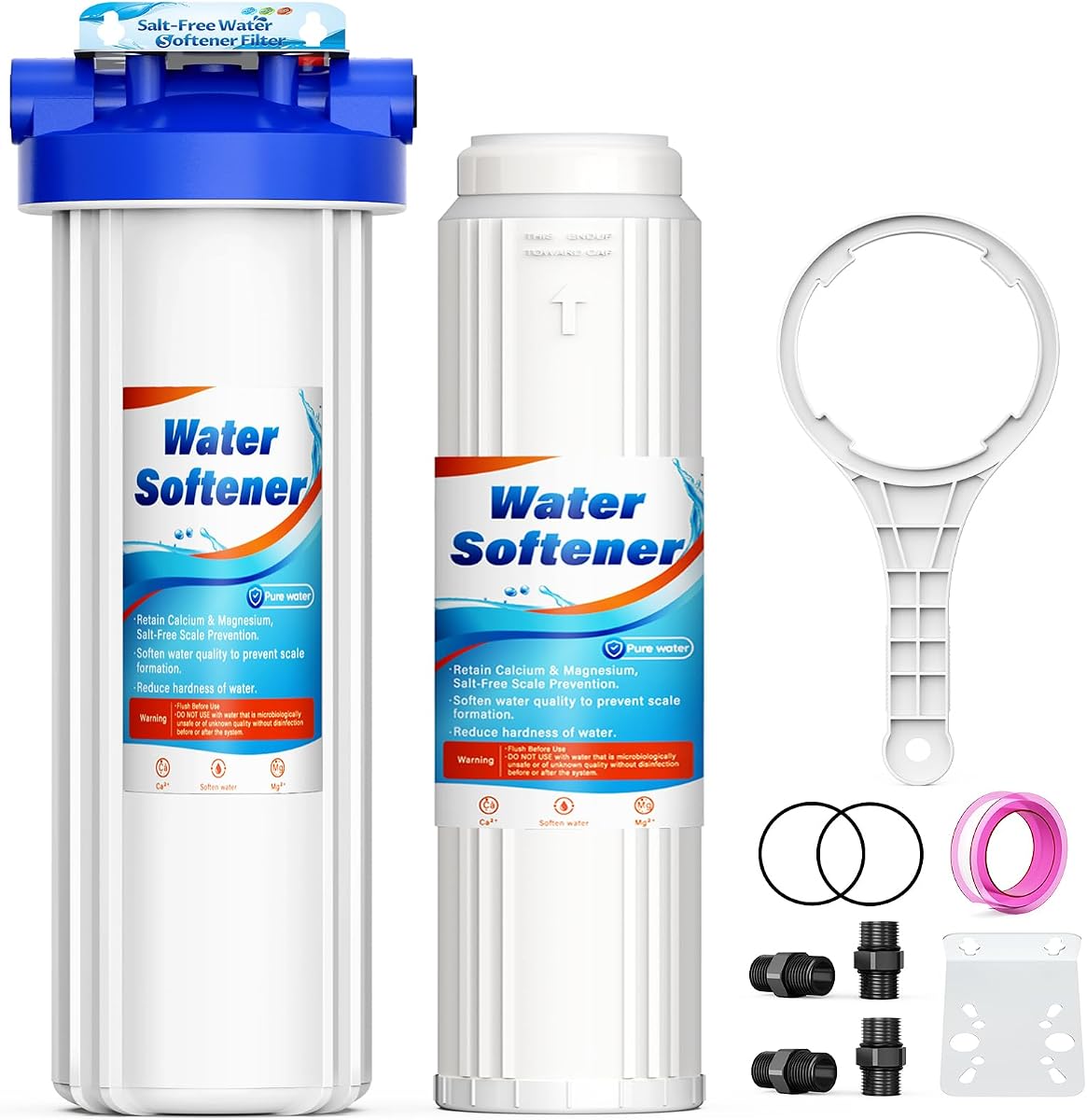
This 3/4-inch whole-house system offers salt-free scale control, sediment and odor reduction, and a stated flow rate of 15 gallons per minute. Its 5.0 rating is supported by supplied features such as 0.5-micron filtration, double O-ring sealing, and the inclusion of both 3/4-inch and 1/2-inch connectors. It is designed for homes where several fixtures may operate at once.
We may earn a commission when you buy through this link, at no additional cost to you.
The filter media is intended to reduce the effects of limescale while retaining minerals such as calcium and magnesium. It is also advertised to address chlorine, odor, and impurities while protecting pipes, water heaters, dishwashers, faucets, and fixtures. Because the media preserves minerals, a TDS tester will not register a meaningful change even when scale-prevention performance is working as intended.
Installation appears designed with do-it-yourself households in mind. The package includes a filter housing, softener filter, wrench, thread tape, two 3/4-inch faucet connectors, two 1/2-inch faucet connectors, and a manual. The main ongoing task is replacing the cartridge approximately every four to six months to maintain filtration performance.
This is an attractive choice for buyers who prioritize capacity, compactness, and straightforward connection options over UV treatment or a multi-stage manufacturer ecosystem. It is still a scale-control filter rather than a traditional hardness-removing softener, and households with unusual plumbing or very high demand should verify compatibility before ordering. For a capable high-flow compact system, it stands out.
A stated 15-gallon-per-minute flow rate makes this model suitable for households seeking to avoid the restrictions associated with lower-capacity housings. Installation near the main shutoff is the logical location for distributing treated water throughout the property.
The 0.5-micron filter supports sediment and impurity reduction, but maintaining that performance requires replacing the cartridge every four to six months. Budget-conscious shoppers should include those replacement intervals in their ownership plan.
We may earn a commission when you buy through this link, at no additional cost to you.
The Whole House Salt Free Water Softener uses ion-exchange media to inhibit scale while preserving calcium and magnesium. It holds a 5.0 rating and is positioned for households with high water demand. The system also includes a CTO filter, allowing it to address scale and carbon-related taste, odor, or chlorine concerns in a single unit.
We may earn a commission when you buy through this link, at no additional cost to you.
Scale control is the primary function, with the media intended to help protect water heaters, dishwashers, faucets, showers, and associated plumbing. Because the approach retains healthy minerals and uses no salt, it offers a different experience from conventional softeners that exchange hardness ions for sodium or potassium. It also does not require electricity or generate wastewater.
Installation is described as straightforward, with standard fittings, a wrench, thread tape, adapters, and a manual included. Maintenance is lighter than salt-based operation, but the softener resin filter still needs replacement every six to twelve months according to the supplied information. That interval makes ownership more predictable than purchasing and lifting salt bags.
This model suits users who want scale prevention and basic carbon filtration without changing the water's mineral content. It will not produce the same measured hardness reduction as a true softener, and buyers should judge it by scale control and taste improvements rather than TDS changes. Its broad package and low-waste operation make it a flexible whole-house option.
The ion-exchange media inhibits deposits while leaving calcium and magnesium in the supply. This makes the system attractive for users who prefer not to have hardness minerals removed or replaced through conventional salt-based ion exchange.
Standard fittings and included adapters make planning the installation comparatively direct. A resin filter replacement every six to twelve months is the primary maintenance task, with no salt, electrical supply, or wastewater drain required.
We may earn a commission when you buy through this link, at no additional cost to you.
The E-3000UV is the most feature-rich premium option in this group, combining sediment filtration, carbon block filtration, salt-free softening, and UV treatment. Its 4.7 rating reflects the added microbial-control stage while preserving the convenience of a single whole-house system. It is specifically designed for city-water applications.
We may earn a commission when you buy through this link, at no additional cost to you.
UV light provides a chemical-free treatment stage and is advertised to neutralize up to 99.9% of common waterborne microorganisms. The remaining filtration stages target up to 95% of sediment and more than 155 chemical contaminants, including chlorine, chloramine, VOCs, and pesticides. These claims make the unit relevant to households seeking more comprehensive treatment than a basic scale cartridge provides.
The system still avoids salt, brine discharge, electricity, and bulky tanks. It therefore maintains the operational simplicity of the standard E-3000 while adding a specialized UV stage. It is not intended to replace every specialized treatment measure, but it consolidates several common water-quality goals into a more capable whole-home package.
The E-3000UV is the premium recommendation for buyers who value the added UV stage and want filtration as well as scale management. Those prioritizing only scale prevention may find a less elaborate system adequate, while well-water households should avoid assuming that a city-water system automatically covers every contaminant or condition found in a private well. For advanced city-water treatment, this model is the most complete choice here.
The UV stage is designed to neutralize common waterborne microorganisms without chemical dosing. It differentiates this model from ordinary scale filters and can be especially appealing to households seeking broad treatment in one compact point-of-entry unit.
Sediment, carbon, salt-free softening, and UV stages address several aspects of water quality in a single design. The 120-day satisfaction guarantee provides added confidence, while city-water positioning keeps the intended use clear.
We may earn a commission when you buy through this link, at no additional cost to you.
The Compact Scale Prevention System uses salt-free ion-exchange media to inhibit scale formation throughout a household's plumbing and appliances. Its 5.0 rating reflects a focused alternative to traditional salt-based treatment. It is intended for households seeking whole-home scale control without changing the mineral content of the water.
We may earn a commission when you buy through this link, at no additional cost to you.
The product information says the media retains beneficial calcium and magnesium while helping protect water heaters, dishwashers, faucets, and showers. Operation requires no salt, electricity, or wastewater discharge, reducing environmental impact and eliminating the need for a floor drain. The system is also presented as appropriate for drinking and gardening applications because it does not add sodium.
Compared with multi-stage models, its primary strength is simplicity. The main upkeep is replacing the softener resin filter every six to twelve months, depending on use and water conditions. Standard fittings and a do-it-yourself installation approach further reduce setup complexity, although local plumbing codes and household layouts still apply.
This model is a sensible choice for a homeowner whose main concern is scale rather than broad contaminant filtration. It does not reproduce the filtration variety offered by the Kind, NU Aqua, or multi-stage carbon systems, and it should not be confused with a true hardness-removing softener. For uncomplicated salt-free scale management, it is a focused and practical option.
The system focuses on inhibiting deposits rather than removing hardness from the water. That narrower goal is useful for households primarily concerned about scale on fixtures, inside water heaters, and throughout household plumbing.
A salt-free, non-electric design operates without a regeneration tank or wastewater line. Only the resin filter needs periodic replacement, making the setup smaller and potentially easier to accommodate than a traditional softener.
We may earn a commission when you buy through this link, at no additional cost to you.
This Kind Water Systems model is a whole-house salt-free alternative focused on protecting plumbing and appliances from hard-water scale. Its 4.4 rating reflects a clear combination of sediment filtration, zero water waste, and easy installation. It offers a simpler treatment proposition than the brand's multi-stage E-3000 models.
We may earn a commission when you buy through this link, at no additional cost to you.
A reusable sediment cartridge is designed to filter dirt, sand, silt, clay, rust, and other debris. This particulate filtration can help protect downstream components and improve the basic clarity of the water. Scale-prevention features add value for households that want to reduce mineral deposits without introducing salt into the supply.
The unit operates without wastewater and uses a cartridge that can be reused rather than discarded after a short service interval. Installation is designed to be straightforward, and the low-maintenance format avoids salt replenishment, brine discharge, and electrical operation. A 120-day satisfaction guarantee provides an additional purchasing assurance.
This system is most appropriate for readers who want dependable sediment control and whole-house scale protection in a straightforward package. It does not offer the same broad chemical filtration claims as the E-3000 or E-3000UV, and it should not be selected to replace certified treatment for a known contaminant. For simple sediment and scale management, however, it remains a practical choice.
The reusable cartridge targets sediment, sand, silt, clay, rust, and other debris. Reuse can reduce ongoing cartridge waste while providing an appropriate first stage of protection for the rest of the household plumbing.
Salt-free scale protection and zero wastewater distinguish this model from conventional softeners. It is a practical option when preventing deposits is the priority and full multi-stage contaminant reduction is not required.
We may earn a commission when you buy through this link, at no additional cost to you.
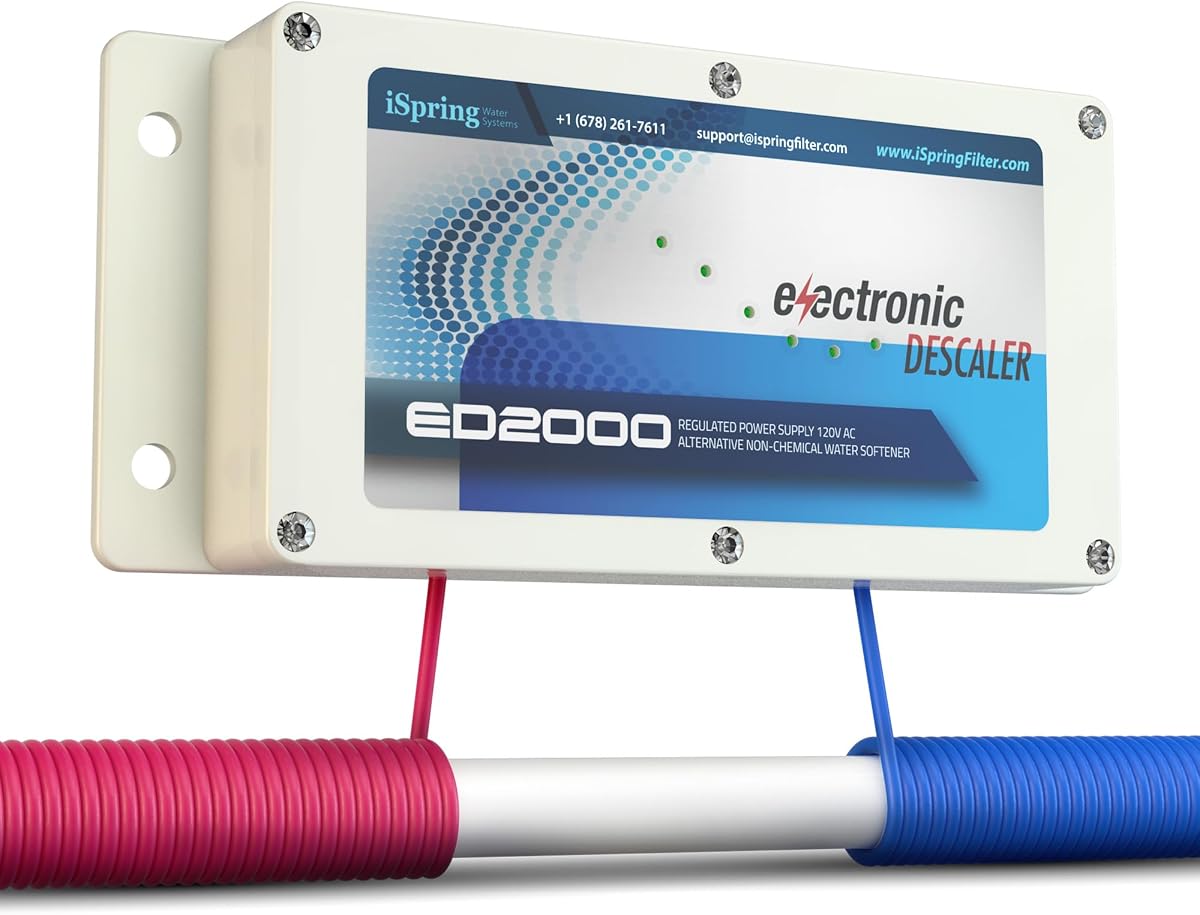
The iSpring ED2000 is an electronic whole-house descaler rather than a filtering or ion-exchange softener. Its 4.1 rating reflects a practical alternative for households seeking to address scale without salt, chemicals, or changes to water chemistry. It installs around the main water line and is designed to work with PEX, PVC, and other pipe types.
We may earn a commission when you buy through this link, at no additional cost to you.
The device uses an electronic signal intended to reduce existing scale and discourage new deposit formation throughout the plumbing system. It is positioned for very hard-water areas, including conditions described as 10 to 19 grains per gallon. iSpring also states that the system can reduce energy consumption associated with scaled equipment and help extend appliance life.
Installation requires no major plumbing modifications, and the unit needs no routine maintenance. Because it leaves calcium and magnesium in the water, it offers a different result from a conventional softener: users may notice improved scale behavior without a large reduction in measured hardness. It does not filter sediment, chlorine, metals, or microorganisms.
The ED2000 is best suited to a specific need: managing scale in a whole-home plumbing system while avoiding salt, electricity, and drain requirements. Buyers who need contaminant filtration or a measurable hardness reduction should select a filter or true softener instead. For straightforward electronic conditioning, it offers a compact, low-maintenance approach with lifetime technical support.
Unlike ion exchange, the ED2000 does not replace hardness minerals or add sodium. It conditions the water to help with scale behavior while leaving its chemical composition intact, which may appeal to users focused on mineral retention.
The electronic housing can be installed on the incoming water line without extensive plumbing modifications. Compatibility with PEX and PVC and the absence of routine maintenance make it convenient for retrofits where space is limited.
We may earn a commission when you buy through this link, at no additional cost to you.
The iSpring EDV2 is an upgraded electronic whole-house descaler with a stated output of up to 12 watts. Its 4.1 rating aligns with the ED2000, but the EDV2 differentiates itself through stronger stated power, aluminum alloy construction, and a more detailed feature set. It is designed to prevent scale without removing beneficial minerals.
We may earn a commission when you buy through this link, at no additional cost to you.
Like other salt-free conditioners, it leaves water chemistry unchanged and does not perform the job of a conventional softener. The supplied information indicates that the electronic treatment can address scale in pipes and help protect water-using appliances, while also helping reduce energy consumption associated with scale buildup. The product is presented as especially useful for households concerned about hard-water effects.
Installation is designed to avoid plumbing modifications and works with all pipe types, including PEX and PVC. The electronic unit is maintenance-free in the sense that it does not use replacement filters, salt, or regenerating tanks, though its battery eventually needs attention. The manufacturer provides a one-year limited warranty upon registration and ongoing lifetime support.
The EDV2 is a good option for buyers seeking stronger electronic conditioning in a durable housing without altering the composition of their water. It does not filter contaminants and is unsuitable for anyone whose main requirement is genuine hardness removal. Within the electronic-descaler category, however, its stated output and construction make it the more advanced of the two iSpring options here.
The stated 12-watt output and robust battery set the EDV2 apart from simpler electronic descalers. The goal is whole-home scale prevention while retaining the convenience of a unit that requires no salt, drain, or continuous power supply.
An aluminum alloy housing is intended to resist corrosion and damage over extended use. Installation on PEX, PVC, and other pipe types without plumbing modifications makes the EDV2 convenient for existing homes.
We may earn a commission when you buy through this link, at no additional cost to you.
The NuvoH2O home system uses CitraCharge technology to soften water without salt while retaining calcium and magnesium. It holds a 3.9 rating, making it the least highly rated product in this comparison, but it offers a distinctive approach that remains relevant for households seeking salt-free softening and filtration in a compact format.
We may earn a commission when you buy through this link, at no additional cost to you.
The citrus-based system is intended to prevent and remove existing hard-water scale, helping protect plumbing, water heaters, and appliances. Its filtration stage is also advertised to remove harsh chemicals and improve taste. Because the treatment retains healthy minerals rather than exchanging them for sodium or potassium, it provides a different result from a standard ion-exchange softener.
Operation requires no salt, phosphates, wastewater, or electricity. Quick-connect, self-contained cartridges can be replaced in a streamlined manner and are stated to last up to six months. This compact approach avoids the large salt and brine tanks associated with conventional softening while combining filtration and scale management in one system.
The NuvoH2O is most suitable for a homeowner who values a salt-free, mineral-retaining system and is comfortable with scheduled cartridge replacement. Its lower rating warrants a more cautious recommendation than the leading multi-stage systems, particularly for buyers who need the strongest broad filtration claims. Still, its environmental profile, compact design, and citrus-based softening method give it a clear niche.
CitraCharge technology provides the core scale-control method without sodium exchange. Retaining calcium and magnesium distinguishes the system from traditional salt-based softeners and supports the NuvoH2O's natural-mineral positioning.
Quick-connect cartridges simplify replacement, with a stated service life of up to six months. The compact format needs no salt tank, drain connection, or electrical supply, though a regular cartridge schedule is necessary.
We may earn a commission when you buy through this link, at no additional cost to you.
The right salt-free system depends on whether the priority is broad filtration, scale inhibition, mineral retention, or simple electronic conditioning. Consider treatment method, whole-home flow, plumbing layout, maintenance commitments, and the specific contaminants present in the incoming water.
A salt-free product marketed as a softener alternative does not necessarily reduce hardness in the same way as a conventional ion-exchange system. Filter-based options inhibit scale, electronic descalers condition the water, and mineral-retaining technologies keep calcium and magnesium in place. Compare the actual treatment method rather than relying on the word softener in the product title.
Different systems address different issues. Sediment filters catch sand, silt, rust, and clay; carbon stages target chlorine, odors, taste, and certain chemicals; scale-prevention media protects plumbing; UV adds microorganism treatment. Private wells may require treatment for microorganisms, iron, sulfur, or other conditions that city-water systems are not designed to address.
A point-of-entry system must support the household's peak demand. The compact 3/4-inch option in this guide states a 15-gallon-per-minute flow rate, while other models do not provide equivalent figures in the supplied information. Larger homes, multiple bathrooms, outdoor spigots, and simultaneous appliance use can place greater demand on a filter housing.
Most whole-house systems belong near the main shutoff or cold-water line. Some products include 1/2-inch, 3/4-inch, or reducing connectors, while the E-3000 models are described as compact but still require adequate clearance and access. Electronic descalers are easier to retrofit because they need no major plumbing modifications, but every installation should follow applicable plumbing requirements.
Salt-free does not always mean maintenance-free. Filter systems may require cartridge or resin replacement every four to twelve months, depending on the model and use. Electronic descalers avoid replacement filters but need battery service. Multi-stage systems offer more treatment but may involve more components, so buyers should compare both maintenance frequency and cartridge availability.
If the main objective is to reduce white deposits on faucets, shower glass, water heaters, and appliances, look for explicit scale-inhibition claims. Some products additionally remove existing scale, while others are designed primarily to prevent new buildup. Higher contaminant-reduction claims do not automatically mean stronger scale performance, so evaluate each benefit separately.
The defining appeal of salt-free treatment is the absence of routine salt use, brine discharge, and continuous electricity. Filter-based systems remain compact, while electronic descalers are usually the least mechanically involved. Buyers should also account for cartridge waste, available replacement parts, and whether the available installation space can accommodate the complete unit.
Several products preserve calcium and magnesium, so total dissolved solids may remain unchanged even when scale, odor, or taste improves. TDS alone is therefore not a reliable measure of a salt-free system's performance. Consider the stated contaminant targets, the specific problem being addressed, and any professional water analysis before deciding whether a model is meeting expectations.
Begin with a baseline assessment of the incoming water and identify the specific problems you want to address. Measure the available installation area, locate the main shutoff, confirm pipe size, and make sure the selected product is appropriate for municipal water, well water, or the local supply conditions. Filter-based systems generally need to be installed at the point of entry so every indoor and outdoor outlet receives treated water.
Follow the included manual for orientation, connection, flushing, and cartridge replacement. Electronic descalers are installed around the main water line, while cartridge systems must be connected in the correct flow direction. After installation, check every fitting for leaks and run the system as directed to clear residual water or loose media. Never assume the connector size included with a listing will fit an unusual or older plumbing setup.
Create a maintenance plan based on the product type. Replace filter cartridges or resin media at the stated interval and more often if flow becomes restricted or water quality changes. Electronic descalers need periodic battery checks, while salt-free systems with carbon stages may require attention to taste, odor, or pressure changes. Keep replacement parts available and periodically inspect seals, housing connections, and the area beneath the unit for signs of leakage.
Most salt-free alternatives inhibit scale or condition the water rather than removing hardness through conventional ion exchange. They can help control deposits while retaining calcium and magnesium, so a hardness tester may not show a major reduction. Buyers who need a measurable decrease in hardness should look for a true ion-exchange softener and accept its salt, wastewater, and regeneration requirements.
Yes, scale-inhibiting systems are designed to reduce the buildup that can restrict water heaters, dishwashers, faucets, and other appliances. They work by limiting deposits rather than stripping hardness minerals from every molecule of water. Protection is not guaranteed for pre-existing scale, and results depend on installation, water conditions, and consistent use.
They avoid the routine consumption of salt and the brine discharge associated with traditional regeneration, and they do not require electricity in most models. However, filter-based products may still create waste through spent cartridges. The overall benefit depends on cartridge life, replacement practices, system longevity, and how the unit is installed and maintained.
The filter-based systems reviewed here operate without electricity, brine discharge, or a wastewater drain. Electronic iSpring descalers also require no household electricity, although their internal battery will eventually need replacement. Installation still must comply with local plumbing requirements, and some conventional home treatment components may require an appropriate discharge or power source.
Many salt-free systems deliberately retain calcium and magnesium, and total dissolved solids primarily reflects dissolved minerals in the water. A scale-inhibiting or electronic conditioning product may therefore improve scale behavior without changing the TDS reading. Evaluate the product against its stated targets and, where appropriate, use contaminant-specific testing instead of relying on TDS alone.
Only after testing the well and identifying the contaminants that require treatment. The Kind E-3000 and E-3000UV products are specifically described for city water, while some other units do not make the same claim. Well water may contain sediment, iron, sulfur, bacteria, or other issues requiring dedicated media or disinfection, so confirm the complete treatment plan before purchasing.
Maintenance depends on the design. The compact 3/4-inch system specifies cartridge replacement every four to six months, while certain resin-filter systems recommend replacement every six to twelve months. Electronic descalers require no filter changes but need occasional battery service. Replacing a cartridge on schedule is important for maintaining filtration and flow performance.
Space requirements vary by model. Compact point-of-entry housings need enough room for the filter, connections, and cartridge removal, while electronic descalers generally need only room around the pipe-mounted housing. Measure vertical and horizontal clearance, keep the unit accessible for maintenance, and confirm that the available pipe diameter and nearby shutoffs will not interfere with installation.
The Kind Water Systems E-3000 stands out as the most balanced overall choice because it combines sediment filtration, carbon block filtration, and salt-free scale protection without salt, electricity, or wastewater. The E-3000UV is the premium selection for households that also want a dedicated UV treatment stage, while the compact 3/4-inch system offers a high-flow alternative with fine filtration and flexible fittings.
Prioritize the treatment outcome your household actually needs. Broad contaminant filtration, heavy-metal particle reduction, citrus-based softening, sediment control, and electronic conditioning are not interchangeable. Confirm flow requirements, connector sizes, installation space, cartridge availability, and the distinction between scale prevention and true hardness removal before purchasing.
Current pricing, availability, warranty terms, and manufacturer details can change, so check the product listing before ordering. Compare the supplied characteristics with a water test and local plumbing requirements, and select professional installation when the connection work is beyond your experience or permitted by local rules.