
Zoom H1 Essential Recorder
4.1Editor score
Compact stereo field capture
USB-C streaming and calls
Built-in microphone recording
Our expert guide compares the best portable recorders for field recording, covering audio quality, inputs, portability, timecode, storage, and creator
Portable recorders for field recording give filmmakers, musicians, journalists, and podcasters a dependable way to capture high-quality sound beyond a controlled studio. The best models balance accurate capture, flexible connectivity, long battery life, simple operation, and enough protection for mobile use. Recording formats, microphone options, and timecode features can vary significantly across models.
This guide compares ten recorders using the information supplied for each product. It examines microphone configurations, XLR and TRS connectivity, multitrack capabilities, 32-bit float recording, sample-rate options, USB workflows, storage support, display features, and specialized functions such as timecode generation. The list includes general-purpose handheld recorders, wearable lavalier systems, music-focused recorders, and compact professional field units.
Each review identifies the most useful qualities and sensible compromises of its featured model. The first three recommendations cover a compact budget-friendly recorder, a versatile all-around option, and a professional field recorder, while the remaining entries cover needs ranging from multitrack music production to timecode-assisted video work. Product prices and availability can change, so readers should confirm current details before purchasing.
4.1Editor score
4.4Editor score

4.6Editor score
The comparison below places all ten recorders side by side, focusing on the features that most affect field capture: microphone configuration, input flexibility, recording format, multitrack capability, portability, and workflow features.


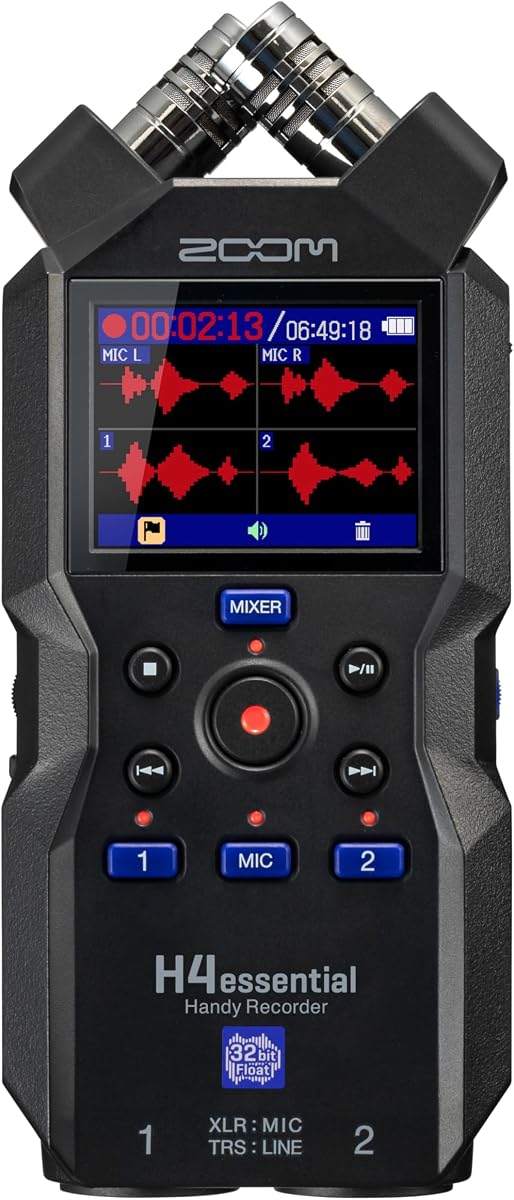
The Zoom H4 Essential is a flexible handheld recorder for creators who want to move between interviews, music, podcasts, video narration, and live environments without changing equipment. It carries a 4.4 rating and stands out for combining built-in stereo microphones with two XLR/TRS inputs. That combination allows a user to capture a location sound with the internal pair while also recording a separately placed microphone or instrument.
We may earn a commission when you buy through this link, at no additional cost to you.
Its four-track capability is the central advantage. The supplied information specifically supports recording music, interviews, podcasts, video audio, live performances, and broader field recordings without distorted takes. The two XLR/TRS inputs can accept microphones, instruments, a mixer, or a soundboard, giving the recorder more usefulness than a basic voice memo or compact stereo-only model. Its portability is balanced by a body designed to be held during location work rather than treated as a stationary studio device.
The H4 Essential also supports USB-C connection to a phone, tablet, or computer for recording or streaming while independently saving a backup to an SD card. That dual-path approach is valuable when reliability matters because it provides separate options for live digital workflow and local file capture. Spoken menu guidance makes the interface more approachable, particularly for visually impaired users or anyone who prefers directed operation over memorizing complex menu structures.
The primary compromise is that it is not as small or specialized as the H1 Essential or wearable F2. It is still more equipment than someone needs for simple ambience collection, and some users may need to add microphones or cables for professional location sound. Even so, the combination of four tracks, external inputs, built-in microphones, and direct computer connectivity makes the H4 Essential the most balanced general-purpose option in this guide. It is the strongest recommendation for a creator who wants one recorder for several kinds of work.
The H4 Essential can begin recording with its stereo microphones and expand into a more structured setup through its two XLR/TRS inputs. That makes it easy to capture ambience in one channel, dialogue on another, or a musician and an instrument in a compact production setup.
USB-C supports connection to computers, phones, and tablets, while SD card recording provides a local route for backing up captures. Using both options can add workflow flexibility without requiring a second recorder.
We may earn a commission when you buy through this link, at no additional cost to you.
The Zoom H1 Essential is a compact stereo recorder aimed at musicians, podcasters, and content creators who need a straightforward way to improve sound capture away from a studio. It has a 4.1 rating and focuses on the kinds of tasks that can be complicated by carrying a larger system. Those tasks include short interviews, voiceovers, rehearsals, lessons, video clips, travel recordings, and natural ambience.
We may earn a commission when you buy through this link, at no additional cost to you.
Its built-in microphones provide natural stereo recording without requiring a separate microphone setup. The supplied product information highlights uses ranging from tutorials, reels, behind-the-scenes clips, songwriting, acoustic performances, and jam sessions to conversations, lectures, meetings, and documentation. For field recording, this makes it a practical option for gathering room tone, environmental sound, travel audio, and sound effects while remaining small enough to carry as an everyday creative tool.
USB-C expands the H1 Essential beyond standalone recording. It can function as a microphone for livestreams, remote meetings, video calls, voiceovers, podcasts, and desktop or mobile recording. This is particularly useful for creators who want to move between location capture and direct digital communication without carrying another interface. The result is a device that supports both captured audio and real-time use.
Its limitations are inherent in its simplified design. Unlike multitrack recorders, it does not offer the supplied feature set of several XLR inputs, and it is less suitable for a complex location rig with multiple microphones, instruments, or mixers. The 4.1 rating also places it below several more specialized units, but that does not diminish its value for simpler assignments. It is the budget-conscious choice for users who want portable stereo capture and USB-C flexibility without a larger professional field rig.
The built-in microphone arrangement is designed to make stereo capture immediately accessible. It suits ambience, rehearsals, lessons, short conversations, and other assignments where environmental context matters as much as isolated dialogue.
USB-C turns the recorder into a usable microphone for meetings, livestreams, calls, and mobile or desktop recording. Creators can pack one device for both planned field sessions and spontaneous communication.
We may earn a commission when you buy through this link, at no additional cost to you.
The Zoom H1 XLR combines a compact two-channel format with professional input and monitoring features. Its 4.5 rating reflects a particularly balanced configuration for filmmakers, musicians, and podcasters who need external microphones but do not require a four-track handheld body. The model records in 32-bit float at 96kHz, providing a high-resolution option with a wide range of practical recording latitude.
We may earn a commission when you buy through this link, at no additional cost to you.
Two XLR/TRS combination inputs accept microphones, instruments, and other compatible sources. This gives users more control over placement than an internal stereo microphone pair alone, particularly for interviews where a close lavalier, a directional microphone, or a stereo pair may be required. The OLED waveform display is one of its most important practical features because it gives immediate visual information about signal levels and helps users judge whether a take is clean.
Additional flexibility comes from the 3.5mm stereo input and headphone output. The headphone connection permits monitoring during capture, while the small input can accept an additional audio source. Storage support extends to 1TB SDXC cards, which is especially helpful for extended field sessions and high-quality recordings. Together, the waveform display, external inputs, and large storage ceiling make this a convincing recorder for location professionals who prefer a compact two-channel setup.
The central trade-off is channel count. Two channels are enough for a focused interview, a stereo source, a performer with an instrument, or a production involving a small number of microphones, but they are not sufficient for the same multitrack flexibility offered by the H4 Essential, H5 Studio, R4, or DR-40XP. For users who need more than two simultaneous channels, the H1 XLR would require a more extensive setup. For those who do not, it provides an excellent balance of compactness, visibility, and professional input access.
The OLED waveform display helps users monitor levels without waiting to review the file. This is valuable during interviews and location work because it reduces reliance on a separate metering device.
Recording at up to 32-bit float and 96kHz suits projects that value both detailed capture and a wide range of usable levels. The two-channel format keeps the recording system focused and manageable.
We may earn a commission when you buy through this link, at no additional cost to you.
The Zoom F3 is built for filmmakers, musicians, and recordists who cannot afford to lose a take because a sudden sound exceeded the set recording level. It has a 4.6 rating, tied for the highest among the featured products, and its defining advantage is 32-bit float recording. That feature allows the recorder to capture quiet dialogue and unexpected peaks with less risk of distortion, reducing the need to stop and adjust gain during run-and-gun work.
We may earn a commission when you buy through this link, at no additional cost to you.
Its dual locking XLR inputs add physical security when the unit is mounted in a larger rig or placed somewhere that is not easy to reach. A locking connection is more dependable than a loose connector during movement, which is important in a field environment. Ultra-low-noise preamps support clean, consistent capture when conditions are not controlled, while the compact professional format gives serious users a focused two-channel recorder rather than an overloaded consumer device.
Power and workflow flexibility help the F3 handle long days on set or on location. The supplied information notes flexible power options and both standalone and USB workflows, allowing it to operate as an independent recorder or integrate into a computer-based production process. The lack of a need for constant gain adjustment also reduces operational friction, allowing a recordist to focus on placement, monitoring, and performance rather than riding a level control.
The F3 is specialized by design. It is not the natural first choice for someone wanting built-in microphones, multitrack layering, rhythm accompaniment, or a broad collection of creative tools. It also presents a higher financial commitment than the compact models. For a professional who values robust capture, secure connections, and reliable behavior under unpredictable conditions, however, those limitations are outweighed by the F3's focused performance. It is the premium field-recording recommendation in this guide.
Thirty-two-bit float recording is valuable when a location includes a quiet conversation followed by a sudden loud sound. The broad capture range reduces the chance that either portion of the recording will be unusable.
Locking XLR inputs remain secure when the recorder is mounted away from the operator. This makes the F3 especially suitable for location work where cables may be moved, routed, or exposed to ordinary production wear.
We may earn a commission when you buy through this link, at no additional cost to you.
The Zoom R4 is a portable multitrack recorder built primarily around music creation rather than conventional location recording. It has a 4.5 rating and stands out because it can capture up to four tracks, mix and bounce them to a dedicated bounce track, and then continue adding layers. An undo function also gives users room to correct an arrangement without starting an entire session again.
We may earn a commission when you buy through this link, at no additional cost to you.
Its 32-bit float recording technology provides clip-free capture without requiring continual gain adjustments. For musicians tracking vocals, instruments, or ideas on the fly, that means the recorder can remain focused on performance rather than being interrupted by level management. Two XLR/TS combination inputs provide connections for microphones, instruments, keyboards, and other sources, making the R4 more flexible than a simple voice recorder while remaining approachable for songwriters.
The built-in rhythm section includes more than 80 patterns across genres such as rock, hip hop, funk, and metal. This is a distinctive benefit for a musician who wants to develop an idea immediately without first setting up a separate backing track. Effects, rhythms, multitrack bouncing, and the built-in stereo microphone give the R4 several ways to make a recording usable without a large studio setup.
It also functions as a 32-bit float two-in, two-out USB audio interface for a computer or smartphone and can run on four AA batteries or USB-C power. That makes it adaptable to mobile music sessions. The trade-off is that its rhythm and effect features are less relevant to a documentary recordist who primarily wants clean location sound, and the expanded controls require more learning than a simple stereo recorder. Even so, it is a compelling choice for musicians who want portable recording, layering, and accompaniment in one device.
Four-track capture and a dedicated bounce track allow performers to build arrangements over time. The process is particularly useful for singers and songwriters who want to add parts while retaining a manageable number of active channels.
More than 80 built-in rhythm patterns give users a way to accompany an idea without preparing backing tracks in another program. It turns the recorder into a compact sketching and practice instrument as well as an audio capture tool.
We may earn a commission when you buy through this link, at no additional cost to you.
The Zoom F2 is a compact wearable recorder designed for interviews, vlogs, on-camera productions, journalism, and other assignments where a visible microphone setup may be undesirable. It has a 4.0 rating and includes an LMF-2 omnidirectional lavalier microphone with a screw-lock connector, windscreen, and lapel clip. That included microphone means the system can be used for personal recordings without requiring a separate lavalier purchase.
We may earn a commission when you buy through this link, at no additional cost to you.
The F2 records at 32-bit float and supports 44.1kHz or 48kHz capture. As with other float recorders in this guide, the benefit is a wide level range without the need to continually adjust gain. For a wearable recorder used on a person who may turn, move, or speak at different volumes, automatic handling of a broad dynamic range is particularly useful. The package emphasizes convenience and secure placement rather than a collection of onboard microphones.
Its portability is reinforced by a stated battery life of up to 15 hours on two AAA batteries. MicroSD, microSDHC, and microSDXC cards up to 512GB are supported, allowing long-form interviews, film shoots, and extended sessions. A REC Hold switch helps prevent accidental stops during important recordings, while the internal clock has a stated accuracy of plus or minus 0.5ppm for synchronization with video.
The wearable design is the central trade-off. The F2 is not a broad stereo field recorder with a built-in microphone array, and its included LMF-2 configuration is more specialized than a pair of XLR microphones. It is also less appropriate for capturing a location's natural stereo ambience. For solo presenters, discreet interview subjects, and mobile video creators, however, the F2 offers an unusually practical combination of small size, long battery life, clip-free capture, and synchronization-oriented timing.
The included lavalier, screw-lock connection, windscreen, and lapel clip create a secure, unobtrusive capture arrangement. This suits productions where keeping the microphone out of the frame is important.
Up to 15 hours of operation and support for cards as large as 512GB reduce the likelihood of an interrupted session. A REC Hold control and the precise internal clock further support critical recordings.
We may earn a commission when you buy through this link, at no additional cost to you.
The EVIDA 9296 is a high-capacity digital voice recorder designed for lectures, meetings, speeches, interviews, and spoken notes. It has a 4.3 rating and distinguishes itself with 128GB of built-in storage. The supplied information states a capacity of up to 9,296 hours of recording, or 54 hours of continuous recording with a full battery, making it appealing to users who want extended sessions without managing removable storage.
We may earn a commission when you buy through this link, at no additional cost to you.
Voice activation is the defining convenience. The recorder can be set to six different voice-decibel levels, allowing it to capture speech while reducing blank sections and whispered fragments when the threshold is set appropriately. This is helpful for unattended meetings, lectures, or interviews because it can reduce the need to manually start and stop the device. A microphone with noise cancellation and a recording chip support clear speech capture, while playback provides a convenient way to review files.
File management is handled through four storage folders labeled A, B, C, and D. Other useful functions include A-B repeat, bookmarks, automatic recording, and password protection. Files can be transferred to a computer, and the device can also work as a USB flash drive and MP3 player. Recording formats include MP3 at 128kbps or 192kbps and WAV at 1536kbps, giving users a choice between compact storage and higher-quality files.
This is not a field recorder for building a multitrack music production, operating a complex XLR rig, or generating professional timecode. Its strengths are storage, voice activation, organization, and straightforward documentation. Buyers seeking a wearable professional microphone system, stereo ambience capture, or multiple external inputs will find the Zoom products better aligned with those tasks. For students, teachers, business users, writers, senior listeners, and meeting documentation, the EVIDA 9296 offers a large amount of storage in a focused voice-recording format.
A claimed 128GB of internal storage and a stated recording capacity of 9,296 hours suit long lecture, meeting, and interview series. The included storage reduces the need to stop a session to change memory cards.
Six adjustable voice-decibel levels make voice activation more adaptable to different recording conditions. Four storage folders, bookmarks, repeat playback, and password protection help users organize and protect extended recordings.
We may earn a commission when you buy through this link, at no additional cost to you.
The Zoom H5 Studio is a premium handheld recorder for filmmakers and musicians who want a large stereo microphone array, 32-bit float capture, and flexible multitrack recording. Its 4.5 rating reflects a feature set aimed at serious location and performance work. The 19.4mm X/Y microphone capsule is emphasized as the largest microphone set on a handheld recorder, providing rich, detailed stereo audio with a wide dynamic range.
We may earn a commission when you buy through this link, at no additional cost to you.
Thirty-two-bit float recording adds a wide margin for unexpected peaks, reducing the risk of losing a take when levels change quickly. Dedicated gain knobs give users direct, tactile control over input levels, which is useful when a recorder is being monitored quickly during a shoot or rehearsal. Those manual controls complement the recorder's automatic tolerance for large level changes, giving the operator both flexibility and insurance.
The H5 Studio can record up to four tracks simultaneously and supports WAV capture at up to 192kHz. That makes it more versatile than a basic stereo-only field recorder and suitable for projects that demand high-resolution source material. Its lightweight design and battery operation support use on location, in the field, or while traveling. The combination of stereo recording, external production possibilities, and high-resolution multitrack capture is particularly attractive to filmmakers and musicians who need a capable standalone unit.
Its larger size and higher financial commitment make it less appropriate for a casual user who only needs occasional voice notes. Users should also consider whether their storage and postproduction workflow can comfortably handle high-resolution multitrack files. For a creator whose priority is microphone quality, tactile gain control, and professional handheld capture, though, the H5 Studio makes a strong case. It is the high-audio-quality choice in this roundup.
The 19.4mm X/Y capsule configuration emphasizes full-bodied stereo recording. It is a strong match for ambience, ensembles, location sound, and productions that benefit from a detailed built-in microphone array.
Dedicated gain knobs make quick manual adjustments possible, while 32-bit float recording provides extra protection against accidental clipping. Creators can respond to a performance while retaining a safety net for sudden peaks.
We may earn a commission when you buy through this link, at no additional cost to you.
The TASCAM DR-40XP is a four-channel portable recorder for musicians, filmmakers, and interview producers who want adjustable built-in microphones along with external input options. It has a 4.1 rating and supports 32-bit float recording through ultra-low-noise HDDA preamps. The stated maximum sound pressure level of 125 dB SPL gives the built-in microphone system considerable headroom for environments that range from quiet interiors to demanding sources.
We may earn a commission when you buy through this link, at no additional cost to you.
The microphones can be arranged in A-B or X-Y configurations. That choice allows a user to favor focused, directional coverage or broad stereo separation depending on the scene. The recorder can also capture its built-in microphones and external inputs at the same time across four channels, making it useful for filming a performance, recording a presenter and a guest, or layering a room with separate microphones.
Two XLR/TRS inputs support external microphones and other compatible sources. A two-in, two-out USB-C audio interface lets the DR-40XP connect directly to a computer or compatible mobile setup. Recording formats include 32-bit float, 24-bit, and 16-bit WAV at 96kHz, 48kHz, or 44.1kHz, so the device can accommodate different quality and storage priorities. The stated long battery life supports extended work, although the product information notes that a microSD card and batteries are not included.
The missing accessories and relatively modest rating deserve attention. A new user must plan to supply suitable storage and power, and the DR-40XP may feel more complex than a simple voice or stereo recorder. Its adjustable microphones, four-channel support, flexible format options, and USB-C interface nevertheless make it a capable field tool for creators who want meaningful microphone control without carrying a separate stereo microphone pair. It is particularly well aligned with music, video, and interview work.
Switching between A-B and X-Y arrangements gives the user a practical way to trade focused directionality against broad stereo separation. That flexibility helps one recorder cover different kinds of location environments.
The ability to combine built-in microphones with external inputs expands the recording options for interviews, performances, and video production. Multiple angles can be captured simultaneously instead of forcing a choice between built-in and wired sources.
We may earn a commission when you buy through this link, at no additional cost to you.
The TASCAM FR-AV2 is a compact field recorder created specifically for videographers who need to integrate recorded audio with professional video timing systems. It has a 4.6 rating and combines enhanced 32-bit float recording with internal timecode generation. This is the most specialized model in the guide, and that focus makes it particularly relevant to crews that already work with timecode rather than creators who only need isolated sound files.
We may earn a commission when you buy through this link, at no additional cost to you.
Internal timecode allows the recorder to serve as its own timecode source, reducing the need to carry a separate timecode generator for compatible production setups. Timecode input and output provide additional ways to integrate with industry-standard videography equipment, and the stated high-accuracy TCXO supports precise timing. These functions can make it easier to align separate audio and video recordings during production.
Audio capture uses dual ADCs and 32-bit float technology for fast setup and clip-free recording. The recorder includes two XLR/TRS combination inputs with Ultra HDDA preamps, plus a 3.5mm input. Recording formats cover 48kHz, 96kHz, and 192kHz, offering choices between efficiency, detailed production, and high-resolution workflows. A compact enclosure helps preserve portability even though the professional input and timing features add complexity.
Wireless monitoring is possible through the optional AK-BT2 Bluetooth adapter, and the supplied information specifically notes that the product is compatible only with that adapter. That limitation should be considered before purchase. The FR-AV2 is not the most approachable option for general interviews, music sketching, or basic voice notes, and a timecode-aware user gets much more value from it. For videographers who need accurate synchronization, flexible external inputs, and no-clip capture in a compact unit, it is one of the strongest professional choices available.
Internal timecode generation gives videographers an integrated source for production timing. Timecode input and output add flexibility when connecting the recorder to a broader professional video system.
Dual ADCs and 32-bit float recording help establish levels quickly and reduce the risk of clipping. Two XLR/TRS inputs, a 3.5mm input, and multiple sampling rates support a broad range of production sources.
We may earn a commission when you buy through this link, at no additional cost to you.
Choosing a portable field recorder means balancing recording quality, input flexibility, physical size, power requirements, storage, and the type of production you will actually make. The most important step is to identify the sources you need to capture before comparing features.
A recorder with built-in stereo microphones is convenient for ambience, rehearsals, quick interviews, and travel documentation because it can begin capturing without a separate microphone kit. The Zoom H1 Essential, H4 Essential, H5 Studio, R4, and TASCAM DR-40XP all provide built-in microphone options, although their arrays and configurations differ. The DR-40XP stands out with adjustable A-B and X-Y arrangements, while the H5 Studio emphasizes large 19.4mm capsules. If a project depends on a directional microphone, radio system, stereo pair, or instrument-level source, a model with XLR or TRS inputs offers more dependable control over placement.
Channel count determines how many independent sources can be recorded at the same time. A one-person vlog or isolated interview may need only one or two channels, while a two-person interview, performance, or location recording often benefits from four. The H4 Essential, R4, H5 Studio, and DR-40XP support four-channel workflows, whereas the H1 XLR and F3 focus on two-channel professional capture. The R4 goes further with dedicated bounce and layering tools, making it better suited to iterative music creation. Choose enough channels for the actual session without paying for complexity that will not improve the final recording.
Thirty-two-bit float recording provides a broad range of usable levels and reduces the likelihood that a sudden peak will cause clipping. It is particularly helpful for interviews, live performances, and unpredictable location sound because the recordist can spend less time watching gain. Models in this list using it include the H1 XLR, F3, R4, F2, H5 Studio, DR-40XP, and FR-AV2. The feature does not eliminate the need for good microphone placement, sensible gain staging, or proper monitoring. It also requires sufficient storage, and some editing workflows may need additional handling depending on the software and computer used.
Sample rate and bit depth influence file size, detail, editing requirements, and downstream compatibility. The H1 XLR records at up to 96kHz in 32-bit float, the H5 Studio supports WAV at up to 192kHz, and the FR-AV2 offers 48kHz, 96kHz, and 192kHz recording formats. The EVIDA 9296 provides MP3 options alongside WAV at 1536kbps, which may be more convenient for voice documentation. A creator should consider not only the recorder's maximum specification but also how large the files will be, how long they intend to record, and whether their editing setup can handle the selected format.
Storage support varies from the EVIDA's 128GB internal capacity to removable microSD and SDXC cards. The H1 XLR supports cards up to 1TB, the F2 supports up to 512GB, and the DR-40XP uses microSD cards, although a card and batteries are not included. Consider the number of channels, sample rate, and duration of the longest session before choosing a card. High-resolution multitrack files can consume considerable space, so a large card and a disciplined backup routine are valuable. The H4 Essential's ability to save to an SD card while also working over USB-C offers useful redundancy for digital production workflows.
Field work can keep a recorder active far longer than a desk-based session. The F2 offers a stated battery life of up to 15 hours on two AAA batteries, and the R4 can run on four AA batteries or USB-C. The F3 provides flexible power options for long days on set or on location, while the H5 Studio and DR-40XP also support portable battery operation. Weight and dimensions matter as well: the H1 Essential and wearable F2 are easier to carry discreetly, whereas larger multitrack models offer more physical controls. The best choice is the one whose size and endurance fit the way the recorder will actually be used.
Audio recorded separately from video must be aligned accurately during editing. The F2 includes a precision internal clock and a stated accuracy of plus or minus 0.5ppm, while the FR-AV2 provides internal timecode generation, timecode input and output, and a high-accuracy TCXO. These features are most valuable to videographers already working with timecode equipment. Creators making simpler videos may be able to use a sharp sound at the beginning of a take as a visual reference, while larger productions benefit from a dedicated synchronization method. Do not purchase a specialized timecode recorder unless the rest of the video workflow can use its output.
Standalone capture puts complete control in the field, while USB connectivity can streamline streaming, computer recording, and direct interaction with a mobile device. The H1 Essential supports USB-C use as a microphone for calls and livestreams. The H4 Essential can record or stream over USB-C while backing up to an SD card. The R4 doubles as a two-in, two-out USB audio interface, the DR-40XP can record directly to a computer or compatible mobile setup, and the F3 supports standalone or USB workflows. Consider where the audio will go next and whether redundancy is important before deciding.
Before a session, format the selected storage card in the recorder, confirm the battery or USB power plan, and test the microphones or cables that will be used. A brief recording of each source helps identify channel balance, noise, and level problems before the important take. Set the recording format and sample rate according to the edit requirements, create a folder or project structure, and make sure the clock or timecode is configured correctly for video work.
Once recording begins, monitor both the visual level display and the headphone output whenever possible. Keep microphones positioned away from unnecessary handling noise, wind, and poorly secured cables. For wearable recorders, confirm that the lavalier is firmly clipped and that its windscreen remains correctly positioned. In multitrack sessions, check that every intended source is receiving a signal and that channels are not unintentionally recording duplicate or phase-conflicting material.
After recording, save files to two locations and do not format or erase the original card until the important material is safely backed up. Rename files with useful sequence information, note the source and location if applicable, and clean the recorder by following its manual instructions for storage and contacts. Keep removable cards in a protective case, inspect connectors for debris, and recharge batteries before the next assignment.
The best choice depends on whether you prioritize built-in convenience or external microphone control. The H4 Essential offers four tracks, two XLR/TRS inputs, and built-in stereo microphones, while the H1 XLR provides a more compact two-channel setup with an OLED waveform display. The F3 is better suited to professional run-and-gun work with locking XLR connections. Consider the number of interview subjects, expected noise, and your editing format before choosing.
It is valuable when levels can change suddenly because the format provides a wide capture range and reduces clipping risk. It does not remove the need for proper gain settings, microphone placement, and monitoring. It also creates relatively large files, so storage and editing compatibility should be checked first. A lower-resolution format can be perfectly adequate for voice notes or short online clips.
Not necessarily. Models such as the H1 XLR, F3, and FR-AV2 emphasize external XLR or TRS connections for users who already own suitable microphones. Built-in microphones add convenience for ambience, rehearsals, and unexpected opportunities, but they do not replace a dedicated microphone when a production requires a specific pickup pattern. Choose based on the source and how often you need to record without carrying additional gear.
A two-channel recorder captures two independent signals at once, which works well for a stereo pair, a focused interview, or one performer with an instrument. A four-channel recorder can capture more sources simultaneously, such as two microphones plus built-in stereo sound or multiple members of a performance. More channels provide flexibility but also increase file size, setup demands, and the need for careful monitoring.
The amount depends on sample rate, bit depth, channel count, and recording duration. High-resolution multitrack WAV files can use space quickly, while compressed voice formats are more economical. The H1 XLR supports SDXC cards up to 1TB, the F2 supports cards up to 512GB, and other models may require a smaller capacity. Bring more storage than the estimate suggests, keep files backed up, and verify card compatibility before traveling.
Yes, and most video work benefits from recording isolated or carefully placed audio rather than relying only on a camera. The F2 includes a precision internal clock, while the FR-AV2 adds internal timecode generation and timecode input and output. Smaller productions can align clips using a distinct sound at the start of each take, but larger crews may need a recorder that works directly with their established timecode system.
Choose a multitrack model when you need to capture several sources at once, layer parts, or monitor a full performance. The R4 and H5 Studio are particularly music-oriented because they support four tracks, and the R4 adds bouncing, effects, and rhythm accompaniment. For straightforward ambience or single-source documentation, a simpler stereo recorder may be easier to carry and operate.
Use the recorder's record-hold feature when available, lock important files or folders if the device supports it, and avoid formatting the card until the originals have been copied elsewhere. Save each recording to at least two separate locations before editing. For a sensitive production, the EVIDA 9296 also offers password protection and organized storage folders, which can add an extra layer of file management.
The Zoom H4 Essential is the strongest all-around recommendation because it combines four tracks, two XLR/TRS inputs, built-in stereo microphones, and USB-C and SD card workflows in one adaptable package. The Zoom H1 Essential is the compact budget pick for creators who need portable stereo recording and direct USB use. For professional run-and-gun work, the Zoom F3 stands out with 32-bit float capture, locking XLR connections, low-noise preamps, and dependable field operation.
The best recorder still depends on the assignment. Musicians who want accompaniment and iterative layering may prefer the Zoom R4, wearable presenters can benefit from the Zoom F2, and dedicated voice documentation may be simpler with the EVIDA 9296. The Zoom H5 Studio emphasizes microphone quality and high-resolution multitrack work, the TASCAM DR-40XP offers adjustable built-in microphones, and the TASCAM FR-AV2 is built around professional timecode integration. Prioritize the sources, channel count, storage, and synchronization method that your finished project actually requires.
Before buying, verify the current specifications, storage requirements, included accessories, and compatibility with your microphones, editing software, and video system. Product prices and availability can change, and accessories such as cards, batteries, cables, or adapters may not be included. With those details confirmed, the right portable recorder can become a dependable partner for interviews, music, ambience, documentation, and professional location sound.