
Motovera Self Leveling Laser Level 100ft
4.2Editor score
Green 100-foot cross line
Four brightness modes
Included adjustable tripod
Compare the best laser level for tile work, including accuracy, coverage, mounting options, battery life, and features for precise tile projects.
A laser level for tile work creates dependable horizontal, vertical, and intersecting reference lines, helping installers align wall tile, floor tile, cabinets, trim, and other surfaces. The most useful model combines visible beams, accurate projection, secure mounting options, and enough coverage to work across an entire room without repeated repositioning.
This guide compares ten self-leveling and cross-line laser levels based on their documented accuracy, working range, number of laser planes, self-leveling range, manual mode, battery configuration, included accessories, and suitability for tile-related projects. It covers compact tools for smaller layouts as well as 3D and 4D systems designed for full-room coverage.
Each review explains the product's strongest benefits, practical limitations, and most appropriate user, while the comparison table makes the major differences easier to scan. Ratings reflect the supplied customer feedback, and specifications are based on manufacturer descriptions. Availability, features, and prices can change, so confirm current listings before buying.
4.2Editor score

4.8Editor score

4.6Editor score
The table below compares all ten models by coverage, accuracy, power, and mounting capabilities. It is intended to help tile installers identify the right balance of range, line visibility, and setup convenience for walls, floors, and complete-room layouts.




The Motovera 100ft Green Cross Line is a compact, budget-conscious option for laying out one wall or a defined tile area. It receives a 4.2 rating and stands out for its vivid green projection, four brightness settings, pulse function, and the included adjustable tripod. Those features make it more versatile than a basic picture-hanging laser without adding the complexity of a full 3D system.
We may earn a commission when you buy through this link, at no additional cost to you.
Its documented accuracy is plus or minus 1/9 inch at 33 feet, with visibility stated for indoor use up to 100 feet. The tool self-levels within plus or minus four degrees, while manual mode allows lines to be projected at custom angles. For tile work, the green cross is useful for checking level, establishing vertical references, and aligning individual rows or panels.
The trade-offs are its two-line format and lack of a receiver in the package. It does not create the full floor-to-ceiling grid offered by 3D or 4D models, so large-format projects may require more frequent repositioning. The supplied information also notes that the protective acrylic window can produce tiny gaps in the laser lines, although this is described as normal and not an accuracy problem.
This is a practical choice for a homeowner, renovator, or tile installer who needs a dependable cross-line reference without a larger multi-plane unit. The supplied tripod and carry bag improve the ready-to-use package, while the brightness controls help in bright interiors. For a compact tile-layout tool with a useful accessory bundle, it is one of the strongest budget-oriented selections.
The green diode is stated to be four times brighter than standard red lasers, making the cross easier to follow in well-lit rooms. For tile layouts, that extra visibility can reduce the time spent repositioning the tool to find a faint line.
Self-leveling mode handles ordinary level and plumb references, while locked manual mode projects at arbitrary angles. The pulse function can also support compatible receiver setups, although a receiver is not included.
We may earn a commission when you buy through this link, at no additional cost to you.
The CinusLinus 4×360 Laser Level is a 4D self-leveling tool designed for full-room tile and renovation layouts. It has a 4.4 rating, 16 green lines, and a documented indoor range of up to 165 feet. The four-plane configuration is particularly useful when a tile installer needs horizontal and vertical references across the floor, walls, and ceiling from one central position.
We may earn a commission when you buy through this link, at no additional cost to you.
A rechargeable 4800mAh battery is rated for up to eight hours of operation, and the included remote lets users change functions without walking to the tool. Brightness controls can make the beams more or less prominent in different indoor lighting conditions. Self-leveling operates within plus or minus four degrees, and manual mode allows angled projections for stairs or custom patterns.
Its main limitation is environmental. The manufacturer advises against outdoor use or intense natural light because the lines may become difficult to see. A compatible receiver can help in diminished-light conditions, but it is not included. The brightness adjustment also cannot be used simultaneously with pulse mode, so users may need to change settings between different working environments.
The model suits remodelers, floor installers, and serious DIY users who want a room-filling grid without buying separate horizontal and vertical lasers. The included 47-inch tripod and remote control are valuable for a central setup. If your tile work frequently spans multiple surfaces, its 4D coverage makes it more versatile than a conventional cross-line tool.
Two 360-degree horizontal planes and two 360-degree vertical planes create references at the floor, ceiling, and wall intersections. This allows the tool to establish square grid lines without moving it away from a central tripod position.
The remote can operate the main functions from across the room, which is useful when the laser is already positioned on a ladder or tripod. Separate brightness controls let users tune line visibility for changing indoor conditions.
We may earn a commission when you buy through this link, at no additional cost to you.
The CIGMAN CM-G16 is the most complete tile-layout tool in this group, combining a 4.8 rating with 16 green lines and four 360-degree laser planes. It projects intersecting horizontal and vertical references at 90 degrees, creating an effective room-wide grid for tile, flooring, cabinets, framing, ceilings, and other installation work.
We may earn a commission when you buy through this link, at no additional cost to you.
Its documented accuracy is plus or minus 1/8 inch at 33 feet, with a stated indoor working range of up to 100 feet. The self-leveling range is plus or minus three degrees, and manual mode supports angled projections. A 4000mAh rechargeable battery, USB-C charging, four brightness levels, app control, and an included remote provide flexible operation during a long installation.
The package includes a hard case, magnetic L-shaped bracket, USB-C cable, remote, and 5/8-11 thread adapter. That broad accessory selection supports different tripods, poles, and metal surfaces. The main limitation is that a compatible receiver is not included for longer pulse-mode operation. Users who do not want to use the app may still operate the tool through its physical controls and remote.
For contractors, remodelers, and serious DIY users, the CM-G16 offers the strongest balance of coverage, precision, control options, and included mounting hardware. It is particularly well suited to a kitchen, bathroom, or other tiled room where multiple walls and the floor must share one consistent reference grid. Its rating and feature depth make it the most balanced recommendation in the guide.
Four full 360-degree planes place level and vertical references across the floor, walls, and ceiling. For tile work, that means the installer can transfer alignment points between intersecting surfaces without repeatedly changing the instrument's location.
The Smart Leveling app and included remote allow individual planes to be switched on or off, while four brightness levels accommodate changing interiors. USB-C charging adds convenience for jobs where a replaceable battery pack would be inconvenient.
We may earn a commission when you buy through this link, at no additional cost to you.
The Huepar HM03CG is a premium 3D laser level with a 4.6 rating, one 360-degree horizontal plane, and two 360-degree vertical planes. That arrangement gives tile installers the core references needed to establish level lines, plumb lines, and 90-degree intersections around a room without using a full 16-line system.
We may earn a commission when you buy through this link, at no additional cost to you.
The HM03CG provides a stated working range of up to 98 feet at 100 lux and accuracy of plus or minus 1/9 inch at 33 feet. Its rechargeable battery runs for up to eight hours, and the type-C port can be used with a laptop, power bank, or car charger. Self-leveling works within three degrees, while manual mode allows fixed angled projections.
Mounting versatility is a major strength. A bottom 1/4-20 thread supports tripods, and the included magnetic bracket offers 1/4-20 and 5/8-11 threads, two nail holes, and 360-degree positioning. A hard carry case is also included. The long-distance outdoor pulse range requires a compatible Huepar detector, which is not part of the package.
One practical caution is specific to tile: the glass laser window can reflect from mirrors, glass, and glossy tile, potentially creating the appearance of extra lines. Operators should identify the true reference line and work in non-reflective surroundings when possible. Despite that optical effect, the HM03CG is a strong premium choice for installers who need accurate 3D coverage, flexible mounting, and solid warranty support.
One horizontal and two vertical 360-degree planes cover level, plumb, and intersecting references across a room. This focused 3D layout is often easier to interpret than a dense 4D grid while still supporting square tile layouts.
The magnetic bracket can attach to steel surfaces, while its threaded options fit common tripods and laser poles. The lower 1/4-20 mount also allows the unit to be positioned on a standard tripod independently of the bracket.
We may earn a commission when you buy through this link, at no additional cost to you.
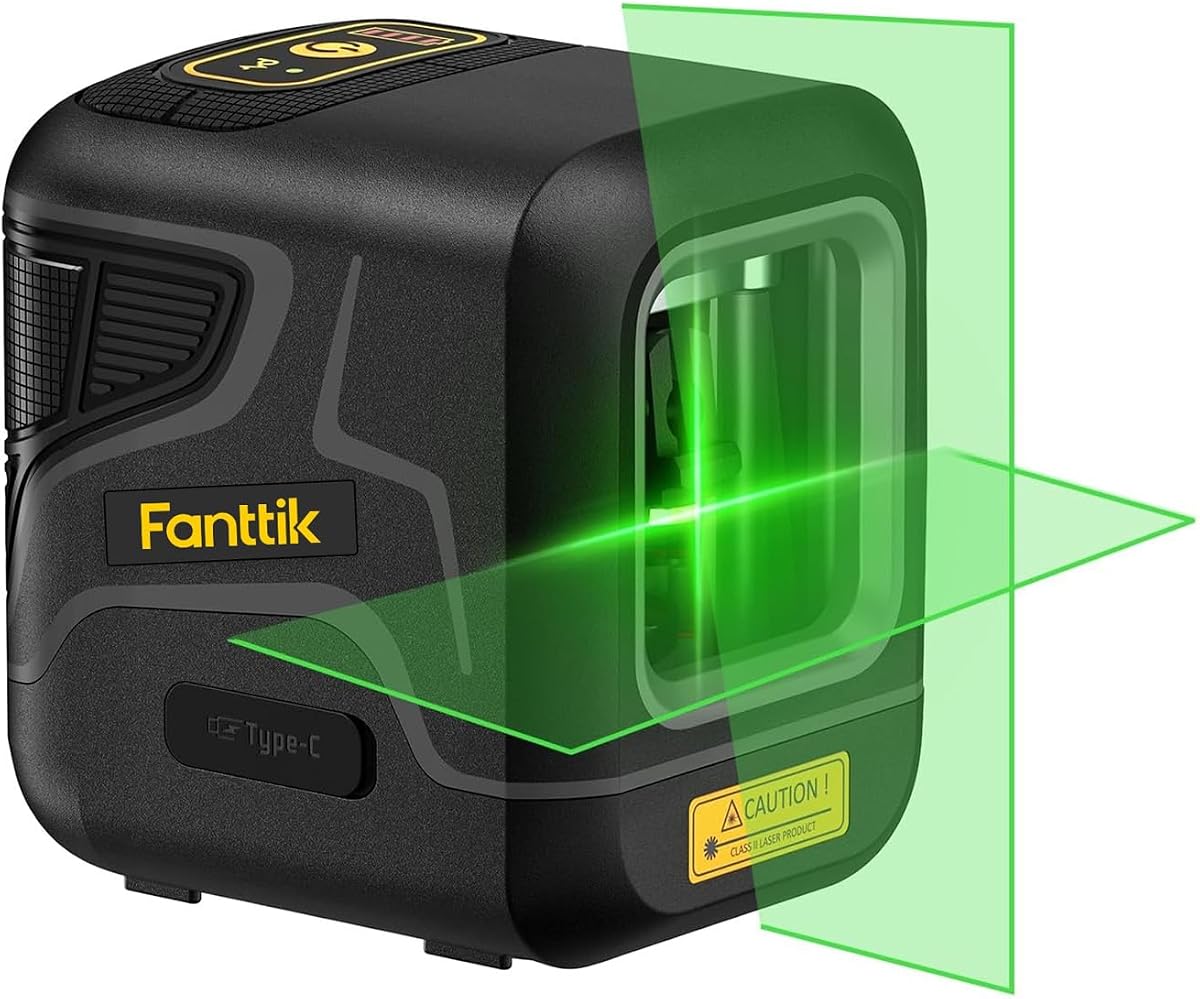
The Fanttik D2 is a compact green cross-line laser designed for picture hanging, shelves, and smaller home tile projects. It carries a 4.5 rating and weighs only 0.56 pound, making it attractive for installers who want a pocketable reference tool rather than a large multi-plane instrument.
We may earn a commission when you buy through this link, at no additional cost to you.
Its documented accuracy is within 1/8 inch at 30 feet, and the bright green diode is stated to be four times brighter than red lasers under comparable lighting. Self-leveling operates within plus or minus four degrees, with flashing when the tool is tilted beyond that range. Locking the pendulum activates manual mode for projecting lines at selected angles.
A 2200mAh rechargeable battery provides up to ten hours of continuous operation, while the included magnetic bracket can rotate 360 degrees and attach to metal surfaces. Pulse mode can extend the working range to 164 feet when paired with a receiver, although that receiver is not supplied. Its two-line format is the main limitation for whole-room tile grids.
The D2 is best suited to a small bathroom wall, backsplash, shelf installation, or a tile project where a quick level and plumb reference is needed. It also works as a secondary tool for checking a room while a larger laser handles the primary grid. For portability, simple controls, and long rechargeable runtime, it is a highly practical choice.
The palm-sized housing and 0.56-pound weight make the D2 easy to move between walls, floors, and work areas. A magnetic bracket and drawstring pocket add convenience for storage and quick attachment.
The integrated 2200mAh battery is rated for up to ten hours. That runtime makes the tool practical for a full workday without requiring access to a charging point between setup changes.
We may earn a commission when you buy through this link, at no additional cost to you.
The Huepar BOX-1G combines a 150-foot cross-line laser with a portable 40-inch tripod, creating a convenient kit for tile layouts, trim, shelving, and general construction. Its 4.4 rating and stated accuracy of plus or minus 1/13 inch at 33 feet make it one of the more precise conventional cross-line choices in the group.
We may earn a commission when you buy through this link, at no additional cost to you.
The laser projects a 130-degree horizontal line and a 150-degree vertical line, while selectable single-line and cross-line modes help conserve power. It self-levels within four degrees, offers manual mode for angled work, and includes pulse mode. In bright outdoor conditions, the manufacturer recommends a compatible Huepar receiver because direct sunlight can make the naked-eye line difficult to see.
The included tripod extends from 11.4 to 40 inches and has a 1/4-20 mount and three-way pan head. It is intended for indoor use on flat surfaces in windless conditions, so it may need to be placed on furniture or replaced with a larger outdoor tripod for exposed work. The package also includes four AA batteries, a manual, and a carry bag.
This model is a good fit for installers working on a wall or floor where a traditional horizontal and vertical reference is sufficient. Its included stand makes setup straightforward, and the stated precision is well suited to repeatable tile alignment. It is less appropriate for central, full-room 3D layouts, but it delivers a focused and capable cross-line package.
The stated plus or minus 1/13-inch accuracy at 33 feet supports careful reference layouts. Operators can select a single line to conserve power or use both lines when establishing a level-and-plumb cross.
The compact aluminum tripod offers useful height adjustment and smooth swivel options. Its stated design is best for level indoor floors and windless conditions rather than exposed outdoor installation.
We may earn a commission when you buy through this link, at no additional cost to you.
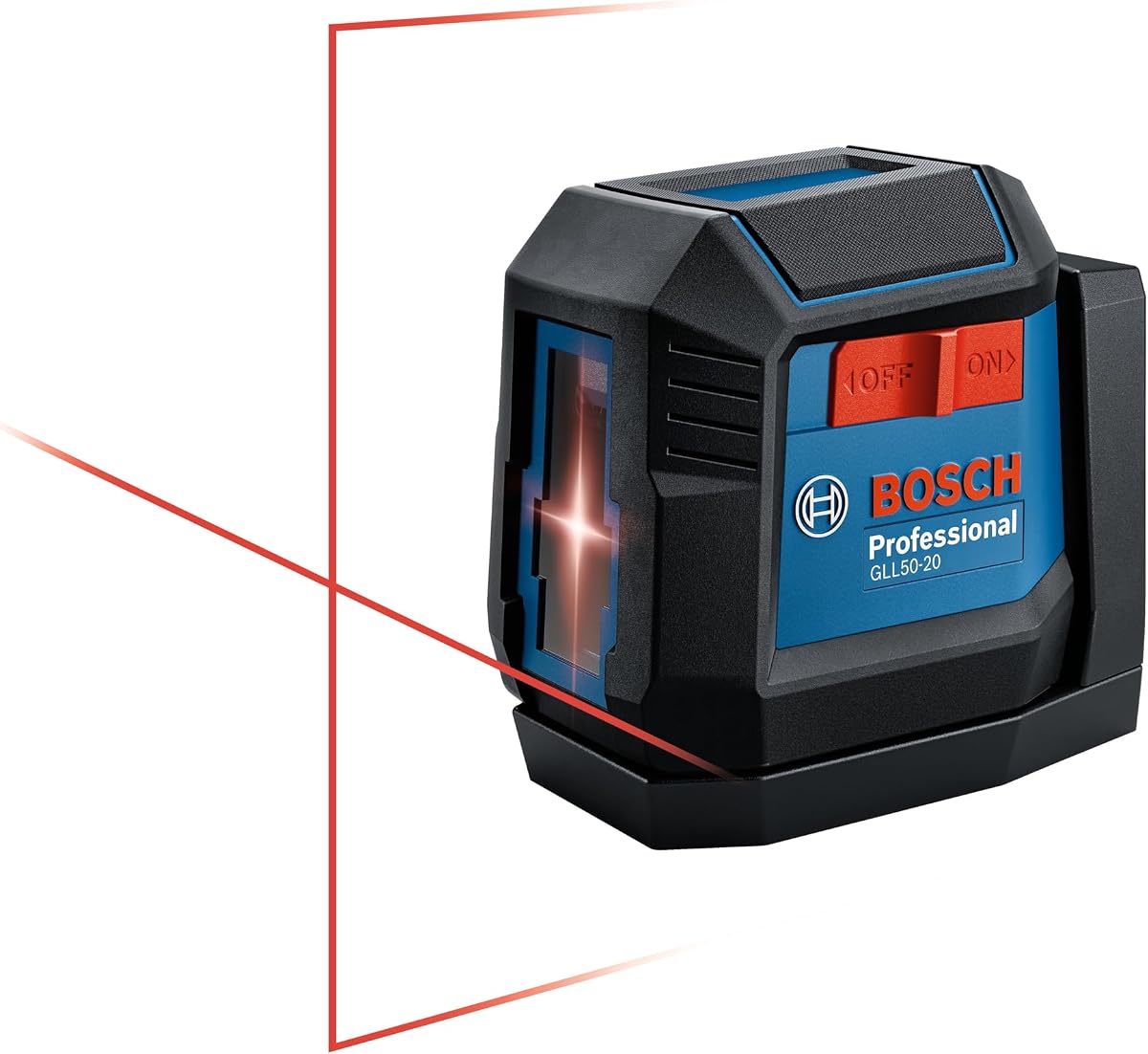
The Bosch PRO GLL50-20 is a compact self-leveling cross-line laser built around simple level-and-plumb references. It has a 4.4 rating, projects two lines, and offers a stated 50-foot range with 5/16-inch accuracy at 30 feet. Those specifications place it among the more compact options rather than the room-filling 3D or 4D systems.
We may earn a commission when you buy through this link, at no additional cost to you.
The full rubber overmold helps protect major impact points, while an IP55 rating provides dust- and water-resistance. Its integrated mounting point supports magnets and 1/4-20 threaded mounts, allowing use on a tripod or metal surface. The smart pendulum system self-levels, blinks when out of level, and locks when switched off for transport.
Power flexibility comes from two included AA batteries or a separately sold Bosch 3.7V lithium-ion battery. The separately purchased battery adds expense and requires another accessory decision, but it can reduce downtime on extended jobs. Compared with many green multi-plane competitors, its range and stated accuracy are more modest, and the tool does not create 360-degree planes.
The GLL50-20 is a sound choice for a contractor who values a compact, rugged, straightforward cross-line laser and already uses Bosch tripods or batteries. It is especially suitable for short wall-tile sections, trim, cabinetry, and installation checks in protected indoor spaces. Its primary appeal is dependable construction and easy transport rather than whole-room laser-grid coverage.
The rubber overmold and IP55 enclosure are intended to handle demanding work environments. A compact housing also makes the laser easier to carry between a vehicle, workbench, and installation area.
The integrated mount can attach magnetically or accept a 1/4-20 thread. That flexibility lets installers place the tool on a standard tripod, cabinet, shelf, or suitable metal surface without a separate adapter.
We may earn a commission when you buy through this link, at no additional cost to you.
The Huepar 9011G is a straightforward green cross-line laser aimed at users who need dependable wall and shelf references. It has a 4.3 rating, a stated 100-foot range, and accuracy of plus or minus 1/16 inch at 16.4 feet, a particularly useful short-distance figure for checking alignment around tiles, trim, and fixtures.
We may earn a commission when you buy through this link, at no additional cost to you.
The 110-degree field provides broad cross-line coverage, and the tool self-levels within plus or minus four degrees after the pendulum is unlocked. A flashing line indicates that the surface is outside the self-leveling range. Locking the pendulum switches to manual mode for angled lines on stairs, patterns, or nonstandard layouts.
A magnetic bracket allows metal-surface mounting, and the bottom 1/4-20 thread supports a tripod. The package includes the bracket, two AA batteries, a user manual, and a carry bag. The main operational caution is placement: an unstable or unlevel tripod can cause continuous flashing, even when the laser itself is functioning normally.
This model makes sense for a focused backsplash, a single wall of tile, picture hanging, or a general-purpose alignment tool kept in a small toolbox. It is less suitable than a 3D model for laying a floor-and-wall grid, but its compact design, clear controls, and short-distance accuracy make it a practical entry for careful reference work.
The plus or minus 1/16-inch rating at 16.4 feet is useful when installing backsplash tile, wall tile, shelves, or trim. These smaller projects benefit from close reference accuracy without requiring a large multi-plane laser.
The pendulum only self-levels within four degrees, and the tool flashes when tilted farther. A level surface, stable tripod, or flat board beneath the tripod can prevent misleading alerts during layout work.
We may earn a commission when you buy through this link, at no additional cost to you.
The Klein Tools 93CPLG offers three bright green 360-degree laser planes in a compact format. Its 4.4 rating and 100-foot stated range make it a capable middle ground between basic cross-line lasers and larger 16-line systems. The three-plane configuration is directly relevant to tile work because it can establish horizontal and vertical references around a room.
We may earn a commission when you buy through this link, at no additional cost to you.
The green planes are stated to shine up to twice as brightly as standard red beams, improving visibility in occupied work areas. A built-in, non-removable rechargeable battery supplies more than six hours of runtime. Tilt mode locks the pendulum so the laser can project at different angles, expanding the tool beyond strictly level and plumb references.
As a compact device, it is easy to store and use in tight areas, but the non-removable battery means the unit must be recharged between extended sessions. The supplied information does not specify the same detailed self-leveling range, mounting thread, pulse range, or accessory package found in the Huepar and CIGMAN options, so buyers should verify those details if their setup depends on them.
The 93CPLG is a strong choice for electricians, remodelers, cabinet installers, and tile professionals who want full-plane references in a smaller housing. It is especially appealing for users who recognize the Klein Tools brand or need a straightforward three-plane laser for a residential installation without carrying the largest model in the guide.
Three 360-degree planes provide a more useful spatial reference than a conventional two-line cross. The compact construction makes the tool easier to carry between installation areas and store in a crowded toolbox.
The integrated rechargeable battery offers more than six hours of continuous operation. While shorter than eight-hour systems, it should cover many common installation shifts without frequent battery changes.
We may earn a commission when you buy through this link, at no additional cost to you.
The DEWALT DW088K is a rugged red-beam cross-line laser with a 4.7 rating and a well-established physical design. It projects level and plumb lines with approximately 1/8-inch accuracy at 30 feet, making it a practical option for wall tile, cabinets, shelving, trim, and general installation work.
We may earn a commission when you buy through this link, at no additional cost to you.
Its overmolded housing carries a one-meter drop rating, while the IP54 specification helps protect against water and debris. A patented integrated magnetic bracket provides a convenient metal-surface mounting option, and the 1/4-20 thread accepts a standard tripod. A durable storage case is included for transport.
The important accessory limitation is that neither a tripod nor a detector is supplied. The detector can extend the stated range to 165 feet, which is valuable in bright spaces, but it must be purchased separately. Red beams are also less conspicuous than many green alternatives in bright interiors, so line visibility may require careful control of ambient light.
Despite the age of this design, the DW088K remains a credible pick for installers who prioritize a recognizable rugged platform, straightforward cross-line output, and strong physical protection. It is less versatile than the 3D and 4D models because it cannot project full horizontal and vertical 360-degree planes. It therefore fits projects centered on two intersecting references rather than a complete room grid.
The overmolded housing, one-meter drop rating, and IP54 protection suit repeated handling in construction environments. A hard storage case adds another layer of protection during transport between project sites.
The unit can use a detector to reach a stated 165-foot range, but the detector and tripod are separate purchases. Users needing immediate full-room or outdoor setup should account for those accessories before finalizing the purchase.
We may earn a commission when you buy through this link, at no additional cost to you.
The right laser level depends on the size of the tiled area, the number of reference planes required, the lighting conditions, and the mounting surfaces available. Accuracy and range matter, but setup speed, line visibility, and included accessories can have an equally large effect on daily productivity.
A conventional cross-line laser projects one horizontal and one vertical reference, which is sufficient for checking level and plumb on a single wall. A 3D model adds a second vertical plane, while a 4D model creates two horizontal and two vertical 360-degree planes. The extra planes are valuable when a floor and multiple walls must be aligned from one central position, especially for large-format tile, diagonal layouts, cabinetry, and dropped ceilings.
Choose a cross-line for focused two-dimensional work. Choose 3D or 4D coverage for full-room grids and repeated reference transfer.
Accuracy specifications matter because a small line error can accumulate across a long tile run. Compare the stated tolerance at the distance that matches the project. A tool rated within 1/8 inch at 30 feet may be sufficient for general installation, while a plus or minus 1/16-inch rating at 16.4 feet offers a more refined reference for shorter layouts. Beam visibility, mounting stability, and the quality of the setup also influence the final result.
Match the published accuracy to the scale of the installation. Do not assume a longer stated range automatically produces better short-distance precision.
Green lasers are generally easier for the human eye to see than red lasers, particularly in bright indoor spaces. That advantage can reduce setup time when a line is faint or surrounded by visual clutter. However, direct sunlight can still overpower either color, and reflective tile, glass, mirrors, and glossy surfaces may create apparent extra lines. Users working around polished materials should identify the true beam and avoid interpreting reflections as additional references.
Green is usually preferable for indoor tile work, while high-gloss surfaces call for careful beam interpretation.
Self-leveling mode allows the pendulum to establish a level reference automatically, usually within a stated range of three or four degrees. Beyond that range, the line flashes to indicate an out-of-level condition. Manual mode locks the pendulum and permits angled projections for stairs, decorative patterns, and irregular layouts. Understanding this distinction prevents a normal warning flash from being mistaken for a malfunction.
Use self-leveling for standard level and plumb references. Lock manual mode only when an intentional angled line is needed.
A 100-foot or 150-foot range may sound more than sufficient for a bathroom or kitchen, but large rooms, diagonal layouts, and outdoor work can quickly consume that coverage. Pulse mode and a compatible receiver extend the usable range in bright conditions, though most receivers are not included. None of the reviewed products should be assumed to maintain strong naked-eye visibility in direct sunlight, and outdoor users should confirm receiver compatibility before purchasing.
Check indoor range for normal projects. For bright outdoor work, confirm pulse mode, receiver requirements, and compatible models.
A threaded 1/4-20 mount is the most common connection for compact laser levels, while larger systems may also offer 5/8-11 threads for professional tripods and poles. Magnetic brackets are useful on metal surfaces but are not suitable for every wall material. A supplied tripod can make a tool ready to use, although compact tripods are generally best indoors and on flat surfaces. Hard cases, remote controls, adapters, and brackets can also influence the overall value of the package.
Prioritize a compatible mount or included tripod. Confirm that the bracket can attach safely to the surfaces used on the job.
Rechargeable tools are convenient for daily use and reduce the need to carry spare cells, while AA-powered models are often easier to service in the field. Runtime ranges from more than six hours on the Klein Tools model to ten hours on the Fanttik D2. Some products use a replaceable battery, while others integrate a non-removable pack. Battery status indicators, type-C charging, and eight-hour runtimes can help prevent mid-project shutdowns.
Choose enough runtime for a full work period. Consider whether replaceable cells or a sealed rechargeable battery better matches your working habits.
IP54 and IP55 ratings indicate resistance to some dust and water exposure, but no laser should be intentionally soaked or left in severe weather. Rubber overmolds, drop ratings, compact dimensions, and hard cases help protect the optics and internal pendulum. Portability is especially valuable when moving between a wall, floor, and adjacent rooms. A heavier system may feel stable in a central position, while a compact model is easier to reposition for close alignment work.
Balance protection with mobility. The most rugged tool is only useful if it can be positioned quickly and supported safely.
Begin by selecting a stable location where the unit can remain centered and unobstructed. For a cross-line laser, place the tool on a level tripod or suitable bracket and aim the horizontal line at the tile reference. For a 3D or 4D model, place it near the room's center and verify that each required plane is visible on the relevant floor, wall, and ceiling surfaces. Confirm that the pendulum is unlocked for self-leveling and that the lines stop flashing.
Mark the reference points lightly, check them from more than one viewing position, and avoid treating reflections from glossy tile as separate lines. Transfer the reference to the work surface with a pencil or scribe rather than assuming a visual line is perfectly centered. Recheck the tool's level and position after moving it, especially when working across large rooms, around uneven surfaces, or with heavy tile formats that require exact parallel lines.
After use, switch the tool off so the pendulum locks for transport, remove the batteries if the model uses removable cells, and store it in a dry case. Clean the lens gently, keep the charging contacts and mounting threads free of dust, and inspect brackets and tripod locks before the next setup. Outdoor use should follow the manufacturer's guidance, and protective glasses should never be assumed to make it safe to look directly into a laser beam.
A 360-degree or multi-plane laser is not always necessary for a small wall installation. A clear cross-line tool can establish level and plumb references for a single backsplash or tiled wall. Multi-plane coverage becomes more valuable when a floor, multiple walls, cabinet tops, and ceiling lines must be transferred from one central setup.
Green beams are generally easier to see than red beams in typical indoor work areas, so they can make tile references easier to follow. Neither color is reliably visible in direct sunlight without a receiver. Highly reflective surfaces can also generate extra apparent lines with either color, so users should identify the true beam before marking.
Most professional-style tools in this guide publish tolerances around 1/8 to 1/16 inch at various reference distances. The appropriate specification depends on the tile size, layout pattern, substrate condition, and project tolerances. For large-format tile or a long uninterrupted run, a tighter published tolerance and a stable mounting setup are especially valuable.
A flashing line usually means the surface is tilted beyond the tool's self-leveling range, often because the tripod is unstable or its head is not level. Check the surface, adjust the tripod, or place a flat board underneath it. A periodic flash in manual mode can simply be a reminder that the pendulum is locked and the line is not a level reference.
Yes, if it projects a horizontal plane as well as vertical references. A 3D or 4D model can establish a shared floor-and-wall grid from one position, while a cross-line model may need to be moved and leveled separately for each surface. The 4D models in this guide provide the most complete central coverage.
Usually not. Receivers are most useful in bright outdoor conditions, large spaces, or situations where the naked-eye beam becomes difficult to follow. Most of the reviewed tools can operate at their normal indoor ranges without a receiver, but the receiver is generally sold separately where pulse-mode range is advertised.
A tripod is generally best for establishing a room-wide reference because it keeps the tool stable and at a useful height. Magnetic brackets work well on suitable metal surfaces, such as cabinets or metal studs, but can be awkward on drywall. Wall mounting may require anchors or a suitable nail hole, and no bracket should be attached to a surface that cannot support it safely.
Reflective tile, glass, mirrors, and glossy surfaces can reflect the beam and create lines that appear to come from a different direction. These reflections are not additional reference planes. Work slowly, identify the true line by moving your head slightly, and use a matte surface or different mounting position if the reflections make the layout confusing.
The CIGMAN CM-G16 stands out as the most complete overall option because its 16 lines, four 360-degree planes, app control, remote, and mounting accessories support almost any interior tile layout. The Huepar HM03CG offers a more focused premium 3D configuration with strong accuracy, flexible brackets, and a five-year device warranty, while the Motovera model is the most accessible way to obtain a green cross-line and tripod in one kit.
Prioritize the number of reference planes your project actually needs. Use a cross-line for one wall or a small area, a 3D model for coordinated floor-and-wall work, and a 4D system for a complete room grid. Accuracy, stable mounting, line visibility, battery runtime, and the availability of a compatible receiver should be evaluated together rather than relying on range alone.
Before purchasing, verify the current listing, included accessories, mounting threads, battery configuration, and warranty terms because bundled features can change. Prices and availability also change over time, so compare the final package and current product details rather than assuming every specification remains identical to the original listing.