
Rechargeable Headlamp 3PCS
4.5Editor score
Three complete headlamps
230-degree flood beam
Motion-sensor operation
Discover the best headlamp for auto mechanic work, with 10 expert picks compared for brightness, beam control, runtime, durability, and hands-free use.
A headlamp for auto mechanic work must provide bright, controlled illumination without occupying the hands needed for wrenches, wiring, fasteners, or diagnostic equipment. The right model also needs comfortable fit, dependable runtime, and a beam that can shift between close-range detail work and distant inspection areas.
The products in this guide were compared using their listed lumen output, beam patterns, lighting modes, runtime claims, charging options, water resistance, mounting features, weight, and suitability for vehicle repair. The list includes compact multipacks, wide-beam models, detachable work lights, neck lights, and rugged premium headlamps.
Each pick highlights a different way to approach automotive lighting, from broad illumination around an engine bay to focused beams for inspection and hands-free use under a vehicle. Ratings and product details reflect the supplied information, while prices and availability can change, so confirm current listing details before purchasing.
4.5Editor score

4.7Editor score

4.4Editor score
This side-by-side comparison evaluates all ten headlamps for automotive work, emphasizing usable light output, beam flexibility, battery life, mounting options, weather resistance, and convenience.




The Coast XPH30R combines a 4.7 rating with the most balanced feature set in this guide. Its 1200-lumen turbo mode provides ample power for dark engine bays, while lower outputs of 500, 160, and 46 lumens offer more practical choices for prolonged work or less reflective spaces.
We may earn a commission when you buy through this link, at no additional cost to you.
Its greatest advantage is the patented twist-focus system. Instead of accepting a fixed flood or spot, a mechanic can rotate the optic to transition between short-range viewing and long-range illumination without halos or hot spots. The housing also detaches from the head strap, creating a handheld flashlight with a magnetic base for attaching beneath a hood, beside a component, or to metal surrounding the vehicle.
The trade-offs are modest. High mode is listed for 6.75 hours, which is shorter than the runtime available from several high-capacity models, and the product is rated IP54 rather than fully waterproof. It also does not include dedicated hardhat clips, although the detachable body and magnetic base reduce its reliance on head mounting.
This is the strongest general-purpose recommendation for automotive technicians because it combines focused, flood, and handheld lighting in one compact design. Choose it when adaptable beam control and magnetic placement matter more than an exceptionally long maximum runtime.
The twist-focus optic lets users move smoothly between a broad work area and a concentrated beam. That versatility is valuable when diagnosing a fuse location, tracing a wire, inspecting a fastener, or looking farther beneath a raised vehicle.
Removing the lamp from its bracket turns it into a compact handheld light. The built-in magnetic base can secure it near the work area, leaving both hands available for tools and components.
We may earn a commission when you buy through this link, at no additional cost to you.
This three-headlamp set offers an unusually practical way to equip a small repair team, workshop, or household with dedicated automotive lighting. Each lamp has a 4.5 rating and a 230-degree COB flood beam designed to illuminate a broad working area without requiring repeated head movement.
We may earn a commission when you buy through this link, at no additional cost to you.
Five operating modes include COB high and low, side LED high and low, and strobe. A side light can illuminate a distance of nearly 300 feet, while the motion sensor allows a gloved hand to switch the lamp on or off without touching the housing. The package also includes twelve hardhat clips, three USB-C cables, and an instruction manual.
The main limitation is that the supplied information does not state a maximum lumen output. That makes it difficult to compare the lamp directly with models advertising 1200, 1500, 2000, 2700, or 3000 lumens. The 1200mAh battery is also permanently installed, and the stated 2.5-to-8-hour runtime varies by mode.
Despite that uncertainty, the three-lamp bundle, wide beam, sensor control, and hardhat accessories make this an attractive budget option. It is particularly useful for mechanics who want a spare lamp in the toolbox, on a service van, or shared among several workers.
The broad 230-degree field is especially helpful in cramped engine compartments and around dashboards. It spreads light across nearby components instead of concentrating it in a small circle, reducing frequent head movement.
The three-lamp configuration provides a simple way to keep one unit in a vehicle, another in a toolbox, and another at a workbench. Included hardhat clips broaden its usefulness beyond automotive diagnostics.
We may earn a commission when you buy through this link, at no additional cost to you.
The EZRED ANYWEAR NK15 is a neck light rather than a conventional forehead headlamp, but that difference can be valuable during automotive work. A 4.6 rating, rechargeable design, and four modes make it a credible option when illumination must follow the mechanic's gaze without pressing a headband against hair, safety glasses, or a hat.
We may earn a commission when you buy through this link, at no additional cost to you.
Its two dual-articulating beam heads can be adjusted and locked independently by as much as 90 degrees. This creates a broader and more directional field than a single conventional lamp, which can help illuminate both the work area and a nearby component. Output ranges from 15 to 300 lumens, and each light offers up to nine hours of runtime.
The obvious limitation is maximum brightness. At 300 lumens, it sits below the high-output models in this list and may not provide as much reach in a large, dark shop. Its neck-worn form may also feel unusual to technicians accustomed to a headband, and sweat or clothing coverage can affect comfort during long shifts.
Mechanics who prioritize close-range work and an unobstructed view of the hands should consider the NK15. It is a specialized alternative when directional task lighting matters more than raw output or long-distance beam reach.
Because the light rests on the shoulders, its output naturally follows the head and eyes. It can illuminate a belt line, wiring cavity, or component without requiring the mechanic to turn a conventional headlamp toward every task.
Independent articulation allows the two beam heads to cover different angles. That flexibility is useful when one hand is holding a tool while the other requires light at a specific depth or orientation.
We may earn a commission when you buy through this link, at no additional cost to you.
The svsviio Rechargeable Headlamp PRO combines a 4.5 rating with a 1500-lumen maximum and a large 5000mAh battery. Its 31 LEDs are arranged to create a 230-degree beam, allowing technicians to illuminate a broad engine bay or work area while keeping their head relatively still.
We may earn a commission when you buy through this link, at no additional cost to you.
A useful battery indicator helps prevent an unexpected power loss during a repair. The head can rotate downward by up to 90 degrees, allowing the beam to be aimed toward the mechanic's hands or across nearby engine components. High, low, and strobe modes are supplemented by red taillights, and the IPX6 enclosure is designed to handle rain and water mist.
The battery's size does not translate into unlimited working time. The listing gives up to five hours in high mode and nine hours in low mode, with a full charge taking approximately five hours. It is also larger than compact models, and the product does not offer the independently articulating lamps or magnetic base found in some alternatives.
This headlamp is best for mechanics who want strong broad illumination, a generous battery, and a visible charge status without moving to a premium-tier product. It balances output and endurance better than basic compact lamps, although its charging schedule requires planning.
The 5000mAh battery and status light give technicians a more practical way to judge remaining use. Low mode is intended to stretch runtime when maximum output is not necessary.
A 230-degree field covers a substantial area in front of the wearer. This is useful for inspections that involve several components and a need to see surrounding connectors, hoses, or fasteners.
We may earn a commission when you buy through this link, at no additional cost to you.
This rechargeable LED headlamp earns a 4.6 rating and offers a balanced combination of output, battery capacity, and mounting accessories. Its advertised maximum output is 1500 lumens, spread through a 230-degree wide beam for broad illumination around an engine or under a raised vehicle.
We may earn a commission when you buy through this link, at no additional cost to you.
The 5000mAh battery is listed at up to 12 hours in low mode and six hours in high mode. A USB-C cable allows recharging without battery removal. High, low, and strobe modes cover most working needs, while red rear lights improve visibility when the mechanic is working in traffic, a driveway, or a poorly lit service area.
Eight hardhat clips are included, and the lamp head adjusts through 90 degrees so the beam can be directed downward. The listing describes the unit as lightweight and shockproof, with IPX6 protection against harsh weather. However, it provides fewer mode choices than several competitors and does not advertise a precise beam-distance figure.
This is a practical choice for mechanics who need a straightforward rechargeable headlamp with a large battery and hardhat compatibility. Its strong rating and balanced runtime make it easier to recommend than a novelty light, while the wide beam handles routine repair work well.
Up to 12 hours in low mode makes the lamp suitable for extended diagnostics. High mode retains stronger output for darker bays, while the listed six-hour runtime is easier to plan around than a very short burst.
White front and red rear lights can operate together, and the rear illumination is useful when the technician's face is directed into an engine compartment or the vehicle is being serviced near traffic.
We may earn a commission when you buy through this link, at no additional cost to you.
The two-headlamp bundle balances broad coverage, sensor convenience, and compact construction. Its 4.5 rating reflects a generally well-received feature set, while the 230-degree field makes it useful for automotive tasks that require visibility across a wide engine compartment rather than one small target.
We may earn a commission when you buy through this link, at no additional cost to you.
The lamp combines wide-beam and spotlight functions, and the intelligent sensor can switch it on or off when a hand passes within approximately 10 centimeters. This can be helpful with dirty or gloved hands, although the stated sensing distance means the user must move quite close to the control. Five regular modes and a motion-sensor mode provide several operating choices.
The main drawback is the absence of a stated maximum lumen output, making direct brightness comparison difficult. Its IPX4 rating handles splashing water but offers less protection than IPX6 or IP68 models. A soft silicone housing, adjustable elastic band, low weight, and pocket-friendly folding design help offset the limited specifications.
For technicians who want one headlamp for daily use and another as a vehicle or workshop spare, the bundle is practical. It is also a good fit for users who value a wide beam and hands-free activation more than long-distance reach or highly rugged construction.
The motion sensor is intended for situations where touching a small button would be inconvenient. At roughly 10 centimeters, it reduces accidental activation while still allowing quick control in a workshop.
Two units allow one lamp to remain in a service vehicle or toolbox while another is worn. The compact folding shape also makes each unit easier to store between jobs.
We may earn a commission when you buy through this link, at no additional cost to you.
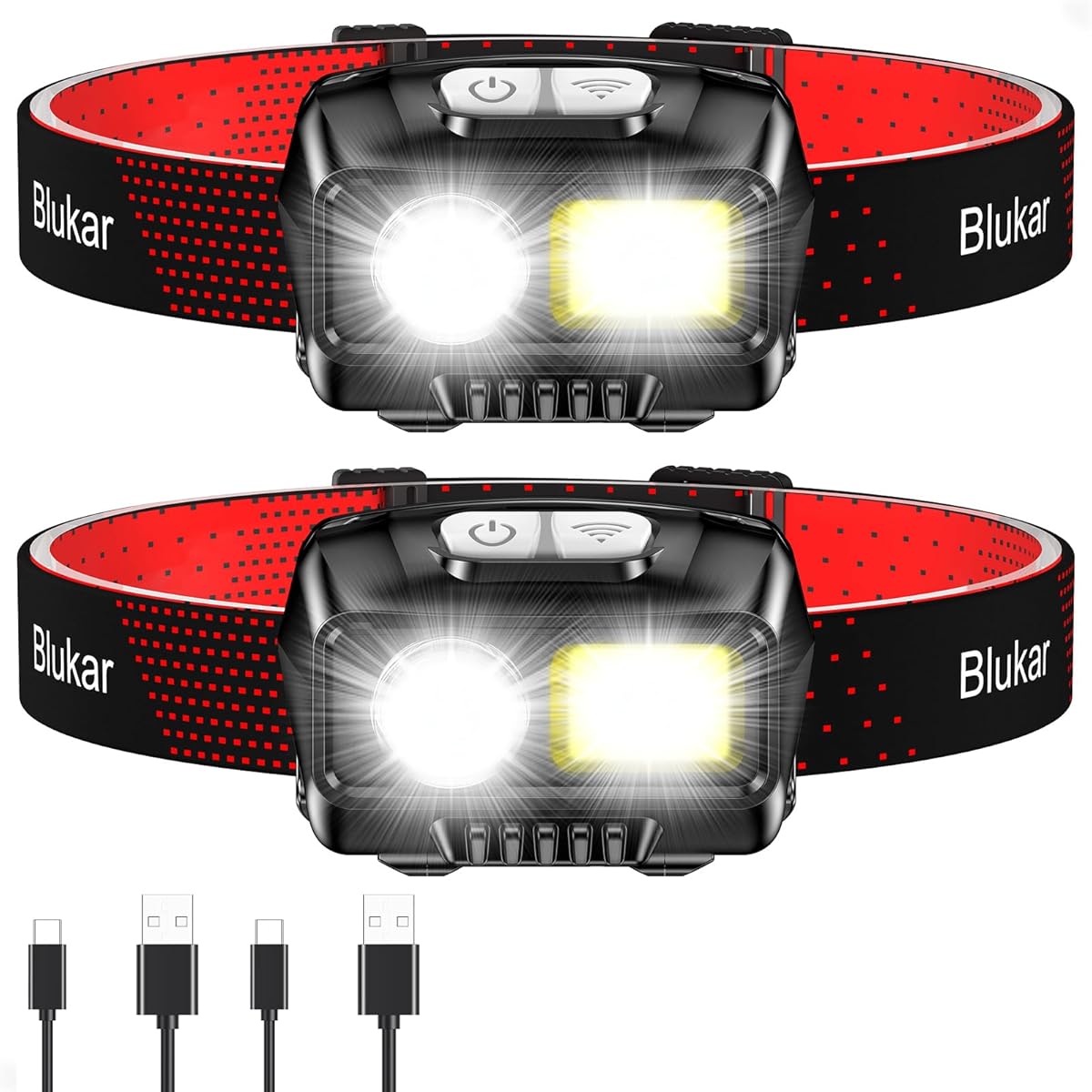
The Blukar Rechargeable Headlamp offers the most granular brightness control in this guide. Its 4.5 rating, 2000-lumen maximum output, and stepless dimming from full brightness to 30% give technicians a way to tune illumination for reflective metal, dark cavities, and prolonged close work.
We may earn a commission when you buy through this link, at no additional cost to you.
The mode system includes five standard choices—XPG white, COB white, combined XPG and COB white, COB red, and COB red strobe—plus three motion-controlled white modes. A long press adjusts brightness, and a removable, washable elastic band can be adjusted to fit the wearer.
The product is rated IPX5 for water resistance and uses a 1200mAh rechargeable battery with USB-C charging. However, the supplied details do not provide runtime estimates. The lamp head tilts through 45 degrees, which is adequate for downward aiming but less flexible than the 90-degree adjustment of several alternatives.
Blukar is a good fit for mechanics who want fine output control, red-light options, and sensor operation in a compact unit. Those adjustable features make it more versatile than a basic three-mode headlamp, even though exact endurance is not clearly specified.
Stepless adjustment helps avoid the abrupt jump between discrete brightness levels. A technician can lower the output near shiny brackets or reflective housings without surrendering useful visibility.
Red illumination can preserve night-friendly visibility in less demanding situations, while sensor modes allow activation with a wave of the hand. These options expand control beyond the standard flood and spot arrangement.
We may earn a commission when you buy through this link, at no additional cost to you.
The Coast XPH34R is the most powerful model among the two Coast XPH models in this guide, with a 4.6 rating and 2700-lumen maximum output. It also reaches 295 meters, making it suitable for technicians who occasionally need to inspect a large shop floor, outdoor lot, or the area beneath a vehicle from a distance.
We may earn a commission when you buy through this link, at no additional cost to you.
The Pure Beam twist-focus system transitions between a broad Ultra View flood and a concentrated Bulls-Eye spot. This allows the user to cover an entire work area and then tighten the beam around a specific component without changing lamps. The aluminum body detaches from its bracket and rolls for dynamic directional use, while the magnetic tailcap provides another attachment point.
Maximum runtime is listed at 120 hours, although that figure applies to the lowest output rather than high-output repair work. IP54 provides water resistance but not the deeper protection of the Nitecore models. Its metal body also makes it less compact than several plastic alternatives.
Choose the XPH34R when maximum output, precise optical transitions, and long-range reach are priorities. For automotive work, it is especially useful for mechanics who work across multiple bays or need to illuminate both nearby and distant vehicle areas.
The 2700-lumen maximum provides abundant illumination for large engine bays and workshop spaces. It also makes the lamp useful for roadside and outdoor vehicle inspections where ambient light is limited.
The detachable housing, rolling bracket, and magnetic tailcap offer several ways to aim or secure the light. These options are particularly helpful when the work area does not permit the mechanic to look directly at the source.
We may earn a commission when you buy through this link, at no additional cost to you.
The Nitecore HC65 UHE stands out for rugged construction and a broad range of lighting functions. Its 4.6 rating is supported by a 2000-lumen maximum output, 243-yard beam distance, and an IP68 waterproof rating. The aluminum body is also impact resistant up to two meters, making it a natural candidate for demanding shop environments.
We may earn a commission when you buy through this link, at no additional cost to you.
The primary white LED offers four output levels plus SOS and beacon functions. A separate reading light has two low brightness levels, and an auxiliary red light expands nighttime usability. A built-in waterproof USB-C port recharges the unit in approximately two hours, and the power indicator shows when charging is needed.
Maximum runtime is listed at 82 hours, though sustained high output will be shorter. Multiple light sources and operating functions can make the interface less intuitive than a simple three-mode model, and the metal construction is heavier than plastic headbands. These are trade-offs rather than serious flaws for a rugged work light.
The HC65 UHE is a strong recommendation for professional technicians who regularly work in wet, greasy, or physically demanding environments. It offers enough specialized functions to justify its position as a premium, heavy-duty option.
The IP68 rating provides stronger water protection than the IP54 and IPX-rated models here. Its two-meter impact resistance and hard-anodized aluminum body suit shops where drops, vibration, and grime are common.
The reading and auxiliary red lights are useful when the main beam is excessive. A low reading mode can illuminate close instructions, while red output offers a less conspicuous option for brief low-light tasks.
We may earn a commission when you buy through this link, at no additional cost to you.
The Nitecore HC75 UHE delivers the highest listed maximum output in the guide at 3000 lumens, making it the most demanding premium option. Its 4.4 rating is slightly lower than the ratings of the other nine products, but its specification set is aimed at users who value output, adjustable optics, and direct control.
We may earn a commission when you buy through this link, at no additional cost to you.
A stepless electronic focus system moves from a wide floodlight to a focused spotlight or a mixed beam without fixed click stops. Five white levels and two red modes provide further control, while two-button operation gives direct access to ultra-high, low, and red outputs. The 209-yard beam throw remains useful for industrial work despite the emphasis on close-range adjustability.
The integrated waterproof USB-C port charges in just over two hours, and a power indicator communicates battery status. Lockout prevents accidental activation, which is valuable when the headlamp is packed with oily tools or stored in a crowded van. The listed 4.4 rating is the lowest in this group, so buyers should weigh their preference for premium controls against that distinction.
This is the best premium recommendation for mechanics who want maximum brightness and smooth beam transitions. It is especially suitable for heavy diagnostics, shop work, and users who value the ability to move precisely between broad and concentrated illumination.
Stepless focus lets the beam change continuously instead of jumping between preset optics. A technician can begin with a broad view and narrow the light onto a bolt, connector, or inspection point.
Direct-access buttons, a charge indicator, and lockout mode support repeated practical use. The zoomable output lets one headlamp cover both detailed diagnostics and broader vehicle inspection tasks.
We may earn a commission when you buy through this link, at no additional cost to you.
The best headlamp for auto mechanic work is not determined by lumen output alone. Beam shape, color, runtime, fit, mounting method, weather resistance, and control access should match the tasks and working environment.
Automotive work often requires two different kinds of illumination at once. A wide flood is useful for seeing an entire engine bay, dashboard, wheel well, or workbench, while a focused beam is better for tracing a wire, checking a fastener, or examining a hidden component. Fixed wide-beam headlamps are efficient for broad tasks, but twist-focus and zoomable models offer greater flexibility when the repair changes direction.
Choose a wide beam for close, area-filling work. Choose adjustable focus when you move between inspection distances or need a sharper center of illumination.
Lumen output is a useful measure of total visible light, but it should not be treated in isolation. Beam distance, reflector design, and hotspot control also influence how well a lamp illuminates a specific target. A broad 1500- to 2000-lumen model can be highly effective inside a vehicle even when another lamp advertises greater reach.
For general repair, moderate-to-high output with several brightness levels is usually more useful than relying exclusively on maximum output. Save turbo or ultra-high settings for genuinely dark spaces to conserve battery life.
A mechanic should consider how long a repair lasts, whether the lamp can be recharged in the shop, and how much runtime remains in the mode likely to be used most. High-capacity models advertise extended low-mode runtime, while smaller lamps can still be sufficient if they are recharged regularly. USB-C charging is convenient because it reduces the need to carry a dedicated charging cable.
Compare stated runtimes by mode rather than looking only at the largest number. Maximum runtime usually occurs at the dimmest setting and is not a reliable indicator of high-output endurance.
A headlamp should remain stable while the wearer bends, lies beneath a vehicle, or raises both arms. Adjustable elastic bands are common, but fit also depends on head size, glasses, hats, and whether the user works while wearing a hard hat. Neck lights are an alternative when a headband interferes with safety glasses or becomes uncomfortable during long shifts.
Try the product with the equipment normally worn at work. Also consider weight, strap adjustability, and whether the lamp can be removed from the headband for handheld use.
Hardhat clips are valuable in industrial settings, while magnetic bases allow a light to be attached to a vehicle panel or other metal surface. Detachable housings add flexibility because the same unit can move from the forehead to the engine bay without requiring a separate work light. The bracket should also permit the beam to point downward toward the user's hands.
Look for multiple mounting options if you work in different environments. A strong magnetic base and included hardhat clips provide more flexibility than a conventional headstrap alone.
Vehicle repair environments can involve rain, coolant, oil, and accidental impacts. IPX4 and IP54 models offer varying degrees of splash resistance, while IPX6 and IP68 models are better suited to wet conditions and outdoor service. Impact resistance is another factor, especially for a lamp stored in a toolbox or carried around a busy shop.
Match the protection rating to the environment. A higher rating is valuable for roadside work and frequent exposure to water, while durable materials and secure brackets are equally important in a crowded workshop.
Simple high, low, and strobe modes are easy to learn, but many mechanics will benefit from a dedicated low setting, a focused spotlight, and motion activation. Red light can be useful in dark surroundings without producing the same disruptive glare as a bright white beam. Sensor controls should be tested with gloves and should not activate unexpectedly inside a toolbox.
Prioritize modes that improve the task rather than adding novelty. Motion sensing, stepless dimming, red output, and lockout are useful when each serves a clear workflow need.
Neutral or cool white light generally makes colors and markings easier to distinguish, while a warmer beam may feel less harsh during long jobs. Brightness also affects glare inside reflective engine bays. A dimmable low mode can be more comfortable and may reveal details that are washed out under maximum output.
Consider a model with several output levels rather than evaluating only its brightest setting. Fine control can reduce eye fatigue and help prevent a mechanic from missing small leaks, cracks, worn components, or improperly seated connectors.
Before work begins, fully charge the headlamp using the specified cable and confirm that the strap, bracket, buttons, and housing are secure. Fit the lamp so the light lands on the work area without pointing directly into another person's eyes. If using hardhat clips, test the attachment and keep the cable routed so it cannot catch on a moving component.
Begin with a low or medium setting in reflective engine bays, then increase output when a deeper cavity or larger area needs illumination. Use a focused beam for connectors, fasteners, wire routing, and inspection points, but use the flood pattern for general work around the vehicle. Motion modes are useful with dirty gloves, while a detachable or magnetic light can be placed securely near the component instead of worn continuously.
After use, switch the lamp off and disconnect it from the charger. Wipe away oil, dirt, and moisture with a soft cloth, and check the lens and charging port for debris. Store the unit in a dry location with the band loosened, and recharge it before anticipated use. Do not use harsh solvents, and consult the manufacturer's guidance for cleaning and battery care.
A model with adjustable output is generally more useful than one that only offers a very bright setting. Medium or low illumination works well for close engine-bay tasks, while high or turbo output is valuable for deep cavities, large bays, and outdoor work. The most important feature is a beam that can be aimed without producing excessive glare.
A headlamp keeps the light aligned with the wearer's line of sight and is usually the more conventional choice. A neck light can be comfortable with glasses, helmets, or hats and offers independently directed beams for close work. The best option depends on comfort, workspace, and whether the light must stay pointed at a specific area.
Yes, particularly when the lamp can be removed from its head strap and attached to a metal surface. It can illuminate a recessed area while both hands remain free for tools. The surface should be clean and stable, and the user should check that the magnet will not interfere with sensitive vehicle components.
Runtime depends more on selected mode than on battery capacity alone. A 5000mAh model may provide useful low-mode endurance, while a smaller 1200mAh battery can still work well if it is recharged between jobs. For extended shifts, check the stated runtime in the mode you expect to use and keep a charging cable available.
Most automotive work occurs in dry conditions, so water resistance may be sufficient. Mechanics working outdoors, washing vehicles, or handling wet components should favor a higher IP rating. Even an IP68-rated lamp should not be submerged unless its documentation specifically permits that use.
They are useful when a headlamp must attach securely to industrial head protection. A standard elastic band may be sufficient for technicians not wearing a hard hat. For the greatest flexibility, look for a lamp with a strong detachable bracket, magnetic base, and compatible clips.
A wide beam is better for seeing an entire engine bay, dashboard, or workspace, while a spotlight is better for a particular connector, fastener, or inspection point. Adjustable-focus headlamps combine both and are particularly useful when the task requires frequent changes in lighting direction.
Clean it whenever oil, dust, or moisture accumulates on the lens or around the charging port. A soft dry or lightly damp cloth is generally appropriate, but harsh chemicals should be avoided because they can damage plastics and seals. Keep the charging port clear and dry before reconnecting the cable.
The Coast XPH30R is the most balanced overall recommendation because its twist-focus optic, detachable magnetic housing, and four output levels cover many automotive tasks without excessive bulk. The three-headlamp bundle is a compelling budget option for shared shops, while the Nitecore HC75 UHE represents the premium choice for maximum output and precise beam control.
Prioritize the features that match your actual work. Wide-beam models suit engine-bay visibility, focused lights help with detailed inspection, and rugged premium units are worthwhile for wet or demanding environments. Battery runtime, comfortable fit, hardhat compatibility, and magnetic placement are just as important as headline lumen output.
Finally, check the current listing, included accessories, charging requirements, and availability before purchasing. Product features and prices can change over time, and the most reliable choice is the one that combines an appropriate beam, comfortable hands-free control, and dependable power for the way you actually work.