
Elitech CLD-100
4.3Editor score
Six-second preheating time
Seven sensitivity adjustments
Audible and visual alarms
Flexible 8.26-inch probe
Broad halogenated compatibility
Our Freon Leak Detector Tool guide compares ten professional and DIY detectors for sensitivity, display quality, probe reach, alarms, battery life, and
A Freon leak detector tool helps technicians locate refrigerant escapes in HVAC, automotive air-conditioning, and refrigeration systems before a small leak becomes a major repair. The best models combine sensitive sensors, clear readings, flexible probes, useful alarms, and compatibility with the refrigerants commonly encountered in the field.
We compared ten detectors using the specifications supplied for each product, including sensor technology, stated sensitivity, refrigerant coverage, display features, probe length, power source, and alert options. The list includes budget diode units, professional infrared and heated-diode instruments, rechargeable models, and multi-gas tools for varied service environments.
Each review explains the strongest reasons to consider the detector, along with practical limitations or setup considerations. Ratings, specifications, and features reflect the supplied product information, while product availability and pricing can change. Always verify refrigerant compatibility, calibration requirements, and current certification before purchasing.
4.3Editor score

4.9Editor score
4.4Editor score
The comparison below highlights ten Freon leak detectors across important field considerations, including sensor type, stated sensitivity, display design, probe flexibility, power, and supported refrigerants. The products range from simple diode detectors for routine service to advanced infrared instruments built for demanding diagnostic work.




This rechargeable HVAC refrigerant and combustible gas detector has a 4.4 rating and stands out for its combination of a long-running internal battery, live ppm display, and broad gas coverage. It is designed for technicians who need more refrigerant information than a simple audible alarm can provide while still keeping the tool ready between service calls.
We may earn a commission when you buy through this link, at no additional cost to you.
The Japanese-made metal-oxide semiconductor sensor responds to an extensive list of halogenated refrigerants, and the listed SFD201 configuration also detects hydrocarbons and combustible gases such as propane, methane, ethane, isobutane, natural gas, LPG, gasoline vapor, and alcohol. A large color LCD shows the measured concentration and a bar graph, while the buzzer follows the reading and can be muted. The built-in 2500mAh battery is stated to provide up to 24 hours of continuous operation and charges through USB-C.
The important trade-off is the sensor's warm-up behavior. The product guidance says metal-oxide sensors need several hours to reach full sensitivity, particularly when new or stored, and that each use should begin in clean air away from the suspected leak. That makes the model less convenient for a quick walk-around than a fast-starting diode detector, although it may reward users who follow the calibration process carefully. It is also a hand-held inspection instrument, not a listed residential gas alarm.
This is a strong choice for professional HVAC and service work where a technician values ppm readings, long runtime, and the ability to inspect multiple gas categories. It is less suitable for buyers who need instant operation, pocket-sized convenience, or a certified safety alarm. For those who can accommodate the specified warm-up and clean-air calibration routine, it is a flexible and information-rich diagnostic tool.
The stated 24-hour runtime reduces interruptions between jobs, while USB-C charging simplifies replenishment from compatible power sources. A battery indicator helps users avoid discovering a depleted instrument at the start of an inspection.
A numerical ppm reading and bar graph give useful feedback as the probe approaches a joint. That information can help distinguish a stronger concentration near the source from a weak background response farther away.
We may earn a commission when you buy through this link, at no additional cost to you.
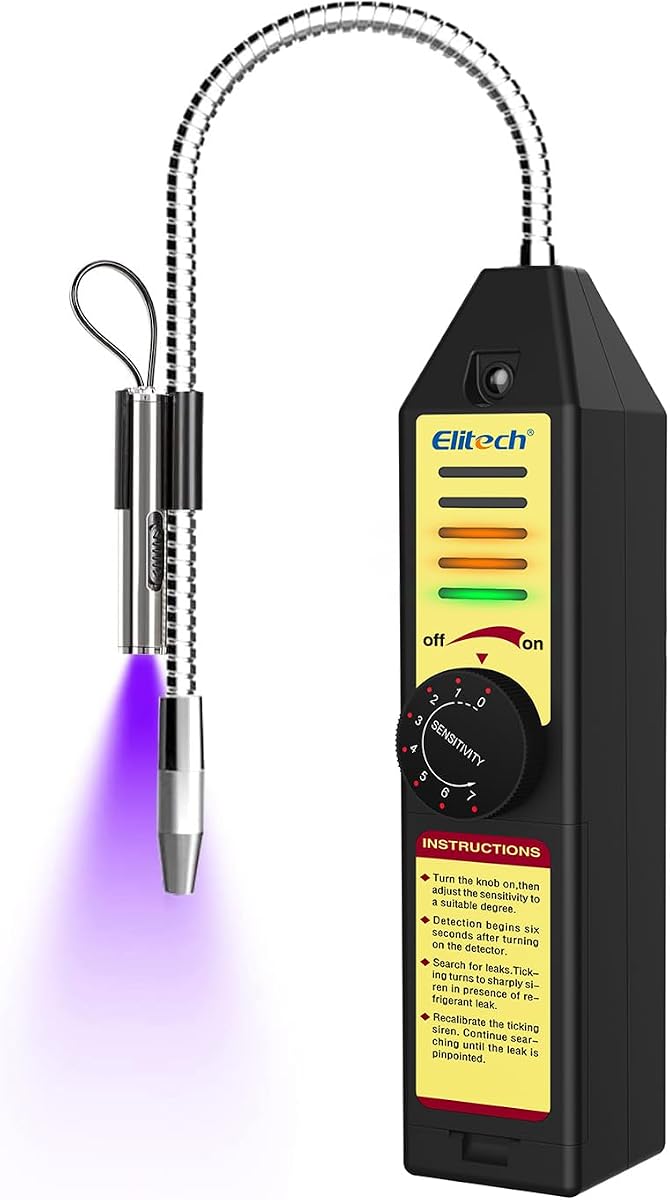
The Elitech CLD-100 carries a 4.3 rating and offers a practical entry point for technicians, maintenance workers, and serious do-it-yourself users. It uses an updated analogue circuit with a traditional corona sensor, reaches a usable state after six seconds, and provides a 0.21 oz/year maximum sensitivity for locating common refrigerant escapes.
We may earn a commission when you buy through this link, at no additional cost to you.
Its strongest features are speed, simplicity, and broad refrigerant support. The detector responds to R11, R22, R134A, R404A, R410A, and halogenated refrigerants across the HFC, CFC, and HCFC families. Six sensitivity levels appear in the supplied data, while audible and visual leakage indicators make the operating state obvious. A flexible probe of about 8.26 inches reaches around fittings and into areas that a rigid probe may not comfortably enter.
The main compromise is power. It runs on four AAA batteries, which are not included, and the product description does not list a rechargeable battery. Users must therefore keep suitable batteries available and may prefer a disposable-battery instrument for infrequent service calls where simplicity matters more than compact charging hardware. The stated sensitivity is also lower than that of several advanced models in this comparison.
For routine automotive A/C, residential air-conditioning, and refrigeration checks, the CLD-100 provides the essential functions without an elaborate display. It is a sensible budget selection for technicians who value fast startup, tactile sensitivity control, and a narrow flexible probe. Buyers should not expect the ppm-level information, multi-gas coverage, or micro-leak capability offered by premium instruments.
The six-second preheat is especially convenient for a technician moving between vehicles, appliances, and indoor equipment. It reduces the downtime associated with allowing a sensor to stabilize before every check.
Audible and visual alarms communicate the leak response without requiring interpretation of a complex menu. Dual-color battery indicators add a straightforward way to check power status before starting work.
We may earn a commission when you buy through this link, at no additional cost to you.
The Elitech ILD-100H has a 4.4 rating and targets technicians who want a fast, sensitive heated-diode detector with an informative color screen. Its stated maximum sensitivity of 0.1 oz/year improves the prospect of finding small leaks, while the one-second response helps reduce hesitation when moving the probe around a fitting or coil.
We may earn a commission when you buy through this link, at no additional cost to you.
The TFT display presents sensitivity, leak alerts, battery level, and other operating information in a more readable format than a basic indicator panel. High, medium, and low sensitivity settings allow the operator to begin with broad coverage and then move closer to a suspected joint. Two front-panel buttons provide direct access to sensitivity changes and buzzer muting, which supports repeated inspections in noisy or quiet environments.
The detector covers CFC, HCFC, HFC, HC, HFO, and mixed refrigerants, with examples including R11, R22, R404A, R410A, R600a, and R1234yf. It also lists blends such as AZ-50, HP62, and MP39. A one-year warranty and 24/7 service support are included in the supplied information. One omission in the provided specifications is a stated battery runtime, so buyers should verify the power configuration and expected operating duration.
The ILD-100H is a good match for HVAC professionals seeking more feedback than an audible sniffer provides without moving to an advanced infrared premium model. It is particularly useful for fast leak isolation and for technicians who work with many of the listed refrigerant families. Users should still follow the manufacturer's warm-up, calibration, and probe technique instructions to obtain reliable results.
A one-second response allows the operator to sweep systematically and react quickly when concentration rises. This makes the tool practical for tracing a suspected leak across multiple joints without repeatedly pausing.
The display centralizes sensitivity, battery, and alarm status, reducing the need to interpret separate LEDs. Direct front controls also keep routine adjustments simple while the probe remains in position.
We may earn a commission when you buy through this link, at no additional cost to you.
The Elitech ILD-200 has a 4.4 rating and uses infrared detection to provide faster response, strong interference resistance, and a claimed 10-year sensor life. It is positioned for professional refrigerant diagnostics where a durable sensor and an easy-to-read peak display can reduce the difficulty of locating small or intermittent leaks.
We may earn a commission when you buy through this link, at no additional cost to you.
Its maximum sensitivity is listed at 0.14 oz/year, with high, medium, and low adjustments available. The instrument detects CFC, HCFC, HFC, HC, HFO, and mixed refrigerants, including R11, R22, R404A, R410A, R600a, R1234yf, and blends. The 2.8-inch screen uses a peak display to indicate the orientation of the detected leak point, allowing the user to find the strongest reading while retaining useful information during the search.
The main consideration is that this is a more specialized instrument than a basic corona detector, and the supplied listing does not state battery capacity or runtime. It also remains important to understand the manufacturer's warm-up and operating procedure; an advanced sensor does not remove the need for correct baseline calibration and controlled probe movement. The peak display can be particularly valuable around crowded equipment where the source is not immediately obvious.
The ILD-200 is best suited to professional technicians, facilities teams, and serious hobbyists who perform regular leak detection and want infrared response and long sensor life. It may be unnecessary for occasional checks, but its broad refrigerant support and informative display make it a compelling specialist tool for demanding service environments.
The listed ten-year sensor life makes the instrument relevant to technicians who want to minimize sensor replacement concerns. Its advertised resistance to interference is also useful in equipment rooms containing other electrical and environmental influences.
Holding the highest concentration can make it easier to return to a leak source after exploring surrounding components. The orientation feature is intended to guide the user toward the strongest detection point.
We may earn a commission when you buy through this link, at no additional cost to you.
The Elitech WJL-6000S has a 4.2 rating and is a straightforward choice for routine HVAC and automotive A/C leak checks. Its rotary control, audible and visual indicators, and quick startup make it approachable for users who want an uncomplicated instrument rather than a screen-heavy diagnostic device.
We may earn a commission when you buy through this link, at no additional cost to you.
The detector responds to R22, R134A, R404A, R410A, R1234YF, and all listed halogenated refrigerants in the HFC, CFC, HCFC, and blend categories. A knob provides seven sensitivity levels, with maximum sensitivity stated at 0.21 oz/year. The electronic response time is three seconds after a six-second warm-up, and the 7.9-inch flexible probe can access tighter locations around fittings and service areas.
Compared with a TFT or color-LCD model, this unit offers less diagnostic detail. It does not provide a numerical concentration reading, trend graph, or broad multi-gas coverage in the supplied information. That is not a serious limitation for basic sniffing, but it means the user must rely on changes in alarm behavior to judge proximity and may need to repeat a sweep at a different sensitivity.
The WJL-6000S is a practical choice for maintenance staff, entry-level technicians, and do-it-yourself users who regularly inspect residential or automotive systems. It offers the essential refrigerant response and probe flexibility without a more complex interface. Those searching for micro-leak capability, live readings, or rechargeable convenience should consider one of the more advanced options.
The rotary sensitivity control is easy to understand and adjust in the field. Dual battery indicators and familiar audible and visual alerts make the unit convenient for intermittent use.
A 7.9-inch flexible probe helps technicians inspect around service ports, narrow gaps, and crowded fittings. Its length offers useful reach without the handling complexity of a much larger instrument.
We may earn a commission when you buy through this link, at no additional cost to you.
This rechargeable detector has a 4.7 rating and combines a Japanese semiconductor sensor, real-time ppm readings, and three independently configurable alarm types. It is well suited to technicians who want measurable concentration feedback while working in environments where sound, vibration, and visual signals each have different practical value.
We may earn a commission when you buy through this link, at no additional cost to you.
High, medium, and low sensitivity levels help balance broad searching with close inspection around coils, valves, fittings, and service ports. The stated maximum sensitivity is 3 grams per year, or 0.1 ounce per year. Its full-color TFT screen offers a funnel view for quick intensity visualization and a trend graph for watching concentration changes. Sound, indicator light, and vibration alerts can be enabled independently, and the buzzer can be muted.
The built-in 2000mAh battery supports up to eight hours of continuous use and charges through USB-C. A 14.5-inch flexible gooseneck reaches around condensers, evaporators, pipes, and other confined areas. Refrigerant support includes R134a, R410A, R407C, R404A, R22, R123, R32, R502, R503, and R1234yf, with broader HFC, HCFC, CFC, PFC, HFO, R717, and mixed-halogen support stated.
This is a well-balanced option for residential HVAC, commercial air conditioning, automotive work, and refrigeration service. The numeric display and trend graph are particularly useful when documenting how the signal changes during a systematic search. As with other semiconductor-based instruments, users should allow the sensor to stabilize and begin in clean air for dependable baseline readings.
The funnel view gives immediate visual feedback about leak intensity, while the trend graph helps a technician see whether concentration is rising or falling during a pass. Together they support more methodical isolation than a basic alarm-only detector.
Independent sound, light, and vibration controls let users suppress distracting alerts in offices or basements while retaining useful signals. Quick mute provides another way to work quietly without abandoning the inspection.
We may earn a commission when you buy through this link, at no additional cost to you.
The Aprvtio ALD-200 has a 4.3 rating and stands out for broad compatibility across A1, A2L, and A3 refrigerants, hydrocarbons, and nitrogen-hydrogen tracer gas. Its next-generation heated-diode sensor, 0.14 oz/year maximum sensitivity, and intelligent display functions make it a versatile option for both conventional HVAC service and modern refrigerant work.
We may earn a commission when you buy through this link, at no additional cost to you.
A 2.8-inch TFT color display presents concentration information, while the audible alarm's beep frequency increases as the leak intensifies. Peak Mode captures the maximum reading during a search, and the reset function recalibrates the sensor to help reduce false alarms. The unit also supports a mute button for quiet operation and is designed to perform automatic zero calibration in clean air.
The compatibility list is extensive, covering CFC, HCFC, HFC, HFO, PFC, and hydrocarbon refrigerants, as well as blends and a 5% hydrogen/95% nitrogen tracer mixture. That breadth is valuable for technicians who service heat pumps, refrigeration equipment, and automotive air conditioning. The housing is described as oil-resistant and impact-resistant, while the rechargeable battery is intended to support a full service day.
The ALD-200 is a sensible pick for maintenance professionals who encounter varied refrigerant categories and want peak capture rather than only a present-moment alarm. Its warm-up, clean-air baseline, and calibration routine require more care than a simple sniffer, but those procedures are central to dependable readings. Buyers should confirm that every specific refrigerant or tracer gas they use appears on the current compatibility list.
Capturing the maximum concentration can be useful when probing several nearby components in sequence. The operator can then return to the strongest point and inspect the associated joint more closely.
A2L refrigerants, hydrocarbons, and nitrogen-hydrogen tracer gas broaden the tool beyond traditional Freon checks. That makes it useful for service environments where a technician may encounter several refrigerant safety classes.
We may earn a commission when you buy through this link, at no additional cost to you.
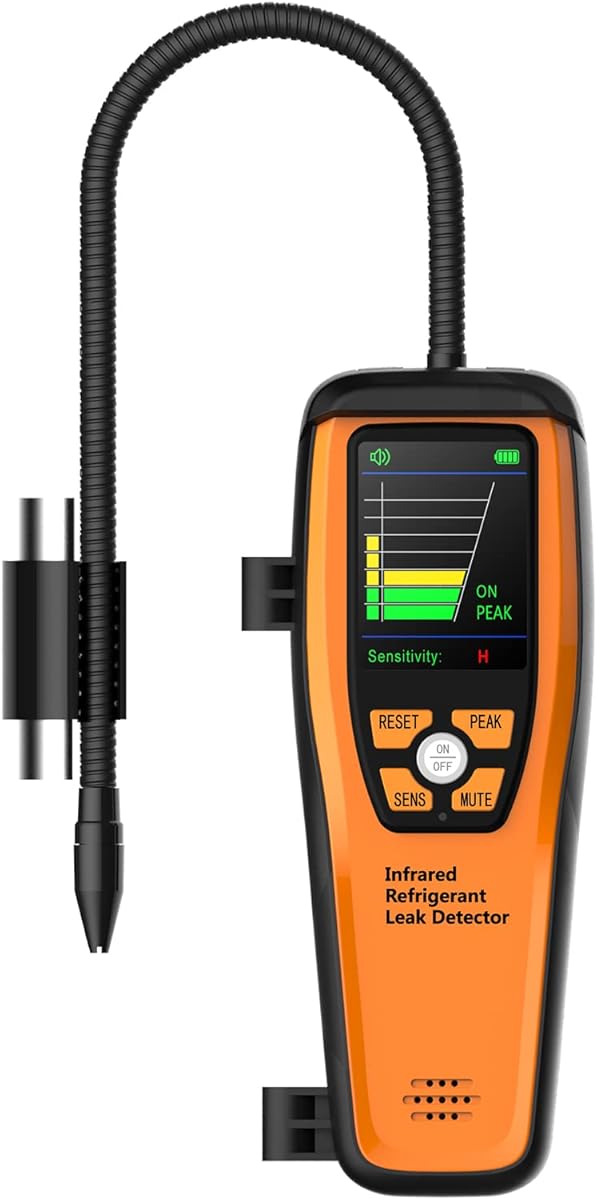
The NF-605 refrigerant leak detector has the highest supplied rating in the group at 4.9 and offers an unusually balanced combination of sensitivity, visual feedback, flexible alerts, and rechargeable power. Its three-level adjustment, real-time bar graph, and 3-gram-per-year maximum sensitivity make it a strong general-purpose choice for professional and advanced do-it-yourself users.
We may earn a commission when you buy through this link, at no additional cost to you.
The detector covers CFC, HCFC, and HFC refrigerants, including R11, R12, R22, R32, R134a, R404a, R410a, and R507. Its display shows concentration, sensitivity, battery status, and alarm information, while a buzzer, vibration alarm, and screen indication provide multiple ways to recognize a leak. Alarm intensity changes in proportion to detected concentration, which helps users understand whether they are moving closer to the source.
The 3000mAh lithium battery is stated to provide more than six hours of continuous operation, and the included Type-C cable keeps charging straightforward. A carrying bag, user manual, and charging cable are included. The automatic preheat takes 30 seconds, longer than the quickest-starting units in this guide, so technicians who perform very brief checks should account for that setup time. Its refrigerant list is focused on halogenated families rather than hydrocarbons or tracer gas.
The NF-605 is the most broadly attractive choice in this comparison for users who want professional-style features without moving to the premium infrared category. Its rechargeable design, clear bar graph, three sensitivity levels, and multi-alarm support suit daily HVAC, refrigeration, and automotive work. The 30-second preheat is a minor inconvenience for most full inspections, making overall convenience and diagnostic feedback difficult to surpass.
The real-time display translates concentration into an immediately recognizable visual trend. Users can watch the graph rise while approaching a suspected leak and fall while moving away.
A rechargeable 3000mAh battery supports extended service time, while automatic shutdown helps conserve power during inactivity. The included carrying case makes the instrument easier to keep with a technician's other field tools.
We may earn a commission when you buy through this link, at no additional cost to you.
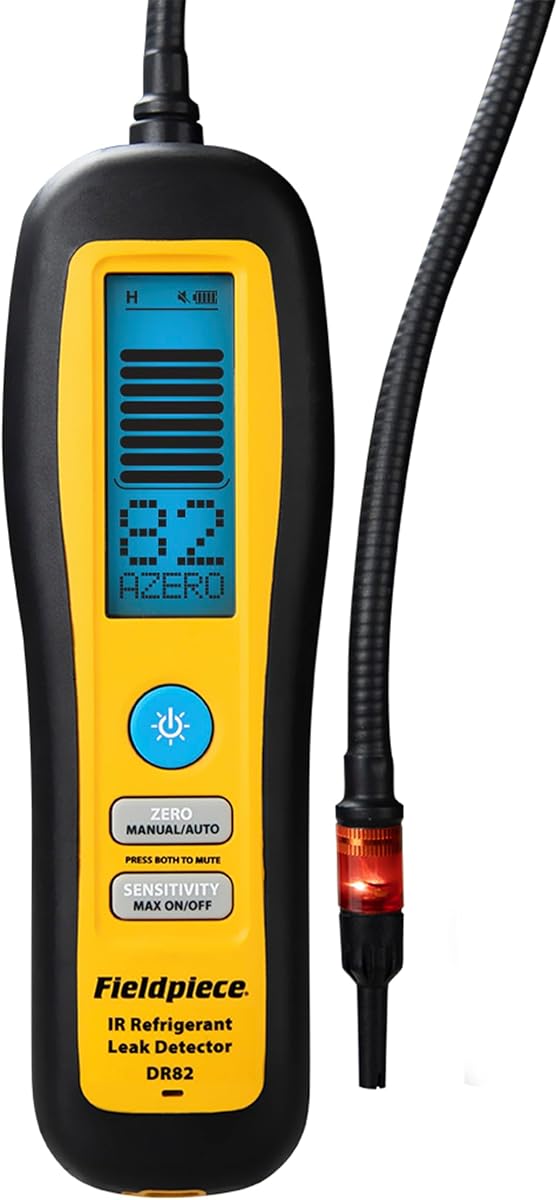
The Fieldpiece DR82 has a 4.4 rating and is the premium option in this guide because of its stated infrared sensitivity to leaks below 0.03 oz/year. That capability is especially relevant for finding micro leaks that conventional soap bubbles or visual inspection may miss, making the detector appealing to experienced technicians and demanding service organizations.
We may earn a commission when you buy through this link, at no additional cost to you.
The instrument works with CFC, HCFC, HFC, HFO, and blend refrigerants used in HVACR service. A large backlit LCD displays leak size and intensity, while an LED probe tip and beep help pinpoint the source. The infrared sensor is rated for a 10-year service life, and the IP54 housing resists moisture and oil, both valuable traits in mechanical rooms, vehicle interiors, and other demanding environments.
A 17-inch flexible probe provides the longest reach among the listed products, allowing access around coils and into tight equipment spaces. The battery lasts more than 10 hours and uses USB-C charging. Replaceable filter tips help protect the sensing path from contamination. The main trade-off is cost, but the appropriate comparison is the detector's capability rather than the price of basic corona units.
The DR82 is best for professional technicians who routinely chase small leaks, work with modern blends, or need a durable infrared instrument. It is less compelling for occasional users who only need a basic audible sniffer. Even with exceptional sensitivity, accurate results still depend on a clean baseline, correct warm-up, and slow, controlled probe movement near suspected joints.
The listed sensitivity below 0.03 oz/year creates a major advantage when identifying slowly leaking joints. It can reduce the need for repeated disassembly that might be necessary when a micro leak is below the practical threshold of a simpler detector.
An IP54 rating, oil and moisture resistance, and replaceable filter tips suit regular HVACR work. The 17-inch probe reaches crowded spaces while keeping the instrument body accessible for the technician to read.
We may earn a commission when you buy through this link, at no additional cost to you.
The TOPTES RT-389 has a 4.1 rating and is designed as a rugged rechargeable detector for automotive, residential, and commercial HVAC service. Its Japanese semiconductor sensor, three sensitivity modes, and stated 0.1-ounce-per-year maximum sensitivity place it among the more capable instruments in the group.
We may earn a commission when you buy through this link, at no additional cost to you.
The TFT display provides real-time ppm information in either a funnel chart or trend graph, with adjustable brightness and an automatic screen-off function. Sound, visual, and vibration alarms can be enabled independently, and a 90dB audible alarm provides a strong signal in noisy service environments. A built-in top light improves visibility in basements, garages, and confined workspaces where overhead illumination may be poor.
The 14.5-inch flexible gooseneck reaches around coils, valves, and service points, while the 2000mAh battery is stated to last more than eight hours and recharge through USB-C. The housing is described as waterproof, explosion-proof, and dustproof, and the package includes a multilingual manual, charging cable, and storage case. As with other semiconductor tools, users should allow the sensor to stabilize and establish a clean-air baseline before searching.
The RT-389 is a good fit for technicians who want ppm data, several alarm methods, and a long probe in one rechargeable package. Its features align well with daily service work, although it shares the low point of the supplied rating scale. Buyers should confirm the current technical documentation, exact refrigerant list, and applicable safety certifications before using it in specialized applications.
Sound, light, and vibration can be adjusted separately to suit the environment. A technician can rely on a quiet visual cue in an occupied room or use vibration and sound in a louder mechanical area.
A dedicated top light makes fittings and surrounding components easier to see during an inspection. The TFT display's brightness adjustment further helps preserve readability across poorly lit and brightly illuminated jobsites.
We may earn a commission when you buy through this link, at no additional cost to you.
Choosing a Freon leak detector requires balancing sensitivity, refrigerant compatibility, probe design, display information, power, and field durability. The best tool is the one that matches your typical refrigerant inventory and inspection routine, not simply the model with the largest feature list.
Corona and diode sensors are familiar choices for routine halogenated refrigerant checks, while heated-diode and infrared designs offer advanced performance characteristics. Infrared detectors are especially compelling for micro leaks, and heated-diode instruments are often positioned as a professional middle ground. Semiconductor sensors can provide useful numeric readings but should be given adequate warm-up time. The correct choice depends on the sensitivity you need, the refrigerants you service, and your willingness to follow calibration procedures.
Choose a sensor that suits the work: choose a simple diode detector for routine checks, a heated diode for broader professional diagnostics, and infrared when very small leaks justify advanced instrumentation.
A detector must respond to the refrigerant actually used in the customer's system. The products in this guide cover numerous CFCs, HCFCs, HFCs, HFOs, blends, and hydrocarbons, but coverage varies. R22, R134a, R410a, R404a, and R1234yf appear repeatedly, while some tools also support R32, R454B, R290, R600a, R717, or tracer gas. Compatibility should reflect the refrigerant safety class and the exact system being inspected rather than a broad marketing claim.
Write down the refrigerants you use and verify each one against the manufacturer's current compatibility chart before purchasing.
Stated sensitivity indicates the size of leak the instrument is designed to identify under defined test conditions. The group ranges from 0.21 oz/year for basic corona models to below 0.03 oz/year for the premium infrared detector. Faster response helps users react to a rising signal, while multiple sensitivity levels allow a broad initial sweep followed by focused inspection. Actual results also depend on technique, distance, airflow, and sensor stabilization.
For difficult micro leaks, prioritize higher sensitivity and infrared technology; for routine service, adjustable levels and reliable alarms are usually more important.
A flexible probe can reach service ports, narrow gaps, crowded fittings, and the far side of a coil without forcing the entire detector into an awkward position. Listed probe lengths range from roughly 8 inches to 17 inches, with the longest options offering the greatest reach. Probe flexibility should be balanced against durability and comfortable handling, particularly when the tool is used repeatedly throughout a day.
Choose a longer gooseneck for tight or crowded equipment and a shorter flexible probe when compact storage and simple handling are the priority.
Audible and visual alarms remain the most common way to identify a leak, but higher-end models add ppm readings, bar graphs, peak values, and trend graphs. Numeric data can make it easier to compare readings from different joints and determine whether the probe is moving closer. Independent sound, light, and vibration controls are useful in offices, occupied rooms, noisy shops, and confined areas where a constantly sounding buzzer would be inconvenient.
Choose a numerical display and adjustable alerts when you need diagnostic records or quiet operation; an audible and visual indicator is sufficient for many straightforward sniffs.
Rechargeable instruments reduce the need to carry spare disposable batteries and are convenient for daily field use. Stated runtimes in this group range from more than six hours to as much as 24 hours, although actual use depends on alarm settings, display activity, and sensor behavior. Disposable-battery models may be simpler and inexpensive to keep in service, but users must confirm the correct battery type and whether batteries are included.
Prioritize a long-running USB-C rechargeable model for full service days, or choose disposable power when simplicity and minimal charging routine matter more.
Every detector benefits from a clean baseline, but metal-oxide and semiconductor models can require a longer warm-up than basic corona units. Some products specify a quick start, while others need tens of seconds or even several hours to reach full sensitivity after storage. Users should work in clean air away from the suspected leak, allow the sensor to stabilize, and follow the manufacturer's reset or zero-calibration instructions. Rushing this stage can create false alarms or missed micro leaks.
Read the operating instructions before the first job and build warm-up and calibration time into every inspection routine.
Oil resistance, moisture resistance, impact-resistant construction, and replaceable filter tips matter in mechanical rooms, vehicle interiors, and commercial refrigeration environments. A carrying case, charging cable, and multilingual manual can improve daily usability, while an integrated work light helps in poorly illuminated areas. Buyers should also consider warranty coverage and technical support, although those factors should not replace checking the sensor specification and refrigerant list.
Prioritize proven environmental resistance, included charging accessories, and a protective case if the detector will travel frequently in a service kit.
Begin by reading the detector's manual, charging it if necessary, and confirming that the intended refrigerant appears on the compatibility list. Inspect the probe and filter for damage, remove any covering that could obstruct airflow, and allow the sensor to warm for the stated period. For many semiconductor models, this can take substantially longer than the quick preheat offered by basic corona detectors.
Perform the initial zeroing or calibration in clean air away from the suspected leak. If the system is depressurized and open, move the probe near the suspected area without placing it directly in a plume of refrigerant, since an excessively high concentration can saturate the sensor. Switch to a lower sensitivity for a broad sweep, then increase sensitivity as you move closer to a joint. Search methodically with slow, controlled movement rather than sweeping rapidly.
Approach fittings, valves, service ports, coils, brazed joints, and other likely leak points in small increments. Watch the display, listen for changes in the alarm, and use peak mode if available to retain the strongest reading. Avoid drafts, fans, and moving air that can dilute the refrigerant. After the inspection, switch off the detector, disconnect power, clean the probe as directed, replace a contaminated filter when necessary, and store the unit in a dry, protected case.
The best type depends on the leaks you need to find. Professional technicians often favor heated-diode or infrared models for strong sensitivity, numerical readings, and broad refrigerant support. A basic corona detector can still handle routine checks, while a premium infrared instrument is especially useful for micro leaks. Probe reach, battery life, and the refrigerants handled by your service business should also shape the decision.
No single tool necessarily covers every refrigerant and gas used in the field. Most models in this guide detect common halogenated refrigerants, but support for hydrocarbons such as R290, R600a, R717, or nitrogen-hydrogen tracer gas varies. Always check the exact refrigerant, blend, and safety class in the current manufacturer specifications before using a detector on a system.
Calibration establishes the instrument's baseline before the probe enters an area containing refrigerant. A high ambient reading can cause false alarms or drive the sensitivity so low that a small leak is missed. Warm the sensor for the recommended period, perform the reset or zero function in clean air, and then begin the search away from the suspected source.
Higher sensitivity can make micro leaks easier to detect, but it is only one part of an effective inspection. A very sensitive instrument still requires correct warm-up, baseline calibration, controlled probe movement, and attention to airflow. For routine service, a detector with adjustable levels and clear alerts may be more practical than an advanced instrument the user rarely operates correctly.
Keep the probe close to likely joints without touching components, and move it slowly enough to observe changes in the reading. Several product descriptions recommend a distance of roughly one-quarter inch from a joint and a movement rate around one inch per second, although the manual for the chosen model should take priority. Approach likely fittings and valves methodically rather than making rapid passes.
A leak detector can be highly effective for locating small escapes and checking larger areas, but different methods can complement one another. Bubble testing is useful for visible leaks at accessible joints, while dye can help reveal a suspected location over time. A detector should also be checked for calibration, and severe or uncertain leaks may still require verification with another appropriate method.
Store the device fully charged or with fresh batteries, clean and dry, in its protective case. Avoid compressing or sharply bending a flexible gooseneck probe, and keep replacement filter tips accessible. If the detector uses a semiconductor sensor, follow the manufacturer's storage guidance because extended storage may require a longer warm-up before the next use.
A semiconductor sensor's output stabilizes as its operating temperature and surrounding gas conditions settle. The supplied guidance for one metal-oxide model says full sensitivity may take several hours after the unit is new or has been stored. Other models advertise preheating periods of tens of seconds, so users should follow the exact instructions for their detector rather than assuming startup times are interchangeable.
The NF-605 Rechargeable Detector is the most well-rounded option, combining a high rating, real-time bar graph, three sensitivity levels, multiple alarm methods, and a rechargeable battery. The Elitech CLD-100 is the best budget choice for straightforward leak sniffs, while the Fieldpiece DR82 is the premium selection for technicians who need exceptional stated infrared micro-leak sensitivity.
Prioritize refrigerant compatibility, correct calibration, and a sensitivity level that matches the size of leak you need to find. Longer probes help in crowded equipment, color displays make concentration easier to interpret, and independent alerts make a detector more comfortable in different work environments. The right tool should also use a power source and form factor that fit your service routine.
Product specifications and prices can change, so confirm the current listing before purchasing. Check the manufacturer's instructions for warm-up, baseline zeroing, probe technique, battery use, and cleaning. Those operating details are essential for dependable results and help the selected Freon leak detector tool perform at its stated capability.