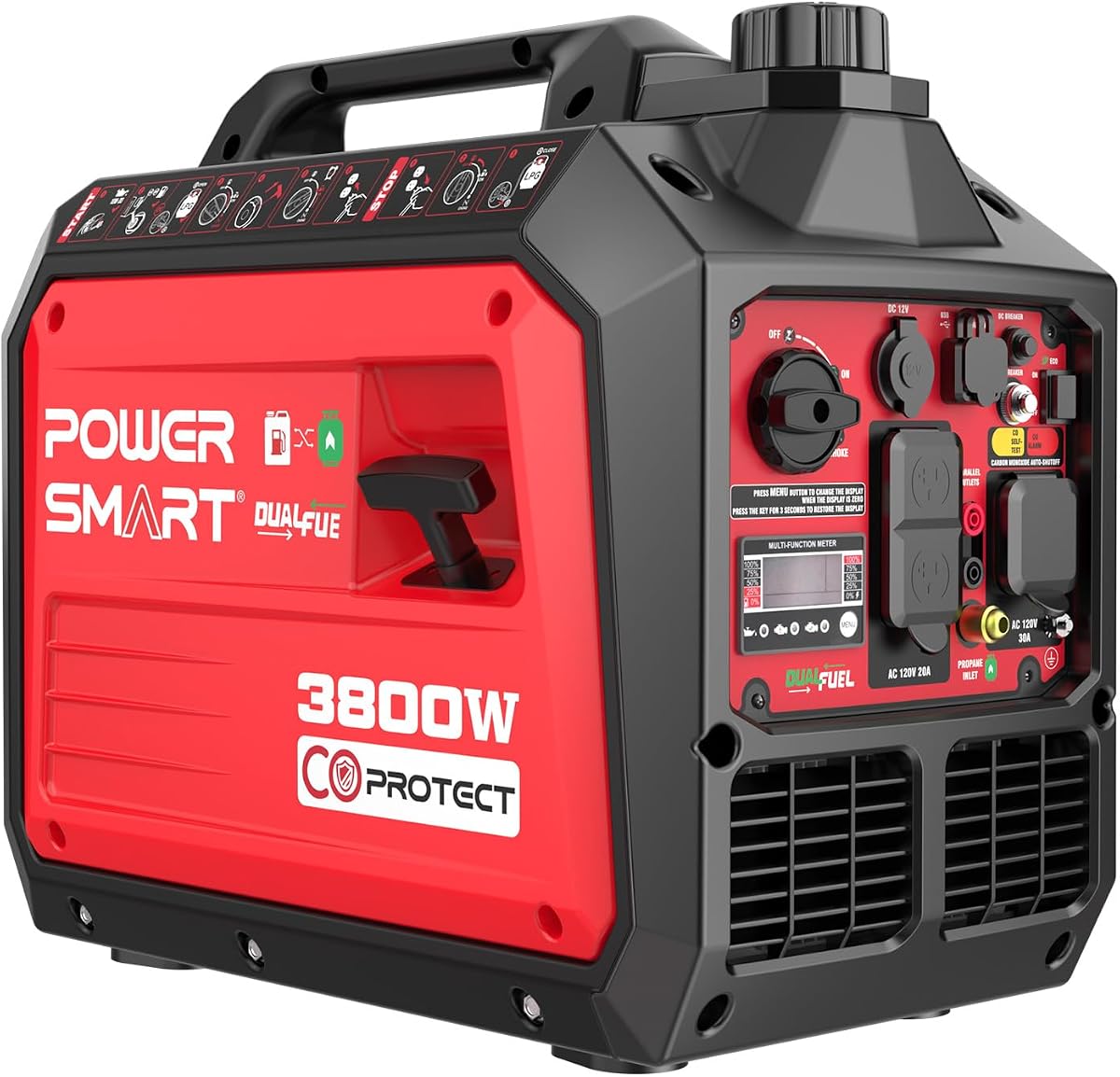
PowerSmart 3800 Watt Dual Fuel Inverter Generator
4.5Editor score
Low 59 dBA operation
Propane runtime up to 24 hours
Inverter generator portability
CO sensor and low-oil shutdown
Explore the best dual fuel generators, comparing wattage, runtime, outlets, safety features, fuel flexibility, and ideal uses to help you choose with confidence
Dual fuel generators combine gasoline and propane in one portable power unit, giving users convenient fuel flexibility during outages, camping trips, roadside emergencies, and jobsites. The right model should deliver adequate running power, clean and dependable electricity, manageable noise, useful outlet options, and protection features suited to the equipment being powered.
This guide compares ten dual fuel generator listings by examining starting and running wattage, fuel capacity, runtime claims, engine configuration, voltage support, transfer-switch readiness, outlet selection, remote or electric starting, carbon monoxide protection, and portability. It covers compact inverter units, conventional home-backup models, and higher-output portable systems for demanding loads.
Each review identifies the product's most useful strengths and practical trade-offs, while the top picks identify the strongest options for different priorities. Specifications, ratings, and availability can change over time, and retailer prices fluctuate, so readers should verify the current listing and technical details before making a purchase.
4.5Editor score
4.6Editor score

4.8Editor score
The comparison below places each generator's power output, fuel support, runtime, starting method, and major connectivity features side by side so buyers can quickly identify the model that fits their intended equipment and operating environment.


The Westinghouse 12500 Watt Dual Fuel generator combines a 4.7 rating with substantial home-backup capability. It delivers 9,500 running watts and 12,500 peak watts on gasoline, plus 8,500 running watts and 11,200 peak watts on propane, giving users a meaningful power reserve for common household circuits.
We may earn a commission when you buy through this link, at no additional cost to you.
Its strongest features include remote electric starting with an included key fob, electric and recoil starting options, and a digital VFT display that reports voltage, frequency, and lifetime operating hours. Two GFCI household receptacles, a transfer-switch-ready 30-amp L14-30R outlet, and a 50-amp RV-ready outlet make the connection options unusually versatile.
The 457cc four-stroke OHV engine uses a cast-iron sleeve and includes automatic low-oil shutdown. A 6.6-gallon tank, fuel gauge, and stated runtime of up to 12 hours support extended operation, although the machine is not as compact or quiet as an inverter model. The included battery charger, oil, funnel, tool kit, and remote make initial setup relatively straightforward.
This generator is well suited to homeowners who need meaningful backup capacity, remote starting, and several connection types without moving to a permanently installed standby system. It is less appropriate for compact camping or quiet electronics-only use, but as a general-purpose dual fuel home backup unit, it offers a balanced and thoughtfully equipped package.
The gasoline and propane ratings provide enough headroom for combinations of lighting, refrigeration, communication devices, and selected household appliances when load management is followed. The separate peak and running ratings also help users distinguish brief startup demands from sustained output.
The combination of GFCI household outlets, a 30-amp transfer-switch outlet, and a 50-amp RV outlet means the unit can support several common connection needs. A qualified electrician should determine whether and how a transfer switch is installed.
We may earn a commission when you buy through this link, at no additional cost to you.
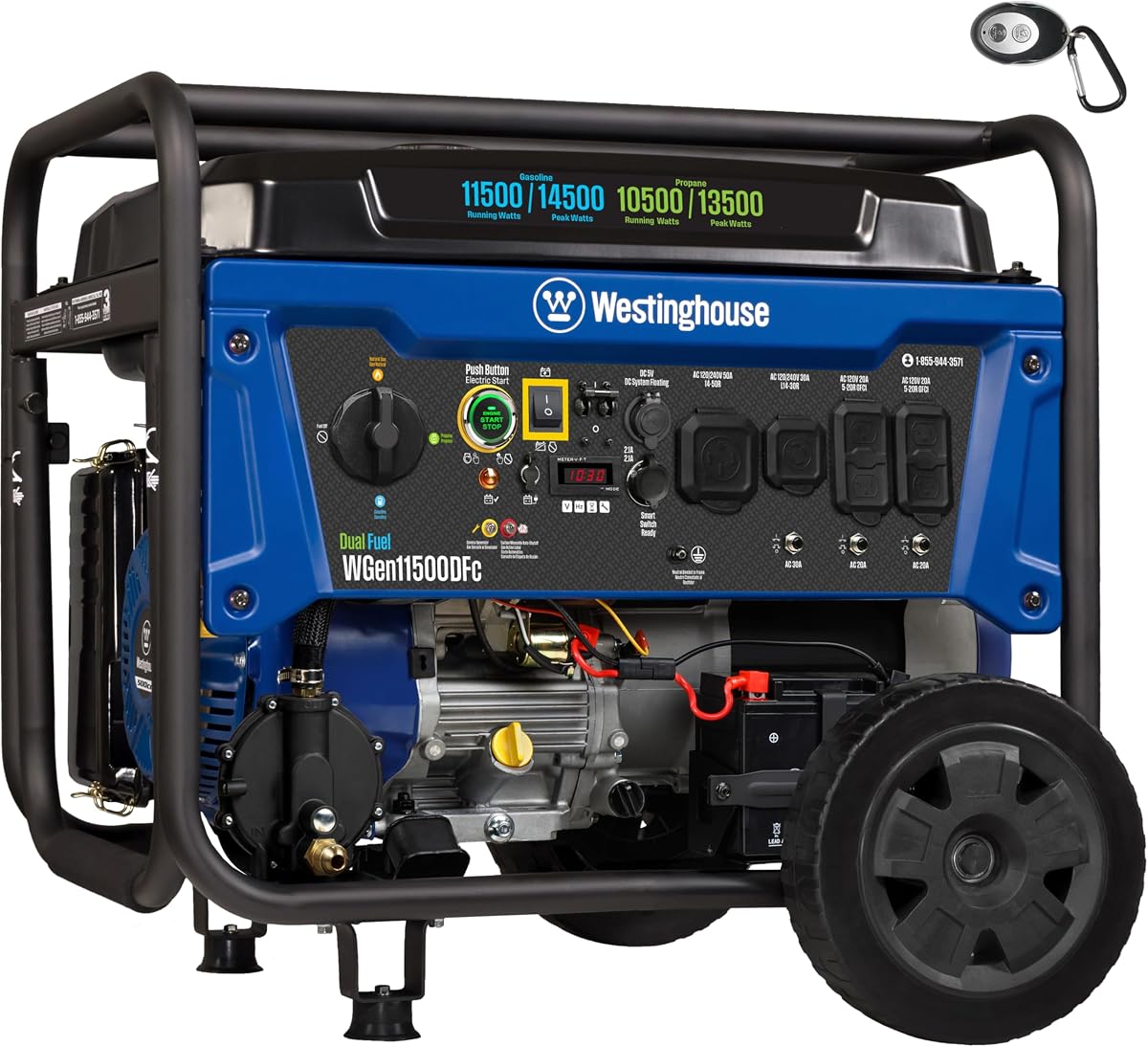
The Westinghouse 14500 Peak Watt Dual Fuel generator offers a 4.6 rating and substantial output for larger homes, portable work, and prolonged outages. Its 11,500 running watts on gasoline and 10,500 running watts on propane place it above many conventional portable alternatives.
We may earn a commission when you buy through this link, at no additional cost to you.
The stated 19-hour gasoline runtime comes from a 9.5-gallon tank with a built-in gauge, while propane operation is listed at up to seven hours on a 20-pound cylinder. Its low total harmonic distortion is designed for sensitive electronics, and durable copper windings are intended to support cooler operation and longer service life.
A 550cc four-stroke OHV engine with a cast-iron sleeve forms the mechanical core. Although the unit offers remote electric starting, its size and power class make it more realistic as a home or jobsite machine than a lightweight recreational generator. Buyers should also confirm the exact receptacle configuration and included accessories for their intended use.
This is a compelling selection for households that want high output, low harmonic distortion, and long gasoline runtime from a portable dual fuel platform. It fits users who prioritize capacity and power quality over small size, quiet operation, or minimal fuel consumption.
With 11,500 running watts on gasoline, the generator offers considerable operating headroom for well-planned household backup. It is better suited to broad load requirements than a small inverter intended mainly for phones, laptops, and a few essential appliances.
The 9.5-gallon fuel tank and stated 19-hour runtime reduce the frequency of gasoline refills. Actual results depend on load, fuel condition, altitude, temperature, and how often the unit cycles through the Eco Mode available on dual-fuel models.
We may earn a commission when you buy through this link, at no additional cost to you.
The PowerSmart 3800 Watt Dual Fuel Inverter generator is a focused compact option with a 4.5 rating. It provides 3,300 running watts on gasoline and 3,100 running watts on propane, making it more appropriate for essential equipment and moderate household loads than for starting numerous large appliances at once.
We may earn a commission when you buy through this link, at no additional cost to you.
Its standout advantage is quiet operation: the listing specifies 59 dBA at 25 percent load in Eco Mode. It also claims up to eight hours on a 1.3-gallon gasoline tank and up to 24 hours on a standard 20-pound propane cylinder, with Eco Mode supporting extended use.
The control panel includes a 120-volt 30-amp twist-lock outlet, a 120-volt 20-amp duplex household outlet, a 12-volt DC port, and two USB ports. Overload and short-circuit protection, a carbon monoxide sensor, and low-oil shutdown improve the safety proposition, though the absence of a 240-volt output narrows whole-home and transfer-switch use.
This generator makes sense for campers, travelers, apartment residents, and homeowners seeking a quiet unit for essential circuits. Its main limitation is output: users must calculate their simultaneous surge and running demand and keep heavier appliances on separate, appropriately sized circuits.
A 59 dBA rating at 25 percent load makes this model a strong candidate for campsites and residential use where operating noise matters. Inverter design also targets smoother, more efficient power delivery than a basic conventional generator.
The ability to switch between gasoline and propane adds resilience when one fuel is easier to obtain. A 20-pound propane cylinder and Eco Mode can provide very long operating periods for appropriately sized loads.
We may earn a commission when you buy through this link, at no additional cost to you.
The DuroStar DS13000MX is a high-output portable generator built around 13,000 watts of stated capacity, gasoline or propane operation, and a 500cc engine. Its 4.4 rating reflects its positioning as a rugged option for homes, jobsites, RVs, and emergency preparation.
We may earn a commission when you buy through this link, at no additional cost to you.
A push-button electric starter and front-facing fuel selector make operation comparatively convenient. Its most notable safety feature is CO Alert, which automatically shuts the engine down when dangerous carbon monoxide levels are detected. The all-metal frame and reinforced control panel are also intended to withstand demanding environments.
The transfer-switch-ready 50-amp outlet is the key feature for users seeking to connect the generator to a home transfer system. As with any portable generator, it should operate outdoors in a location that meets the manual's placement and ventilation requirements, and installation of a transfer switch should be handled appropriately.
This model is a good fit for buyers prioritizing maximum output, rugged construction, rapid fuel switching, and a high-capacity connection over quiet inverter operation. The absence of published runtime and noise figures in the supplied information means those factors should be checked before purchase.
The 13,000-watt output class gives owners room for more demanding emergency equipment than compact dual fuel models can support. Users should still identify startup surges and avoid exceeding the generator's running capacity.
CO Alert provides an added layer of protection, while the metal frame and reinforced panel suit frequent transport and demanding sites. Carbon monoxide protection does not permit indoor operation or placement in an enclosed area.
We may earn a commission when you buy through this link, at no additional cost to you.
The WEN DF475T combines a 4.4 rating with a manageable power class and useful 120V/240V flexibility. It produces 3,800 running watts and 4,750 surge watts on gasoline, while propane operation provides 3,500 running watts and 4,350 surge watts.
We may earn a commission when you buy through this link, at no additional cost to you.
Electric starting is operated by a key, and the selection dial changes fuel type. A 4-gallon tank is listed for up to 11 hours of runtime at half load. The output panel includes two 120-volt GFCI household outlets, a 120/240-volt 30-amp L14-30R twist-lock outlet, and a 12-volt DC connection.
Its most notable advantage over many similarly sized alternatives is the 240-volt capability. That makes the generator more relevant to transfer switches and selected higher-voltage equipment, although an appropriately rated transfer switch and installation remain necessary. The wheel and handle kit improves movement, but the generator is still a substantial portable machine.
This WEN is well suited to homeowners who want 240-volt capability without moving to a much larger unit. It is also practical for RV, tool, and emergency use where moderate output, dual fuel, and straightforward electric starting are more important than ultra-quiet inverter behavior.
The L14-30R outlet allows the generator to support 120/240-volt loads within its ratings. Users should match the load and connection to the generator's capacity and follow the supplied instructions when operating a transfer switch.
GFCI household outlets, a 12-volt DC socket, the included wheel kit, and key-operated electric starting make day-to-day use straightforward. The listed half-load runtime provides a useful basis for estimating fuel needs.
We may earn a commission when you buy through this link, at no additional cost to you.
The DuroMax XP13000EH is a 13,000-watt dual fuel portable generator with a 4.5 rating. Its stated purpose is whole-home outage support, and it is also positioned for RV travel, jobsites, and other mobile power applications.
We may earn a commission when you buy through this link, at no additional cost to you.
A push-button start, front-facing fuel selector, and broad outlet selection make it convenient to operate. The inclusion of a transfer-switch-ready 50-amp outlet is particularly important for users planning a professionally assessed home connection. A heavy-duty all-metal frame and power panel, copper windings, and no-flat tires support durability and mobility.
Its strengths are clearly aimed at buyers who want substantial output and rugged construction. The trade-off is portability relative to compact inverter generators, and the supplied product information does not provide a specific runtime or sound-level figure. Buyers should therefore evaluate fuel consumption and operating noise from the current manual and listing.
The XP13000EH is appropriate for households seeking flexible high-power backup, particularly where a transfer switch is already in place or professionally planned. It is less compelling for tent camping or quiet nighttime operation in populated areas.
The metal frame, copper windings, and no-flat tires are designed for repeated transport and heavy use. These features make the unit more suitable as a dedicated backup or jobsite machine than a lightweight travel companion.
Push-button starting and a front-facing fuel selector reduce the number of steps needed to change operating fuel. The control layout is intended to make emergency use less cumbersome.
We may earn a commission when you buy through this link, at no additional cost to you.
The Westinghouse 14500 Peak Watt Tri-Fuel generator stands apart with a 4.8 rating and support for gasoline, propane, and natural gas. It offers 11,500 running watts on gasoline, 10,500 on propane, and 9,500 on natural gas, combining high output with the broadest fuel flexibility in this group.
We may earn a commission when you buy through this link, at no additional cost to you.
The 9.5-gallon tank provides a claimed gasoline runtime of up to 19 hours, while a 20-pound propane cylinder is listed for up to seven hours. A 550cc four-stroke OHV engine with a cast-iron sleeve, low total harmonic distortion, and copper windings support dependable, potentially cleaner power for sensitive electronics.
Natural-gas compatibility is the defining premium feature, but it also introduces installation and availability considerations. Users need an appropriate natural-gas supply arrangement and should follow all supplied instructions. The trade-off is reduced output on natural gas compared with gasoline, which is common in fuel-flexible engines.
This is the top pick for buyers who want serious power output and the ability to draw from three fuel sources. It is especially compelling for prepared households that value supply resilience, long run time, and flexible installation possibilities over a compact form factor.
Gasoline, propane, and natural gas support allow users to respond to different fuel availability. The additional fuel choice is particularly useful for long-term emergency planning, provided the appropriate connection and safe supply system are in place.
Low total harmonic distortion makes the generator more suitable for phones, computers, televisions, and other sensitive electronics. Copper windings are also designed to reduce heat and support longer alternator life.
We may earn a commission when you buy through this link, at no additional cost to you.
The WEN DF680iX combines a 4.4 rating with inverter technology, RV connectivity, and a specialized bonded-neutral 240-volt configuration. It supplies 6,800 surge watts and 5,100 rated watts on gasoline, with 6,000 surge watts and 4,500 rated watts on propane.
We may earn a commission when you buy through this link, at no additional cost to you.
Its most distinctive feature is the ability to provide low-power Level 2 charging for battery and hybrid electric vehicles through the bonded-neutral 240-volt setup. This should be understood as a limited charging function rather than a substitute for a dedicated high-power EV charger, and vehicle compatibility must be verified before use.
The outlet panel includes an L14-30R 120/240-volt receptacle, two 120-volt receptacles, an RV TT-30R outlet, a 12-volt DC receptacle, and two 5-volt USB ports. A fuel shutoff uses remaining fuel in the carburetor before shutdown, while the CO Watchdog stops operation if dangerous carbon monoxide levels are detected.
This generator is well suited to RV owners, EV households seeking a limited charging backup, and users who want a larger inverter platform with a broad outlet selection. Its principal trade-off is that reduced propane output and specialized charging configuration may not serve every application.
The bonded-neutral 240-volt arrangement is designed for low-power Level 2 charging of compatible battery and hybrid vehicles. Users should confirm charging requirements, vehicle guidance, and any manufacturer limitations before relying on the generator for this purpose.
A TT-30R RV receptacle, telescoping handle, and onboard wheels support travel use. The tool-free LPG quick connector and six-foot regulator hose simplify fuel changes, while the fuel shutoff is intended to reduce carburetor maintenance.
We may earn a commission when you buy through this link, at no additional cost to you.
This entry corresponds to Amazon ASIN B099KS71QX, but the supplied product data does not include a title, rating, image, or description. As a result, there is not enough verified information to explain the engine size, power ratings, runtime, outlet configuration, or safety equipment.
We may earn a commission when you buy through this link, at no additional cost to you.
A product page is available through the provided link, so prospective buyers can inspect the current listing for the missing details. Even then, shoppers should treat marketplace claims carefully and compare the generator's running watts, surge capacity, fuel compatibility, warranty, and required safety clearances with established alternatives.
Because no specifications were supplied, it would be misleading to describe this as a quiet, compact, high-output, transfer-ready, or feature-rich model. The absence of an image also prevents a useful visual assessment of size, control layout, frame design, and outlet placement.
This product should not be chosen over the documented models without first confirming its specifications and warranty directly from the current listing and manufacturer information. Among the well-documented choices in this guide, the Westinghouse, DuroStar, DuroMax, PowerSmart, and WEN generators provide a clearer basis for comparison.
A missing rating and specification sheet prevents meaningful assessment of output or runtime. Buyers should obtain the engine displacement, rated and surge watts, fuel tank capacity, outlet types, starting method, and warranty before assigning it a place in a shortlist.
The current product page can reveal updated information, but the manufacturer's manual and warranty terms are the most appropriate references for setup and safe operation. Users should also confirm whether dual-fuel operation is approved for the exact model.
We may earn a commission when you buy through this link, at no additional cost to you.
This final entry maps to Amazon ASIN B0D3WW1CSQ, but the supplied dataset provides only the ASIN and destination link. No product name, rating, price information, image, or factual description is available, so a detailed performance assessment would be speculative.
We may earn a commission when you buy through this link, at no additional cost to you.
Prospective buyers can open the current listing to determine whether it is a conventional dual fuel generator, an inverter model, or another product format. The key facts to locate include gasoline and propane power ratings, tank capacity, run time, noise level, engine size, remote starting, CO protection, and outlet configuration.
Without those facts, it is impossible to judge whether the listing is better suited to home backup, RV travel, camping, emergency use, or jobsite work. Comparing it directly with a documented model would be misleading because the output class and feature set are unknown.
This listing is best treated as a product requiring additional research rather than an informed recommendation. Buyers should prioritize the fully documented alternatives in this guide unless the current listing reveals compelling specifications, warranty support, and safety features.
Running and surge ratings on each fuel are the foundation of a sound comparison. They determine which appliances can operate together and whether a generator is suitable for emergency, RV, or jobsite applications.
A prospective buyer should locate the owner's manual, warranty terms, and any applicable compliance information. Carbon monoxide protection, low-oil shutdown, ventilation guidance, and transfer-switch compatibility should be confirmed before use.
We may earn a commission when you buy through this link, at no additional cost to you.
The most useful dual fuel generator is not simply the one with the highest wattage. Buyers should balance output, power quality, runtime, noise, connectivity, safety, portability, and fuel availability against the equipment they expect to operate.
Running watts represent the sustained output available for connected loads, while surge watts cover the brief extra power many motors need during startup. Start by listing the wattage of every device likely to operate simultaneously, then leave reasonable headroom for unexpected starts. A generator that is at its maximum while appliances cycle on is likely to stall, trip a breaker, or shut down. The starting figure should be comfortably above the combined steady load, while the running figure must support it continuously.
Gasoline and propane usually produce different ratings, with gasoline commonly providing the higher output. Compare the values for each fuel rather than relying on the largest number on the packaging. Propane may also have a shorter runtime because the model consumes more fuel per hour to maintain comparable performance. Users who expect to operate primarily on propane should use that fuel's running and surge ratings when sizing the generator.
Runtime claims are most useful when compared with the actual load and the tank capacity. A stated maximum is usually obtained under favorable conditions and may not represent operation at higher output. Estimate how long the generator must operate between refills, then check whether gasoline storage and a propane cylinder are practical in the intended location. For emergency use, adequate fuel storage and safe rotation are as important as the engine itself.
Noise is a decisive factor for camping, residential use, and overnight operation. Inverter generators are specifically designed to vary engine speed with load, often producing lower sound levels and smoother electrical output. Conventional generators may be quieter under light loads but louder at higher output. The stated noise figure should be checked for its load condition, because a decibel rating measured at 25 percent load does not describe performance when the engine is working hard.
Outlet selection determines which equipment can be connected safely. Standard household users may need 120-volt GFCI receptacles, while RV owners should look for a compatible TT-30R connection. The L14-30R twist-lock is common on higher-output portable generators, and some models include a 50-amp outlet for a professionally installed transfer switch. A generator being transfer-switch ready does not mean the switch and installation are included.
Recoil starting is dependable but requires effort, while electric starting improves accessibility in cold weather, darkness, or an emergency. Remote electric start is even more convenient for generators operated near a home entrance. A digital display can provide useful information such as output voltage, frequency, and accumulated operating hours. Users should confirm that the battery, key fob, charger, and required accessories are included or compatible with the model.
A carbon monoxide sensor with automatic shutdown provides an important layer of protection, but it does not make indoor operation safe. Portable generators should be used outdoors in an open area, well away from doors, windows, and vents, following the manual's exact guidance. Low-oil shutdown, overload protection, short-circuit protection, covered outlets, grounded receptacles, and proper fuel connection also contribute to safe operation.
Portability depends on more than listed wattage. Consider weight, wheel design, handle arrangement, and whether the generator will be moved frequently. Compact inverter units are easier to transport, while full-size home-backup models generally require deliberate lifting and stable placement. Metal frames and reinforced control panels may be advantageous for jobsite durability. Buyers should also account for the space needed to maintain safe clearance around the generator during operation.
Before first use, read the complete manual, identify the gasoline and propane connections, inspect the generator for damage, and confirm that the engine oil and fuel are at the required levels. Place the unit outdoors on stable, level ground with the exhaust pointed away from doors, windows, vents, and occupied areas. Connect loads before starting, select the intended fuel, and make sure the fuel valve and control switch are in the correct position.
Start the engine according to the instructions and allow it to stabilize before attaching sensitive equipment. Do not overload the generator, and never attempt to run it indoors or in an enclosed shelter. Use appropriately rated outdoor extension cords for distant appliances, connect them while the generator is stopped, and avoid extension cords whose combined length and amperage rating create excessive voltage drop. Before changing fuel, switching voltage, or servicing the machine, turn it off and allow it to cool.
For long-term storage, run the engine sufficiently to cool it, disconnect loads, close the fuel valve, and store the generator in a clean, dry location. Follow the manual for draining old gasoline or propane procedures, changing the oil, cleaning the air filter, and preserving the battery. Monthly operation under load can help reveal problems, while periodic fuel stabilization and filter maintenance help prevent contamination. Always consult the manual for the correct fuel type, oil specification, and service schedule.
A dual fuel generator offers greater fuel flexibility, which can be valuable when gasoline is difficult to obtain or a propane cylinder is more convenient to store. However, it may be larger, cost more, and produce somewhat different output on propane. For many homes, a conventional dual fuel model remains a practical choice; compact inverter users may need to weigh the extra features against available power.
Most dual fuel generators can operate on propane, but output and runtime commonly differ from gasoline operation. Propane often provides lower running watts and may consume more fuel per hour. Use the propane ratings when calculating capacity, and follow the manual's approved fuel and cylinder procedures.
The correct wattage depends on the appliances you plan to operate, not on the size of the home alone. Add the running watts of essential equipment, include surge requirements for motors, and leave headroom for startup overlap. A qualified electrician can also help identify the loads that should be prioritized and whether a transfer switch is appropriate.
Only connect a generator to home wiring through a properly installed and correctly rated transfer switch. Direct connection to household wiring can create dangerous backfeed risks for utility workers and occupants. Installation should be handled by a qualified electrician who can assess the panel, generator output, and local requirements.
Inverter generators are generally designed to run more quietly at light and moderate loads because the engine speed adjusts to demand. Conventional models may also remain relatively quiet under light loads but typically become louder as output rises. Compare published noise ratings only when they use the same measurement distance and load condition.
Operate it outdoors on stable, level ground with ample ventilation, following the manufacturer's placement instructions. Keep the exhaust well away from doors, windows, vents, vehicles, and combustible materials. A CO sensor adds protection but does not make an enclosed location safe or legal for use.
They require similar core maintenance, including oil changes, air-filter care, spark-plug service, battery upkeep, and fuel-system inspection. Propane operation can leave residue in certain carburetors on some designs, and the manual may include extra fuel-switching or storage procedures. Follow the schedule and approved lubricants specified for the exact model.
A 50-amp generator can power many essential household circuits, but it cannot automatically operate every appliance or circuit in a home. The correct generator size depends on the connected loads, their surge demands, and the installed transfer-switch system. Use an electrician to create a safe and adequate emergency load plan.
The Westinghouse 12500 Watt model stands out as a balanced home-backup option with remote starting, useful household and RV outlets, and solid gasoline output. The larger Westinghouse 14500 Peak Watt Dual Fuel unit adds more power and runtime, while the PowerSmart 3800 Watt Inverter is the most portable-oriented selection for quiet operation and essential loads.
Buyers should prioritize the generator's real intended job. A compact inverter model is useful for camping and sensitive electronics, a 120/240-volt unit may suit RV and transfer-switch applications, and high-output conventional models are better for larger emergency load plans. The Westinghouse Tri-Fuel model offers the most extensive fuel flexibility, while the DuroStar and DuroMax options target high-capacity backup use.
Before purchasing, verify the current listing, manufacturer manual, warranty, and all outlet and connection requirements. Retailer prices and specifications can change, so confirming the latest information helps ensure that the selected generator still meets your power, safety, portability, and fuel-availability needs.