
DREO TurboPoly Fan 353
4.7Editor score
Up to 1000 CFM airflow
Adjustable 38-42-inch height
90-degree oscillation
Detachable cleaning components
Dorm room fans are small but essential appliances for students who want personalized comfort without occupying much space. The right model should balance useful airflow, quiet operation, easy controls, and a footprint that fits on a desk, dresser, or nightstand. Compactness alone does not guarantee performance, so each fan also needs to fit the way it will be used.
This guide compares ten dorm room fans across important factors including airflow reach, sound levels, oscillation range, timer functions, power requirements, and ease of cleaning. It covers compact desk models, slim towers, smart fans, and small standing units, giving dorm residents options for narrow rooms, shared study areas, and nighttime use.
Each selection highlights a different balance of features: quiet circulation, powerful room airflow, flexible oscillation, smart-home control, or straightforward operation. Ratings and specifications reflect the supplied product information, while current prices and availability can change. Always verify the latest listing details before making a purchase.
4.7Editor score

4.7Editor score

4.3Editor score
As an Amazon Associate we earn from qualifying purchases.
The comparison below places all ten fans side by side, emphasizing airflow performance, sound characteristics, adjustability, controls, and practical features for dorm living.




The DREO Tower Fan combines a narrow profile with a claimed airflow speed of up to 28 feet per second, making it a practical consideration for dorm rooms where a traditional circular fan would consume valuable surface area. Its 4.5 rating reflects a generally favorable balance of performance, quiet operation, adjustable comfort, and easy maintenance.
We may earn a commission when you buy through this link, at no additional cost to you.
An upgraded brushless DC motor and algorithmic impeller support the fan's stronger airflow and projected reach of up to 34 feet. Eight speed settings and four modes—Normal, Natural, Sleep, and Auto—give users a useful range of choices without requiring manual adjustments throughout the day. The remote control and touch interface also make changes convenient from a desk or bed.
The 90-degree oscillation helps distribute air across a dorm room rather than directing one concentrated stream. For cleaning, the removable rear grille and impeller reduce the work normally associated with dusty blades and grilles. A pinch-proof grille, fused plug, circuit safety features, and ETL certification add reassuring attention to safety, although the unit still requires access to a power outlet.
This model is a strong fit for students who value a slim footprint, multiple settings, and flexible placement. It is less suited to anyone seeking a cordless fan or extensive height adjustment. Overall, it offers a versatile combination of airflow reach, quiet comfort, and cleaning convenience for a bedroom or study area.
Four operating modes and eight speeds let students move from a gentle sleep breeze to stronger circulation while studying. The remote is particularly useful when the fan is positioned across the room.
The removable rear grille and impeller simplify routine maintenance, while the pinch-proof grille and circuit protections add practical safeguards for busy dorm environments.
We may earn a commission when you buy through this link, at no additional cost to you.
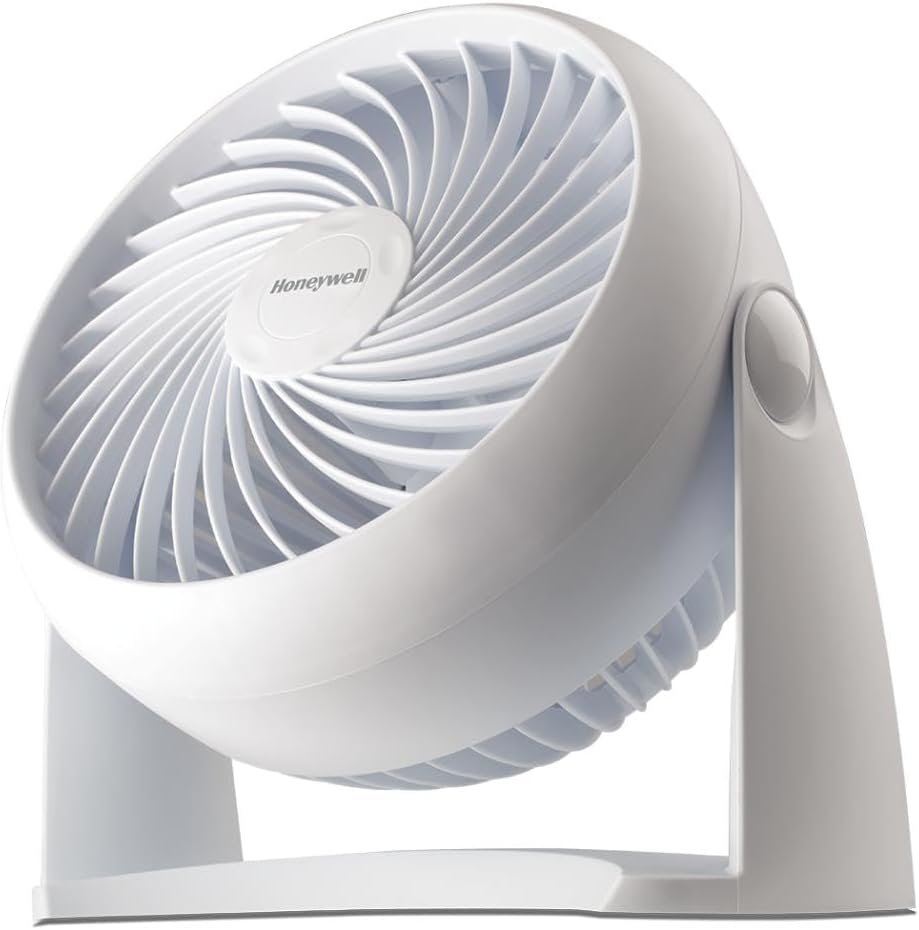
The Honeywell HT900 is a compact personal fan designed for desks, tables, and small-to-medium rooms, with a 4.6 rating that places it among the strongest-rated selections in this guide. Its aerodynamic TurboForce design emphasizes directed air movement rather than the broad decorative footprint of a tower fan.
We may earn a commission when you buy through this link, at no additional cost to you.
Three speeds and a 90-degree pivoting head provide straightforward comfort control. The product information states that the fan can move air from as far as 25 feet away, making it useful for directing a breeze toward a bed, study chair, or desk. It may also be wall-mounted, giving students with limited floor or surface space another placement option.
Its simplicity is both a strength and a limitation. A physical control scheme is easier to understand than an app or complex panel, but there are only three speeds, no timer, and no remote. The listing describes the model as 25% quieter than comparable fans, although exact noise figures are not provided, so quiet-sensitive shoppers should consider that limitation.
Buy the HT900 if you want dependable, uncomplicated circulation and the flexibility to use it on a desk or wall. It is not the strongest choice for someone requiring automatic room adjustments, sophisticated oscillation, or sleep timers. For most students, its compact design and focused airflow make it a sensible all-purpose option.
The ability to serve as a tabletop, floor, or wall-mounted fan means students can reposition it when furniture arrangements change. Its small body also leaves more usable room than a large pedestal model.
The uncomplicated controls make the HT900 approachable for anyone who does not want to manage an app or multiple operating modes. Its main trade-off is less granular airflow adjustment.
We may earn a commission when you buy through this link, at no additional cost to you.
The Levoit Tower Fan prioritizes quiet operation, portability, and low power use, making it especially relevant for bedrooms, study corners, and small shared rooms. It carries a 4.4 rating, and its listed noise range begins at 20 dB, which offers a promising foundation for sensitive sleep and focused-work environments.
We may earn a commission when you buy through this link, at no additional cost to you.
The efficient DC motor and VortexAir Technology are designed to provide consistent airflow at speeds as high as 23 feet per second. Maximum power consumption is listed at 7.5 watts, and optional sound-off and display-off functions can reduce distractions further. Five speed settings plus an additional Turbo setting give users more control than a basic three-speed model.
A soft carrying handle and minimalist tower shape make the fan easy to move between a bedroom, lounge, and library. Multi-angle oscillation can be set at 30, 60, or 90 degrees, allowing the breeze to be shared without moving the unit. The limitation is that the fan is not cordless and must remain connected to an outlet during use.
This is a good option for students who work late, study in quiet spaces, or want a fan they can carry between rooms. Those seeking remote control, a sleep timer, or battery operation should look elsewhere. Even so, its quiet range, compact form, and flexible angles make it a well-rounded dorm companion.
The 20-43 dB range and optional sound and display-off functions help minimize audible and visual distractions. Low-speed operation should be especially appealing during study sessions or bedtime.
A soft carrying handle makes the tower easy to lift despite its full-size appearance. Students can move it to wherever a personal breeze is needed without relying on complicated setup.
We may earn a commission when you buy through this link, at no additional cost to you.
The DREO Smart Fan 565S is the most feature-complete dorm option in this roundup, earning a 4.7 rating and an Editor's Choice designation. Its 12-inch format fits a desk or nightstand while delivering claimed whole-room airflow of up to 950 CFM and a reach of 85 feet.
We may earn a commission when you buy through this link, at no additional cost to you.
The fan's most distinctive feature is horizontal and vertical oscillation, allowing coverage across a 90-degree range in both directions. Nine speed settings and six airflow modes provide substantial control, while a brushless DC motor operates as quietly as 20 dB at its lowest setting. Those specifications make it versatile for studying, sleeping, video calls, and general room circulation.
Smart control is available through the DREO app or compatible Alexa and Google Home systems. Other useful functions include an eight- or twelve-hour timer, child lock, power-off memory, and a 60-second automatic screen-off. These extras are useful in a dorm, though they also create more complexity than a simple mechanical fan and depend on compatible smart-home services.
Choose the 565S when you want strong airflow, quiet low-speed operation, flexible positioning, and remote or voice control in one unit. It is less appealing if you prefer minimal controls or need cordless operation. For a tech-oriented student who wants one fan to handle many daily routines, it is an especially complete recommendation.
App and voice control are useful when the fan is across the room or when changing settings without getting out of bed. Power-off memory also helps preserve a preferred setup between uses.
The combination of 90-degree horizontal and vertical oscillation distributes air beyond a single target. This is helpful in compact rooms where one directional stream can leave corners feeling warmer.
We may earn a commission when you buy through this link, at no additional cost to you.
The DREO TurboPoly Fan 353 stands apart as a premium standing circulator for dorm rooms where students want substantial airflow and the ability to adjust fan height. Its 4.7 rating reflects a strong combination of 1000 CFM airflow, broad room coverage, quiet DC-motor operation, and flexible positioning.
We may earn a commission when you buy through this link, at no additional cost to you.
According to the supplied information, the upgraded circulator can move air up to 90 feet and circulate the air in a bedroom, living room, or kitchen in under two minutes. Horizontal oscillation spans 90 degrees, while the pivoting head adds 105 degrees of adjustment. A 38-42-inch height range allows the unit to be lowered for children or pets, placed at a comfortable living-room level, or raised toward a bed.
Eight speed settings and an automatic mode give users both direct and hands-off control. The auto function increases fan speed by one level whenever the room temperature rises by two degrees. An eight-hour timer and a remote control add convenience, while the detachable blade, front grille, and rear grille simplify cleaning. A built-in aroma pad also offers an optional fragrance feature.
This model is a good fit for students who want a standing fan they can adapt to different activities and room arrangements. Its larger footprint makes it less appropriate for very cramped desks, and cordless use is not an option. Even so, the adjustable height, broad airflow, and easy-clean construction make it a strong premium all-around choice.
The unusual height-adjustment range lets one fan serve several users and activities. Raising the head toward a bed can improve directional comfort, while lowering the unit suits shared spaces.
Auto mode adjusts the speed as room temperature changes, reducing the need to intervene manually. The remote, timer, and muteable beeps add further convenience for daily use.
We may earn a commission when you buy through this link, at no additional cost to you.
The DREO 11-Inch Circulator offers a balanced combination of airflow, adjustability, and cleaning convenience, supported by a 4.5 rating. Its 750 CFM airflow and claimed 65-foot reach make it suitable for moving air around a dorm bedroom, home office, or compact living area.
We may earn a commission when you buy through this link, at no additional cost to you.
TurboSilent operation and a unique airfoil design are intended to deliver strong airflow at a listed 25 dB. The head combines 90-degree oscillation with a 120-degree manual vertical tilt, allowing users to direct air across the room, toward a bed, or down over a desk. A four-speed control, two wind modes, remote, and eight-hour timer cover the main daily needs.
A 60-second automatic screen-off prevents the display from becoming a nighttime distraction. The detachable front grille and blades make cleaning easier than with a fixed-head fan. Compared with the 565S, however, it omits app control, voice assistants, and two-axis automated positioning, making it a better choice for people who prefer physical controls.
Buy this model if you want a compact circulator with remote convenience and broad manual positioning. It is a good middle ground between basic personal fans and feature-heavy smart units. Students who specifically need voice control or a larger selection of operating modes should compare the 565S, while those wanting simple controls may prefer the Amazon Basics model.
The 120-degree vertical adjustment works together with horizontal oscillation to cover both broad room movement and targeted personal airflow. This is useful for students alternating between study and sleep positions.
The 25 dB operating level and automatic display shutoff are helpful when the fan runs overnight. An eight-hour timer also prevents it from continuing to run after a set period.
We may earn a commission when you buy through this link, at no additional cost to you.
The Honeywell HT-904 delivers the same basic circulation concept as the HT900 in a white finish, earning a 4.6 rating and serving as a straightforward option for a dorm desk or nightstand. Its compact body supports placement on a tabletop, small floor area, or wall.
We may earn a commission when you buy through this link, at no additional cost to you.
Three speeds and a 90-degree pivoting head allow the user to choose between softer airflow and a stronger personal breeze. The supplied information describes a maximum perceived reach of 25 feet and an aerodynamic turbo design intended to move air efficiently. That makes it more useful as a focused circulator than as a decorative room fan.
The major appeal is the absence of unnecessary complexity. There is no app, voice assistant, display, remote, or timer to manage. That simplicity may appeal to students who want a fan that works immediately and can be moved easily. It also means there is less ability to automate airflow or fine-tune the output than with several newer models in this list.
The HT-904 is a sensible pick for anyone prioritizing compactness, familiar controls, and flexible placement over advanced features. It can provide a personal breeze during study or sleep and may help redistribute air from another source. Students seeking timers, stronger whole-room specifications, or more oscillation should examine one of the DREO models instead.
Mechanical operation and three clearly defined speeds make the fan easy to use without learning an app or navigating a digital panel. This keeps the focus on straightforward personal comfort.
The option to sit on a desk or mount the fan on a wall helps students make the most of limited room space. The white finish also blends easily with a variety of dorm decors.
We may earn a commission when you buy through this link, at no additional cost to you.
The Amazon Basics Air Circulator is the budget-oriented choice in this guide, combining a familiar three-speed design with a compact footprint. Its 4.3 rating is the lowest in the roundup, but the product remains appealing for students seeking a simple circulator without premium smart features.
We may earn a commission when you buy through this link, at no additional cost to you.
The fan measures 6.3 by 11.1 by 10.9 inches and uses three seven-inch blades. Its 90-degree variable tilt head directs airflow toward a desk, bed, or the opposite side of the room. Settings are controlled through a back-mounted knob with positions for off, low, medium, and high, making operation clear and easy to understand.
At three pounds, the unit is easy to carry between rooms. Its listed 35-watt power use and 120-volt operation offer recognizable efficiency information for anyone comparing electricity demands. The trade-offs are clear: no remote, timer, digital display, oscillation, or stated decibel figure is included, so it is less versatile than the premium selections.
This model is a good choice for a first dorm fan, a backup unit, or a no-frills personal circulator. It covers the essential functions of adjustable speed and directional airflow without unnecessary complexity. Those who want whole-room specifications, automatic controls, or finer noise information should spend more on a model that provides those details.
Three speeds and a rear control knob cover the basic functions students need for a personal breeze. There is little setup involved, making the fan convenient for shared or temporary living arrangements.
The small dimensions minimize surface use, and the three-pound weight makes repositioning effortless. It can move easily between a study desk, bedside table, and other compact spaces.
We may earn a commission when you buy through this link, at no additional cost to you.
The DREO 11-Inch Circulator combines a listed 20 dB operating level with substantial airflow, making it a compelling option for students who need strong circulation in a quiet setting. Its 4.4 rating reflects a balanced product with an 800 CFM airflow rating and a claimed reach of up to 60 feet.
We may earn a commission when you buy through this link, at no additional cost to you.
TurboSilent Technology and a wind-tunnel-style design are intended to move air farther and faster than a traditional desk fan. The listing states that the unit can produce whole-room circulation in three minutes without blind spots. A seven-inch blade sits inside a compact body measuring approximately 11 by 11 inches overall.
Manual controls are refreshingly direct. A twist knob provides three speed settings, while the head tilts from minus 30 to 90 degrees for a total vertical range of 120 degrees. A built-in handle supports wall mounting, which helps direct air from above and can save desk space. The trade-offs are the lack of a remote, timer, oscillation, and automatic modes.
This fan suits students who value quiet output and simple physical controls but do not need smart-home features. It works well as a personal or room circulator for study, rest, and cooking areas. If timers or remote adjustment are priorities, the DREO 11-Inch Circulator with Remote is the more convenient alternative.
At a listed 20 dB, the fan is designed for students concerned about noise during lectures, calls, or sleep. Strong airflow helps it remain useful even when operating quietly.
The 120-degree tilt range directs air across a work surface or around a room, while the integrated handle supports wall mounting. Both features help conserve limited dorm space.
We may earn a commission when you buy through this link, at no additional cost to you.
The IRIS USA WOOZOO is a compact remote-controlled circulator designed for desks, countertops, and nightstands, supported by a 4.4 rating. Its most useful dorm-friendly feature is the included remote, which allows students to change power, mode, speed, oscillation, and timer settings without leaving bed or a study chair.
We may earn a commission when you buy through this link, at no additional cost to you.
Auto-oscillation moves through 65 degrees to distribute air toward different parts of the room. The head can also be manually adjusted to six angles, while three speeds range from a whisper-quiet breeze to a stronger gust. A timer offers one-, two-, or four-hour settings, giving the user a straightforward way to limit overnight operation.
The fan weighs 3.5 pounds and measures 7.09 by 7.09 by 9.84 inches, so it remains portable and easy to arrange on a compact surface. Its main limitations are the absence of smart-home integration and the maximum timer setting of only four hours. The supplied listing does not provide a specific decibel rating despite describing the fan as quiet.
Choose the WOOZOO for straightforward remote convenience and automatic side-to-side airflow. It is less advanced than the DREO Smart Fan 565S but avoids the need for an app or compatible voice assistant. It works well for dorms where a small unit, remote access, and automatic movement are the primary priorities.
The remote handles the controls students use most often, reducing the need to reach across a desk or get up during the night. Automatic oscillation further reduces the need for manual repositioning.
The square footprint and built-in handle make the fan easy to carry between rooms. One-, two-, and four-hour timer options add useful scheduling, although students wanting an all-night setting must maintain it manually.
We may earn a commission when you buy through this link, at no additional cost to you.
The right dorm room fan depends on room size, noise sensitivity, available surface area, and control preferences. Comparing the following factors can prevent a powerful but impractical model from crowding out a simpler fan that better suits your routine.
Airflow should be judged by more than the word powerful. Specifications such as CFM, feet per second, and maximum reach indicate how much air a model is designed to move and how far that air may travel. Tower fans often emphasize concentrated vertical airflow, while air circulators are engineered to move air around an entire room and reduce isolated warm areas.
Choose a model that matches the space rather than assuming the largest number is always preferable. Compact dorms may be well served by a focused personal circulator, while larger rooms benefit from broader oscillation or higher CFM. Consider how the fan is positioned because even a powerful model cannot distribute air effectively if it is blocked or aimed into a corner.
Dorm rooms serve as offices, bedrooms, and social spaces, so noise can influence whether a fan feels acceptable. Fans specified at 20 or 25 dB are presented as quiet options, while models described only as quiet may not disclose a precise figure. Blade design, motor type, speed setting, and oscillation can all affect the sound produced during operation.
A stated minimum noise level should not be treated as a guarantee at every setting. Higher speeds will usually produce more sound, and structural vibration may vary by surface. Students who study at night, use a microphone, or sleep with a roommate should prioritize the lowest published specifications and consider a model with a display-off function.
Dorm furniture is often limited, making footprint a practical rather than cosmetic consideration. Measure the intended desk, dresser, or nightstand before purchasing, including the space needed to tilt or oscillate the head. Slim tower fans consume less horizontal area, while square circulators may fit a corner more efficiently.
Height adjustment is especially useful for standing models because it allows the same fan to circulate room air or direct a breeze toward a bed. Models with a pivoting head are more flexible than fixed-head units. If space is extremely tight, prioritize a compact model that can be placed against a wall or mounted rather than one that requires open clearance on every side.
A fixed fan concentrates air in one direction, while an oscillating model distributes airflow across a wider area. Manual tilt adds another layer of control, allowing the breeze to move from a desk level to a ceiling or bed. The ten-inch DREO model offers a 120-degree vertical range, while several other models pivot through 90 degrees.
Look for both horizontal and vertical movement if you want broad room coverage. Two-axis oscillation is especially useful in square rooms or shared spaces because it reduces the need to reposition the unit manually. On the other hand, a fixed or manually tilted fan may be preferable when you want a consistent personal breeze and do not need to share the airflow.
Controls range from a simple knob to a remote, touch panel, mobile app, and voice-assistant support. Basic controls are easy to learn and reliable, but they require the user to approach the fan. A remote or app is more convenient in a bedroom, especially for students who are already studying or trying to sleep.
Timers can prevent unnecessary overnight operation. The available options range from one to four hours on the WOOZOO to eight or twelve hours on DREO models. Smart controls are valuable if the fan is already part of a compatible home ecosystem, but they add complexity and are not essential for basic comfort.
Dorm fans collect dust quickly, and blades and grilles that are difficult to remove make routine cleaning more of a chore. Detachable blades, front grilles, rear grilles, and impellers provide a clear advantage in this category. Regular cleaning helps maintain airflow and keeps the fan operating as intended.
Before cleaning, unplug the unit and follow the manufacturer's instructions. Do not spray liquid directly into the motor or electrical openings. A model with a removable grille or blade assembly is usually easier to wipe down, but students should still expect to dust accessible parts regularly, particularly in rooms with heavy carpet, pets, or open windows.
Most dorm room fans require a nearby outlet and a cord long enough to reach it safely. The Levoit model is explicitly plug-in rather than cordless, and that distinction should be considered before buying if you want to move the fan around freely. Cordless operation would be useful in rooms with limited outlets or for short periods away from a desk.
Weight and handles also affect portability. A three-pound fan can be moved between a desk and bed without much effort, while larger standing models require more deliberate lifting. Keep cords out of walking paths, avoid overloading outlets, and ensure that the selected placement does not crowd the only available outlet.
Begin by placing the fan on a stable, dry surface with enough clearance around the grille and controls. Position it where the intended breeze will reach you without directing air against a wall, curtain, or pile of belongings. For an air circulator, begin near a wall and use oscillation or tilt to spread air through the room rather than immediately placing it in the center.
Choose the lowest comfortable setting first, then increase the speed as needed. Use a timer or automatic mode when available, especially overnight. Avoid placing the fan where its cord creates a trip hazard, and do not obstruct the outlet. If using the WOOZOO or DREO remote, confirm that the fan responds before leaving the room.
For maintenance, switch the fan off, unplug it, and allow moving parts to stop before cleaning. Remove detachable grilles or blades where the instructions permit, then wipe surfaces with a lightly damp cloth or use a soft brush. Keep water and cleaning liquid away from the motor, switch, plug, and electrical openings, and reassemble every removable component before operating the fan.
A compact desk circulator is usually the most practical choice because it can sit on a desk or dresser without consuming much floor space. A slim tower fan can also work well when horizontal surface area is limited. Choose based on available clearance, desired reach, and whether you need to move the fan between your bed and study area.
Lower noise is generally preferable when the fan runs overnight, especially in a shared room. Models with a listed minimum operating level of 20 or 25 dB may suit noise-sensitive sleepers better than units without a published decibel figure. The lowest speed and display-off setting can further reduce disturbance.
Fans primarily move air across your skin, which can feel cooling even though they do not lower the room temperature like an air conditioner. Air circulators also redistribute air that may be unevenly distributed. Their effectiveness depends on placement, airflow reach, and the amount of heat in the room.
A fan can help distribute cooled air and may allow some people to feel comfortable at a higher air-conditioner setting. It does not replace mechanical cooling and will not lower the temperature by itself. Close doors and windows when using air conditioning for the best results.
A model with a remote is the most convenient for nighttime use. The IRIS USA WOOZOO includes a remote, while the DREO Smart Fan 565S supports app and voice control in addition to its timer functions. The remote-only WOOZOO may be simpler, while the 565S offers broader scheduling options.
Only use mounting methods approved for the specific model. The Honeywell HT900 and HT-904 are described as wall-mountable, and the DREO table circulator with a handle also supports wall mounting. Check the instructions carefully and make sure the surface and fasteners are appropriate.
Dust the blades and grille regularly, especially in carpeted rooms where fibers can be drawn into the airflow. Clean the unit whenever buildup becomes visible or airflow seems to decline. Always unplug it first and follow its cleaning instructions, particularly for models with detachable components.
Not necessarily. Sound depends on the motor, blade or impeller design, speed, and operating mode. Some tower models and circulators are specified as quiet, but products using different noise claims may not be directly comparable. Check the published decibel range and choose the lowest suitable setting when noise matters most.
The DREO Smart Fan 565S is the most versatile overall choice because it combines strong 950 CFM airflow, a 20 dB minimum noise level, app and voice control, two-axis oscillation, and extended timers. The DREO TurboPoly Fan 353 stands out as the premium option for students who want high airflow, adjustable standing height, and easy-clean components.
For a simpler experience, the Amazon Basics Air Circulator provides three speeds, an adjustable tilt head, and a compact body without the complexity of an app. Prioritize the features that directly affect your routine: low noise for sleep, a remote for bedtime control, broad oscillation for shared rooms, or a slim footprint for a crowded desk.
Before buying, verify the current listing, dimensions, included accessories, power requirements, and latest availability. Prices and retailer terms can change, so a current comparison is more useful than relying on an old deal or review. The right dorm room fan should fit your space, support your routine, and provide comfortable airflow without crowding out your daily activities.