
UBBO 95oz Dehumidifier
4.4Editor score
Up to 1.2L daily moisture removal
Includes continuous drainage hose
Quiet 35 dB sleep mode
Our expert guide compares the best cheap dehumidifiers for bedrooms, basements, bathrooms, RVs, and larger homes, with features, performance details, and key
A dehumidifier can make damp rooms more comfortable, protect belongings from moisture, and help control musty odors, but choosing a low-cost model requires balancing capacity, coverage, noise, and convenience. The most suitable unit depends heavily on room size, temperature, humidity levels, and how often you are willing to empty the tank.
We compared ten available models using the specifications and features published for each product. Our guide covers compact thermoelectric options for bedrooms and closets, portable units for bathrooms and RVs, and larger compressor dehumidifiers intended for basements and expansive areas, while highlighting differences in drainage, automation, and noise control.
Each review identifies the product's strongest use case and important limitations so you can judge whether it fits your space. Product listings and technical details can change, and prices fluctuate over time, so check the current listing, coverage claims, and operating conditions before making a final purchase.
4.4Editor score

5.0Editor score

4.5Editor score
The table below compares the ten models by technology, coverage, tank capacity, convenience features, and intended room size, making it easier to distinguish compact thermoelectric units from high-capacity compressor models.
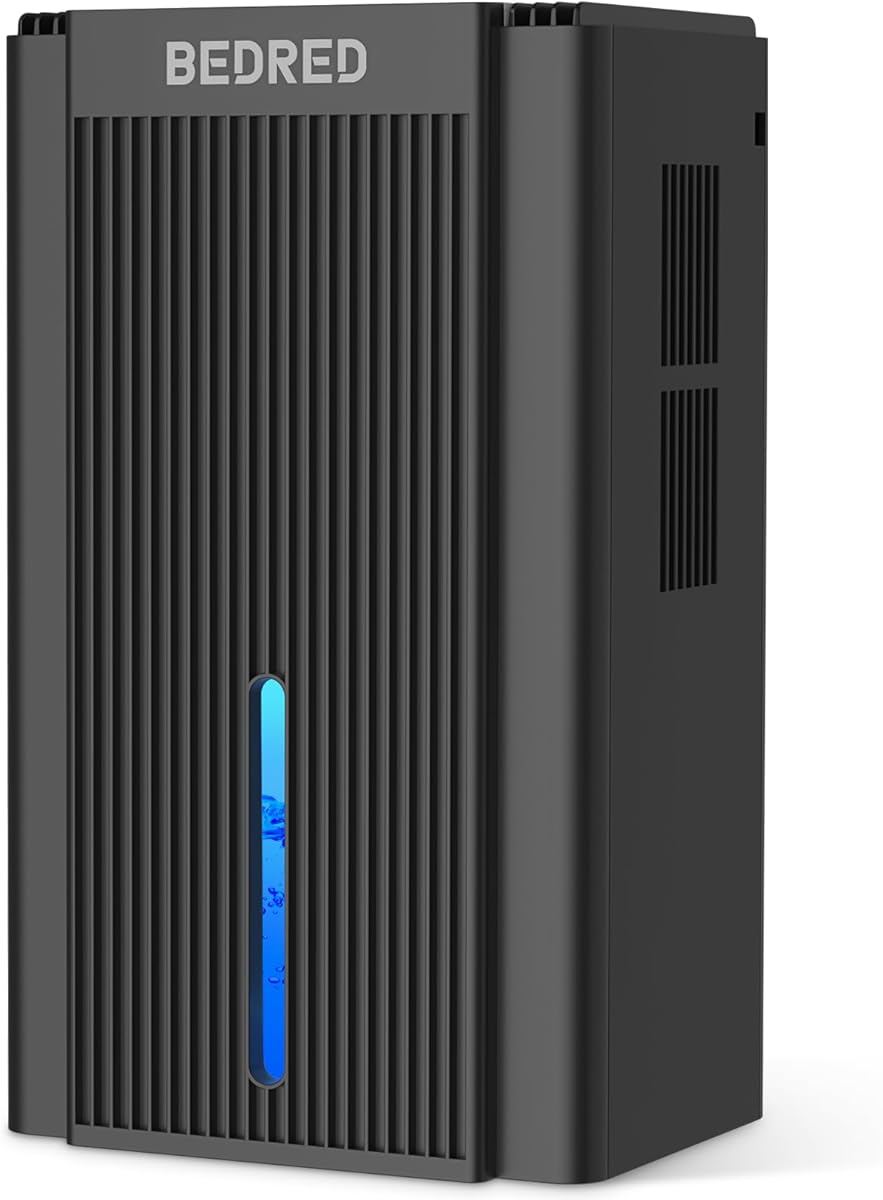


The BEDRED 95oz Dehumidifier combines a relatively generous collection tank with a thermoelectric design and a claimed coverage area of up to 1000 square feet. Its 4.3 rating reflects a generally positive customer response, while its strongest qualities are portability, uncomplicated operation, and a feature set that works well in bedrooms, bathrooms, basements, and RVs.
We may earn a commission when you buy through this link, at no additional cost to you.
Automatic shutoff activates when the water tank is full, reducing the chance of overflow during unattended operation. Sleep mode turns off the ambient lighting and lowers the operating noise, making the unit more suitable for a bedroom or nursery. Seven color choices add visual appeal and allow the dehumidifier to double as a subtle night light, although lighting is primarily decorative rather than a moisture-control advantage.
The principal compromise is that the product information does not identify a humidity display, humidity target, or continuous drainage option. It also relies on thermoelectric condensation, a technology generally most effective in modest, enclosed spaces. The 1000-square-foot claim should therefore be treated as a maximum suitability figure rather than a guarantee of powerful performance throughout a large, open area.
This is a sensible choice for someone who wants a portable, uncomplicated dehumidifier with a larger tank than the smallest bathroom models. Choose it for a bedroom, closet, office, bathroom, RV, or modest basement area, especially if quiet operation and automatic tank protection are priorities. For whole-home or large-basement moisture removal, one of the compressor models is a more capable choice.
Sleep mode suppresses the colored lights and reduces noise, making the BEDRED less visually and audibly distracting during nighttime use. Its compact thermoelectric format also makes it easy to reposition as humidity conditions change.
The 95-ounce tank reduces the frequency of manual emptying compared with mini models. Automatic shutoff provides an additional safety layer by stopping the unit when the tank reaches capacity.
We may earn a commission when you buy through this link, at no additional cost to you.
The PSOS 98 OZ Dehumidifier stands out as the most balanced compact model in this guide. It has a 5 rating, a 98-ounce tank, dual semiconductor condensers, a real-time humidity and temperature display, and a claimed coverage area of up to 1000 square feet. Those features make it easier to monitor and control than many similarly compact alternatives.
We may earn a commission when you buy through this link, at no additional cost to you.
Two operating modes serve different needs. The stronger mode focuses on moisture reduction, while the low-speed sleep mode operates below 30 dB and disables the lighting. A filter is also included in the product description to help capture hair and dust while supporting airflow, and the control panel allows users to monitor the room's current conditions rather than relying entirely on a visual guess.
Automatic shutoff protects against overflow when the tank fills, while an auto-defrost system supports operation at temperatures as low as 41°F. The listed power-management system is said to save up to 20% energy while maintaining comfort. These are meaningful advantages in cool rooms where basic thermoelectric models may frost or lose effectiveness.
The main limitation is scale. Despite the 1000-square-foot claim, the unit measures approximately 9.44 by 5.9 by 14.17 inches and relies on semiconductor technology, so it is best suited to a bedroom, bathroom, basement corner, closet, or RV rather than a heavily damp expansive basement. Within that category, however, its display, low noise, filtration, and cold-weather safeguards make it an excellent all-around choice.
The integrated display reports humidity and temperature, allowing you to judge whether the unit is operating in a useful environment. This visibility is especially helpful in basements and bedrooms where dampness can be difficult to assess accurately by sight alone.
A sleep mode below 30 dB supports bedroom use, while the stated 41°F operating capability and automatic defrost make the model more versatile than many basic thermoelectric units.
We may earn a commission when you buy through this link, at no additional cost to you.
The ToLife 95oz Dehumidifier is a portable thermoelectric model designed for rooms up to 1000 square feet. It carries a 4.3 rating and offers a 95-ounce tank, sleep mode, automatic shutoff, and a seven-color lighting system. Its most useful qualities are straightforward controls, a relatively roomy reservoir, and easy movement between the spaces where dampness appears.
We may earn a commission when you buy through this link, at no additional cost to you.
The powerful mode is intended to reduce humidity more aggressively, while the low-speed sleep mode operates below 30 dB. Lighting can cycle through seven colors, be selected, or locked to create a steady night-light effect. This makes the product visually flexible, though buyers should view the illumination as an optional convenience rather than a core performance feature.
Automatic shutdown protects the unit when the tank is full or not seated correctly, providing useful overflow prevention. On the other hand, the published information does not mention a humidity display, humidity-level control, continuous drainage, or a low-temperature defrost system. These omissions make it less informative and less adaptable than the PSOS model.
ToLife is a good fit for a bedroom, bathroom, closet, office, RV, or small basement area where portability matters. Its tank size means it will not require emptying as often as a mini unit, and the sleep mode helps limit nighttime disruption. It is most appropriate for buyers who want simple moisture control and lighting rather than detailed environmental monitoring or whole-basement capacity.
The unit measures approximately 8.27 by 5.55 by 13.78 inches and includes handles for moving it between bedrooms, bathrooms, closets, and other small spaces. Its relatively narrow footprint makes placement easier in crowded rooms.
A stronger setting addresses active moisture problems, while the quiet sleep setting prioritizes low noise. This gives the unit flexibility for both daytime drying and overnight use.
We may earn a commission when you buy through this link, at no additional cost to you.
The OWAAE 1000 Sq.Ft. Dehumidifier is designed for moderate-to-high humidity in everyday spaces, with particular emphasis on bedrooms, bathrooms, closets, RVs, and other enclosed areas. Its 4.3 rating and simple feature set make it a practical option for buyers who want quiet moisture control without a large installation.
We may earn a commission when you buy through this link, at no additional cost to you.
The standout feature is the sleep mode, which operates below 30 dB to minimize disruption during sleep or quiet work. The unit also has automatic shutoff when the tank is full or incorrectly positioned, preventing overflow. Integrated seven-color LED lighting adds a soft glow, while a built-in handle and lightweight construction make repositioning straightforward.
The listing does not specify a humidity display, adjustable humidity target, continuous drainage, or automatic defrost. That means users have less feedback and fewer ways to automate long-term operation than they would with the PSOS or larger compressor units. The 1000-square-foot claim also describes maximum suitability for a thermoelectric product, not performance equivalent to an 80-pint compressor model.
This dehumidifier is best for someone dealing with moderate moisture in a smaller, enclosed room. It is particularly suitable for a bathroom that dries slowly, a bedroom where low noise matters, a closet protecting clothing, or an RV with limited space. For a large basement or a home with widespread dampness, choose a higher-capacity compressor unit with continuous drainage and wider humidity controls.
The sub-30 dB sleep mode is a meaningful benefit in bedrooms and nurseries, where continuous compressor noise or fan sound could be distracting. It allows moisture control to continue without taking over the room.
A lightweight body, integrated handle, and compact form make the unit easy to position where it is needed. The automatic shutoff reduces the attention required during routine tank emptying.
We may earn a commission when you buy through this link, at no additional cost to you.
The Small 44oz Dehumidifier is built for spaces where a full-size unit would be inconvenient. It measures just 6.56 by 4.94 by 9.29 inches, targets areas up to 260 square feet, and has a 4.2 rating. Its compact dimensions make it particularly appealing for dorm rooms, apartments, closets, bathrooms, campers, offices, and RVs.
We may earn a commission when you buy through this link, at no additional cost to you.
Automation is unusually strong for a small unit. It offers continuous operation plus 24-, 48-, 72-, and 96-hour automatic shutoff timers. Three working modes—Sleep, Normal, and Performance—allow a suitable balance between moisture removal and noise. Sleep mode operates below 28 dB, giving it an advantage for nighttime placement close to a bed or desk.
The model also includes automatic shutoff with a flashing red full-tank alert, automatic defrost for lower temperatures, ten light colors, and three brightness levels. It carries FCC, CE, UKCA, and RoHS approvals. These features make it convenient and adaptable, but the 44-ounce tank still needs regular monitoring and emptying.
Its limited 260-square-foot coverage means it is not the right choice for a large, damp basement or whole-floor moisture problem. It is ideal for a localized patch of dampness, a small bathroom, or a portable seasonal unit you can move between rooms. Buyers who value scheduling, multiple modes, and a tiny footprint will get more from this model than those who need high daily extraction.
The unit occupies very little floor space while offering five timer durations and three operating modes. That makes it easier to integrate into a bathroom, camper, dorm, or tightly furnished room.
Sleep operation below 28 dB minimizes sound, while ten colors and three brightness levels let the light function as a subdued night-light rather than an overpowering fixture.
We may earn a commission when you buy through this link, at no additional cost to you.
The Waykar 80-Pint Dehumidifier is built for serious moisture control in basements and other large areas. It carries a 4.3 rating and claims a maximum extraction rate of 80 pints per day under 95°F and 90% relative humidity. That capacity separates it decisively from the small thermoelectric models designed for localized moisture.
We may earn a commission when you buy through this link, at no additional cost to you.
Its 90-degree automatic swing distributes air throughout the room, while smart humidity control spans 30% to 80% relative humidity. The 30% minimum is useful for spaces that need more aggressive drying than a conventional 40% floor allows. It also includes a 24-hour timer, automatic defrost, overload protection, and an intelligent sensing system intended to adjust performance as conditions change.
Drainage options add practical value. The removable 4.3-liter tank supports manual emptying, while the included 3.3-foot hose and standard 3/4-inch garden-hose connection allow continuous gravity drainage. Around 42 dB operation is quieter than many similarly capable units and is described as acceptable background white noise for sleeping, working, or relaxing.
The trade-off is size and a higher ownership outlay than compact thermoelectric options. It is not the convenient choice for a travel RV or a small room where every inch matters. For a persistently damp basement, expansive living area, or property-wide humidity problem, however, its extraction capacity, drainage flexibility, and broad humidity control justify the more substantial design.
An 80-pint daily rate and coverage area of up to 5000 square feet make this a practical choice for large spaces where thermoelectric models would take much longer to collect the available moisture.
The removable tank works for temporary collection, while the included hose and standard connection support continuous gravity drainage. This is useful for basements where frequent manual emptying would be inconvenient.
We may earn a commission when you buy through this link, at no additional cost to you.
The UBBO 95oz Dehumidifier delivers one of the strongest combinations of features at the budget end of this guide. Its 4.4 rating, 95-ounce tank, included drain hose, timer, and sleep mode make it especially appealing for someone who wants more automation than a basic mini dehumidifier without moving to a large compressor unit.
We may earn a commission when you buy through this link, at no additional cost to you.
Dual semiconductor condensers are rated to remove as much as 1.2 liters of moisture per day under optimal conditions of 86°F and 80% relative humidity. The sleep mode operates at 35 dB, which is quiet but not as low as the sub-30 dB claims of the PSOS and OWAAE models. A red indicator and five audible beeps notify you when the tank needs emptying.
Its included drain hose enables continuous drainage, reducing tank-emptying demands in a bathroom, bedroom, basement corner, or RV. Run-time options of 8, 16, and 24 hours provide a useful middle ground between continuous operation and fully manual control. Seven-color lighting can be turned off or locked, while an integrated aromatherapy box allows scented air to circulate.
The largest compromise is capacity relative to larger compressor dehumidifiers, and the 1.2-liter claim applies under favorable test conditions rather than every real environment. Overall, UBBO is a well-equipped option for a small-to-medium room, particularly if continuous drainage and scheduled operation matter more than whole-basement extraction.
The supplied hose allows continuous drainage, while three timer settings support scheduled operation. Together, these features reduce the need to empty and restart the unit throughout the day.
A 35 dB sleep mode makes the unit suitable for many bedrooms and living areas. The lockable color light and aromatherapy box add comfort features that are not necessary for moisture removal but can improve the experience.
We may earn a commission when you buy through this link, at no additional cost to you.
The OWAAE 1000 Sq.Ft. Dehumidifier offers a simple, quiet approach to moisture control in enclosed areas. With a 4.3 rating, a sub-30 dB sleep mode, automatic shutoff, and integrated lighting, it is well suited to bedrooms, nurseries, bathrooms, closets, RVs, and other spaces where moderate humidity can become uncomfortable.
We may earn a commission when you buy through this link, at no additional cost to you.
Its most important advantage is the combination of low nighttime noise and easy portability. A built-in handle supports movement between rooms, while the compact design should be easier to place near a damp wall, inside a closet, or beside a bathroom fixture. Seven-color lighting provides a gentle visual accent, and the lighting can be disabled when its decorative function is not needed.
Automatic shutdown stops the machine if the tank is full or positioned incorrectly, limiting spill risk. However, the supplied information does not mention a humidity display, adjustable target, timer, continuous drain, or auto-defrost capability. These missing features may matter if you want to automate the unit or operate it in a cool environment.
This model is best for localized dampness in a small-to-medium enclosed space rather than aggressive basement drying. It also makes sense for renters or seasonal users who want an approachable unit they can move as needed. For a room with constant high humidity, consider a model with a measurable humidity display and drainage hose, or a compressor unit with much higher extraction capacity.
The stated sub-30 dB sleep mode is appropriate for overnight moisture control, particularly in a bedroom, nursery, or other space where background sound could interfere with rest.
Automatic tank shutoff adds a basic safety layer, and the integrated handle makes it easy to carry the unit to whichever small room needs attention. The seven-color light adds flexibility without changing the core function.
We may earn a commission when you buy through this link, at no additional cost to you.
The Pro Breeze Mini Dehumidifier is the smallest and most restrained option in the guide. It is designed for rooms of about 215 square feet, has a 16-ounce tank, and carries a 3.9 rating. Its compact size, 23-watt power draw, and straightforward operation make it useful for a single small room rather than a broad home moisture-control project.
We may earn a commission when you buy through this link, at no additional cost to you.
The unit can remove up to nine ounces of water per day and includes automatic shutoff with an indicator light when the collection tank is full. Its product information describes whisper-quiet operation, making it suitable for bedrooms, offices, kitchens, bathrooms, RVs, garages, and closets. It also benefits from recognition as a brand that received an America's Best Home and Garden Brands award in 2022.
The small tank requires frequent emptying, and the 215-square-foot area is narrow. Its optimal operating range is stated as 59°F to 86°F, and it will not operate below 41°F. Buyers also need to clear the dust-intake valves regularly so airflow is not blocked, which adds a small but important maintenance responsibility.
This model makes the most sense for a bathroom, small office, RV, kitchen corner, or closet where a full-size compressor would be excessive. It is less suitable for a basement, large bedroom, or area with serious dampness. Its lower rating and modest extraction rate are reasonable reflections of its entry-level position, but the result is a focused solution for small, contained humidity problems.
A 23-watt power draw suits users who want a dehumidifier they can operate intermittently without the energy profile of a large compressor. The simple controls also reduce the learning curve.
The unit is most effective in an enclosed area of roughly 215 square feet. Its compact size makes it easy to place in tight locations, while automatic shutoff handles the full-tank condition.
We may earn a commission when you buy through this link, at no additional cost to you.
The AEOCKY 5500 Sq.Ft. Dehumidifier combines high extraction capacity with advanced efficiency features. It carries a 4.5 rating and is identified as ENERGY STAR Most Efficient 2025 certified. Maximum rated extraction reaches 80 pints per day at 95°F and 95% relative humidity, with 56 pints per day specified at 86°F and 80% relative humidity.
We may earn a commission when you buy through this link, at no additional cost to you.
Its efficiency-oriented design uses a high-efficiency rotary compressor, copper evaporator and condenser tubing, hydrophilic aluminum foil, and a high-performance control chip. The humidity-compensation algorithm and millisecond-level detection are designed to maintain the target level more precisely. A power-off memory function can also resume operation after power restoration, which is useful with smart sockets or in specialized areas.
Defrost sensors support operation at low temperatures, while the lowest fan setting is listed at 44 dB. The dimensions are 14.45 by 8.66 by 24.09 inches and the unit weighs 31 pounds, so it offers substantial capability at the cost of portability. ETL and RoHS certification and three years of coverage support the product's positioning as a long-term appliance.
This model is most appropriate for a large basement, broad living area, or other high-humidity environment where extraction volume and operating efficiency are priorities. It is less attractive for a small bedroom because of its size and cost. Compared with the Waykar, AEOCKY emphasizes certified top-tier efficiency, precision humidity logic, and low-temperature performance, making it the more technically advanced premium selection.
ENERGY STAR Most Efficient 2025 certification distinguishes the unit from standard ENERGY STAR models. Its high extraction rate is particularly relevant in large basements and other spaces with substantial moisture loads.
The humidity-sensing system and compensation algorithm are designed to maintain levels more consistently. Defrost sensors also help the unit operate in cooler conditions where frost can otherwise interrupt collection.
We may earn a commission when you buy through this link, at no additional cost to you.
The right cheap dehumidifier depends on room size, moisture load, temperature, and the amount of maintenance you want to avoid. These factors help separate compact thermoelectric models from powerful compressor units and prevent buyers from expecting more capacity than a small appliance can provide.
Choose by actual room size and dampness, not the largest number on the box. A compact unit is usually more appropriate when the goal is protecting one small area, while a high-capacity model is the better fit when moisture is present throughout a basement or broad living space.
Use a thermoelectric model for a targeted bedroom, closet, bathroom, or RV problem. Choose a compressor model when the entire room remains damp, the space is large, or you need faster moisture removal.
For frequent monitoring, a larger tank is valuable. For locations where a hose can reach a suitable drain, continuous drainage is the more convenient long-term arrangement.
Prioritize a documented sleep mode for bedrooms. Otherwise, account for normal fan and compressor noise rather than assuming every dehumidifier will be background-silent.
Choose a display when you want feedback or precise control. Prioritize automatic modes and safety shutoff when you mainly need unattended operation.
Match the unit's temperature limits to the environment. In a cool room, look for verified low-temperature operation and an automatic defrost system.
For occasional use in a small room, lower consumption may be sufficient. For continuous basement control, efficient high-capacity operation is usually the more important consideration.
Prioritize the features that improve moisture control, then consider lights and other extras. A stylish unit is only a good purchase if it also suits the space and operating conditions.
Place the dehumidifier on a level surface with space around its air intake and outlet. Keep it away from walls, curtains, bedding, and other objects that could block airflow. Choose the operating mode and humidity goal appropriate for the room, and position the unit where collected water can drain into the tank without creating a slip or overflow hazard. Before starting, confirm that the tank and filter are seated correctly.
Check the tank regularly and empty it before reaching full capacity, even if automatic shutoff is present. If using continuous drainage, secure the hose to a proper drain and check it for kinks or disconnected sections. Clean the intake grille and filter on the recommended schedule, especially in dusty basements, because restricted airflow reduces performance and places strain on the fan. Allow the unit to operate within its published temperature range.
For optimal results, address the source of moisture alongside dehumidifier use. Repair plumbing leaks, use exhaust fans in bathrooms and kitchens, separate damp materials from walls, improve ventilation where outdoor conditions permit, and avoid placing clothing or furniture directly against cold surfaces. When moving the unit, unplug it, empty the tank, and keep it upright. Allow internal moisture to dry if it has been transported in damp conditions before powering it on.
A cheap thermoelectric model can help with mild dampness in a small, enclosed basement, but it may not keep up with a large or persistently humid space. For widespread basement moisture, look for a compressor dehumidifier with a high daily extraction rate, continuous drainage, automatic defrost, and a wide humidity-control range. Also address leaks, ventilation, and other sources of moisture.
A compact 95- to 98-ounce model is a reasonable starting point for many bedrooms up to the manufacturer's stated coverage area. A smaller 16- or 44-ounce model is better when the goal is a closet, bathroom, or localized damp patch. Measure the room and assess the severity of the humidity before selecting a capacity.
It depends on the tank size, room humidity, temperature, and how much moisture enters the space. Small tanks may need attention every day, while larger units can operate longer between emptying sessions. Automatic shutoff prevents overflow but does not restart the machine, so the tank still needs to be emptied and replaced correctly.
Yes, if the unit's operating temperature and power requirements match the RV environment. Several compact models in this guide are specifically listed for RVs and are easier to transport because of their size and weight. Secure the unit on a stable surface, avoid blocking its airflow, and use continuous drainage only when the hose can be routed safely.
Thermoelectric models are generally smaller, quieter, and intended for modest enclosed spaces. Compressor models use a cooling system designed to extract more moisture and are better suited to large, humid rooms and basements. The strongest compact model cannot equal the capacity of an 80-pint compressor appliance, although it may be more appropriate for a modest bedroom or bathroom.
Not always. A larger tank with automatic shutoff can be sufficient for a bedroom or closet if you are comfortable checking it regularly. Continuous drainage is more convenient in basements, laundry rooms, and bathrooms where the unit may collect water quickly or run for extended periods without supervision.
Reducing humidity can discourage mold growth, but a dehumidifier does not remove existing mold or address the underlying moisture source. Clean affected areas safely, repair leaks, improve ventilation, and use products and procedures appropriate for the extent of the problem. In extensive cases, professional remediation may be necessary.
A sleep mode below 30 dB is preferable for bedrooms and nurseries, but placement also affects perceived noise. Put the unit on a stable surface away from your head and keep airflow paths clear. Larger compressor models generally produce more sound, so quiet sleep modes are one reason compact thermoelectric products are often preferred in sleeping spaces.
The UBBO 95oz Dehumidifier stands out as the best budget-oriented all-rounder because it combines a substantial tank, an included drain hose, useful timers, and quiet operation. The PSOS 98 OZ Dehumidifier is the strongest overall compact choice, with a 5 rating, humidity and temperature display, sub-30 dB sleep mode, and low-temperature defrost. For a large basement, the Waykar or AEOCKY compressor models provide the extraction capacity that small thermoelectric units cannot match.
Choose according to the scale of the moisture problem, not simply the lowest ownership outlay. A mini unit works for a tiny, enclosed area, while a 95- to 98-ounce model offers more useful capacity for bedrooms and bathrooms. Large basements benefit from a compressor appliance with continuous drainage, broad humidity settings, and automatic defrost. Noise, displays, timers, and ambient lighting should support your main priorities rather than replace them.
Product availability, technical claims, and prices can change, so review the current Amazon listing before ordering. Confirm the coverage area, operating temperature, drainage method, and room conditions, and compare the current model with the features identified in this guide. That final check helps ensure the chosen dehumidifier fits both the space and the way you intend to use it.
