
weBoost Drive Reach Overland
4.2Editor score
50 dB maximum signal gain
Supports 5G and 4G LTE
Tough outdoor antenna system
All major US carrier support
Our Cell Signal Booster for Trucks guide compares ten models for gain, carrier compatibility, antenna durability, multi-device support, and easy installation.
A cell signal booster for trucks can improve calls, navigation, streaming, and hotspot reliability where cellular coverage fades. The right model depends on supported carrier bands, available signal, antenna construction, multi-user capacity, and whether the installation must withstand heavy travel, vibration, dust, and weather.
This guide compares ten boosters based on the supplied specifications, including maximum gain, supported frequencies, carrier compatibility, outdoor antenna design, display features, installation requirements, and intended vehicle applications. It also highlights important limitations, such as Verizon band 13 exclusions and narrow-band-only models, before making a recommendation.
Each review explains who the product is best suited for, along with its most useful strengths and practical trade-offs. Ratings reflect the supplied customer feedback and may change over time, while product availability, promotions, and technical details can also vary. Always verify compatibility and the latest specifications before ordering.
4.2Editor score

4.9Editor score

4.8Editor score
The comparison below highlights maximum gain, supported bands, multi-user capabilities, and installation features to help truck owners identify the most appropriate booster for their carrier, route, and vehicle setup.



The weBoost Drive Reach Overland combines a booster, rugged outdoor antenna, and mounting bracket in a package explicitly designed for off-road vehicles. Its supplied rating is 4.2, and its defining advantage is broad compatibility with major US carriers, including Verizon, AT&T, T-Mobile, and UScellular. The system supports 5G and 4G LTE, making it a broad option for drivers who are not certain which cellular bands their phones and carriers will use during a trip.
We may earn a commission when you buy through this link, at no additional cost to you.
Maximum gain is listed at 50 dB, which provides a useful indication of the system's amplification potential. The product description also highlights support for current 5G technology, although actual network performance remains dependent on the signal available from a nearby tower. The outdoor antenna is presented as tough enough for adventure-oriented installations, while the included mounting bracket offers flexibility for different vehicle and antenna positions. This makes the package easier to assess than a loose collection of components.
There are practical trade-offs. A gain specification does not mean the booster can manufacture coverage where no tower signal is available, and correct separation between the outdoor and indoor antennas remains essential to avoid oscillation. The rating of 4.2 is positive but not among the strongest figures in this list. The premium positioning may also be difficult to justify for a driver who only needs basic low-band coverage and has a simpler installation.
This is the strongest all-around recommendation for truck owners who travel through varied terrain, use more than one carrier, and want a complete off-road-oriented system. It is especially appropriate when a robust antenna, established carrier support, and accessible customer assistance matter more than a minimal installation. Verify your current carrier bands and follow the placement guidance carefully to obtain the intended performance.
Support for Verizon, AT&T, T-Mobile, UScellular, 4G LTE, and 5G gives this system broader flexibility than boosters limited to only a few bands. That versatility is valuable when a truck changes routes, travels near different carrier networks, or carries passengers using different providers.
The combination of a tough outdoor antenna, flexible mounting bracket, and 50 dB maximum gain is well suited to trucks used for travel beyond paved urban routes. Installation quality remains the deciding factor because poor antenna positioning can reduce performance regardless of the booster's headline gain.
We may earn a commission when you buy through this link, at no additional cost to you.
The weBoost Drive Reach OTR is specifically positioned for trucks and SUVs, making it a more focused choice than a general residential or office booster. It carries a supplied rating of 4.3 and supports major US carriers, 5G, and 4G LTE. Its 50 dB maximum gain specification is designed to improve weak cellular service in rural corridors, mountainous areas, and other locations where a truck can move beyond dependable tower coverage.
We may earn a commission when you buy through this link, at no additional cost to you.
The product is advertised as reaching farther cell towers and boosting the signal for multiple devices. That combination matters for commercial trucks, family vehicles, and travel configurations in which a driver, passengers, tablets, hotspots, or other cellular-connected equipment all need service. The OTR designation, supported network types, and stated gain make this a credible premium package for owners who regularly encounter weak coverage while driving.
Its main limitation is cost relative to simpler boosters, although the requested guide does not include product pricing. It also cannot overcome a complete lack of usable tower signal, and an incorrectly positioned indoor antenna can interfere with the boosted signal. Buyers should expect to follow the installation instructions carefully rather than treating the maximum gain figure as a guarantee of a particular download speed.
Choose the Drive Reach OTR when your truck spends substantial time outside reliable coverage and you value multi-device performance, broad carrier support, and a system marketed specifically for on-the-road applications. It is less compelling for occasional travelers who already have good service and need only a simple way to improve one low-band signal.
This model is expressly designed for trucks and SUVs rather than adapted from a stationary-home system. That focus makes sense for drivers who need stronger service across changing terrain, with the 50 dB gain specification providing ample potential when a usable tower signal is present.
Multi-device boosting is especially useful in occupied trucks where several passengers may use different carriers or data devices. The result can be more consistent service for calls, navigation, streaming, and hotspot tasks, provided the antennas are installed with adequate separation.
We may earn a commission when you buy through this link, at no additional cost to you.
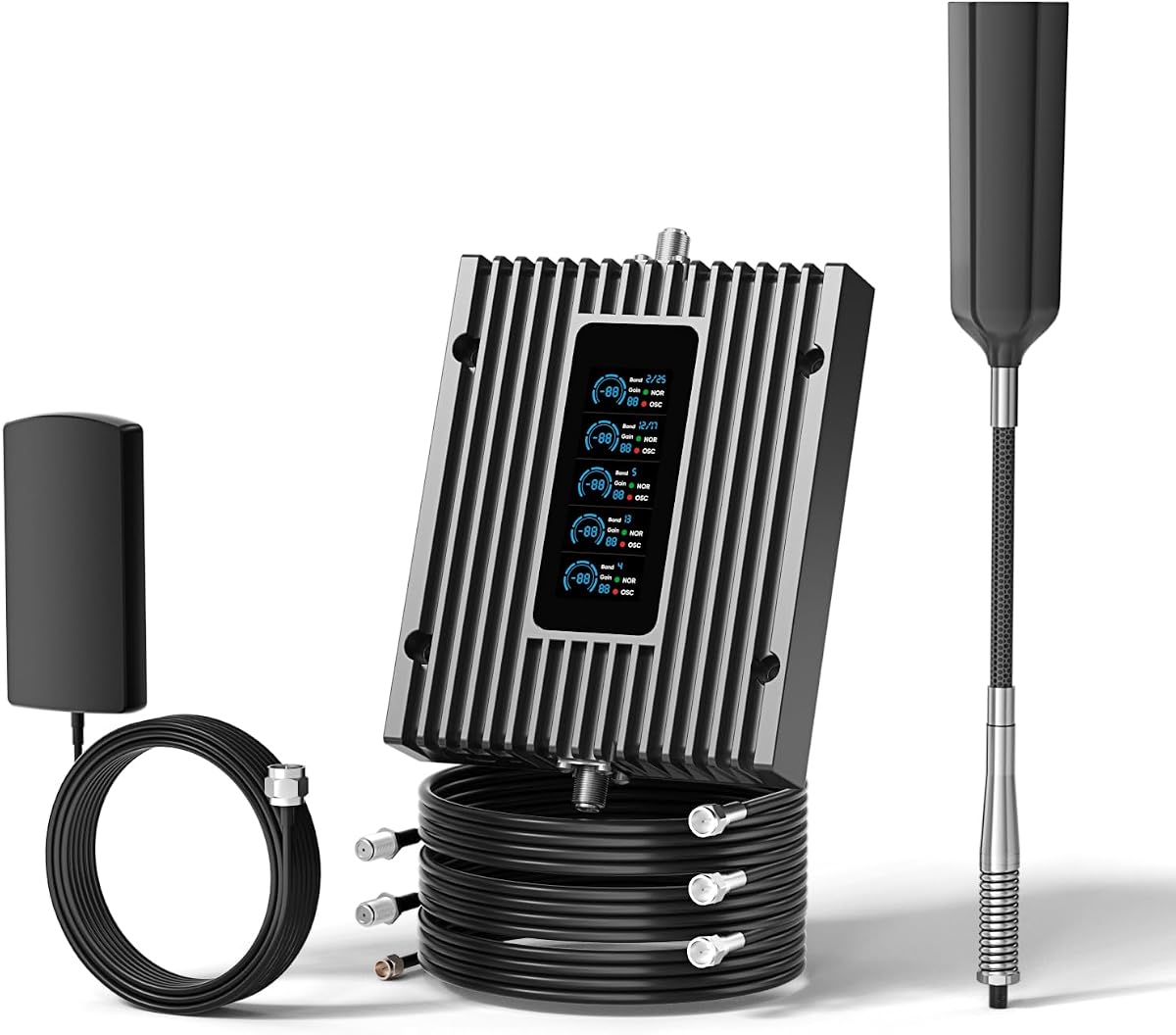
This RV and truck booster stands out for its large color LCD, which shows operating status and gain information across five frequency bands. It has a supplied rating of 4.5 and supports smartphones, tablets, and data modems at the same time. The design is aimed at both stationary and on-the-move use, making it suitable for truck cabs, RVs, and mobile workspaces where a visible diagnostic tool is useful.
We may earn a commission when you buy through this link, at no additional cost to you.
The listed supported bands are 12/17, 13, 5, 2/25, and 4. Its included omnidirectional outdoor antenna uses a spring-mounted design intended to absorb vibration and shocks, while its body is described as resistant to dust, oil, and water. The product information also states a maximum communication range of 5–8 miles and enhancement of weak signals by as much as 100 times, with the caveat that the booster can only improve an existing signal.
The LCD is particularly helpful during installation because it provides immediate information about band gain and working status. A visible display can make troubleshooting more accessible than a kit with only basic indicator lights. The trade-off is that the display takes up more room and may be less useful once installation is complete. As with other multi-band products, carrier and phone compatibility should be checked before purchasing.
This is a good match for RV and truck owners who want a clear installation dashboard, simultaneous device support, and a vibration-conscious outdoor antenna. It is best for users willing to verify their phone's frequency band before ordering and who appreciate being able to monitor performance while traveling.
The color LCD reduces uncertainty by displaying real-time operating status and gain for five frequency bands. This is particularly useful when comparing mounting positions or confirming that a selected band is receiving usable outdoor signal.
A spring-mounted omnidirectional antenna can flex under road vibration while its rugged housing is designed to resist dust, oil, and water. Those traits suit long-distance travel, but the antenna still needs a secure, unobstructed mounting location.
We may earn a commission when you buy through this link, at no additional cost to you.
The Cell Phone Booster for Truck with LCD offers the strongest supplied customer rating in this group at 4.9. It is explicitly designed around truck installation, with a real-time display, a 50 dB maximum gain specification, and two mounting bracket options for the center console. The product supports 5G and 4G LTE and is listed as compatible with major US carriers, giving it a balanced feature set for everyday travel.
We may earn a commission when you buy through this link, at no additional cost to you.
Its LCD shows signal strength changes and working status, which can help users troubleshoot installation or identify whether a chosen position is receiving the expected signal. The system supports multiple users, and its listed band coverage includes 12/17, 13, 5, 2/25, and 4. The upgraded omnidirectional outdoor antenna is described as waterproof, shockproof, and rustproof, which makes it suitable for exposed road-trip installation.
A typical installation is stated to take less than an hour, and the package includes the required accessories. That convenience comes partly from the truck-focused bracket choices. The main limitation is that a phone must use one of the supported bands, and 50 dB is a maximum gain rather than a guaranteed output. As with any booster, separating the receiving and transmitting antennas is important for stable performance.
This model is the leading recommendation for most truck owners seeking a complete package, useful diagnostics, and broad carrier support without needing a separate app or subscription. It is particularly suitable for families, contractors, and long-haul drivers who regularly encounter weak signal. Buyers should check their frequency band before installation and use the LCD to optimize placement.
The HD LCD is more than a decorative status window: it provides real-time signal information that can reveal whether the booster is receiving a signal and how conditions change while driving. This makes setup more methodical and troubleshooting more approachable.
Including two center-console mounting options shows attention to the limited space and vibration conditions inside a truck. A more general kit may offer adequate performance, but this model is easier to integrate into its intended cabin environment.
We may earn a commission when you buy through this link, at no additional cost to you.
The Vehicle Cell Phone Signal Booster is a focused, three-band option for drivers seeking an uncomplicated way to improve low-band cellular service. Its supplied rating is 4.8, and it supports bands 12, 13, and 17. The listing identifies it for cars, RVs, and trucks while providing an omnidirectional roof antenna and a simple installation approach.
We may earn a commission when you buy through this link, at no additional cost to you.
Because the system is limited to bands 12, 13, and 17, it offers a streamlined solution rather than broad multi-band coverage. It can improve calls and data loading when the phone is using one of those supported frequencies. The manufacturer specifically notes that 5G improvement is possible only when the phone's active 5G band falls within the supported set. Compatibility is therefore more important than the presence of the word 5G in the product description.
The purchase requirement is explicit: the user's phone should display one of the supported bands and receive at least two bars of signal outdoors. This limitation helps set expectations because a booster cannot create service in an area with no usable cellular signal. Its narrow band selection may be a drawback for users on less common frequencies, but it can be a sensible choice for drivers whose phones consistently use the supported low bands.
This is the best budget-oriented choice for a truck owner who first verifies band compatibility and wants a simple roof-mounted antenna system. It is less suitable for travelers carrying several devices with varied carrier or frequency requirements. Checking the phone's band display before ordering can prevent the most common source of disappointment.
Supporting only bands 12, 13, and 17 makes this system easier to understand than a wide-band kit. It can be an efficient choice when every device in the truck reliably uses those frequencies, but it lacks the flexibility of broader alternatives.
The omnidirectional antenna can receive signals from different directions, reducing the need to constantly aim it toward a tower. Drivers should still place it where it has an unobstructed view of the sky and keep the indoor antenna separate.
We may earn a commission when you buy through this link, at no additional cost to you.
This overland truck and RV booster offers a substantial 70 dB maximum gain specification, making it the highest-gain model in the comparison. It supports 3G, 4G LTE, and 5G across bands 4, 12, 17, 5, 2, and 25. The supplied rating is 3.9, so its technical specification is impressive, but the customer feedback is less favorable than that of the leading alternatives.
We may earn a commission when you buy through this link, at no additional cost to you.
The system is designed for remote and fringe coverage areas and can serve multiple smartphones, tablets, and data modems simultaneously. Its LCD provides real-time signal strength information, while the upgraded omnidirectional outdoor antenna uses a flexible spring base and is described as waterproof, shockproof, and wear resistant. The listing states a maximum communication range of 5–8 miles and an ability to enhance weak signals up to 100 times.
The critical limitation is explicit: this model is not compatible with Verizon band 13. That makes it a poor choice for some Verizon users, especially if their phones rely on band 13 for low-band coverage. The requirement for at least one outdoor signal bar also means it cannot compensate for an area with no usable tower signal. The 70 dB figure is a maximum capability, not a promise of equal performance in every environment.
This booster makes sense for off-road and overland travelers on supported networks, especially when several users need service in a remote location. It is a strong technical option for AT&T, T-Mobile, Sprint, and UScellular users within the stated band limits. Anyone using Verizon should confirm their active band before considering it.
The listed 70 dB maximum gain provides greater potential than the 50 dB and 65 dB alternatives in this list. It can be valuable in fringe areas, but only when a usable outdoor signal exists and the antennas are installed correctly.
Verizon band 13 is excluded, so the headline carrier compatibility does not apply equally to every Verizon connection. Checking the active phone band is essential for anyone whose coverage is primarily supplied by that frequency.
We may earn a commission when you buy through this link, at no additional cost to you.
The Phonetone Vehicle Cell Phone Signal Booster provides a focused approach for cars, SUVs, and trucks. It supports bands 12, 13, and 17, and its supplied rating is 4. The system is designed to improve dropped calls and slow 4G LTE or 5G loading when the phone is using one of its supported frequencies.
We may earn a commission when you buy through this link, at no additional cost to you.
The operating principle is straightforward: an external antenna receives cellular signals from nearby towers, the booster amplifies them, and an indoor antenna rebroadcasts the improved signal inside the vehicle. The included omnidirectional roof antenna is intended to capture signals without requiring precise directional alignment. This keeps the installation approachable and helps maintain usable reception as the truck changes direction.
The important limitation is compatibility. The product only amplifies bands 12, 13, and 17, and it cannot improve Wi-Fi or cellular signals on other frequencies. The seller advises confirming that the phone shows one of these bands and that at least two bars are available outdoors. The repeated compatibility guidance in the supplied listing may feel repetitive, but it highlights the condition that most strongly affects whether the system will work as expected.
This model is a practical alternative for truck owners whose devices consistently use supported low bands and who prefer a simple system over a full multi-band dashboard. It is less suitable for a household of users with different carrier requirements or for anyone who needs Verizon compatibility across every possible active band. Confirming the phone's band before ordering is the essential first step.
The limited frequency range makes expectations easy to define. When a truck's phones use bands 12, 13, or 17, the booster can improve service; when they use anything else, it cannot, making pre-purchase verification particularly important.
An omnidirectional antenna is convenient on a moving truck because it does not need to be pointed toward one tower. It still requires a high, clear mounting position, and the indoor antenna should remain separated to reduce the chance of oscillation.
We may earn a commission when you buy through this link, at no additional cost to you.
The Car Cell Phone Booster is a vehicle-focused kit listed for trucks, RVs, SUVs, vans, and campers. It supports 3G, 4G LTE, and 5G on bands 12, 13, and 17, with a maximum gain of 65 dB. No numerical customer rating was supplied for this product, so its feedback cannot be directly compared with the rated models in the guide.
We may earn a commission when you buy through this link, at no additional cost to you.
Automatic gain control is one of its most notable technical features. The system can detect incoming signal strength and adjust amplification to reduce self-oscillation, while an LED indicator communicates connection and reception status. A sleep mode is also included to reduce power use when the booster is inactive. The aluminum alloy housing is intended to improve heat dissipation and extend component life.
Installation is presented as taking approximately 10–20 minutes, with all accessories included and no drilling required. That makes it attractive for truck owners who want a less permanent installation. The system can only amplify bands 12, 13, and 17, and the listing clearly notes that it cannot create signal where none exists. Users are also advised to turn the unit off during long periods of nonuse to avoid draining the vehicle battery.
This model is worth considering for a truck or RV that needs a removable installation and benefits from automatic gain adjustment. Its missing customer rating means it carries less social proof than the alternatives, so buyers should place greater weight on band compatibility, antenna placement, and the included three-year manufacturer warranty. It is not the broadest option, but it may be the most convenient for the right setup.
Automatic gain control allows the booster to respond as signal conditions change, which is useful during a long drive through rolling terrain. Sleep mode reduces unnecessary power draw, although the listing recommends switching the unit off during extended inactivity to protect the vehicle battery.
The no-drilling format and included accessories make the kit practical for owners who do not want permanent modifications to a truck. The stated installation time is short, although correct antenna placement remains essential for consistent results.
We may earn a commission when you buy through this link, at no additional cost to you.
The RV Cell Phone Signal Booster combines 65 dB maximum gain with broad frequency support across bands 2, 4, 5, 12, 13, 17, 25, and 66. Its supplied rating is 4.4, and the listing identifies major US carriers including Verizon, AT&T, T-Mobile, Straight Talk, Cricket, and UScellular. It is also marketed for a wide range of vehicles, from trucks and RVs to cars, vans, boats, and travel trailers.
We may earn a commission when you buy through this link, at no additional cost to you.
The broad band list gives it more flexibility than three-band systems, while multi-user support allows phones, tablets, and hotspots to benefit simultaneously. Automatic gain control, inactivity mode, and oscillation elimination are included to help the system adapt to changing conditions. The product description gives a maximum communication range of 5–8 miles, though that figure depends on available tower signal and installation quality.
One caution is that the product title describes 2G support even though the listed frequency groups are generally associated with current cellular technologies, and the 5G wording is not a guarantee that every device will receive 5G. Buyers should distinguish between advertised network-generation language and the actual bands their phone uses. The kit is also not suitable for areas with no usable outdoor signal.
This is a strong choice for RV and truck travelers who need compatibility across more carrier bands and want several devices connected at once. It is particularly useful for mixed-carrier groups, long road trips, and mobile work setups. Installation is described as plug-and-play, but buyers should still follow the instructions to achieve the stated performance.
Eight listed frequency groups make this kit more adaptable than products restricted to bands 12, 13, and 17. That matters for travelers who move between carrier territories or use devices configured for different bands.
Multi-user support extends the system beyond one driver's phone, making it useful for families, work teams, and RVs with tablets or hotspots. The automatic adjustments help maintain performance as signal strength changes during travel.
We may earn a commission when you buy through this link, at no additional cost to you.
The weBoost Drive 4G-X OTR is a traditional truck-specific booster with a supplied rating of 4.4. It is designed to improve calls, voice quality, data speeds, hotspot capability, and streaming in remote areas. Rather than emphasizing a screen or app, its value comes from multi-user cellular support and a complete truck antenna mounting system.
We may earn a commission when you buy through this link, at no additional cost to you.
The included hardware comprises a weather-resistant 17-inch omnidirectional antenna, a three-way CB antenna mount, a mast extension, and a side-exit adapter. That collection of mounting components is a meaningful advantage for owners who want to raise the receiving antenna and keep it secure. The booster supports all major US networks, including Verizon, AT&T, Sprint, T-Mobile, UScellular, and others.
Its main limitation is the focus on 4G LTE rather than the broader 5G positioning of newer models. It remains a valid option when a truck primarily needs reliable voice, navigation, and data on an LTE network. The product is also FCC approved under FCC ID PWO460021. As with every booster, the stated improvement depends on receiving a usable signal and maintaining proper antenna separation.
The Drive 4G-X OTR is best for a truck owner who values a proven-style 4G setup, complete mounting hardware, and multi-user support over a modern diagnostic display. Its weather-resistant antenna and comprehensive mount are especially attractive for heavier travel. Drivers needing 5G across a wider set of modern bands should consider one of the newer multi-band systems instead.
A 17-inch omnidirectional antenna, three-way CB mount, mast extension, and side-exit adapter give owners several ways to position the receiving antenna. This is particularly useful for trucks where mounting height and clearance need careful planning.
The system is designed to strengthen service for every passenger and reduce the cellular power a phone may need to maintain a weak connection. Its 4G focus makes it a practical fit for coverage on networks where LTE remains the primary cellular service.
We may earn a commission when you buy through this link, at no additional cost to you.
The most important choices are supported carrier bands, usable outdoor signal, antenna placement, gain, and multi-device requirements. Comparing those factors before purchasing is more reliable than choosing solely by headline gain or the inclusion of 5G in a product title.
A booster can only amplify cellular frequencies that its hardware supports. Some models in this comparison handle only bands 12, 13, and 17, while others cover additional low, mid, and high bands. Check the band display on the phone or device that will use the system, then confirm that its active band is included. A booster may support 4G LTE, 5G, or both, but the active cellular band still determines whether it can help.
Choose a broad-band system when devices use different networks or frequency combinations. Choose a three-band model only when every important device consistently uses the supported bands.
Carrier marketing names do not tell the entire compatibility story because each carrier can use several bands in different locations. The major US networks are broadly represented among the products here, but there are notable exceptions. One truck and overland model explicitly does not support Verizon band 13, which can be decisive in rural and low-band coverage areas.
Do not rely on a general carrier logo alone. Verify the specific frequency used by your phone in the places you travel, and pay particular attention to any stated carrier or band exception.
Maximum gain is a useful comparison point, but it is not the same as guaranteed signal quality. The listed figures range from 50 dB to 70 dB across the products, yet performance also depends on the incoming tower signal, supported frequencies, antenna gain, cable placement, and separation between antennas. A well-installed 50 dB system may outperform a poorly positioned higher-gain model.
Prioritize a compatible and well-designed system rather than treating the largest number as the only criterion. The product's automatic gain features and installation guidance can also influence stability.
The outdoor antenna collects the available tower signal and should have a clear view of the sky. Many products use an omnidirectional design, which is convenient on a moving truck because it does not need to remain aimed at a particular tower. Others use a whip antenna, while the weBoost OTR options provide mounting hardware for greater placement flexibility. Spring-mounted and reinforced designs may better absorb road vibration.
Consider height, clearance, weather resistance, and secure mounting. A technically powerful booster cannot perform well if its outdoor antenna is blocked by a roof rack, placed inside the cab, or installed with too little separation from the indoor antenna.
Truck and RV travelers often carry more than one connected device. Phones, tablets, hotspots, data modems, and passenger devices may all compete for the improved signal. Boosters with explicit multi-user or multi-device support are better aligned with group travel, commercial work, and mobile-office needs than a system intended mainly for one handset.
Even when multiple devices are supported, they must use compatible bands and the system must be installed correctly. Multi-user support improves convenience, but it does not override the underlying limits of the incoming carrier signal.
Models with an LCD can show real-time signal strength, operating status, and gain by band. That information is valuable during setup because antenna height and position can make a noticeable difference. The LCD-equipped truck models are particularly helpful for owners who are not experienced with cellular installation. Simpler kits with indicator lights may be sufficient when the owner follows a clear step-by-step guide.
Look for mounting hardware suited to the vehicle, understandable instructions, and the time required for installation. The claim that setup can take less than an hour does not include the learning needed to diagnose a poorly performing installation.
Truck-mounted equipment faces vibration, dust, oil, water, temperature changes, and constant road movement. An outdoor antenna described as waterproof, shockproof, rustproof, or wear resistant is better suited to exposed use than an unprotected component. Inside the cab, mounting options should avoid interfering with controls, storage, or passenger space.
A compact, removable kit can be easier to maintain or move between vehicles. A fixed installation with a mast and side-exit adapter may offer more antenna height and routing options. Choose the design that matches how and where the truck is actually used.
A vehicle booster should be wired so the engine-off draw does not become a problem. Automatic gain control, inactivity or sleep modes, and clear power guidance are useful features. The weBoost products offer US-based support through several channels and a two-year warranty, while some alternatives list three years of repair coverage or longer technical support. Local support and clear installation assistance can be especially helpful when signal behavior changes along a route.
Review the included warranty, replacement terms, and support channels before installing. Also check whether a companion app or subscription is required; several products explicitly operate without one.
Begin by confirming that the booster supports the active band of every phone, tablet, hotspot, and data modem that will be used. Test the outdoor signal in the area where the truck spends the most time. If the device displays no usable signal outdoors, repositioning the antenna may help, but a booster cannot create cellular service where a compatible tower signal is entirely absent.
Mount the outdoor antenna as high as practical, with a clear view of the sky, and secure it so vibration cannot shift its orientation. Place the indoor antenna inside the passenger compartment and maintain the separation specified by the manufacturer. Connect the antennas and power supply according to the included instructions, then use any LCD or indicator controls to confirm that the relevant bands are receiving signal.
After installation, test calls, navigation, streaming, and hotspot performance both while parked and at different points along a typical route. Watch for overheating, unstable connections, or unexpected battery drain. Keep the system switched off during long periods of inactivity, clean exterior antennas from dust and road grime, inspect cable connections, and recheck mounting tension after rough travel.
No. A booster receives an existing signal from a nearby tower, amplifies it, and rebroadcasts it inside the vehicle. It can improve weak or fringe coverage, but it cannot manufacture a carrier signal where a compatible tower is not reachable. Checking the outdoor signal before installation helps set realistic expectations.
Check the active band on the phone or cellular device you plan to use, especially in the rural areas where you need help. Some boosters only support bands 12, 13, and 17, while others cover more bands. A device that uses an unsupported band will not benefit from that particular booster, even if the product listing mentions 5G.
Only when the phone's active 5G band is supported by the booster and a usable tower signal is available. A listing that states support for 5G does not mean every 5G frequency is included. The product's detailed band list is the more useful guide when 5G performance is important.
An omnidirectional antenna is usually convenient because it can receive signals from several directions without continuous manual aiming. It still benefits from a high, unobstructed location. Mounting height, cable routing, vehicle obstructions, and separation from the indoor antenna can be as important as the antenna's directional style.
Many of the listed systems support multiple users and devices, including phones, tablets, hotspots, and data modems. All devices must use frequencies supported by the booster, and the incoming tower signal must be adequate. Multi-user support distributes the available improvement among connected users rather than creating additional network capacity.
Install the outdoor antenna where it has the clearest possible view of the sky, preferably above the vehicle and securely protected from vibration. Place the indoor antenna inside the cab or living space and keep it separated from the outdoor antenna as directed by the manufacturer. Overlapping antenna coverage can cause oscillation and unstable service.
A properly installed booster uses relatively little power, but a wiring error can create unwanted draw. Follow the supplied power instructions, use automatic or inactivity features where available, and switch the unit off during long storage periods. If the vehicle battery drains unexpectedly, inspect the connection and verify the system is operating normally.
No. Carrier compatibility is constrained by the frequencies in use, and some products include specific exceptions. One model in this list explicitly does not support Verizon band 13. Confirm both the carrier and the active band rather than assuming that a general carrier list guarantees complete compatibility.
The Cell Phone Booster for Truck with LCD is the most balanced overall choice, combining a strong supplied rating, 50 dB maximum gain, multi-user support, and truck-specific mounting. The weBoost Drive Reach Overland and Drive Reach OTR are compelling premium options for owners who value established carrier breadth, robust outdoor components, and 5G-oriented support.
Prioritize phone band compatibility and real outdoor signal before focusing on maximum gain. Broad-band systems offer flexibility for mixed carriers, while three-band models can be simpler and more affordable when every device uses bands 12, 13, or 17. The best outdoor antenna is the one that can be mounted securely, exposed to the sky, and separated from the indoor unit.
Before ordering, review the latest listing details, compatibility notes, included mounting hardware, warranty terms, and current promotions. Product configurations and customer feedback can change, so confirming the current specifications is especially important for long-distance, overland, RV, and commercial truck applications.