
Attwood 9067-1 Vented Battery Box
4.7Editor score
Fits Group 27 batteries
Integrated ventilation design
Heavy-duty hold-down strap
Battery Box for LiFePO4 or Agm Battery guide comparing fit, ports, protection, ventilation, power management, and outdoor usefulness.
A battery box for LiFePO4 or AGM battery applications should do more than hold a battery. It needs to fit the chosen battery group, restrain it securely, manage cables cleanly, and provide useful protection in marine, RV, camping, and off-grid environments. The best options also add convenient power ports, voltage monitoring, and dependable overload protection.
This guide compares ten products based on the information supplied by each listing, including battery compatibility, internal and external dimensions, ventilation, hold-down systems, port layouts, circuit protection, and construction. It includes traditional marine battery boxes, multifunction trolling motor power centers, compact LiFePO4 cases, and one fire-resistant storage bag that serves a different purpose.
Each numbered review identifies the strongest reason to consider a product, along with its limitations and ideal user. Ratings reflect the supplied customer feedback, while product details may change over time. Prices and promotions also change frequently, so shoppers should confirm current listings, dimensions, and included accessories before making a final decision.
4.7Editor score

4.6Editor score

4.1Editor score
The table below compares all ten products by their core purpose, battery fit, electrical features, and practical trade-offs, helping distinguish conventional hold-down boxes from integrated marine power centers and protective storage solutions.



The SUNAPEX Smart Battery Box PRO is the strongest all-around choice for readers who want a combined battery enclosure and marine power center. Its supplied rating is 4.6, and its standout qualities are the two 30A Anderson connections, broad charging-port selection, digital voltmeter, and support for Group 24, 27, and 31 AGM or lithium batteries.
We may earn a commission when you buy through this link, at no additional cost to you.
Its electrical layout is the primary attraction. The box includes a 16A overload switch, a 12V cigarette lighter socket, QC3.0 and USB-C ports, high-current terminals, lighting, and two fused Anderson plugs. That makes it convenient for trolling motors, portable refrigerators, ovens, fish finders, and other 12V or 24V equipment without requiring a separate collection of adapters. Each Anderson plug has a 30A fuse, although the combined maximum output is 50A.
The trade-offs relate mainly to sizing and system limits. The listed external dimensions are 14 by 12.6 by 8.5 inches, with internal dimensions of 13.1 by 8.2 by 7.8 inches, so a prospective buyer should measure the actual battery rather than rely only on its group designation. The battery is not included, and the box is not a substitute for a correctly rated fuse, cable, or charging system. It is also a powered enclosure rather than a bare hold-down box.
This is the most appropriate recommendation for boaters, anglers, and mobile-power users who want one enclosure to organize several connections. Its combination of battery fit, high-current outputs, protected ports, monitoring, and lighting gives it broader utility than a conventional box. For those needs, it stands out as the most complete option in the group.
The two fused Anderson plugs are the centerpiece for trolling motor and other high-current applications. Because their combined maximum is 50A, users should calculate expected draw and stay within the stated limit while preserving the individual fuse protection.
The digital voltmeter gives at-a-glance battery status, while the cigarette lighter socket, QC3.0, and USB-C ports broaden the box's usefulness beyond propulsion power. These features are particularly helpful for camping, fishing, and mobile electronics.
We may earn a commission when you buy through this link, at no additional cost to you.
The Attwood 9067-1 is a focused, traditional battery box that stands out for marine-grade restraint, ventilation, and a restrained feature set. It carries a supplied rating of 4.7 and is a particularly compelling budget-oriented pick for a Group 27 battery in a boat, RV, or outdoor installation.
We may earn a commission when you buy through this link, at no additional cost to you.
Its internal measurements are 13.06 by 6.9 by 10.5 inches, and the listing states that it holds marine and RV batteries up to 10.5 inches high. The polypropylene construction is described as impact-tested from minus 20°F to plus 120°F. A 40-inch strap rated for 350 pounds of force provides serious hold-down support, exceeding the cited USCG requirement.
This box does not attempt to be an all-in-one power center. There is no built-in voltmeter, charging socket, or Anderson connection, so users will need to route and secure cables independently. The vented design is intentional rather than a flaw: it allows hazardous gases to escape while the cover helps limit water intrusion. Buyers must also ensure the specific Group 27 battery matches the interior dimensions.
It is best for someone who prioritizes dependable retention, ventilation, and compliance over integrated electronics. Fishers, boaters, and RV owners who already have their own cable and connection plan will find the simpler design easier to manage. For that use case, it is an excellent budget selection.
Integrated ventilation addresses the accumulation of battery gases, while the protective cover helps reduce water intrusion. This balance makes the box appropriate for marine and outdoor settings where a sealed enclosure would be less suitable.
The heavy-duty strap and 350-pound force rating help keep the battery locked down as the boat or vehicle moves. That restraint is more important than decorative convenience when the installation faces vibration, shifting loads, or rough conditions.
We may earn a commission when you buy through this link, at no additional cost to you.
The Trolling Motor Smart Battery Box Power Center is a versatile 12V and 24V enclosure for users who need many connection methods. Its supplied rating is 4.1, while its defining strengths are two 30A Anderson plugs, USB-A QC3.0, USB-C PD, a cigarette lighter socket, a voltmeter, and compatibility with several common marine battery groups.
We may earn a commission when you buy through this link, at no additional cost to you.
The stated internal dimensions are 13.39 by 7.68 by 9.06 inches, and the listing identifies fit for Group 24, 27, 31, and 27/29 marine batteries. The shell is described as UV-resistant polypropylene with reinforced ribs, brass terminals, and stainless steel fasteners. Cam buckles, a broad strap, and a tightly snapping lid add stability and resistance to rain, splash, and sun exposure.
The most important caveat is that the listing emphasizes compatibility with 12V lead-acid batteries, even though the enclosure is described as a 12V and 24V system. Buyers using LiFePO4 should carefully confirm their battery's actual dimensions and the intended electrical configuration. The 50A combined maximum for the Anderson plugs also needs to be respected, and the battery is not included.
This product makes sense for anglers and mobile installers who want a single organized power hub for trolling motors, fish finders, solar charging, phones, speakers, tablets, and lights. The ability to charge without removing the lid is especially convenient. It is a broad-feature choice, though the lower rating calls for careful attention to fit and electrical compatibility.
The mix of high-current, regulated USB, and 12V connections lets one enclosure serve propulsion accessories and smaller electronics. That flexibility reduces the need to route separate adapters for every category of device.
Reinforced ribs, corrosion-resistant terminals, stainless steel fasteners, and a weather-resistant closure support outdoor use. Side handles also improve portability when the box needs to move between a bench, trailer, boat, or campsite.
We may earn a commission when you buy through this link, at no additional cost to you.
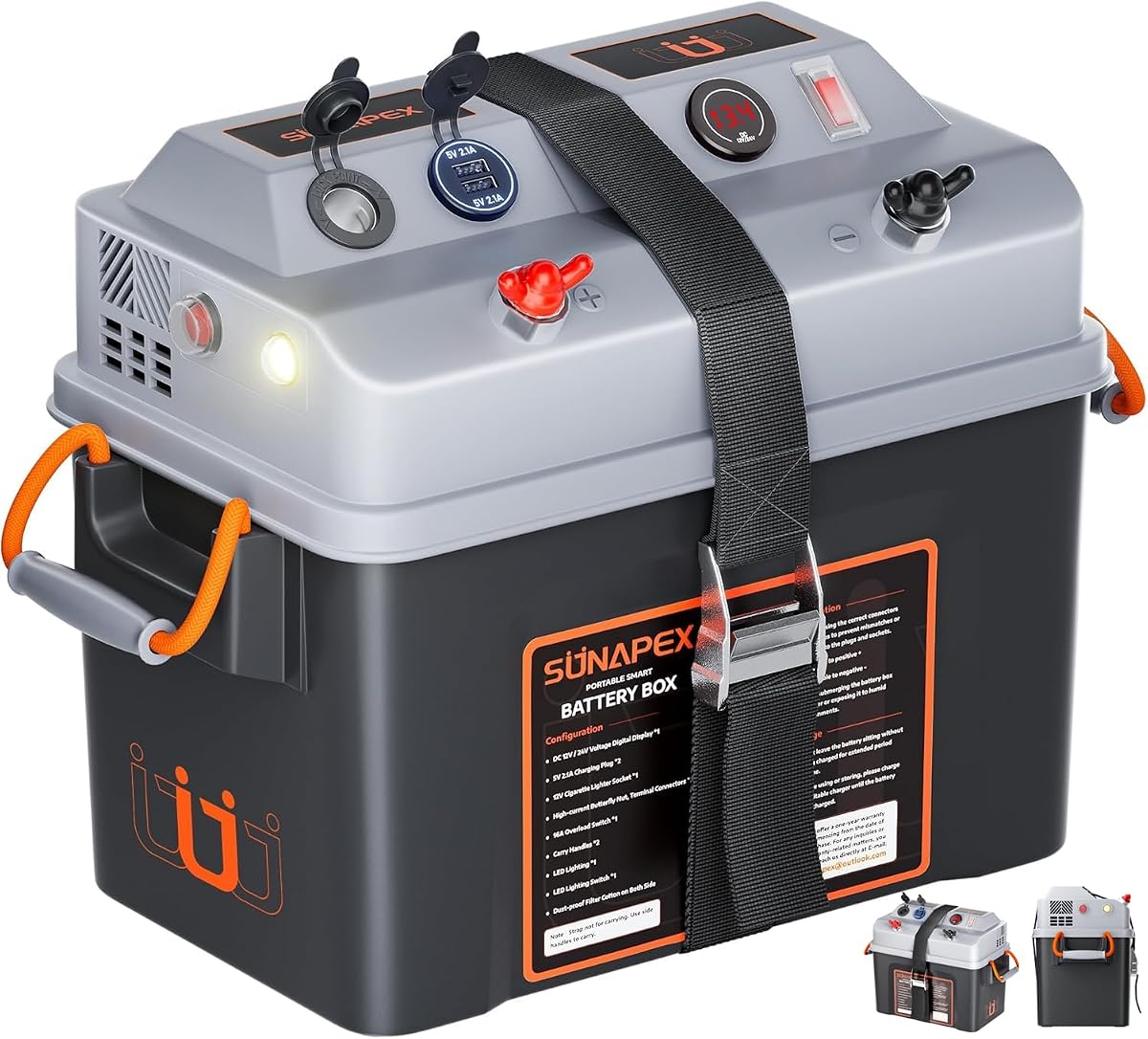
The SUNAPEX Trolling Motor Smart Battery Box is a simpler alternative to the PRO version, with a supplied rating of 4.5. It retains the core features most marine users need: high-current terminals, a 12V cigarette lighter socket, two 5V 2.1A USB-A ports, a 16A overload switch, a digital voltmeter, and integrated lighting.
We may earn a commission when you buy through this link, at no additional cost to you.
It is compatible with Group 24, 27, and 31 AGM or lithium batteries. External dimensions are listed at 14 by 12.6 by 8.5 inches, and internal dimensions at 13.1 by 8.2 by 7.8 inches. Side handles make it easier to carry, while the built-in light adds visibility when operating in low-light conditions or at night.
Compared with the SUNAPEX PRO, this model does not list the PD USB-C port or dual 30A Anderson plugs. That makes it better suited to general DC accessories and standard charging needs than demanding multi-device high-current distribution. As with other enclosures in this category, battery dimensions should be checked carefully, and the battery itself is not included.
The product is a good fit for anglers, kayakers, and small-boat owners who value lighting, monitoring, and a manageable selection of ports. It offers a useful balance of portability and electrical functionality without attempting to be the most expansive power center in the group.
The integrated side light is a practical distinction in low-light fishing, camping, and maintenance situations. It provides localized visibility without requiring a separate work light around the battery.
A dedicated 16A overload switch protects the listed ports from excessive draw and short circuits, while the digital voltmeter lets users check battery status without opening the enclosure.
We may earn a commission when you buy through this link, at no additional cost to you.
The Camco Double Battery Box is the natural choice when an installation needs room for two batteries rather than one. It has a supplied rating of 4.6 and stands out for accommodating either two 6V Group GC2 batteries or two 12V Group 24 or 24M batteries.
We may earn a commission when you buy through this link, at no additional cost to you.
Its internal dimensions are 21.5 inches long, 7.375 inches wide, and 11.1875 inches high. The heavy-duty polymer is designed to resist corrosion, and the package includes two straps plus four strap clamps and screws. The listing states that it meets USCG CFR 183.420 and ABYC E-10.7 specifications when configured with the specified pair of 6V GC2 batteries.
The enclosure is entirely dedicated to storage and restraint. It does not include a voltmeter, power outlets, breaker, or external terminals, so electrical planning remains the installer's responsibility. A double-battery arrangement also requires attention to how the batteries are electrically connected, ventilation, and load demands rather than treating the box as a complete power system.
RV owners, marine users, and installers maintaining two-battery systems will find the dedicated capacity especially useful. It is less appropriate for a single compact LiFePO4 setup because the additional room and hardware do not serve that use case. The box is best viewed as a robust foundation that must be paired with suitable cables, holds, and ventilation appropriate to the installation.
The long interior is designed around two batteries rather than a single unusually large unit. This makes the box useful for common paired 12V marine systems and 6V configurations used in larger RV installations.
Two straps, four clamps, and screws give the installer the principal components needed to secure batteries. The separate hold-down arrangement also helps keep each battery from shifting during travel.
We may earn a commission when you buy through this link, at no additional cost to you.
The VOLTSET Trolling Motor Smart Battery Box is a 12V and 24V power center with a supplied rating of 4.0. Its defining qualities are explicit protection for LiFePO4, AGM, and lead-acid batteries, a 16A resettable overload switch, a digital voltmeter, external terminals, and compatibility with Group 24, 27, and 31 batteries.
We may earn a commission when you buy through this link, at no additional cost to you.
The enclosure includes a 12V cigarette lighter socket, two 5V 2.1A USB-A ports, high-current terminals, and a left-side LED. The listing specifies the same general exterior and interior dimensions as the related SUNAPEX designs, while flexible ABS construction is described as resistant to cracking and shattering. Ergonomic side handles support transport.
Its rating is lower than those of the leading products, and buyers should not treat that number as proof of a flaw or a guarantee of quality. It simply indicates less uniformly favorable supplied feedback. The USB outputs are also modest, and there are no listed Anderson plugs or USB-C PD connection. Battery size, voltage, and cable demands should all be verified before purchase.
This box is most appropriate for mobile users who want straightforward external access, basic charging, status monitoring, and battery-type flexibility. It works well for trolling motors, kayaks, boats, RVs, and trailers where a compact power hub is more useful than a large enclosure with numerous connection formats.
The product information specifically identifies LiFePO4, AGM, and lead-acid batteries. That stated flexibility is useful, although users must still match the correct battery type to the appropriate charging equipment and system voltage.
External battery terminals allow connection without opening the case, and the digital voltmeter keeps status visible. These details improve usability when the box is mounted in a boat, trailer, RV, or remote work area.
We may earn a commission when you buy through this link, at no additional cost to you.
The 12V Portable Waterproof Battery Box is built for smaller LiFePO4 batteries and has a supplied rating of 4.7. It stands out for a compact format, strong sealing, dual QC3.0 charging, QC3.0 plus PD support, 30A overload protection, and an Anderson connection that can be used with solar charging.
We may earn a commission when you buy through this link, at no additional cost to you.
The listing says it is suitable for 10Ah, 16Ah, 18Ah, 20Ah, and 30Ah batteries. This makes it more specialized than the large Group 24, 27, and 31 cases. The battery's physical dimensions are crucial because amp-hour capacity alone does not determine whether it will fit, and the product description explicitly asks buyers to pay attention to size.
There is no digital voltmeter, integrated lighting, or 12V cigarette socket listed among its primary features. Its core advantage is therefore environmental protection and portability rather than comprehensive device management. Users should also confirm the full details of the charging and solar connections for their specific equipment before integrating the box into a larger system.
Camping, fishing, hunting, photography, RV, trailer, and boat users can benefit from a small protected LiFePO4 power case. It is especially attractive where space and portability matter. Among the ten options, it is one of the clearest examples of a purpose-built compact LiFePO4 enclosure rather than a general marine battery box.
The enclosure is sized for relatively compact LiFePO4 batteries, making it easier to carry than a full-size marine case. That portability supports photography, camping, fishing, and mobile power applications.
A waterproof and dustproof seal helps the case cope with harsh outdoor conditions. The stated 30A overload protection adds a layer of defense for connected equipment and the battery.
We may earn a commission when you buy through this link, at no additional cost to you.
The NOCO Snap-Top BG27 is a rugged, conventional enclosure that emphasizes quick installation and cable routing. Its supplied rating is 4.7, and its standout qualities include a reinforced snap-top design, pre-drilled mounting holes, a strap-mount alternative, and cable entry points at both the front and sides.
We may earn a commission when you buy through this link, at no additional cost to you.
The listing describes compatibility with Group 27 and Group 24 batteries, including automotive, marine, RV, deep-cycle, and lithium-ion examples. A honeycomb lattice structure supports impact resistance down to minus 20°F, while the material is described as resistant to acid, gas, ultraviolet exposure, and oil. The package includes a 48-inch strap, mounting tray, and four self-tapping screws.
This is not a power center: there is no voltmeter, USB port, cigarette socket, breaker, or Anderson plug. Optional ventilation holes can add airflow, but ventilation is not presented as a fully integrated feature. The choice between pre-drilled mounting holes and the new strap system is useful because it allows the installer to match the retention method to the application.
The NOCO is well suited to marine, automotive, RV, camper, and travel-trailer installations where cable access and fast assembly matter. Its included hardware and flexible routing make it especially attractive for custom installs. It also complies with USCG 183.420 and ABYC E-10.7 specifications according to the supplied listing.
Pre-drilled pilot holes support direct mounting, while the included strap system provides a stronger hold for demanding installations. This dual approach makes the enclosure adaptable to different deck, tray, and compartment configurations.
Front and side cable entries reduce the need to force cables through awkward openings. Better routing can make installation neater and may reduce strain on the battery's terminal connections.
We may earn a commission when you buy through this link, at no additional cost to you.
The SunnyLith Fireproof Battery Bag is a soft protective storage solution rather than a conventional wired battery box. Its supplied rating is 4.6, and it stands out for accommodating large LiFePO4 batteries, offering fire, heat, water, and radiation protection, and providing a reinforced handle for portable storage.
We may earn a commission when you buy through this link, at no additional cost to you.
The listed dimensions are 22 by 9 by 9 inches, with one description also stating 22 by 9 by 9.4 inches. The stated compatibility includes 12V 200Ah, 24V 100Ah, 38.4V 60Ah, and 48V, or 51.2V, 60Ah batteries, along with certain EcoFlow power stations. Buyers should still verify exact measurements before ordering, particularly when a close fit is needed.
The manufacturer is appropriately clear that the bag is not completely safe and cannot guarantee protection against spontaneous combustion. It also has no battery restraint, electrical outlets, fuses, circuit breaker, voltmeter, or venting system. It should therefore not be confused with a marine-grade battery hold-down box or treated as a guaranteed fire solution.
The bag is best for charging, transporting, and storing compatible lithium batteries where a lightweight protective enclosure is desired. It also has secondary value for passports, records, documents, cards, and photographs. Buyers seeking a permanent trolling motor installation should choose a rigid box with proper restraint and electrical features instead.
The large interior can hold sizable 12V 200Ah-class LiFePO4 batteries and other compatible power equipment. The foldable construction also allows the empty bag to be stored more efficiently than a rigid enclosure.
The bag is described as helping reduce risk if a LiPo fire occurs while also providing a barrier against water, heat, and everyday handling. It should be treated as added protection, not a guarantee that a damaged or defective battery cannot ignite.
We may earn a commission when you buy through this link, at no additional cost to you.
The LiTime Smart Battery Box is a premium-feature enclosure with a supplied rating of 4.1. It supports Group 24, 27, and 31 batteries across lithium, lead-acid, gel, and other types, and stands out for external terminals, a real-time voltmeter, two 15A cigarette-lighter ports, QC3.0, and USB-C connectivity.
We may earn a commission when you buy through this link, at no additional cost to you.
Its internal dimensions are approximately 14 by 8.11 by 8.66 inches, while the full enclosure measures 16.54 by 9.84 by 12.6 inches. The box weighs 3.04 pounds, uses PC/PBT plastic, and is stated to support battery weights up to 66 pounds. Included 6AWG silicone cables with M8 ring terminals provide a ready starting point for external connections.
The main concern is the relatively low supplied rating compared with the leading traditional boxes. It also has a larger external footprint than several alternatives, and two 15A ports plus other outputs still require careful load planning. The automatic 16A reset breaker adds protection, but users must understand the limits of each connector and avoid treating all outputs as unrestricted battery current.
This product is a good choice for RV, travel trailer, home backup, and off-grid users who want a polished portable power case with a broad range of outputs. Its strong fit range and external-access design make it especially relevant to LiFePO4 owners who want convenient cable management without opening the enclosure.
Two 15A cigarette-lighter ports, QC3.0, and USB-C cover both traditional and modern charging needs. The combination is useful for users who want a single box to serve several classes of equipment.
The PC/PBT enclosure is described as light enough for transport while supporting substantial battery weight. That combination can make the unit easier to reposition without implying that it is intended for constant moving.
We may earn a commission when you buy through this link, at no additional cost to you.
The right battery box depends on battery dimensions, chemistry, electrical demand, mounting conditions, and whether you need integrated power distribution. Use the following factors to narrow the field before checking the final listing.
Start with the battery's group designation and then measure the actual unit. Two batteries carrying the same group label can differ in height, width, terminal position, and overall shape, especially when comparing AGM with lithium. Products supporting Groups 24, 27, and 31 provide a broad starting point, but the listed internal dimensions are the more reliable guide. Confirm both the battery's maximum body size and the clearance needed for terminals, cables, and the lid.
A box can physically accommodate a LiFePO4 or AGM battery without providing the right charging method. LiFePO4 and AGM batteries have different voltage, charge, and power characteristics, so use a charger and controller appropriate for the installed chemistry. For boxes that include USB, cigarette lighter, or other regulated outputs, confirm whether those outputs are suitable for the battery and connected equipment. The enclosure protects and organizes the battery; it does not automatically make an improvised charging system safe.
Batteries can release gases during operation or charging, and sealed storage may be inappropriate in some installations. A vented design can allow those gases to escape while the cover limits direct water intrusion. Optional or configurable vents give installers control, but the vent configuration must suit the environment and comply with applicable marine requirements where relevant. A fire-resistant storage bag serves a different role and should not be treated as a ventilated hard enclosure.
A battery box must keep the battery from shifting, tipping, or lifting away from its terminals. Straps, clamps, pre-drilled mounting holes, and mounting trays offer different installation methods. Marine environments add vibration, so evaluate the rated restraint system rather than relying on friction from the enclosure walls. For permanent installations, match the mount to the deck or platform and follow local boating, RV, and vehicle requirements.
Determine the current required by a trolling motor, refrigerator, oven, lighting system, or charging load before choosing ports. Anderson connections may be appropriate for higher-current equipment, while cigarette sockets, USB-A, QC3.0, and USB-C serve different power levels. Look for individual fuse ratings, a combined output limit, and a resettable breaker. These labels do not remove the need for correctly sized cables, fusing, grounding, and an appropriate circuit breaker.
A digital voltmeter is useful for checking state of charge, while external terminals make charging and routine connections easier without opening the enclosure. USB charging, lighting, and quick-connect sockets can improve usability around a boat, campsite, or work area. These features add value only when they simplify the user's actual setup. A simple hold-down box may be easier to maintain if all charging and power distribution happens elsewhere.
Marine boxes should be considered for acid resistance, ultraviolet exposure, impact, water intrusion, and corrosion. RV and camping boxes benefit from portable handles and secure closures, while portable systems may need a more compact form. Descriptions such as weatherproof, waterproof, or explosion-resistant express different levels and types of protection, so read the stated limits. Keeping terminals dry, maintaining seals, and avoiding prolonged exposure to standing water remain important regardless of the label.
A box that must be moved should have suitable handles, manageable weight, and a closure that can be operated in the installation environment. Side handles, folding soft storage, and quick-access terminals suit different mobility needs. Also consider whether the lid can remain closed during charging and whether the voltmeter remains visible. A convenient box should still allow terminals to be inspected and connections to be serviced without forcing the battery out of the case.
Before installation, disconnect the battery according to the equipment manufacturer's procedure, identify the correct positive and negative terminals, and confirm that the battery fits without forcing it into the case. Position the box on a stable surface, route cables through the intended entries, and use the specified hold-down hardware so the battery cannot shift. Check terminal clearance before tightening connections and follow the box and battery instructions where they differ.
Connect the cable and charging system appropriate to the battery chemistry. A LiFePO4 battery should not be treated as an AGM or lead-acid battery when selecting a charger, controller, or operating profile. Do not exceed the listed breaker, fuse, socket, and combined current limits. For portable power centers, match each load to the correct port and monitor the digital voltmeter without using the display as the only safety mechanism.
Inspect the enclosure, cable entries, seals, terminals, and hold-down system regularly. Remove corrosion with appropriate methods, keep the inside dry, and avoid blocking ventilation. Do not use a soft fire-resistant bag as a permanent marine hold-down enclosure. Recycle or service batteries according to local rules, and follow the product listing's guidance for damage, overheating, unusual odor, swelling, or other warning signs.
Many boxes can physically accommodate both chemistries, but battery group size does not guarantee compatibility. Measure the battery and compare it with the internal dimensions, then verify cable clearance and terminal position. The charging equipment and controller must also be appropriate for whichever chemistry is installed.
Several of the power centers in this guide fit Group 24, 27, or 31 batteries, while the Attwood and NOCO products are focused more specifically on Group 27 and Group 24 configurations. Measure the actual battery because manufacturers can vary dimensions within a group. Always allow adequate clearance for the lid, hold-down, and terminals.
A USB-equipped box may provide convenient regulated outputs, but that does not automatically mean it is a LiFePO4 charger. Confirm the port's voltage, current, and charging protocol, and follow the battery manufacturer's charging instructions. The enclosure and its connected charger should both be suitable for the installed battery chemistry.
Ventilation is important where batteries may release gases and when batteries are operated or charged in an enclosed area. Vented designs allow gases to escape while limiting direct water intrusion, and some products offer optional or configurable ventilation. The correct approach depends on the chemistry, charger, installation environment, and applicable safety requirements.
A rigid battery box is intended to contain, restrain, route cables around, and sometimes power a battery. A fireproof bag is a soft protective layer for compatible batteries during storage, charging, or transport. It does not provide a fixed mounting system, electrical ports, or a guaranteed fire barrier, so it is not a direct replacement for a marine battery box.
The battery should be held firmly enough that it cannot shift, tip, or rise under vibration without crushing the battery. Use the supplied or specified straps, clamps, and mounting hardware, and avoid overtightening. The correct system should meet applicable marine requirements when installed in a boat.
Some smart boxes include high-current Anderson connections suited to larger 12V equipment, but the appliance's current draw must remain within the individual fuse and combined output limits. Cable size, connector condition, protection, and the battery's discharge capability also matter. A product designed for lighting and phone charging is not automatically appropriate for a high-draw appliance.
Use a stable, dry location with the battery protected from impact, excessive heat, and physical damage. A compatible protective bag or rigid enclosure can reduce handling risks, but neither eliminates the need for sound battery care. Check the manufacturer's storage guidance, use the correct charger, and inspect the battery before returning it to service.
The SUNAPEX Smart Battery Box PRO is the most complete all-around pick because it combines broad common-battery fit, two high-current Anderson connections, modern charging ports, voltage monitoring, lighting, and overload protection. The Attwood 9067-1 is the best budget choice for a straightforward marine hold-down box, while the LiTime Smart Battery Box offers a premium portable power enclosure with the widest explicit battery-chemistry compatibility.
The right choice for other needs may differ. The NOCO Snap-Top BG27 suits installers who prioritize quick assembly and cable routing, the Camco Double Battery Box serves paired-battery systems, and the compact waterproof box targets smaller LiFePO4 power kits. The SunnyLith bag is a portable protective storage accessory rather than a conventional hold-down enclosure.
Before buying, measure the battery, confirm the chemistry-specific charging arrangement, and calculate the current required by every attached device. Review the enclosure's ventilation, restraint, environmental ratings, and port limits against the installation. Finally, check current prices and availability, as they can change even though the product's core features remain the more important basis for selection.