
Foval Automatic Trickle Charger
4.6Editor score
Compact 1A charging
Four-step charging program
Ring and alligator leads
Our 12v DC Battery Charger guide compares charging speeds, battery compatibility, safety features, portability, and maintenance functions across 10 strong
A 12v DC battery charger can keep an automotive, marine, RV, or leisure battery ready for use, but the right model depends heavily on installation, chemistry, and charging demands. Key considerations include current output, charge-stage control, battery compatibility, and whether the unit works from household power or directly from a vehicle alternator.
The products in this guide were compared using their stated output, supported battery types, charging stages, safety protections, display features, and intended installation method. The list includes compact maintainers, powerful multi-stage chargers, onboard units, lithium-specific models, and DC-to-DC chargers designed for auxiliary batteries.
Each pick highlights a different practical advantage, from low-current storage care to rapid charging, repair modes, or permanent vehicle installation. Ratings and technical details reflect the supplied product information, while current prices can change and should be checked on the retailer page before buying.
4.6Editor score

4.6Editor score
4.0Editor score
The comparison below organizes all ten chargers by power source, charging capacity, battery compatibility, and installation style, making it easier to identify a model suited to routine maintenance, garage charging, onboard use, or auxiliary-battery charging.



The NOCO GENIUS2D is a 2A onboard charger built for vehicles that benefit from consistent maintenance while parked. Its 4.6 rating reflects a strong combination of flexible battery support, temperature-aware charging, and recovery features. It is particularly well suited to 12-volt AGM, gel, SLA, VRLA, flooded, maintenance-free, deep-cycle, marine, and RV batteries.
We may earn a commission when you buy through this link, at no additional cost to you.
The direct-mount bracket is one of its most useful distinctions. Instead of leaving a loose charger in a trunk or attaching it for each charging session, the unit can be secured near the battery with the included hardware. An integrated thermal sensor adjusts charging according to ambient temperature, helping prevent excessive charging in hot conditions and insufficient charging in cold weather.
Recovery capability sets it apart from many small maintainers. The charger can work with batteries down to 1 volt, while Force Mode is intended for batteries at or near zero volts. Precision pulse charging is also described as detecting and reversing sulfation and acid stratification. These functions are most useful for neglected or deeply discharged batteries, although they should not be confused with guaranteed restoration of every failed battery.
This is the best overall choice for a driver who wants dependable, permanently installed 12V maintenance rather than maximum speed. The 2A output is modest, so it is better for preserving a healthy battery or bringing one back gradually than for quickly filling a deeply depleted large-capacity bank. The included 24-inch AC and DC cables, mounting bracket, screws, and three-year warranty make the package installation-ready.
Because the charger measures ambient conditions and adjusts its output, it is better suited to year-round vehicle installation than a fixed-output trickle device. This temperature compensation supports more consistent battery care across changing seasons.
Low-voltage charging and Force Mode add practical value for batteries that have sat unused or become deeply discharged. Pulse charging further targets sulfation and stratification, although battery age and physical damage remain outside the charger's control.
We may earn a commission when you buy through this link, at no additional cost to you.
The MOTOPOWER MP00205A combines an 800mA charger, maintainer, trickle charger, and desulfator in a straightforward package. Its 4.5 rating reflects an uncomplicated charger for 12-volt flooded, AGM, gel, and sealed maintenance-free lead-acid batteries. It is a sensible option for smaller vehicles, motorcycles, and batteries that primarily need preservation rather than rapid recovery.
We may earn a commission when you buy through this link, at no additional cost to you.
Automatic desulfation is the central feature. The unit detects sulfation and applies pulse current to address it without requiring a separate manual procedure. This makes the charger easier to use over time: connect it, select charging or maintenance operation, and let the programmed stages govern the process. A 24-hour timer also moves the unit into maintenance mode after the battery reaches the specified charging voltage.
Safety and standby behavior deserve attention. The charger produces zero output in standby mode, reducing the risk of unnecessary battery drain when it is connected. It is also protected against overcharging, short circuits, and reverse polarity, while the lead connection is described as spark-proof. Once charged, it maintains the battery at 13.6V to reduce unwanted gassing and support longer service life.
Its main limitation is current. At 800mA, it is not the right tool for quickly charging a large battery bank or recovering a severely depleted high-capacity battery. It also focuses on lead-acid chemistry rather than lithium. For a small lead-acid battery needing uncomplicated automatic care, however, it offers a clear combination of desulfation, maintenance, and protective controls.
Pulse-current desulfation runs as part of the charging process, removing the need for separate manual controls. This makes the MP00205A convenient for owners who want corrective charging and everyday maintenance in one device.
Zero output in standby helps preserve a connected battery during extended periods. The timer and maintenance-voltage control further reduce the likelihood of continuous high-rate charging once the battery has reached its target.
We may earn a commission when you buy through this link, at no additional cost to you.
The TowerTop Smart Charger is the most feature-rich conventional charger in this guide, combining selectable output, an eight-stage process, repair controls, an LCD, winter mode, and engine-start assistance. Its 4.4 rating reflects a broad tool for 12V standard, AGM, gel, wet, maintenance-free, EFB, calcium, and deep-cycle batteries.
We may earn a commission when you buy through this link, at no additional cost to you.
Four current settings—2A, 10A, 25A, and auto—allow the user to match charging conditions to different jobs. Maximum output is stated at 25A, and the manufacturer says a 100Ah battery can be charged to full in under 3.5 hours. The automatic mode detects battery status and begins charging within about 30 seconds if the Start button was not pressed, which reduces the chance of leaving a battery unattended without initiating the process.
The LCD shows charging stages and parameters, while independent desulfurization and repair buttons offer manual control. The eight stages include desulfurization, soft start, bulk charge, absorption, analysis, repair, float, and pulse maintenance. After a full charge, the unit enters pulse repair mode and maintains a safe storage voltage, restarting a full output if voltage later falls. Winter Mode adds 0.2V to the standard charging voltage for low-temperature use.
This model suits a garage where fast charging, diagnostics, and maintenance are all desirable. It is less attractive to someone wanting a simple charger, because many modes and indicators create a steeper learning curve. The repair function cannot recover a completely drained battery, so the important limitation is that it works with very low but not entirely dead batteries.
Manual 2A, 10A, and 25A settings support slow maintenance, moderate charging, or faster recovery, while Auto mode simplifies day-to-day use. This range makes one unit practical for batteries of several sizes.
The color LCD provides charging-stage and parameter information rather than leaving the user to infer progress from a small indicator. Automatic activation and last-setting memory further reduce the chance of an incorrect setup.
We may earn a commission when you buy through this link, at no additional cost to you.
The Foval Automatic Trickle Charger is a compact 1A solution for maintaining 12V SLA, VRLA, gel, AGM, and wet lead-acid batteries. It carries a 4.6 rating and combines a four-step program with float maintenance, desulfation, status lights, and a broad range of vehicle and equipment compatibility. Its small footprint makes it especially convenient for storage where space is limited.
We may earn a commission when you buy through this link, at no additional cost to you.
The charging sequence includes initialization, bulk charging, absorption, and float. Once the battery reaches the appropriate condition, the charger switches to a maintenance voltage to support long-term storage. LED indicators use a straightforward color system: green shows that the unit has power, green with red indicates active charging, and green with yellow signals a fully charged battery.
Physical design is unusually practical. The unit measures 3.9 by 2.4 by 1.25 inches and weighs 10.5 ounces. Its combined AC and DC cable is 102 inches long, providing reach for batteries in cars, motorcycles, golf carts, tractors, boats, personal watercraft, jet skis, snowmobiles, RVs, and other equipment. Both ring terminals and alligator clips are included.
Circuit protection covers reverse polarity, overcurrent, overload, and overvoltage, while the charging system is designed to reduce overcharging in hot conditions and undercharging in cold conditions. The trade-off is speed: 1A is best for preservation and occasional top-ups, not for rapidly reviving a depleted battery. For a compact, versatile maintenance charger with useful indicators and broad application, it is a strong contender.
A phone-like enclosure and generous cable length make the charger easy to store and position. Its compatibility with many types of powered equipment makes it useful beyond a single automobile or motorcycle.
The three-pattern LED system communicates power, charging, and full-charge states without navigating a complex menu. That simplicity is useful in garages, sheds, and storage areas.
We may earn a commission when you buy through this link, at no additional cost to you.
This 12V 20A Lithium Battery Charger is purpose-built for 12.8V LiFePO4 chemistry rather than general-purpose lead-acid use. Its 4.7 rating makes it one of the strongest matches in the guide for owners with a compatible lithium battery. The three-stage profile progresses through pre-charge, constant current, and constant voltage to optimize charging efficiency and battery life.
We may earn a commission when you buy through this link, at no additional cost to you.
Its standout recovery feature is 0V activation. A lithium battery protected by a battery management system can sometimes refuse to accept charge after a deep discharge. This charger is designed to wake such a BMS-protected battery and initiate current flow, bringing it back to a normal charging voltage. That makes it particularly relevant for storage batteries that have remained unused for an extended period.
Connection is straightforward. An upgraded M8 terminal arrangement and included charging cable provide a secure, plug-and-play setup without elaborate permanent wiring. The charging maximum is 20A with a 14.6V constant-voltage stage. According to the supplied information, a 100Ah LiFePO4 battery can reach approximately 50% charge in about 2.5 hours, which is substantially faster than a low-current trickle charger.
Safety features include over-voltage, over-current, short-circuit, over-temperature, and reverse-polarity protection, along with automatic full-charge cutoff. A rugged aluminum housing and cooling fan support stable output. This is an excellent focused charger for a compatible lithium installation, but it is not the right choice for a conventional flooded, AGM, or gel battery.
The tailored 12.8V profile is more relevant than headline amperage alone because lithium chemistry requires the correct voltage and charge sequence. Using a lead-acid-oriented charger with a LiFePO4 battery can produce inappropriate charging behavior.
Zero-volt activation can restore communication with a protected battery that has entered a deep-sleep condition. This is a valuable feature for seasonal lithium systems, provided the charger is connected correctly and the battery itself remains serviceable.
We may earn a commission when you buy through this link, at no additional cost to you.
The Schumacher SDC370 is a 25A DC-to-DC intelligent charger designed to work with a vehicle's smart alternator, making it a strong candidate for RV, camping, and off-grid auxiliary-battery systems. Its 4.1 rating is the lowest in this guide, but the product targets a specialized installation need rather than competing directly with ordinary plug-in garage chargers.
We may earn a commission when you buy through this link, at no additional cost to you.
The unit can be permanently installed in an engine compartment, on a chassis rail, or inside a passenger cabin. Its three-stage charging process uses boost, absorption, and float stages to charge an auxiliary battery safely. This design is especially relevant when a secondary house battery needs charging from the vehicle's charging system rather than from household AC power.
Environmental durability is a defining feature. An IP66 rating indicates resistance to dust and water ingress, while the stated operating range extends up to 80 degrees Celsius, or 176 degrees Fahrenheit. That makes the charger better suited to exposed engine compartments and variable conditions than a basic indoor maintainer.
Compatibility extends to standard, gel, AGM, calcium, and lithium batteries, giving users more flexibility than chargers limited to one chemistry. The main limitation is the dependency on a compatible smart-alternator system and proper permanent wiring. The package includes the charger and user manual, but it does not include the broad connector assortment or display offered by several plug-in alternatives.
DC-to-DC operation lets an auxiliary battery draw charging support from a running vehicle rather than requiring access to wall power. This is particularly useful for campers, boats, and installations with separate house and starting batteries.
The IP66 enclosure and broad temperature tolerance support use in locations exposed to dust, moisture, and changing temperatures. Permanent mounting also prevents a loose charger from shifting during travel.
We may earn a commission when you buy through this link, at no additional cost to you.
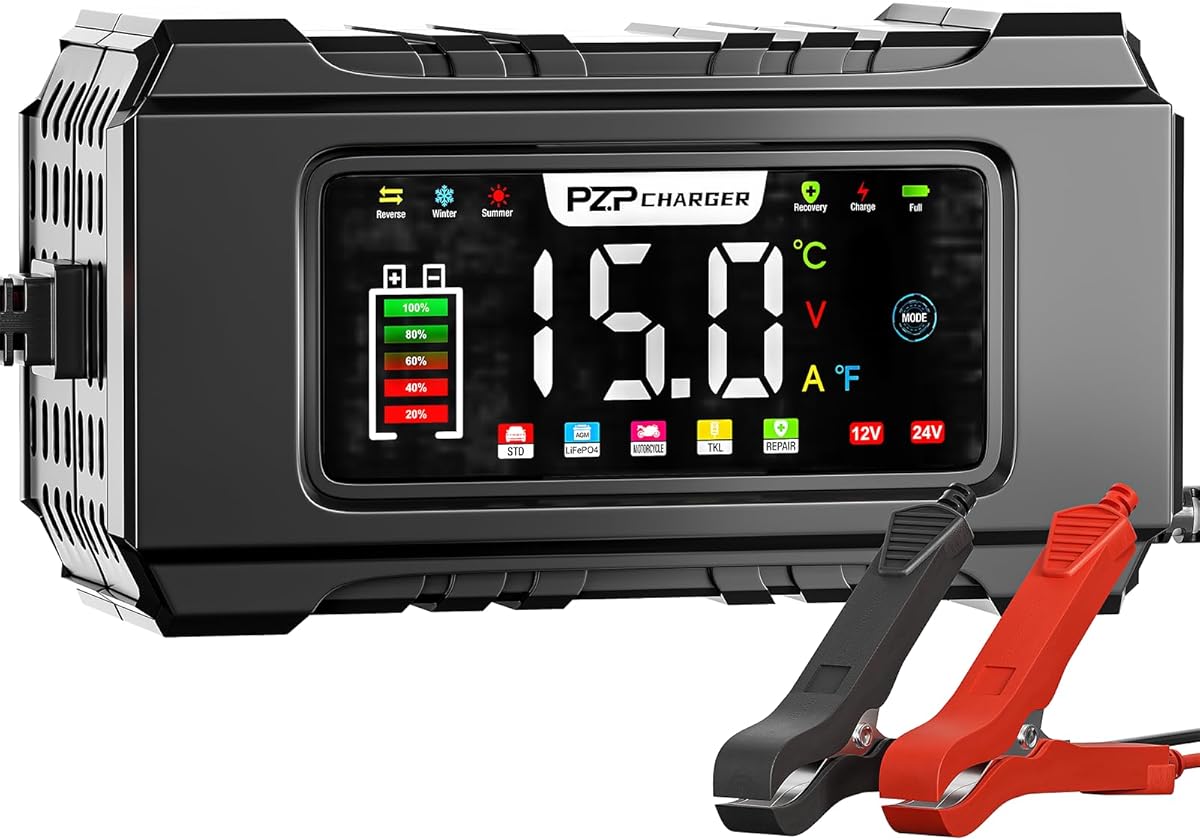
The PZ.P 15-Amp Smart Charger combines 12V and 24V capability, lithium and lead-acid support, a nine-stage program, and a large color display. Its 4.5 rating reflects a versatile charger for cars, trucks, SUVs, motorcycles, lawn mowers, boats, and marine equipment. At 12V it delivers up to 15A, while its 24V setting provides up to 8A.
We may earn a commission when you buy through this link, at no additional cost to you.
Compatible chemistries include LiFePO4, AGM, gel, SLA, and flooded lead-acid. After the main charging process, the unit automatically transitions into trickle or float maintenance, which makes it appropriate for keeping a battery charged during winter or extended storage. A one-click pulse-repair function is also available to address detected sulfation and acid stratification.
The display is unusually informative. It reports charging voltage, current, internal temperature in Fahrenheit or Celsius, charge percentage, summer mode, and winter mode. A 6.7-foot cable improves access to batteries mounted in awkward compartments or other hard-to-reach locations. Temperature compensation adjusts charging behavior across the stated 14-to-82-degree Fahrenheit operating range.
Safety controls include reverse-polarity, overcurrent, overvoltage, short-circuit, undercharge prevention, a cooling system, and fire-resistant materials. The main limitation is important: despite its repair mode, it cannot activate or charge a totally dead battery. It also should not be expected to operate outside its specified temperature range. For a user who values detailed information and broad chemistry support, it offers strong flexibility.
Supporting both 12V and 24V systems makes the unit useful for a wider collection of equipment than a fixed-voltage charger. The reduced 24V output appropriately reflects the higher voltage and current demands of those batteries.
Voltage, current, temperature, and charge-percentage readouts make the charging process easier to evaluate. Summer and winter modes add another layer of seasonal adjustment beyond the automatic maintenance stage.
We may earn a commission when you buy through this link, at no additional cost to you.
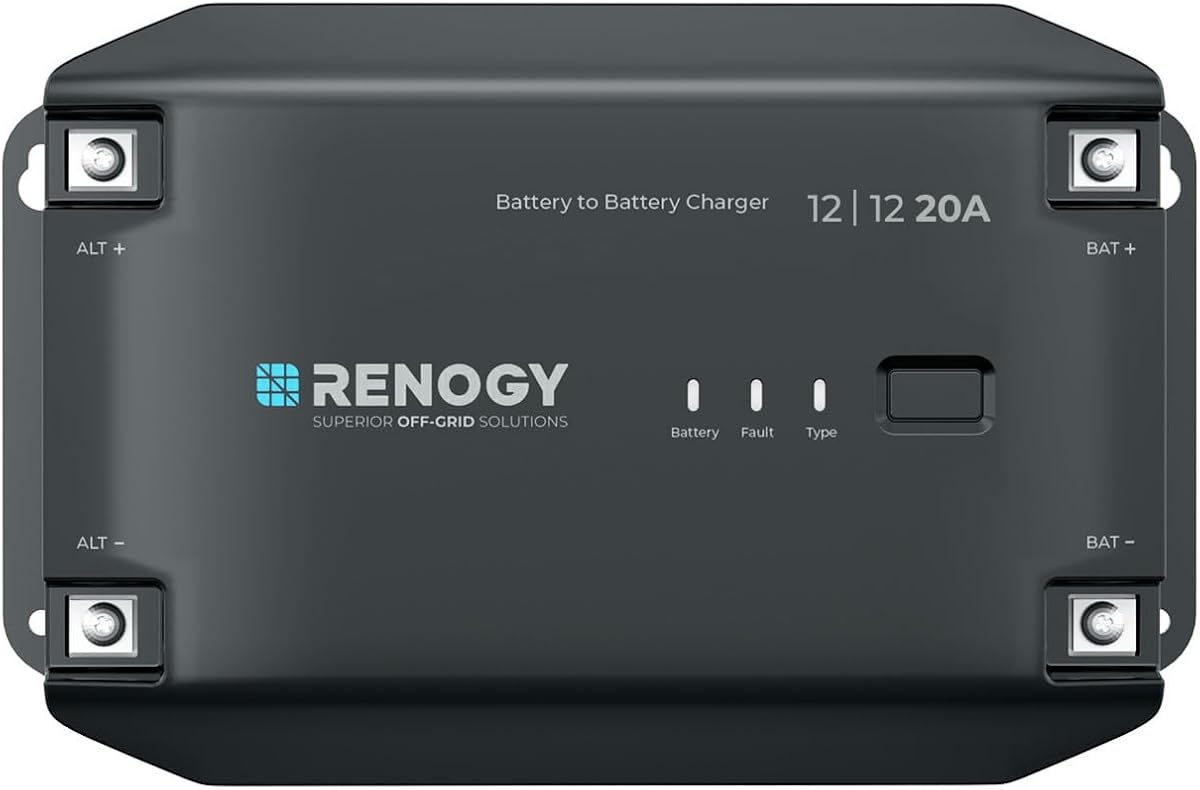
The Renogy 12V 20A DC to DC Charger is designed for permanently installed auxiliary-battery systems in RVs, boats, yachts, commercial vehicles, and other mobile applications. Its 4.0 rating reflects a specialized but capable unit whose standout feature is alternator-aware charging. It charges only while the engine is running and changes strategy at vehicle startup to help protect the starting battery.
We may earn a commission when you buy through this link, at no additional cost to you.
Built-in alternator detection is especially useful in multi-battery installations. Rather than treating the auxiliary battery as though it were connected directly to the vehicle at all times, the charger recognizes engine operation and manages its charging strategy accordingly. The wall-mount design and separated internal input and output terminals support compact, secure installation while helping reduce short-circuit risk.
For lithium systems, intelligent LiFePO4 activation is available, along with a physical one-touch control for enabling or disabling that function. Flooded, gel, AGM, and lithium batteries are supported, giving the unit more flexibility than a chemistry-specific charger. Electronic protection covers overload, short circuit, over-temperature, and overvoltage for demanding marine and RV environments.
Bluetooth monitoring is the premium-oriented feature, although it requires a separately sold Renogy BT-2 module. With the module and compatible Renogy One Core or DC Home setup, users can adjust settings and review up to 365 days of charging data. This adds useful visibility but also increases cost and complexity, so buyers should decide whether remote monitoring justifies the additional equipment.
The charger waits for the engine to run before actively charging the auxiliary battery. This behavior is valuable in vehicles with separate starting and house batteries because it reduces the chance of unintentionally draining the starting battery while parked.
With the optional BT-2 module, remote adjustment and extended charging-history review become available. The added visibility can help owners identify changing voltage or current patterns across long-term travel.
We may earn a commission when you buy through this link, at no additional cost to you.
The Battery Tender Plus is a 12V, 1.25A charger and maintainer with a 4.7 rating, tying for the highest rating among the products in this guide. It is designed primarily to preserve automotive, motorcycle, and lawn-mower batteries through storage, using an adaptive four-step program and float charging rather than aggressive high-current output.
We may earn a commission when you buy through this link, at no additional cost to you.
Its two-color solid-state indicator shows the state of charge. More importantly, the charger resumes full output if battery voltage falls too far under load. That behavior makes it more than a simple fixed trickle device: it can respond when connected equipment places additional demand on the battery and then return the battery to its maintained state.
The quick-disconnect harness improves daily convenience. A user can leave a fixed connector on the battery and detach the charger when the vehicle needs to move, rather than removing individual terminal connections each time. Both a fused ring terminal and alligator clips are included, offering flexibility for different battery layouts and applications.
This is a strong choice for owners who want simple seasonal maintenance from a recognized automotive-power brand. The 1.25A output is deliberately modest, so it is not a rapid charger for large banks or severely depleted batteries. It is also not presented as a broad multi-chemistry repair unit. Within its intended role—keeping a healthy 12V battery charged—the adaptive program, quick connection, and strong customer rating make it a compelling selection.
The four-step program and float stage are designed to maintain rather than continuously flood a battery. Automatic output resumption after voltage falls under load adds responsiveness that makes the maintainer practical for stored vehicles with occasional equipment draw.
The quick-disconnect harness reduces the effort of moving a vehicle with a permanently attached maintenance lead. Ring and alligator accessories give users options for both concealed and accessible battery terminals.
We may earn a commission when you buy through this link, at no additional cost to you.
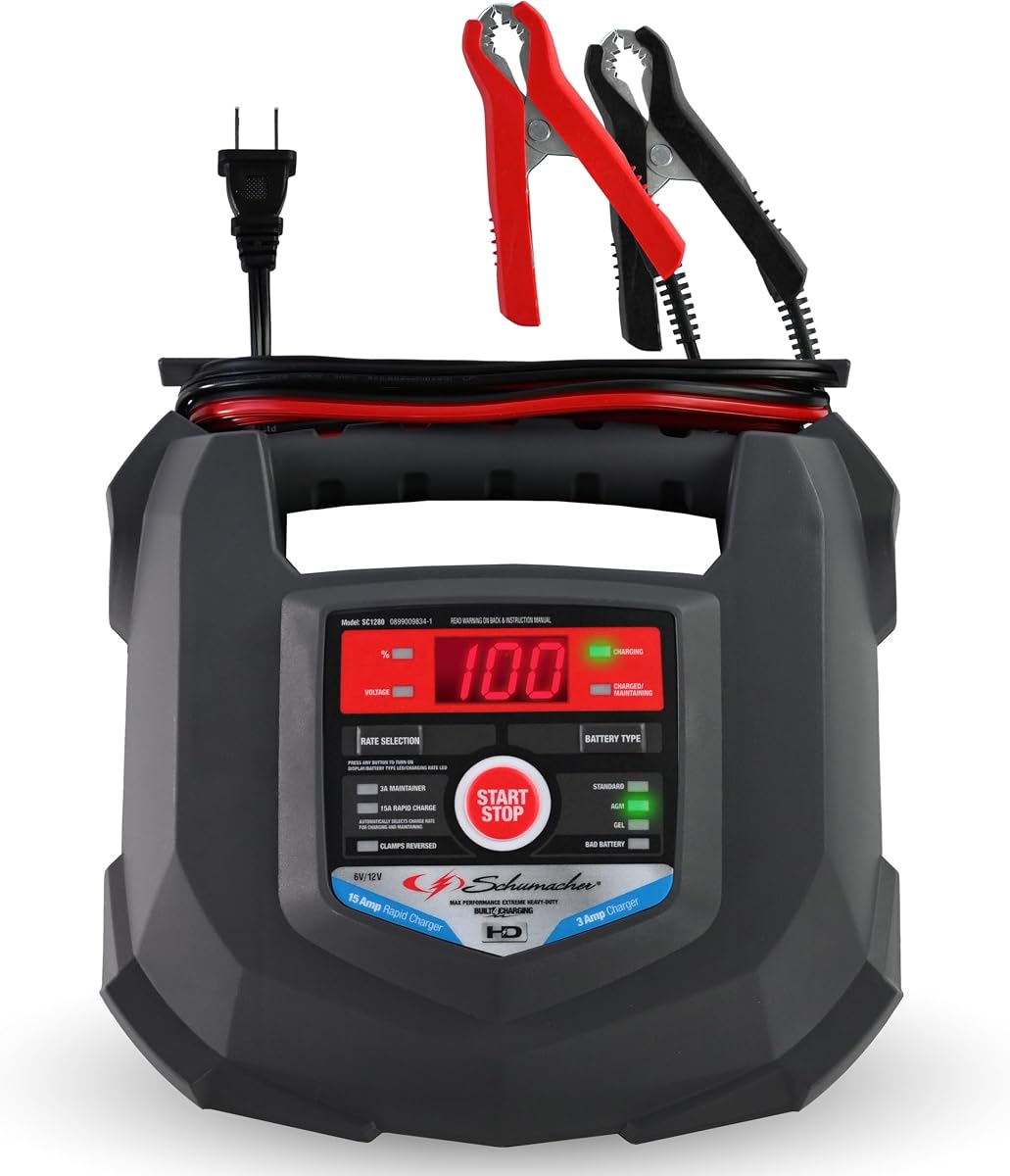
The Schumacher SC1280 is a 15A charger and maintainer that combines charging, maintenance, testing, and restoration functions. Its 4.6 rating reflects a versatile garage tool for cars, motorcycles, ATVs, trucks, SUVs, and boats. Unlike the smallest maintainers in this guide, it provides enough output for more active charging while still transitioning to maintenance when appropriate.
We may earn a commission when you buy through this link, at no additional cost to you.
Microprocessor control and automatic voltage detection make the unit straightforward for mixed battery collections. It supports 6V and 12V operation and works with standard, AGM, gel, and deep-cycle batteries. Smart trickle charging handles the maintenance phase, while an advanced desulfation mode is intended to counter buildup that can reduce battery performance.
The SC1280's main advantage over a compact maintainer is flexibility. It can serve as a charger, maintainer, tester, and restoration-oriented device in one enclosure. That makes it useful for seasonal vehicle storage, occasional battery problems, and general workshop needs without requiring several separate products. The microprocessor-controlled stages help coordinate those functions without requiring constant supervision.
Compared with the TowerTop and PZ.P chargers, its interface is less data-heavy, but that can be an advantage for users who want a conventional charger without menus and repair buttons. It is still a fixed product with a 15A maximum and does not offer the same detailed display or engine-start function. For a straightforward, multi-purpose charger with broad vehicle applications, it remains a balanced choice.
Charging, maintaining, testing, and desulfation functions make the SC1280 useful beyond routine storage. It suits owners who want one garage device to cover several common battery-care needs.
Voltage detection and microprocessor-controlled stages reduce manual configuration. Support for standard, AGM, gel, and deep-cycle batteries adds flexibility for motorcycles, cars, recreational vehicles, and boats.
We may earn a commission when you buy through this link, at no additional cost to you.
The right charger depends on battery chemistry, capacity, how often it is used, and whether charging happens through household power or a vehicle alternator. Output, installation requirements, and safety features should be evaluated together rather than by amperage alone.
A standard plug-in charger draws power from household AC and is appropriate for maintenance when the vehicle can remain parked near an outlet. A DC-to-DC charger instead draws from a vehicle's charging system, usually coordinated with a smart alternator, making it better for auxiliary batteries in RVs, boats, campers, and commercial vehicles. The distinction is essential because a garage charger and an onboard auxiliary charger are designed around different power sources and installation environments.
Lead-acid batteries include flooded, AGM, gel, SLA, VRLA, EFB, and calcium types, while LiFePO4 requires a tailored lithium charging profile. Verify that the charger explicitly supports the installed chemistry. Maximum amperage alone does not make a charger suitable for lithium, and a lead-acid maintenance profile should not be assumed to be safe or optimal for a LiFePO4 battery.
Low-current chargers around 800mA to 1.25A are primarily designed to maintain a healthy battery over time. Models offering 10A to 25A can charge larger batteries more quickly and are more appropriate for depleted starting batteries or sizable house banks. Match output to battery capacity and follow the battery manufacturer's charging guidance, particularly for lithium systems where high current or an incorrect absorption voltage can create risk.
A good charger normally progresses through controlled stages rather than applying one constant output indefinitely. Bulk, absorption, analysis or float, and maintenance stages help reduce overcharging. Desulfation or repair modes can help with sulfation and stratification, but they cannot restore physically damaged, aged, or completely dead batteries. Some products also provide low-voltage or zero-volt activation, which can be valuable for lithium batteries protected by a sleeping BMS.
Battery chemistry behaves differently in hot and cold environments. A charger with an internal temperature sensor can adjust its voltage or output to reduce overcharging in heat and undercharging in cold. Winter modes can provide a small voltage increase, while summer modes may tailor the process for heat. Check both the charger's operating-temperature range and its compensation features if it will remain installed through seasonal changes.
A permanent onboard charger should have a secure mounting bracket and sufficient cable reach. DC-to-DC systems need correct wiring, grounding, and a compatible alternator. Battery location also matters: compact displays, indicator lights, and color screens are easier to use than a charger that must be viewed in a cramped engine compartment. Optional Bluetooth monitoring can be useful, but it should not be confused with core charging capability and may require separately purchased modules.
Look for protection against reverse polarity, short circuits, overcurrent, overload, overvoltage, overheating, and spark-related risks. Good connectors matter as much as electronic safeguards. Ring terminals suit secure battery posts, while alligator clips can be convenient for temporary service. A fused lead, insulated terminals, a protective enclosure, and clear polarity markings help make routine use safer.
A motorcycle, seasonal automobile, RV house bank, marine battery, and lithium storage battery have different charging priorities. Small maintenance units are quiet, compact, and easy to leave on a healthy battery. High-current garage chargers are better when recovery speed matters. Onboard DC-to-DC units are valuable when storage capacity must be replenished during travel. Consider how often the battery is used, how long it sits unused, and whether convenient remote monitoring is worth the added complexity.
Before connecting any charger, identify the battery's voltage and chemistry, inspect the terminals, and consult the battery maker's instructions. Use the correct polarity: positive connects to positive and negative to negative. For a plug-in unit, position the charger in a dry, ventilated location and inspect the cable and connectors for damage before attaching the leads.
Attach the charger correctly and select the battery type and required charging stage. Conventional chargers often begin automatically or require a Start button, while DC-to-DC chargers should be installed according to their wiring diagram and connected to a compatible smart-alternator system. Do not use a lithium-specific profile on a lead-acid battery, and do not expose an indoor charger to rain or extreme heat.
Monitor the first charging session, check the displayed voltage and current, and confirm that the unit reaches its intended full-charge or float state. For long-term maintenance, verify that the charger has entered maintenance mode and reconnect the charger only after the battery has settled if the manual specifies a waiting period. Disconnect and store the unit when maintenance ends or when moving the vehicle, and inspect terminals periodically for corrosion, looseness, or heat damage.
Only if the charger is explicitly rated and configured for 24V operation. Applying a 12V charging profile to a 24V battery will not charge it correctly, while using a charger with an inappropriate higher voltage can damage the battery. The PZ.P model listed here supports both 12V and 24V systems, with different maximum outputs for each voltage.
Only when the charger includes a compatible LiFePO4 charging profile. Most conventional lead-acid chargers use voltage stages that are not appropriate for lithium chemistry. The dedicated 20A lithium charger and the multi-chemistry PZ.P and Renogy models explicitly support LiFePO4 systems, subject to their stated activation limitations and installation requirements.
A trickle or maintenance charger is usually sufficient for preserving a healthy battery during storage. It is less suitable for quickly recovering a severely depleted battery or charging a large battery bank. A higher-current charger such as the TowerTop, Schumacher SC1280, or lithium-specific model offers more capacity when active charging is required.
A maintainer typically plugs into household AC and supplies a low current to keep a battery topped up. A DC-to-DC charger draws from a vehicle's alternator, normally with smart-alternator coordination, to charge an auxiliary battery while the engine runs. The latter is more appropriate for RV, boat, camper, and off-grid auxiliary systems.
It depends on the battery and charger. Some models can initiate charging from a very low voltage, and the NOCO includes a Force Mode for batteries down to zero volts, while the dedicated lithium charger supports 0V activation. Other repair-oriented chargers explicitly cannot activate totally dead batteries, and no charger can reverse every form of permanent battery damage.
Several products in this guide are specifically designed for long-term or indefinite maintenance, using float, pulse, or maintenance stages once the battery reaches the correct voltage. Even so, periodic checks are sensible. Inspect the connection, confirm that the charger remains in maintenance mode, and remove it if it shows abnormal heating, odor, swelling, or other signs of a problem.
The correct current depends on battery-bank capacity, chemistry, and how quickly the bank needs to be ready. Small maintainers preserve individual batteries but can take a long time to recover a large bank. A 20A or 25A charger offers more headroom, while lithium systems require the correct charging profile and should follow manufacturer limits.
Bluetooth is optional rather than essential. It can be valuable in permanent RV, boat, or commercial-vehicle installations where remote charge monitoring is useful. The Renogy model requires a separately sold BT-2 module for this function, so buyers should compare the added visibility with the extra equipment and configuration involved.
The NOCO GENIUS2D stands out as the most balanced onboard option, with secure direct mounting, thermal adjustment, and recovery features. The Foval Automatic Trickle Charger is a compact and versatile budget-friendly maintainer, while the Renogy 20A DC to DC Charger offers the most advanced connected installation for supported auxiliary-battery systems.
Prioritize chemistry compatibility first, then decide whether you need household plug-in charging, maintenance only, faster recovery, or permanent auxiliary-battery charging. After that, examine current output, temperature compensation, safety protections, connector quality, and installation requirements. A larger charger is not automatically better if it cannot safely support the battery you own.
Before purchasing, verify the charger's compatibility, output, and included accessories against your battery and installation. Ratings can change over time, and prices fluctuate as promotions and availability shift, so check the current retailer listing for the latest product details, customer feedback, and cost.