
DHT11 Temperature Humidity Sensor Module
4.5Editor score
Five sensor modules included
Simple single-bus output
Works from 3.3V to 5V
Our Arduino Temperature Sensor guide compares ten modules for accuracy, range, humidity support, voltage, interface, and Arduino compatibility with confidence.
An Arduino temperature sensor gives a microcontroller the ability to measure its surroundings, monitor equipment, or automate climate-sensitive decisions. The best choice depends on whether you need simple ambient readings, higher precision, humidity monitoring, or a waterproof probe suitable for damp and remote locations.
This guide compares ten popular Arduino-compatible sensors using the specifications supplied for each product. It considers measurement ranges, accuracy, voltage, communication methods, physical installation, environmental suitability, and the number of sensors included, without suggesting that every module suits the same project.
Each review explains the standout features, limitations, and most practical uses of its sensor. The list includes single-bus DHT11 and AM2302 modules, I2C AHT30 and SHT31 devices, and waterproof DS18B20 probes. Product listings and availability can change, so confirm current specifications before purchasing.
4.5Editor score

5.0Editor score

4.9Editor score
The comparison below places the ten modules by sensor type, measurement capability, operating range, interface, and installation format, making it easier to identify the right option for a classroom, enclosure, aquarium, greenhouse, or remote monitoring project.




The HiLetgo DHT11 package is a straightforward starting point for projects that need both ambient temperature and relative humidity. It includes five digital sensor modules and connecting cables, giving you enough hardware for multiple rooms, experiments, or comparison nodes. The single-bus signal and straightforward power connections make it particularly approachable for anyone building a first Arduino weather station.
We may earn a commission when you buy through this link, at no additional cost to you.
The specified operating range is 3.3V to 5.5V, allowing use with common Arduino-compatible boards and suitable digital input levels. Temperature readings cover 0°C to 50°C, while humidity spans 20% to 95% relative humidity. The stated accuracy is approximately ±2°C and ±5% relative humidity, with a resolution of 1°C and 1% relative humidity.
The main limitation is that these specifications are modest compared with the AHT30, SHT31-D, and DHT22 options in this guide. The DHT11 is not ideal for subzero environmental monitoring, fine humidity control, or measurements where small deviations matter. Its single-bus protocol also requires careful timing and adequate pauses between readings in many Arduino libraries.
This is a sensible choice for education, simple room monitoring, fan control, and low-demand humidity projects. Buyers who need broader environmental coverage or tighter accuracy should move up to a more capable module, but the DHT11 remains one of the easiest ways to add combined temperature and humidity data to an Arduino.
The DHT11 reports temperature and humidity through one digital connection, so it avoids the separate analog channels and divider circuitry associated with basic thermistors. That simplifies both wiring and the amount of code required for a first prototype.
Five modules are included with cables, making it easier to distribute readings across a room or compare conditions at several points. Each connected module still needs an addressable single-bus arrangement, so planning the wiring and library support remains important.
We may earn a commission when you buy through this link, at no additional cost to you.
The AHT30 I2C module stands out as the strongest general-purpose choice in this collection. It combines a broad environmental measurement range, a stated temperature accuracy of ±0.3°C, and flexible voltage support in a compact digital package. Two modules are included, which is enough to build a paired environmental monitor or keep one spare available.
We may earn a commission when you buy through this link, at no additional cost to you.
Its operating range extends from 2.0V to 5.5V, and the temperature capability covers -40°C to 85°C. Humidity readings span 0% to 100% relative humidity with a stated accuracy of ±2% at 25°C. The fine temperature resolution of 0.01°C and humidity resolution of 0.024% make it suitable for projects that benefit from more detailed readings than a basic DHT11 provides.
I2C communication is a major advantage when an Arduino project already uses bus-based peripherals, although the code must use a library compatible with the AHT30. Because I2C devices share connections and communicate by address, beginners should confirm the library's addressing support and avoid connecting modules with conflicting addresses unless they are configured differently.
Choose this module for indoor climate monitoring, precise environmental logging, fan or heater control, and multi-node sensing. It offers a compelling balance of accuracy, range, voltage flexibility, and compactness without moving to a remote waterproof-probe format.
A 0.01°C temperature resolution is particularly useful when a project needs to detect small changes rather than only display a broad room reading. It does not replace calibration, but it allows the software to work with a more granular measurement stream.
I2C keeps the wiring compact and allows the module to coexist with other supported bus devices. That makes the AHT30 useful for organized projects with displays, data loggers, or multiple environmental nodes.
We may earn a commission when you buy through this link, at no additional cost to you.
The Teyleten SHT31-D is notable for its unusually broad temperature measurement range of -40°C to 125°C. Combined with 0% to 100% relative humidity coverage and a stated temperature accuracy of ±0.3°C, it suits projects that need both environmental readings and a wide operating envelope in an I2C package.
We may earn a commission when you buy through this link, at no additional cost to you.
The module operates from 2.4V to 5.5V, making it compatible with common Arduino platforms while accommodating a variety of embedded projects. Three units are supplied, so it is practical for multi-location monitoring or experimentation with several identical sensing nodes. The SHT31 specification also provides a meaningful upgrade path over older SHT-series components mentioned in the product category.
The main practical consideration is I2C addressing and software support. A project should use a library written for the SHT31 family and verify that it recognizes the SHT31-D variant and module's address. As with any digital environmental sensor, placement away from processors, power converters, and direct sunlight will produce more meaningful results.
This is an excellent selection for advanced greenhouse monitoring, industrial prototypes, environmental logging, or installations that may encounter temperatures beyond the DHT11's range. Its broad specification makes it more versatile than the entry-level humidity modules, while retaining the compact convenience of a bus-connected board.
A -40°C to 125°C specification provides room for refrigerated environments, heated equipment, and broader experimental monitoring. The operating environment still matters, and the sensor should be protected from condensation, direct contact with hot surfaces, and water beyond its intended exposure.
Three matching modules make it easier to compare several locations using the same sensor type. Consistent hardware can reduce calibration differences, although each node should still be checked for placement and self-heating effects.
We may earn a commission when you buy through this link, at no additional cost to you.
The Gikfun EK1183 set is built for projects where the sensing point must be separated from the Arduino. Its one-meter waterproof DS18B20 probes are paired with adapter modules, allowing a controller to remain in a dry enclosure while the probe sits in a tank, appliance, greenhouse, or other monitored location.
We may earn a commission when you buy through this link, at no additional cost to you.
The specified temperature range is -55°C to 125°C, which is broad enough for freezer, room-temperature, and many industrial monitoring tasks. The adapter boards include pull-up resistors and connect to most microcontrollers through clearly identified leads: yellow for data, red for power, and black for ground. The package contains three probe-and-adapter sets.
A crucial detail is that the cable itself can withstand a maximum temperature of 85°C, even though the sensor element has a higher stated measurement range. That distinction matters for ovens, industrial processes, and other high-heat applications. The probe also does not measure humidity, so it should be selected for temperature alone.
This set is well suited to fish-tank monitoring, equipment temperature control, thermostatic projects, and temperature-sensitive systems. Its remote cable is the defining advantage over a small exposed module, provided the installation respects the cable's thermal limit and the probe is properly supported.
A one-meter probe provides enough distance to place the sensor inside a container while keeping the Arduino outside. This separation protects the controller from moisture and makes the measured environment more representative of the actual target.
The included adapters carry the pull-up arrangement and provide a simpler connection than a bare probe. They are particularly helpful for beginners, although multiple 1-Wire devices still require correct data-line management and appropriate library support.
We may earn a commission when you buy through this link, at no additional cost to you.
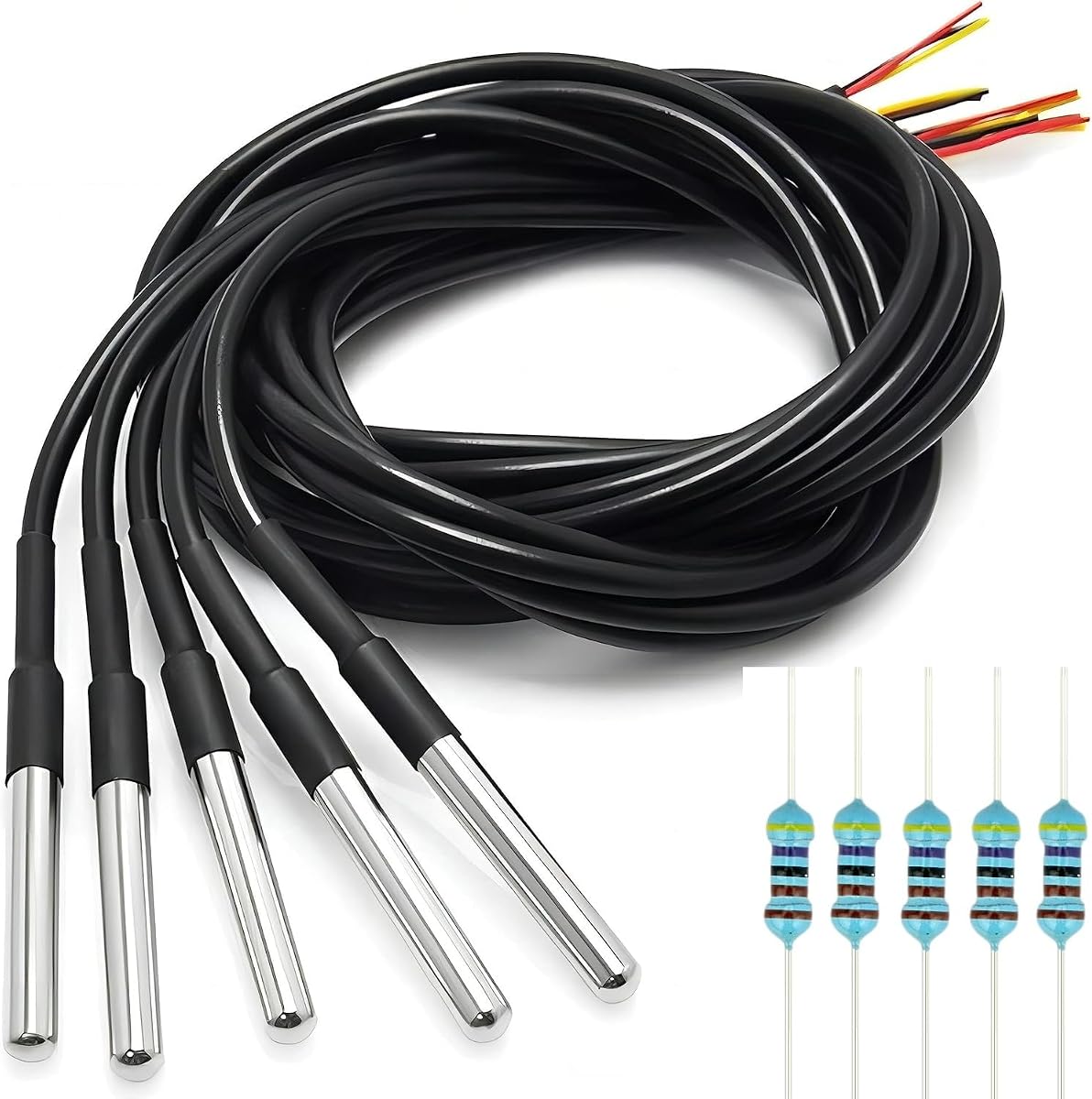
The WWZMDiB DS18B20 bundle is aimed at projects that need several remote temperature points. It includes five waterproof probes and five 4.7-kilohm resistors, giving builders a more complete hardware set for connecting DS18B20 devices to an Arduino, Raspberry Pi, ESP32, or STM platform.
We may earn a commission when you buy through this link, at no additional cost to you.
The probes are designed to function in wet or moist environments and have a stated temperature range of -55°C to 125°C with an accuracy of ±0.5°C. Their supply range is 3V to 5.25V, covering common microcontroller operating voltages. Red, yellow, and black leads identify power, data, and ground respectively.
The greatest benefit is convenience for multi-node projects. Including a resistor for each probe reduces the chance of discovering a missing component halfway through assembly, and five identical probes make it easier to compare separate locations. However, a one-wire bus is not simply five independent analog inputs, so the data line, pull-up arrangement, device discovery, and code must support the intended layout.
Choose this bundle for greenhouse zones, room maps, refrigerator or freezer monitoring, soil-adjacent temperature checks, and multi-location logging. For a single wet-location reading, a two-probe kit may be less cumbersome, but for a distributed system this package provides the most versatile quantity in the list.
The supplied resistors remove a common source of assembly errors when data lines need pull-up support. With careful bus topology, the same hardware can support a useful network of temperature nodes.
The waterproof probe design allows the sensing tip to be placed where condensation or moisture would damage an exposed component. The Arduino itself should remain in a dry enclosure with ventilation and suitable strain relief.
We may earn a commission when you buy through this link, at no additional cost to you.
This two-pack DHT11 provides a compact way to add combined temperature and humidity readings to an Arduino or Raspberry Pi. Each module uses a calibrated digital sensor with a single-bus output, and the included cables make it easier to connect without designing a custom harness.
We may earn a commission when you buy through this link, at no additional cost to you.
The module accepts 3.3V to 5V and reports temperatures from 0°C to 50°C. Humidity coverage runs from 20% to 95% relative humidity, with stated errors of approximately ±2°C and ±5% relative humidity. These figures are appropriate for learning, room comfort displays, and basic automation rather than precision environmental control.
Its strengths are simplicity and accessibility. A suitable library handles the sensor's timing and conversion process, and the digital interface avoids analog calibration. The limitations are equally clear: readings are relatively coarse, the environmental range is restricted, and the sensor requires adequate separation between requests in many library implementations.
This option works well for a two-room comparison, a basic classroom station, or a simple fan-and-ventilation exercise. It is a sensible starting package, while the AHT30 or SHT31-D offers a more convincing upgrade when wider range, finer resolution, and better accuracy become important.
The two included modules and cables are useful for checking how conditions differ across two points. A stable single-bus layout and compatible Arduino library make the arrangement approachable.
Because the module produces a digital reading, the Arduino does not need to calculate resistance or apply an analog conversion curve. This reduces circuit complexity and keeps attention on interpreting the measurements.
We may earn a commission when you buy through this link, at no additional cost to you.
The DROK kit is the most complete remote-probe package in this roundup. It includes two waterproof DS18B20 probes, two adapter boards, female-to-female jumper wires, and 4.7-kilohm resistors. That combination minimizes the number of separate parts needed to construct a two-point temperature-monitoring installation.
We may earn a commission when you buy through this link, at no additional cost to you.
The probes use a waterproof, corrosion-resistant stainless steel housing with thermally conductive sealant. Their specified measurement range is -55°C to 125°C with an accuracy of ±0.5°C, and they operate from 3.0V to 5.5V. Red, yellow, and black wiring identifies power, data, and ground, with heat-shrink tubing protecting the connections.
The included adapter boards simplify integration with Arduino, Raspberry Pi, ESP32, and STM platforms. The instructions also emphasize using a 4.7-kilohm resistor between data and power for stability, and the bundled resistors make that recommendation easy to follow. As with every 1-Wire network, bus length and topology should still be considered.
This is a compelling premium choice for continuous submerged sensing, aquariums, outdoor cabinets, and other harsh or wet environments. It is best suited to temperature-only projects, but the included hardware creates a neat, repeatable installation for one or two remote sensing points.
The stainless steel enclosure and sealed construction are well suited to continuous submersion and moisture-prone locations. The probe tip should still be evaluated for chemical exposure, pressure, and physical impacts that fall outside the stated environmental use.
Adapter boards, jumper wires, and pull-up resistors cover the common electrical requirements in one package. This reduces ordering mistakes and makes the project easier to reproduce across multiple installations.
We may earn a commission when you buy through this link, at no additional cost to you.
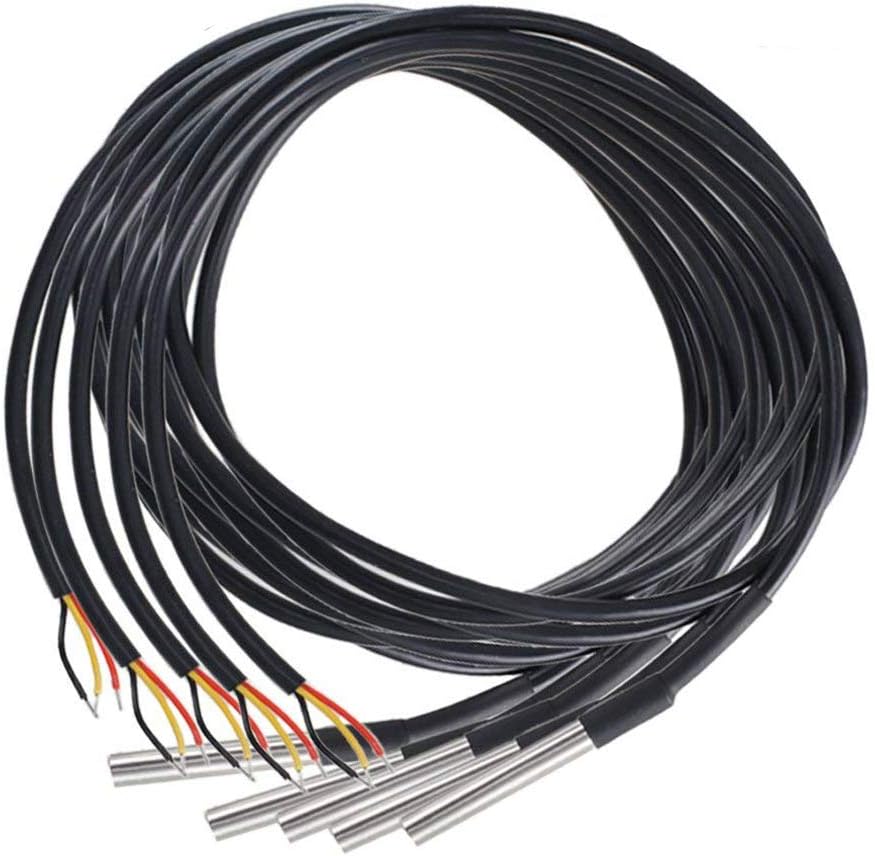
The Gikfun EK1083 offers five one-meter DS18B20 probes for projects that need broad temperature coverage rather than combined humidity data. The probes share a single-bus interface, which makes it possible to connect multiple points while keeping wiring relatively economical.
We may earn a commission when you buy through this link, at no additional cost to you.
Each probe runs from 3.0V to 5.5V and uses red, yellow, and black leads for power, data, and ground. The package does not include the recommended 4.7-kilohm resistor, so builders should obtain one if the connected development board does not already provide the necessary pull-up arrangement.
The absence of a humidity sensor is not a flaw for temperature-only applications, but it narrows the product's role. It is best for thermostatic controls, equipment monitoring, consumer thermometers, and systems that need several remote points. Single-bus communication also means a robust library and correct wiring topology are important when all five sensors operate together.
This set is a practical choice for greenhouse monitoring, building temperature mapping, or comparing several cabinets. Compared with a smaller package, the five identical probes provide flexibility, while one-meter leads make remote placement possible without immediately requiring longer custom wiring.
Five matching probes let a project expand from one reading to several locations without mixing sensor models. A well-designed bus and library allow the Arduino to identify and read each device systematically.
The approximately one-meter cable is useful when the controller and target are not close together. Secure the cable away from moving parts and hot surfaces, and protect the connector area from moisture.
We may earn a commission when you buy through this link, at no additional cost to you.
The HiLetgo DHT22/AM2302 is a sensible middle ground between the basic DHT11 and more advanced I2C sensors. It uses the AOSONG AM2302 as its main chip and provides a single-bus digital output, retaining the familiar wiring approach while improving temperature and humidity performance.
We may earn a commission when you buy through this link, at no additional cost to you.
The stated temperature range is -40°C to 80°C with an accuracy of ±0.5°C. Humidity coverage runs from 0% to 100% relative humidity with an accuracy of ±2%. Two modules are included, and the boards have fixing holes that make them easier to mount inside an enclosure or at a stable monitoring point.
The DHT22 still follows a single-bus protocol, so it remains easy to wire but needs correct timing and adequate delays between readings. Compared with the AHT30 and SHT31-D, its accuracy is more modest, and the board consumes more general-purpose pins than a straightforward I2C arrangement on a project already using that bus.
This module is appropriate for weather stations, greenhouse controllers, room climate monitors, and projects that need broader range than a DHT11. It is also attractive to beginners who understand one-wire wiring but want better specifications without moving to a more involved I2C setup.
The wider temperature range and tighter stated temperature accuracy make the AM2302 more useful in variable indoor conditions. It also measures across the full nominal relative humidity range rather than the narrower DHT11 interval.
The fixing holes help reduce errors caused by the module moving or shifting. A fixed position also makes it easier to compare readings over time and avoid local heat generated by the Arduino or nearby electronics.
We may earn a commission when you buy through this link, at no additional cost to you.
The HiLetgo DS18B20 set provides five stainless-steel, waterproof temperature probes with one-meter cables. It is a practical choice for distributed sensing where several locations must be monitored while the Arduino remains safely housed in a separate enclosure.
We may earn a commission when you buy through this link, at no additional cost to you.
The probes support a stated temperature range of -55°C to 125°C and operate from 3.0V to 5.5V. Red, yellow, and black leads identify power, data, and ground. The product guidance recommends a 4.7-kilohm resistor between the data and power lines, which is not included in the listed package and should be added to the parts list.
As a digital 1-Wire device, each probe can be identified by the compatible Arduino library, allowing multiple units to share the data connection. Cable routing, environmental sealing, and electrical protection deserve attention when the sensors are installed far from the controller. The package does not provide humidity measurement or adapter boards.
Choose this set for equipment monitoring, temperature maps, greenhouses, freezers, and other distributed temperature projects. It offers a good balance of quantity, probe length, and measurement range, particularly when a builder already understands 1-Wire wiring.
The number of probes makes this set useful for comparative rather than single-point projects. Identical sensors can be distributed around a greenhouse, cabinet, or machine while a suitable library reads each device on the shared bus.
The waterproof stainless-steel package supports use in wet locations, while the long lead keeps the electronics away from the measured environment. Strain relief and moisture-safe connections remain essential for dependable installations.
We may earn a commission when you buy through this link, at no additional cost to you.
Start with the measurement task rather than the module name. A useful choice must match the required temperature range, environmental conditions, communication method, Arduino board, accuracy, and installation style of your project.
Begin by deciding whether temperature alone is sufficient. The DS18B20 probe options in this guide are dedicated temperature sensors, which makes them appropriate for tanks, equipment, freezers, greenhouses, and remote locations. The DHT11, AM2302, AHT30, and SHT31-D measure both temperature and relative humidity, adding useful data for indoor climate, comfort, condensation, and ventilation projects. Check the listed environmental span against the temperatures your project will actually encounter, rather than assuming that every sensor can measure the same range.
Accuracy determines how closely a reading may differ from the true value, while resolution describes the smallest numerical step the sensor reports. The AHT30 and SHT31-D list ±0.3°C temperature accuracy, the AM2302 lists ±0.5°C, and the DHT11 lists approximately ±2°C. Those differences matter when controlling a narrow target band, but they may be less important for a basic room display. Accuracy specifications also do not remove environmental errors, so sensor placement and self-heating remain part of the measurement system.
Review both the sensing range and the limits of the cable or enclosure. The DHT11's 0°C to 50°C span is adequate for many indoor projects but excludes freezer and subzero use. The AM2302 reaches -40°C to 80°C, while the AHT30, SHT31-D, and DS18B20 families cover substantially wider ranges. For a hot process, note that the Gikfun probe's lead is limited to 85°C even though its sensor measurement range extends higher. Always distinguish the specification of the sensing element from the limitations of the complete assembly.
The communication method affects wiring, software, and project layout. DHT11 and AM2302 modules use a single-bus digital signal, which is familiar and straightforward for beginners. The AHT30 and SHT31-D use I2C, allowing several supported devices to share power, ground, and data lines. DS18B20 probes also use a 1-Wire bus, with each sensor identified by its device address. The most important requirement is using a library that supports the exact sensor and board, especially for address handling, conversion timing, and bus scanning.
The listed modules support common embedded supply ranges, but their limits are not identical. The AHT30 operates from 2.0V to 5.5V, the SHT31-D from 2.4V to 5.5V, and the DS18B20 probe sets from approximately 3.0V to 5.5V. The DHT11 options support 3.3V to 5V. Voltage compatibility must be considered together with the Arduino board's logic levels and any USB-powered accessories. Do not assume that a sensor accepting 5V will produce a safe 5V signal on a board with 3.3V inputs.
A bare sensor board measures the air and components around it, while a waterproof probe can reach into a wet, remote, or thermally varied location. DS18B20 products are better suited to submerged tanks, damp cabinets, and equipment probes, provided the cable rating and connections are suitable. For humidity modules, protect the board from condensation and splashing while allowing air circulation around the sensing area. Use mounting holes, strain relief, and stable placement so readings are not distorted by movement or heat from the Arduino.
Package quantity can simplify a multi-node installation. The HiLetgo DHT11 includes five modules, the WWZMDiB and HiLetgo DS18B20 sets include five probes, and the Gikfun DS18B20 package includes five sensors. The AHT30, AM2302, and two-pack DHT11 listings provide two modules, while the Gikfun EK1183 includes three probe-and-adapter sets. More sensors do not automatically mean better readings, but matching hardware makes calibration and comparison easier. Confirm whether your bus topology and library support the number of devices you intend to connect.
Hardware accuracy will not help if the library reads the sensor incorrectly. DHT11 and AM2302 libraries must respect the sensor's timing requirements, while AHT30 and SHT31 libraries must recognize the relevant chip variant and I2C address. DS18B20 projects require 1-Wire support, a suitable pull-up arrangement, and code that can identify multiple devices. Check the board's available pins, any examples supplied with the module, and whether the library supports your selected Arduino model before finalizing the project.
Begin by identifying the sensor's interface, power requirements, and data pin. Connect ground to ground, power to the appropriate supply, and the signal pin to the correct Arduino pin. For an I2C AHT30 or SHT31-D, use the board's designated SDA and SCL pins. For a DS18B20, place the appropriate pull-up resistor between data and power if the board does not already provide one. Install a compatible library, confirm that the sensor is detected, and perform a simple read before adding displays, alerts, or logging.
Place the sensing element where it can experience the environment you want to measure. Keep exposed humidity boards away from condensation, direct rain, and direct sunlight, while allowing air to move across them. For waterproof probes, route and secure the cable away from sharp edges and moving parts. Place the Arduino in a ventilated enclosure rather than directly beside the sensor, since processor heat can influence local readings.
Care for the installation by checking connections, cable strain, moisture intrusion, and sensor position periodically. Recalibrate or compare the reading against a trusted reference if the project depends on high consistency. For long-running data collection, use a sensible sampling interval, log timestamps, and monitor for implausible values. Replace the module if readings become erratic, and never energize a wet connector or expose an electronics board to condensation.
The DHT22 is the better choice when you need a wider temperature range or more accurate readings. The DHT11 is simpler, less demanding, and perfectly suitable for basic learning projects. Choose the DHT22 for climate monitoring, the DHT11 for uncomplicated demonstrations, or an AHT30 or SHT31-D when accuracy and bus efficiency matter more.
Most DS18B20 data lines need a pull-up resistor, commonly 4.7 kilohms, connected between data and power. Some development boards or adapter modules already include this arrangement, so inspect the hardware before adding another. Correct pull-up support improves signal stability, especially with longer cables or multiple sensors.
Yes, provided its supply and signal levels match the board. Typical connections are red for power, yellow for data, and black for ground. Use a compatible 1-Wire library, confirm the required pull-up arrangement, and keep the Arduino electronics dry while allowing the probe itself to occupy the damp or remote location.
I2C modules use shared clock and data lines and are addressed electronically, while single-bus sensors use one data line and communicate through a device-specific protocol. I2C is efficient for a bus containing several supported devices. Single-bus modules remain popular because their wiring and code are familiar, although timing and address handling still matter.
The AHT30 is a strong all-around option because it lists ±0.3°C accuracy, a -40°C to 85°C range, and 0% to 100% humidity coverage. The SHT31-D offers a wider temperature range, while the DHT22/AM2302 is convenient for beginners. Choose based on range, interface, environmental protection, and the precision your application requires.
Differences can come from sensor placement, enclosure heat, direct sunlight, airflow, calibration, and the stated accuracy of each device. The Arduino board and nearby regulators may also warm the air around an exposed module. Compare readings after allowing stabilization, position both devices in similar airflow, and account for the sensor's specified tolerance.
Yes, but the communication method affects the wiring. I2C sensors can share data and clock lines when their addresses do not conflict. DS18B20 and DHT-family sensors use a single-bus arrangement with device identification and timing requirements. Plan the topology, ensure the bus is stable, and use a library that can discover and read every connected device.
The appropriate interval depends on the sensor and application. DHT-family modules often need a pause between readings, while faster digital sensors may support more frequent sampling. For room monitoring, a slower interval is usually sufficient; for rapid thermal response, select a sensor designed for the required rate and test the full acquisition cycle.
The AHT30 is the strongest all-around option because it combines a broad operating range, strong stated accuracy, fine resolution, flexible voltage support, and efficient I2C communication. The HiLetgo DHT11 is the practical entry point for beginners and basic climate projects, while the DROK DS18B20 kit stands out as the most complete waterproof remote-probe package.
Prioritize the measurement task first: use a DHT11, AM2302, AHT30, or SHT31-D when humidity matters, and choose a DS18B20 probe for remote or wet temperature monitoring. Then confirm range, interface, voltage, library support, and physical protection. Accurate placement is as important as the headline specifications, particularly near heat-generating electronics.
Product listings, component availability, and manufacturer information can change, so verify the current specifications and compatible accessories before buying. The included module, cables, adapters, and resistors should also be checked against your project plan to avoid missing a necessary connection component.