
Marantz PM6007
4.3Editor score
45-watt integrated stereo amplification
Built-in MM phono stage
AK4490 DAC with digital filters
Explore the best hi end amplifier for audiophiles, comparing sound quality, power, connectivity, DAC capability, and ideal home hi-fi listening setups.
A hi end amplifier for audiophiles must do more than make a pair of speakers play loudly. It should provide stable power, preserve subtle dynamics, reduce unwanted coloration, and integrate cleanly with the source components and speakers in your room. The right choice depends on your musical priorities, system layout, and preferred mix of analog and digital listening.
This guide compares ten amplifiers and network receivers using the specifications and features supplied for each product. We examine amplifier architecture, rated output, analog and digital connectivity, phono support, DAC resolution, streaming functions, speaker control, and room-friendly design. The list also distinguishes conventional integrated amplifiers from streaming models, receivers, and a dedicated balanced tube preamplifier.
Each product receives an award only when it stands out among the three leading choices, while every other model is evaluated on its own practical strengths and limitations. Rankings reflect feature balance, rating, versatility, and fit for audiophile systems rather than a claim that the products were personally tested. Product availability and pricing can change, so confirm current specifications and terms before purchasing.
4.3Editor score

4.8Editor score

4.8Editor score
The comparison covers conventional integrated amplifiers, network-capable models, high-output hybrid designs, a network receiver, and a balanced tube preamplifier. Output power, source support, amplification architecture, and practical system features help clarify which option best matches your speakers, sources, and listening habits.


The Marantz PM6007 is an integrated stereo amplifier built for listeners who want a capable analog foundation and high-resolution digital playback in one enclosure. Its 4.3 rating reflects a generally positive reception, while the supplied specifications reveal a particularly versatile approach. Five analog inputs, a coaxial digital input, two optical inputs, and a dedicated MM phono stage give it a broader role than a basic line amplifier.
We may earn a commission when you buy through this link, at no additional cost to you.
Its most distinctive feature is the AK4490 DAC, which supports resolutions up to 192kHz/24-bit and offers two selectable digital filter modes. That makes the PM6007 a practical centerpiece for a compact but serious system containing a streamer, television, game console, disc player, or computer. Marantz HDAM-SA3 discrete amplifier modules form the analog foundation, while the high-current power supply and thermal compensation are designed to help the amplifier control demanding speakers with consistency.
The main limitation is power. At 45 watts per channel, the PM6007 is best paired with speakers that are efficient or relatively easy to drive. It may feel less effortless with large floorstanding models that require serious current, particularly at low listening levels. Another compromise is the lack of built-in Wi-Fi streaming, although the extensive digital inputs allow an external streamer to fill that role cleanly.
This is a strong recommendation for an audiophile building a two-channel system around digital files, CDs, television audio, and moderate-output vinyl playback. It also suits listeners who appreciate Marantz circuitry without needing a large display or a feature-dense network receiver. For compact rooms, restrained systems, and straightforward hi-fi setups, the PM6007 offers an unusually complete mix of refinement, connectivity, and usability.
Five analog inputs, two optical inputs, coaxial digital audio, and an MM phono stage mean the PM6007 can serve as the central component of a varied two-channel system. A subwoofer output, speaker A/B switching, and gold-plated terminals further improve its practical flexibility.
The AK4490 DAC supports 192kHz/24-bit files and provides selectable filtering, giving listeners a way to compare digital processing options. It is especially useful when the amplifier must handle a modern computer or network streamer without adding another conversion component.
We may earn a commission when you buy through this link, at no additional cost to you.
The Advance Paris A12 Classic combines substantial power with a refined mix of analog and digital connectivity, earning it a 4.8 rating and the Editor's Choice distinction. Its dual Class A/AB architecture is intended to combine the musical character of Class A operation with the efficiency and reach of Class AB design. The result is an integrated amplifier capable of serving as the center of a serious high-performance stereo system.
We may earn a commission when you buy through this link, at no additional cost to you.
Output reaches 190 watts per channel into 8 ohms and 280 watts into 4 ohms, giving it substantially more muscle than many of the compact models in this guide. That makes it a logical choice for large speakers, demanding listening levels, or rooms where the amplifier must exert firm control over bass transients. Oversized toroidal transformers and premium internal components are intended to support stable, low-noise operation.
Connectivity is equally notable. Balanced XLR inputs can provide a cleaner interface with compatible preamplifiers and streamers, while multiple RCA inputs cover conventional analog sources. Optical, coaxial, and USB-B digital inputs broaden the amplifier's role, and a high-quality phono stage serves turntable users. Unlike network-focused products, however, the A12 Classic does not include built-in wireless music streaming, so a separate streamer may be necessary.
The brushed aluminum enclosure and dual VU meters make this amplifier a visual centerpiece as well as a functional hub. It is best recommended for listeners who prioritize high output, balanced connectivity, and substantial physical construction over a compact footprint or turnkey streaming experience. The A12 Classic can be an especially persuasive choice when it replaces a collection of separate components in a dedicated two-channel system.
The amplifier's 190-watt eight-ohm rating and 280-watt four-ohm output provide useful headroom for demanding loudspeakers. That extra reserve can make volume changes seem more controlled, particularly with demanding low-frequency sections or less sensitive studio monitors.
XLR, RCA, optical, coaxial, and USB-B connections allow the A12 Classic to serve both traditional and modern source components. The breadth of input options is particularly helpful when building or revising a system over time.
We may earn a commission when you buy through this link, at no additional cost to you.
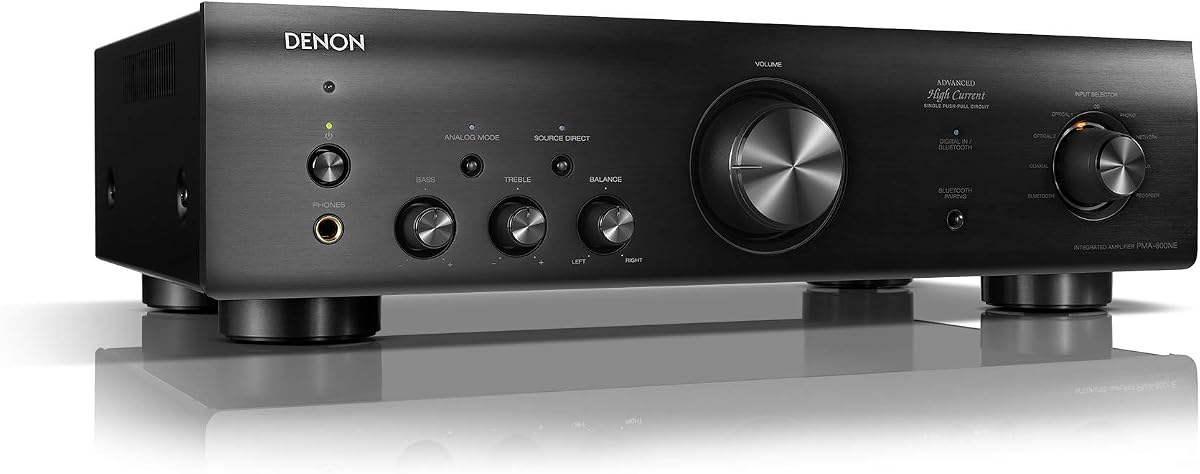
The Denon PMA-600NE is a compact integrated amplifier with a 4.6 rating and a clear emphasis on flexible source selection. Its divided circuitry can disengage the digital section, including Bluetooth, when an undivided analog listening path is desired. That philosophy gives the amplifier relevance for both traditional component systems and listeners who want occasional wireless playback.
We may earn a commission when you buy through this link, at no additional cost to you.
The supplied specifications list 70 watts at 4 ohms, supported by Denon Advanced High Current push-pull circuitry. A vibration-resistant enclosure helps manage resonance, while the relatively slim format makes the PMA-600NE practical in smaller rooms or beside a television. Two optical inputs, one coaxial input, a phono connection, and Bluetooth provide enough flexibility for a broad range of sources without turning the front panel into a control center.
Its limitations are understandable. There is no built-in Wi-Fi, multi-room platform, or television-specific decoding, so advanced streaming functions require an external device. The supplied information also does not state a maximum digital PCM resolution, making it harder to compare its DAC capabilities directly with models that explicitly support 192kHz/24-bit playback or DSD.
The PMA-600NE is best for a compact stereo system centered on analog sources, CDs, a turntable, and occasional Bluetooth convenience. Its 4.6 rating and clean source organization make it a practical choice for listeners who want strong features without a large network receiver. It may not be the ideal centerpiece for a heavily digital or home-cinema-oriented installation, but it remains a convincing two-channel amplifier for everyday audiophile listening.
Divided circuitry allows the digital section to be disconnected, including Bluetooth. Listeners who prefer the perceived purity of a more direct analog path can exploit that separation when their selected source supports it.
The slim, vibration-resistant enclosure makes the PMA-600NE easier to position than a large power amplifier. It works well as the central component in a living room, office, bedroom, or secondary listening area.
We may earn a commission when you buy through this link, at no additional cost to you.
The Marantz Model M1 is a compact network amplifier that combines 100 watts per channel with integrated streaming, wireless casting, Bluetooth, and television audio. Its 4.4 rating makes it one of the more approachable high-performance options for modern listening, particularly for anyone who wants Marantz amplification without a full-size component occupying the cabinet.
We may earn a commission when you buy through this link, at no additional cost to you.
HEOS built in supports high-resolution music up to 24-bit/192kHz PCM and DSD through streaming services, a local network, or USB. AirPlay 2, Spotify Connect, and Bluetooth offer familiar ways to send music from different devices. Marantz Musical Digital Filtering is included to shape the digital playback experience, while a dedicated subwoofer output makes the M1 useful for a 2.1-channel arrangement.
Its most unusual strength is television integration. HDMI eARC and onboard Dolby Digital Plus decoding allow the amplifier to improve television sound, and the television's remote can control volume and audio adjustments. The soft-touch finish, metal grille, and dimmable front panel help it blend into a living environment. The trade-off is that some traditional audiophile features, such as balanced inputs, a moving-coil phono stage, and tactile analog controls, are absent.
The Model M1 is ideal for a compact two-channel system, a secondary room, or a system where wireless access and television sound matter. It can also extend an existing Marantz setup through multi-room listening. For listeners whose priorities are streaming convenience, discrete design, and enough clean power for many bookshelf speakers, it offers an especially attractive balance of modern functionality and compact proportions.
HEOS, AirPlay 2, Spotify Connect, Bluetooth, USB, HDMI eARC, and Dolby Digital Plus decoding cover a wide range of modern listening and viewing. This reduces the need for separate streaming boxes, DACs, and television audio converters in a compact system.
The small enclosure and restrained visual treatment make the M1 easy to place in a living room or secondary listening area. Its multi-room platform also allows it to function as part of a broader networked audio setup.
We may earn a commission when you buy through this link, at no additional cost to you.
The Marantz Model 50 is a fully analog integrated amplifier with a 4.8 rating and an uncompromising focus on traditional hi-fi design. Its 70-watt Class A/B architecture, HDAM SA-3 amplification modules, and JFET-equipped MM phono stage reflect a considered approach to signal flow. The absence of digital circuitry is intentional rather than a simple omission.
We may earn a commission when you buy through this link, at no additional cost to you.
Marantz describes the Model 50 as a balance between its long audio heritage and modern loudspeaker control. A high-current output stage is intended to drive demanding loads with authority, while the pure analog path avoids the interference that can be introduced by internal digital circuits. Six analog inputs include dedicated connections for a CD player and turntable, making the amplifier immediately suitable for a conventional source hierarchy.
The specifications also make the Model 50 unusually expandable for an integrated design. Stereo preamplifier outputs permit connection to a separate power amplifier, while a power amplifier input can accommodate a preamp or other control source. A subwoofer output and speaker A/B switching add practical flexibility. Its trade-off is equally clear: there are no digital inputs, DAC, wireless functions, or television features, so network music requires an external streamer.
This is the ideal choice for an audiophile who wants the signal chain simplified around analog components. It suits listeners with a strong collection of sources, such as a turntable, CD player, and another analog component, who value Marantz amplification and plan their digital path separately. The Model 50 is less appropriate for anyone seeking an all-in-one network hub, but for a carefully assembled stereo system it offers a focused and expandable solution.
The absence of digital circuitry keeps the Model 50's internal architecture focused on analog reproduction. That design choice appeals to listeners who want the amplifier to remain a straightforward control and power component rather than another digital hub.
Preamp outputs, a power amplifier input, a subwoofer output, and speaker switching provide several ways to expand the system. The amplifier can therefore serve as the central component now and remain useful as a larger or more specialized system develops.
We may earn a commission when you buy through this link, at no additional cost to you.
The Yamaha R-N2000A in silver is a network hi-fi receiver designed for listeners who want extensive source support and high-resolution digital conversion. Its 4.4 rating and specification list position it as a feature-rich alternative to a conventional integrated amplifier, particularly for computer audio, streaming, and high-resolution file playback.
We may earn a commission when you buy through this link, at no additional cost to you.
The ESS SABRE ES9026PRO Ultra DAC sits at the center of its digital capabilities. The USB DAC function supports native DSD playback at 11.2 MHz and PCM playback up to 384kHz, exceeding the resolution figures published for several other models in this guide. MusicCast expands access to supported streaming services, while a toroidal power transformer is intended to provide a stable and low-noise supply.
As a receiver, its format and feature set may be more than some listeners need. It is designed to be the visible centerpiece of a stereo system and will likely require more shelf space than a compact integrated model. The supplied information also does not detail the amplifier's rated power, so it is not possible to compare speaker-driving capability directly with the explicitly rated integrated amplifiers here.
The silver R-N2000A is best suited to listeners who want a single component to manage streaming, computer-based high-resolution audio, and conventional sources. Its DAC specifications make it especially compelling for digital enthusiasts, while the network receiver format provides a natural home for a broad collection of source components. Those seeking a minimal, analog-only signal path may prefer a dedicated integrated amplifier instead.
Native DSD 11.2 MHz and 384kHz USB playback make this receiver especially relevant to listeners with large digital libraries. The ES9026PRO Ultra converter provides a clear technical focus for demanding file-based listening.
MusicCast puts familiar streaming services inside the receiver, while the phono stage and other source connections support a conventional stereo system. That combination makes the R-N2000A useful for listeners transitioning between streaming and physical media.
We may earn a commission when you buy through this link, at no additional cost to you.
The Marantz Model 60n is a network integrated amplifier that brings HEOS, Wi-Fi, AirPlay 2, Bluetooth, high-resolution playback, and a 2.1-channel output to a Marantz-style stereo system. Its 4.4 rating makes it a credible modern option, particularly for listeners who want Marantz HDAM circuitry without giving up network streaming.
We may earn a commission when you buy through this link, at no additional cost to you.
The supplied feature list emphasizes support for high-resolution audio up to 24-bit/192kHz and Roon Ready operation. HEOS built in provides access to compatible streaming services, while AirPlay 2 and Bluetooth cover familiar wireless workflows. Vinyl, CDs, and television sources can also be accommodated, making the Model 60n a broad central component for a household that uses several media types.
Its 2.1-channel output is especially useful for adding a subwoofer to a compact stereo setup. Marantz proprietary HDAM circuits support detailed audio reproduction, though the provided information does not give a rated wattage for the power amplifier. That omission makes it harder to judge how comfortably the Model 60n will control low-impedance or power-hungry speakers compared with the models that publish specific output figures.
The Model 60n is a strong recommendation for an audiophile who wants network convenience, high-resolution music, and Marantz amplification in one enclosure. It may be particularly attractive to Roon users or households already invested in HEOS-compatible speakers and components. Prospective buyers should verify current amplifier output, input availability, and dimensions against their speakers and furniture before finalizing the fit.
HEOS, Wi-Fi, AirPlay 2, and Bluetooth integration let the amplifier handle popular streaming and wireless-playback paths directly. That can simplify the signal chain and reduce the need for an external streamer.
Roon Ready status supports a polished metadata-rich playback experience, while the stated 24-bit/192kHz capability is well suited to modern high-resolution libraries. Together, they make the Model 60n relevant to network-audio specialists.
We may earn a commission when you buy through this link, at no additional cost to you.
The black Yamaha R-N2000A is the alternate finish of the same highly capable network receiver featured elsewhere in this guide. Its 4.5 rating is slightly higher than the rating listed for the silver version, but the supplied specifications describe the same core technologies: an ESS SABRE ES9026PRO Ultra DAC, native DSD 11.2 MHz playback, 384kHz USB audio, MusicCast, a phono stage, and a toroidal transformer.
We may earn a commission when you buy through this link, at no additional cost to you.
The most significant attraction is the DAC section. Support for both high-resolution PCM and native DSD makes the receiver well suited to computer audio, local libraries, and quality-focused streaming systems. The toroidal power transformer is designed to contribute a stable supply and spacious, realistic presentation, while the phono stage allows turntable users to share the same central component.
Listeners choosing between the two finishes should focus on aesthetics rather than expecting the supplied data to indicate a meaningful acoustic difference. The black version may integrate more naturally with dark furniture, black speaker grilles, and understated display equipment, while the silver version offers more visual contrast. No amplifier wattage is provided, so speaker compatibility should be confirmed through additional manufacturer information.
The black R-N2000A is recommended for digital-focused audiophiles who want extensive resolution support and streaming in a single network receiver. It is particularly attractive in a dedicated listening room where the component can function as the visual and technical hub. For listeners who want the smallest enclosure or the most explicitly stated power output, other models in this guide may offer a clearer fit.
The ES9026PRO Ultra DAC, native DSD support, and 384kHz playback form one of the strongest digital specifications described here. The receiver can serve as a central digital hub without depending on a separate converter.
The black finish suits equipment cabinets and furniture that favor a discreet appearance. Since the supplied specifications do not identify an acoustic distinction, room aesthetics should guide the choice between finishes.
We may earn a commission when you buy through this link, at no additional cost to you.
The Flyinsky PRT13A-BAL is a dedicated fully balanced vacuum tube preamplifier, and its 5.0 rating is the highest listed among these products. Rather than driving speakers directly, it performs source selection and amplification at line level before sending the signal to a separate power amplifier. It is therefore a specialist choice for audiophiles building a two-piece analog chain.
We may earn a commission when you buy through this link, at no additional cost to you.
Its circuit is described as a balanced design inspired by the classic topology of US Audio Research. The supplied specification lists two ECC82 6N11 tubes, a customized 50VA pure-copper tape-shielded R-Core transformer, and independent voltage stabilization for the left and right channel DC filament supplies. A capacitor-array high-voltage supply and MOS regulator are intended to provide low resistance, transient response, and noise performance.
As a preamplifier, it brings important trade-offs. A separate power amplifier is required, adding another component, more connections, and more space to the system. Tube products also need occasional maintenance and may be more sensitive to placement, noise, and operating conditions than solid-state designs. The supplied information does not list the exact input or output count, so compatibility with existing equipment should be verified before purchase.
The PRT13A-BAL is best for listeners who deliberately seek a classic tube-flavored preamplifier and already own, or plan to add, a suitable power amplifier. Its balanced construction, high-quality transformer, and 5.0 rating make it a compelling specialist component for a carefully assembled analog system. It is not a practical substitute for an integrated amplifier for someone who wants a simple one-box solution.
The fully balanced topology and independent channel filament supplies are central to the PRT13A-BAL's design. They make it especially relevant to listeners who already employ balanced source components or a capable power amplifier.
The capacitor-array supply and MOS voltage regulation are intended to preserve tube character while reducing noise associated with conventional tube rectification and stabilization. This hybrid approach reflects the product's emphasis on refinement rather than nostalgia alone.
We may earn a commission when you buy through this link, at no additional cost to you.
The Advance Paris A10 Classic is a high-output hybrid integrated amplifier with a 4.5 rating. It combines Class A analog amplification with Class D digital amplification, offering a blend of traditional musicality and modern efficiency. Its 130 watts per channel into 8 ohms and 190 watts into 4 ohms provide ample capability for many demanding stereo speakers.
We may earn a commission when you buy through this link, at no additional cost to you.
The amplifier is equipped with analog RCA and balanced XLR inputs, optical and coaxial digital inputs, and USB-B. A built-in phono stage broadens its usefulness for vinyl listeners, while premium components and dual toroidal transformers support stable power delivery. The brushed aluminum front panel and retro-inspired VU meters give it a distinctive presentation that can become a visual focus in a listening room.
Compared with the A12 Classic, the A10 offers lower rated output but retains much of the same broad connectivity philosophy. That makes it another credible option for a system with multiple source types. Its lack of built-in network streaming means that wireless and music-service functionality must be handled by another component, which is a meaningful drawback for modern hi-fi setups.
The A10 Classic is best recommended for audiophiles who want high power, hybrid amplification, balanced connectivity, and phono support in a single integrated unit. It should appeal especially to those pairing moderately demanding floorstanding speakers with a turntable and several digital sources. The large enclosure and bold VU-meter styling may be less suitable for compact spaces, but the underlying feature set is well suited to serious stereo listening.
The Class A and Class D combination is designed to balance musical presentation with efficiency, while the stated 130-watt eight-ohm output gives it considerable authority. The higher four-ohm figure also suggests strong current capability for compatible loudspeakers.
Balanced XLR, RCA, optical, coaxial, and USB-B inputs, combined with an integrated phono stage, allow the A10 Classic to anchor a varied system. It is particularly attractive when avoiding a separate preamplifier and network streamer is a priority.
We may earn a commission when you buy through this link, at no additional cost to you.
The right audiophile amplifier depends on your speakers, sources, room, and tolerance for separate components. Consider power, signal path, input flexibility, digital capability, streaming support, and the amount of physical space available before choosing a model.
Amplifier power should be sufficient to reach comfortable listening levels without making the amplifier work excessively hard. The PM6007's 45-watt rating is appropriate for efficient or easy-to-drive speakers, while the Advance Paris models, Marantz Model M1, and Denon PMA-600NE provide more authority for demanding loads. Output into 4 ohms can be informative when a speaker is rated for lower impedance, but it does not replace checking compatibility with the manufacturer's guidance.
Choose enough power for your speakers, not simply the largest headline figure. A more powerful amplifier can provide cleaner control at moderate levels, while an overly large model offers little benefit with sensitive speakers. Consider sensitivity, impedance, room size, preferred volume, and bass demands together.
Pure analog and network-capable designs serve different priorities. The Marantz Model 50 removes digital circuitry entirely and emphasizes a direct analog path, while the PM6007 includes a high-resolution DAC. The Model M1, Model 60n, and Yamaha R-N2000A add network streaming, wireless functions, and high-resolution conversion for listeners who want a more complete digital hub.
If your sources are primarily analog, a focused analog amplifier may keep the chain simpler. If you routinely use streaming, computer audio, television, or wireless playback, integrated network and digital functions can remove several boxes from the system. Choose the signal path that matches how you actually listen rather than the one with the longest feature list.
Class A, Class AB, Class D, and hybrid designs differ in operating behavior, efficiency, and intended character. The Advance Paris A12 Classic uses dual Class A/AB architecture, the A10 Classic combines Class A and Class D, and the Marantz Model 50 uses a high-current Class A/B design. These labels indicate topology, but they do not guarantee one universal sound. The complete circuit, power supply, output stage, and system interaction all matter.
Architecture is most useful when considered with speaker demands and design priorities. A hybrid model may suit someone seeking substantial power with efficient operation, while a pure analog design may better match a traditional component chain. Avoid choosing solely from a marketing label; review the total design and ensure the amplifier's capabilities suit your system.
An amplifier becomes more useful when its inputs match the components already in your system. Count analog line inputs, balanced XLR connections, digital optical and coaxial sockets, USB-B ports, and phono inputs. Also determine whether you need a phono stage and whether your turntable requires moving-coil compatibility, a feature not established by the supplied information for most integrated amplifiers.
Prioritize the connections you expect to use, while leaving some flexibility for future changes. Optical and coaxial inputs are excellent for compact digital sources, USB-B suits computer audio, and XLR can offer a balanced path with compatible equipment. A subwoofer output, preamp outputs, and speaker A/B switching are also useful system-planning features.
A built-in DAC can simplify a digital system, but the best specification is useful only if your source can deliver the corresponding files. The PM6007 includes an AK4490 DAC supporting 192kHz/24-bit audio, while the Yamaha R-N2000A supports 384kHz PCM and native DSD 11.2 MHz. The Model M1 and Model 60n also support high-resolution network or streamed playback. Check file format, connection type, and supported operating software as well as headline resolution.
Choose a DAC based on the content you own and the path it will take. High-resolution support is valuable for local libraries and carefully prepared downloads, but it does not automatically guarantee a more satisfying experience. A stable, noise-free connection and a clean analog output stage remain the foundation of good digital playback.
Built-in streaming changes the role of the amplifier by adding network control, service access, wireless casting, and sometimes television functionality. The Model M1 supports HEOS, AirPlay 2, Spotify Connect, Bluetooth, HDMI eARC, and Dolby Digital Plus decoding. The Model 60n includes HEOS and Roon Ready support, and both Yamaha R-N2000A versions use MusicCast. Other amplifiers require an external streamer, which can offer more flexibility but adds another component.
Integrated streaming is convenient for a streamlined system and easier to operate for many listeners. An external streamer may be preferable for isolation, software changes, or shared use across multiple amplifiers. Compare the supported ecosystem with the services and control apps already used in your household rather than selecting solely on feature count.
A built-in phono stage can make a turntable setup simpler, but cartridge compatibility matters. The PM6007, A12 Classic, A10 Classic, and Model 50 provide MM phono inputs, while the Yamaha receiver also includes a phono stage. The Flyinsky PRT13A-BAL is a line-level tube preamplifier and is not described as a phono-equipped model, so it requires a separate phono stage if vinyl playback is needed.
Confirm that the phono input supports your cartridge type and includes the correct grounding arrangement. A moving-coil cartridge may require a compatible moving-coil phono stage with adjustable loading. Never assume that every turntable can use every built-in phono input without checking impedance, capacitance, and grounding requirements.
The physical design of an amplifier affects placement, ventilation, and ease of operation. The Marantz PM6007, Model M1, and Model 60n suit more compact installations, while the Advance Paris models and Yamaha network receivers make more deliberate visual statements. High-output transformers and power stages also deserve an open shelf and proper ventilation. The Flyinsky requires separate equipment and a dedicated preamp position.
Plan the cabinet before ordering. Leave room for cables, ventilation, and front-panel access, and account for the amplifier's weight when choosing shelving. If the component will share a cabinet with a media player, receiver, or turntable, check heat buildup carefully. A well-chosen amplifier should fit the room physically as well as electrically and sonically.
Place the amplifier on a stable, level surface with adequate ventilation around its vents. Avoid enclosing it in a tightly closed cabinet, stacking it on a heat-producing source, or using a shelf that cannot support its weight. Connect the power cord to a grounded outlet, use high-quality speaker cables of suitable length, and confirm that each speaker is connected to the correct left and right terminals.
Begin with a moderate volume, select the intended source, and allow the amplifier and speakers to stabilize before evaluating sound. If the amplifier offers selectable digital filters, analog and digital circuit separation, speaker A/B switching, or gain-related controls, consult the manual and make small adjustments while listening to familiar material. Avoid repeatedly switching modes during a single passage because it becomes difficult to judge subtle changes objectively.
For vinyl, use the correct phono-stage setting for your cartridge, connect the grounding wire, and keep the turntable on a stable, isolated surface. For network models, update the amplifier's software, connect through a stable network, and confirm that the selected service and control application work as expected. Tube preamplifiers require more care: power them off when changing connections, avoid leaving them unattended for long periods, and have aging or suspect tubes evaluated by a qualified technician.
An integrated amplifier combines source control and power amplification in one enclosure. A power amplifier only amplifies line-level signals, so it normally requires a separate preamplifier. A dedicated preamplifier can provide more flexibility and cleaner system organization, but it also needs more space and additional connections.
No. Wattage mainly determines how easily an amplifier can drive a given speaker at the desired level. A high-output amplifier is useful with inefficient or demanding speakers, but a smaller model can provide ample control with efficient designs. Match power to speaker sensitivity, impedance, room size, and listening habits rather than choosing by headline output alone.
It can be very useful when the amplifier's digital section supports the formats and sources you actually use. Models with 192kHz/24-bit support, native DSD, USB-B, optical, or coaxial inputs can simplify digital playback. Quality of implementation, connection stability, and the rest of the signal path remain more important than resolution figures alone.
Built-in streaming is convenient when you want one compact hub for music services, network playback, wireless casting, and sometimes television audio. An external streamer can be preferable if you want to change platforms frequently, share one device between systems, or keep the amplifier's internal circuitry completely dedicated to another role.
Lower-power amplifiers are generally best suited to efficient speakers, models with benign impedance behavior, and rooms where moderate volume levels are sufficient. If your preferred speakers have low sensitivity, demanding bass, or low impedance ratings, an amplifier with higher output and strong current capability may control them more easily.
Not automatically. A balanced path can reduce interference when implemented properly and used with compatible source equipment, but it does not guarantee a superior result across different products. Source quality, grounding, cable quality, system matching, and the amplifier's overall design all influence the final performance.
A phono stage applies the gain and equalization needed to bring a turntable's low-level cartridge signal up to a usable line-level signal. It must match the cartridge type, such as MM or moving-coil, and provide proper grounding. An incorrect match can produce low output, excessive bass, or poor tracking behavior.
Neither is universally better. A tube preamplifier may appeal to listeners who enjoy its particular presentation and want a separate analog chain, while an integrated amplifier offers greater convenience and direct speaker control. The best choice depends on the available sources, downstream power amplifier, system goals, and personal listening preferences.
The Marantz PM6007 stands out as the most versatile entry point, combining a capable analog amplifier, MM phono stage, and AK4490 DAC in a slim enclosure. The Advance Paris A12 Classic offers the strongest combination of high output, balanced connections, and broad source support, while the Marantz Model 50 is the focused choice for an all-analog system. Together, these top picks cover three distinct paths without forcing every listener into the same design.
Prioritize speaker compatibility first, then decide how much connectivity and internal digital processing you actually want. High-current output matters with difficult speakers, pure analog circuitry matters to some analog-focused listeners, and built-in streaming matters to those who want a simpler modern hub. A separate preamplifier and power amplifier can provide more flexibility, but only when the added complexity serves your listening goals.
Finally, check the current specifications, connectivity, dimensions, and compatibility requirements directly with the seller before ordering. Product details, firmware, availability, and pricing can change, and room placement may affect the practical choice. The best amplifier is ultimately the one that controls your speakers cleanly, supports your sources, and gives you a musical system you will want to use.