
Cat5e 1000 Ft UTP
4.6Editor score
Cat5e four-pair construction
White easy-pull box
Surveillance network suitability
This 1000 Foot Ethernet Cable guide compares category, shielding, conductor, fire rating, bandwidth, and installation needs.
A 1000 foot Ethernet cable gives installers enough length to connect rooms, buildings, cameras, access points, and structured-cabling runs without constantly joining shorter patch leads. The right roll depends on category, conductor material, shielding, jacket rating, pull-box design, and the equipment it must support.
This guide compares ten 1000-foot options across Cat5e, Cat6, Cat6A, and Cat8 constructions. We considered bandwidth, copper type, fire and outdoor ratings, PoE compatibility, reel handling, termination requirements, and intended residential, commercial, surveillance, or data-center use.
Each review explains the cable's strongest benefits, practical limitations, and ideal installation. The list includes indoor, riser-rated, shielded, and direct-burial choices. Product specifications and availability can change, so confirm the latest listing details and current prices before purchasing.
4.6Editor score

4.8Editor score

4.4Editor score
The table below places every cable by category, conductor, installation environment, and key capability. It is designed to make differences in shielding, fire rating, bandwidth, and included accessories easy to identify before you select a roll.


The TRUE CABLE Cat6A Riser combines 23AWG solid bare copper with a 750MHz bandwidth rating, giving it more performance headroom than most Cat6 alternatives in this roundup. Its 4.8 rating reflects a particularly strong balance of construction, specification, and practical installation features for professional or advanced home networks.
We may earn a commission when you buy through this link, at no additional cost to you.
PoE support extends through PoE, PoE+, and PoE++, with the cable rated for power delivery up to 100W. That makes it relevant for demanding networks carrying power over Ethernet, while the stated support for 10 Gigabit Ethernet up to 328 feet offers useful capacity for future equipment upgrades.
The CMR riser jacket makes this roll more appropriate for vertical routes between floors and other non-plenum spaces than ordinary CM cable. Sequential two-foot markings help installers measure without repeatedly checking a separate tape, while the easy-pull reel supports smoother deployment across larger jobs.
The tradeoff is that it lacks shielding and is not presented as a direct-burial cable. It is best for indoor structured cabling, offices, data centers, and high-end residential networks where a future-oriented balance of bandwidth, PoE capability, and handling matters. For most serious indoor installations, it is the most complete overall choice here.
The stated PoE++ capability makes this cable suitable for current and future powered devices that may require more delivery than a basic cable provides. Its bandwidth headroom also gives installers confidence when a network is expected to grow after the initial structured-cabling work.
A marked jacket and pull reel reduce two common sources of installation waste: uncertain cable length and troublesome dispensing. The listed ANSI/TIA 568.2-E compliance and cETLus certification also make documentation easier for commercial projects.
We may earn a commission when you buy through this link, at no additional cost to you.
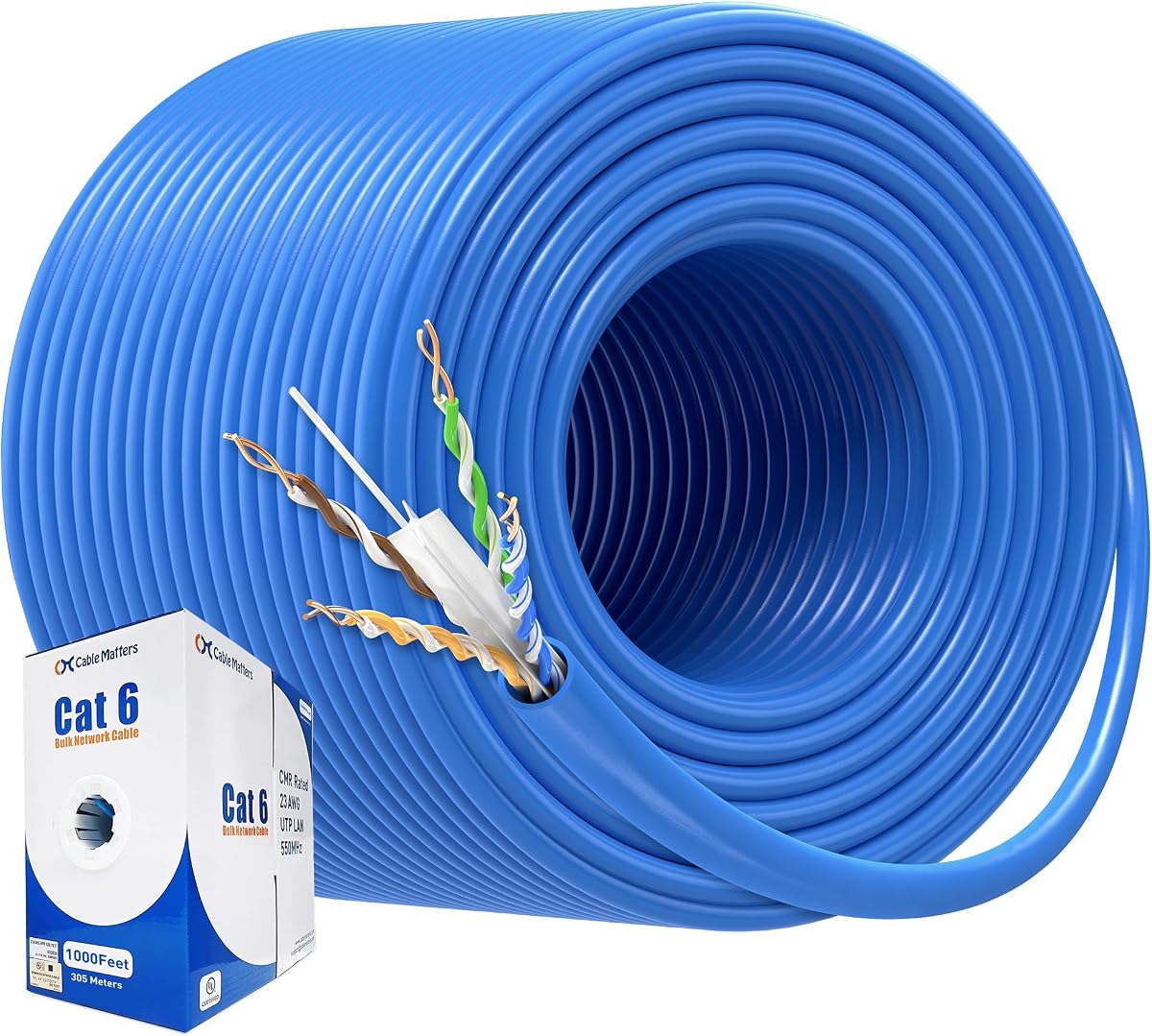
This Cable Matters Cat6 roll is a practical default for installers who want more capability than Cat5e without moving to a thicker shielded cable. It has a 4.7 rating, 23AWG solid bare copper conductors, and a stated 550MHz bandwidth capacity, while remaining compatible with existing Cat5e networks.
We may earn a commission when you buy through this link, at no additional cost to you.
The product supports 10-Gigabit Ethernet and is intended for servers, cloud-computing connections, surveillance, HD streaming, and other demanding applications. Its foot-marked jacket and easy-pull box make a long installation more manageable, especially when exact lengths are needed for multiple wall outlets.
Because the jacket is CM rated rather than explicitly CMR rated, it is not the most suitable option for every vertical pathway. It also lacks shielding, so highly noisy locations, dense shared pathways, or installations running near strong interference sources may benefit from a shielded alternative.
This is a strong choice for standard indoor structured cabling, office networks, and home builds where solid copper and Cat6 headroom are priorities. Buyers who need a higher fire-performance class for a specific code path should verify local requirements, while those needing exceptional electromagnetic isolation should choose shielding instead.
Cat6 offers a useful middle ground between entry-level Cat5e and heavier Cat6A or Cat8 constructions. The solid copper conductors and 550MHz rating provide dependable headroom without the larger termination profile associated with the most premium rolls.
Printed foot markings improve length control, and the box format is well suited to routing multiple wall drops from one purchase. It remains essential to pull smoothly and avoid sharp bends during installation.
We may earn a commission when you buy through this link, at no additional cost to you.
This Cat5e bulk cable is the straightforward budget-oriented option in the group, with a 4.6 rating and a 1000-foot pull box. Category 5e remains widely used for residential networks, file sharing, internet access, video streaming, and IP-based surveillance connections.
We may earn a commission when you buy through this link, at no additional cost to you.
Its four twisted pairs provide the familiar Ethernet structure expected by routers, switches, and standard structured-cabling hardware. The 1000-foot length equals 305 meters, and the white jacket may be useful in finished rooms where visibility matters.
The main limitation is performance headroom. Cat5e is suitable for Gigabit Ethernet but does not offer the higher bandwidth capacity of Cat6, Cat6A, or Cat8. It is also not described as shielded, riser-rated, or suitable for outdoor and direct-burial use.
This roll makes sense for straightforward indoor wiring, especially when a project is budget-conscious and the connected devices use Gigabit Ethernet rather than higher-speed equipment. It is less attractive for a new network expected to remain in service for many years, or for locations with unusually demanding future bandwidth requirements.
Cat5e continues to suit common home and small-office connections where Gigabit Ethernet and stable wired delivery are the main goals. Its straightforward installation requirements make it approachable for basic structured-cabling projects.
The primary benefit is avoiding the premium cost of higher categories when the connected equipment cannot use the extra performance. The tradeoff is less flexibility when upgrading network equipment or adding bandwidth-intensive services later.
We may earn a commission when you buy through this link, at no additional cost to you.
The Cable Matters Cat6 CMR cable earns a 4.8 rating with 23AWG solid bare copper, a 550MHz bandwidth specification, and a jacket intended for routes between floors. It is a particularly relevant option for multi-story homes, offices, and commercial buildings with vertical cable pathways.
We may earn a commission when you buy through this link, at no additional cost to you.
Its listed 10-Gigabit Ethernet support and backward compatibility with Gigabit and Fast Ethernet make it adaptable to different generations of network equipment. It also supports PoE, PoE+, and PoE++, adding flexibility for IP cameras, VoIP phones, access points, and other powered endpoints.
Unlike ordinary CM cable, the CMR jacket provides a more suitable rating for vertical riser installations. However, the cable remains unshielded, and buyers should not confuse CMR with a plenum or direct-burial rating. Local building and fire codes should always govern pathway selection.
This is a strong choice for installers prioritizing solid copper, modern network capacity, and a proper riser rating. The easy-pull reel and marked jacket make deployment easier, while the construction provides a sensible balance for new commercial and residential structured-cabling projects.
CMR is the most important distinction in this product for a vertical pathway. Installers should identify the exact space before purchasing, because general communications, riser, plenum, and underground environments have different jacket requirements.
Supporting the PoE family while offering Cat6 bandwidth makes this roll relevant to current structured networks. It also leaves more performance margin than Cat5e for switches, cameras, and access points that may be upgraded over time.
We may earn a commission when you buy through this link, at no additional cost to you.
This shielded Cable Matters Cat6A roll is the premium selection for installations where signal isolation and substantial bandwidth both matter. Its 4.4 rating is the lowest among the ten products, but the specification is unusually strong: 600MHz bandwidth, 10-Gigabit Ethernet, and an S/FTP design with solid copper conductors.
We may earn a commission when you buy through this link, at no additional cost to you.
Shielding around each pair plus a braided screen under the jacket is intended to reduce EMI, RFI, and alien crosstalk. That makes the cable appealing for data centers, warehouses, offices with dense equipment, and other electrically challenging environments.
Its main practical drawback is size. The 23AWG shielded construction is thicker than standard Ethernet patch cable, and the manufacturer specifically advises against standard RJ45 modular plugs. Shielded Cat6A keystone jacks or patch panels are recommended for easier, more reliable termination.
The premium construction is justified where the installation environment, long-term upgrade path, or PoE requirements make signal quality especially important. It is less necessary for a simple home network with short runs and no significant interference, but for a professional high-performance build, it offers the most robust specification in the group.
The layered shield provides a more controlled signal environment than unshielded cable. It can be especially useful around power equipment, dense commercial pathways, industrial areas, and installations where long runs magnify crosstalk concerns.
The cable's larger diameter and shielding mean installers should select compatible hardware before work begins. Matching shielded keystone jacks, patch panels, and proper grounding practices will help preserve the intended performance.
We may earn a commission when you buy through this link, at no additional cost to you.
The fast Cat. Cat5e cable combines a 4.7 rating with a 350MHz performance figure, solid 24AWG bare copper, and a CMR jacket. It offers a more installation-focused alternative to basic Cat5e while remaining within the familiar Gigabit Ethernet category.
We may earn a commission when you buy through this link, at no additional cost to you.
The FastReel box is designed to let the cable flow freely, reducing snags and saving time during large pulls. Multiple twisted-pair pitches and polyethylene insulation are intended to reduce noise and provide durability, while the stated copper construction avoids the conductivity compromises associated with aluminum conductors.
Its principal limitation is category. A 350MHz Cat5e cable can support Gigabit Ethernet, but it does not offer the bandwidth headroom of the Cat6A options. The UTP construction also leaves it less suited to severe interference than a shielded cable.
This is a compelling option for a professional Cat5e installation, especially one with vertical pathways where CMR is relevant. It is best for users who value reliable copper, smooth reel handling, and certification over the newest category or future-oriented capacity.
The FastReel packaging focuses on the point at which inexpensive bulk cables often become frustrating. Smooth dispensing can reduce kinks, snags, and installation time across a large structured-cabling project.
The stated CSA and ETL certifications, TAA and RoHS compliance, and lot-tracking system add value for buyers who need accountable materials. A documented product can be preferable to an unidentified generic cable in commercial installations.
We may earn a commission when you buy through this link, at no additional cost to you.
The MEIPEK outdoor Cat6 cable is built around a need that indoor bulk rolls cannot meet: routing a permanent connection through soil, garages, outbuildings, or exterior walls. Its 4.4 rating is supported by a stated 250MHz bandwidth and 1Gbps transmission capability.
We may earn a commission when you buy through this link, at no additional cost to you.
The FTP shielding is intended to reduce EMI and RFI, while the sturdy PVC jacket is described as waterproof, high-temperature resistant, flexible, and suitable for direct burial without conduit. A 1000-foot box can therefore serve several exterior runs, cameras, access points, or outbuilding connections.
The conductors are copper-clad aluminum rather than solid bare copper, which distinguishes this cable from the higher-end Cat6A roll. Its stated transmission target is also 1Gbps, so it is more appropriate for Gigabit connections than for demanding multi-gigabit workloads.
This is a focused choice for installers needing a long shielded outdoor run and a generous supply of RJ45 connectors. The included connectors reduce extra procurement, and the cut-to-length format makes it practical for varied outdoor projects where fixed patch-lead sizes would create waste.
For a building-to-building link, backyard camera, gate, or detached office, outdoor-rated construction is essential. This cable's stated direct-burial capability makes it a more relevant option for those routes than an indoor CM or CMR roll.
Cutting the bulk cable to the exact required length reduces unnecessary material and avoids working around preset patch-cable lengths. The included connectors also make it possible to complete multiple short field connections from one reel.
We may earn a commission when you buy through this link, at no additional cost to you.
This outdoor Cat6 package is designed for people who want both cable and the basic tools needed to terminate it. Its 4.6 rating comes with a crimp tool, network tester, wire stripper, 50 shielded RJ45 connectors, 50 snagless boots, and 30 cable labels.
We may earn a commission when you buy through this link, at no additional cost to you.
The cable uses a UV-resistant LLDPE outer jacket and PVC inner jacket for protection across indoor and outdoor environments. The stated construction also supports in-wall, in-ground, underground, garage, and direct-burial placement, giving it broad application potential.
Its listed bandwidth reaches 550MHz and the description claims data speeds up to 10Gbps depending on run length. The conductors, however, are 24AWG copper-clad aluminum, so buyers should interpret the headline speed carefully and consider total channel length and termination quality.
The included toolkit makes this a convenient choice for property owners, installers, and technically confident do-it-yourself users. It is especially helpful when several custom-length runs are needed. The accessories cannot replace correct wiring practices, but they reduce the need to source separate tools and basic consumables.
A tester and crimp tool allow the installer to create and verify custom leads rather than relying only on pre-terminated patch cables. Boots and labels add strain relief and identification, especially valuable in a network with numerous outdoor drops.
The dual-jacket design is built to tolerate moisture, temperature changes, sunlight, and demanding installation conditions. It gives the cable broader placement flexibility than an indoor-rated roll, although proper burial depth and local utility guidance still apply.
We may earn a commission when you buy through this link, at no additional cost to you.
This Cat5e spool provides a practical middle ground for basic indoor wiring, earning a 4.6 rating for its insulation, packaging, and stated Gigabit-oriented use. It is described as suitable for homes, offices, server rooms, voice, data, gaming, VoIP, and surveillance systems.
We may earn a commission when you buy through this link, at no additional cost to you.
The printed running-foot count makes it easier to judge remaining material, and the easy-pull box supports smoother dispensing. HDPE and PVC insulation is intended to resist wear and interference, while the unshielded four-pair construction remains compatible with conventional RJ45 termination practices.
The major consideration is copper-clad aluminum. CCA is not equivalent to solid bare copper in conductivity, weight, bulk, or installation feel, and professional buyers may prefer the copper options elsewhere in this guide. Cat5e also places a lower ceiling on future bandwidth than Cat6 and Cat6A.
For a standard indoor project that does not require high-end copper construction, this cable can be a functional choice. It is best for conventional Gigabit networks, ordinary structured cabling, and installations where the running-foot markings and spool format are particularly helpful.
A running-foot count printed on the jacket is especially useful when one reel supplies several rooms or drops. Installers can estimate consumption while pulling rather than repeatedly measuring the cable against a separate tape.
CCA can suit basic indoor wiring, but it is worth considering the copper alternatives for tighter schedules, heavier terminations, or long-term professional work. Matching the cable to the actual network demand avoids paying for unnecessary performance.
We may earn a commission when you buy through this link, at no additional cost to you.
The Cat8 bulk cable is the specification-focused option in the group, with a 4.7 rating, 26AWG shielded construction, a stated 2000MHz bandwidth, and support for data rates up to 40Gbps. It is aimed at specialized high-speed links rather than typical everyday home Ethernet.
We may earn a commission when you buy through this link, at no additional cost to you.
Its F/FTP design uses shielded foil twisted pairs, and the listed UV-resistant PVC jacket is described as suitable for indoor and outdoor use. Compatibility is broad, covering routers, switches, IP cameras, patch panels, servers, NAS devices, smart TVs, gaming consoles, and other RJ45 equipment.
The 26AWG conductors make the cable considerably thicker than ordinary patch cable, so it requires more space, careful bend radius, and suitable termination hardware. Its enormous stated bandwidth also goes well beyond what a normal home router or switch is likely to use.
This cable makes the most sense for specialized data-center interconnections, small or mid-sized enterprise links, or installers seeking substantial future headroom in a compact bulk format. For ordinary residential networks, Cat6 or Cat6A is generally the more proportionate choice.
The headline bandwidth and 40Gbps target make Cat8 most relevant where equipment is designed for very high-speed short or structured interconnects. It is a specialized tool rather than a necessary upgrade for a typical home network.
A 26AWG shielded cable occupies more pathway space and needs careful handling at bends and terminations. Installers should confirm connector support, port dimensions, and bend allowances before committing to a full-network installation.
We may earn a commission when you buy through this link, at no additional cost to you.
The best bulk Ethernet cable is the one that satisfies the network category, pathway environment, conductor standard, termination method, and device requirements of the installation. Start with the service and space rather than selecting solely by the largest bandwidth number on the box.
Cat5e is suitable for conventional Gigabit Ethernet and many basic voice, data, and surveillance networks. Cat6 increases bandwidth headroom and is a common choice for new office and residential wiring, while Cat6A supports 10-Gigabit Ethernet over longer runs and provides additional margin for high-power PoE. Cat8 is intended primarily for specialized high-speed links and is usually unnecessary for ordinary networks. Choose a category that matches current equipment and likely upgrades rather than paying for a much faster standard that no connected device can use.
Solid bare copper is generally the most straightforward choice for structured-cabling work because it provides reliable conductivity, good tensile strength, and easier handling than aluminum-based conductors. Copper-clad aluminum and CCA can lower material cost, but they differ materially from solid copper in weight, flexibility, termination demands, and performance. CCA is more common among some outdoor and value-oriented products, including two options in this guide. Consider both the cable and connectors: a high-quality cable paired with poorly matched or poorly crimped connectors will not deliver its advertised capability.
UTP and unshielded twisted-pair cables are lighter, smaller, and often easier to terminate, making them suitable for ordinary residential and office environments. Shielded options such as FTP, S/FTP, and F/FTP add protection against electromagnetic and radio-frequency interference, which can be valuable around power equipment, industrial machinery, dense data centers, or long shared pathways. Shielding only works as intended when compatible shielded connectors, proper bonding or grounding, and suitable installation practices are used. Shielding does not eliminate the need for good workmanship.
A communications cable's jacket rating describes appropriate installation environments. CM cable is designed for general communications use, CMR is intended for vertical riser pathways such as runs between floors, and plenum-rated cable is intended for environmental plenums. Outdoor or direct-burial jackets are designed for exposure to soil, moisture, sunlight, and weather. These ratings are not interchangeable. Building codes, local inspection rules, and the exact pathway should determine which rating is required, and installers should not assume that an outdoor jacket is automatically approved for every indoor commercial space.
Bandwidth is only one part of end-to-end performance. The connected switch, router, camera, access point, patch panels, and keystone jacks must also support the intended speed. Cable length, termination quality, grounding, and interference can also affect results. Some product listings describe maximum theoretical rates that depend on run length and equipment. If the practical goal is a home network with a Gigabit router, Cat5e may be sufficient, while Cat6 offers safer headroom. Cat6A is most compelling where 10-Gigabit equipment, heavy PoE, or long-lived infrastructure justify the added size and termination demands.
Power over Ethernet can reduce the number of electrical outlets needed at access points, cameras, VoIP phones, and other network-powered devices. A cable that supports PoE, PoE+, or PoE++ can simplify those installations, but the power source, injector, switch, and receiving device must use compatible standards. Higher-power PoE++ may require heavier 23AWG construction and careful attention to bundle size and heat. Confirm the required wattage and ensure that local electrical and network rules are followed before selecting a cable for a powered run.
A 1000-foot spool is useful because it can serve numerous drops, but the reel and box affect installation efficiency. Easy-pull reels reduce tangles, while printed or sequential foot markings help estimate the correct cut length. A rigid box may protect the cable during shipping but requires a suitable method for dispensing it on-site. Installers should open the package, inspect the cable, and confirm that the box can rotate or be positioned without creating excessive tension at sharp corners.
Some bulk rolls include RJ45 plugs, while others require the installer to source compatible connectors separately. Shielded and larger-diameter cables often need larger or specifically shielded plugs, and Cat6A is generally too thick for ordinary standard modular plugs. Check the manufacturer's recommendations before beginning. A proper crimping tool, wire stripper, cable tester, and correct connector category reduce installation errors. If you do not have experience terminating bulk cable, pre-terminated patch leads or a professional installer may be more dependable than learning during a critical installation.
Plan the route before opening the reel. Identify each wall outlet, equipment location, pathway type, bend radius, and required length, then use the cable markings to estimate the pull. Secure boxes, protect exposed cable ends, and pull one cable at a time to reduce twists and kinks. Avoid stretching, crushing, stapling through the jacket, or forcing a cable through a tight opening.
Terminate the cable with connectors designed for its category, conductor type, diameter, and shielding. Strip the outer jacket carefully, preserve the pair twists as much as possible, arrange the conductors according to the appropriate wiring standard, and use a quality crimping tool. Test every completed run with a cable tester and verify network performance after installation. For outdoor or direct-burial routes, follow the manufacturer's placement requirements and local guidance on depth and environmental conditions.
After installation, keep the reel or remaining cable dry, clean, and supported. Inspect connectors for movement, corrosion, damaged strain relief, or contamination. Do not sharply bend the cable near plugs, and keep it away from hot surfaces, standing water, and moving parts. If a connector is damaged, it is usually better to cut the cable back and terminate a fresh end than to leave a questionable connection in service.
It is often useful because one roll can supply several wall drops while leaving extra length for routing around obstacles. The actual requirement depends on the building layout, number of outlets, and distance from the network distribution point. Measure or estimate each route before cutting, and keep excess length serviceable inside a box or enclosure.
Cat5e remains appropriate for many conventional Gigabit Ethernet connections, including basic internet access, streaming, voice, and surveillance. It has less bandwidth headroom than Cat6 or Cat6A, however, so it is less attractive for new installations expected to use faster equipment or remain in service for many years.
CM is intended for general communications areas, while CMR is designed for vertical riser pathways between floors. Outdoor-rated cable has a jacket made to tolerate weather, moisture, sunlight, and potentially direct burial. These ratings address different hazards, and a cable should be selected according to its actual installation space and local codes.
Shielding can improve resistance to interference and alien crosstalk, especially in electrically noisy environments or long shared pathways. It is less critical in many ordinary homes and can add size, cost, and termination complexity. Shielded hardware, suitable connectors, and proper installation are needed to realize the full benefit.
Yes, bulk cable is intended to be cut into the lengths required for a structured network. Measure carefully, use connectors appropriate for the cable category and diameter, and verify each terminated run with a tester. Some products include connectors, while others require them to be purchased separately.
No. Internet speed depends on the service, modem, router, switches, endpoint equipment, and cable installation. A higher category adds potential network capacity, but it cannot make the internet connection or connected devices faster than their own limits. It is most useful when other components can support the additional performance.
CCA can work for basic connections, but it differs from solid bare copper in conductivity, durability, weight, and handling. Professional requirements should favor solid copper unless a specification explicitly permits CCA and the installation conditions are well understood. Connector selection and workmanship are particularly important with aluminum-based conductors.
Outdoor-rated cable can generally be used indoors, although it may be thicker or more expensive than an indoor-rated option. The reverse is not necessarily true: indoor CM or CMR cable may not tolerate moisture, sunlight, temperature changes, or direct burial. Match the jacket to the harshest relevant part of the route.
The TRUE CABLE Cat6A Riser is the strongest all-around choice because it combines solid bare copper, 750MHz performance, PoE++ capability, useful markings, and a proper riser jacket. The Cable Matters Cat6 CM and CMR rolls offer simpler Cat6 options, while the basic Cat5e spool is the most budget-conscious indoor solution.
Prioritize the installation environment before the headline speed. Choose solid copper for professional structured wiring, shielding for interference-prone locations, a riser rating for vertical pathways, and outdoor or direct-burial protection for exposed routes. The shielded Cat6A and Cat8 rolls make sense when high bandwidth, PoE, or future headroom justifies their larger size and more demanding termination.
Finally, confirm the category, conductor type, jacket rating, connector requirements, and pathway rules before cutting the roll. Product specifications, availability, and prices can change, so check the current listing and current price at the time of purchase.