
PT177 Gas Leak Detector
4.6Editor score
Pocket-sized portable design
Audible and visual alarms
Thirty-second auto-calibration
Our RV propane leak detector guide compares ten portable and installed alarms, helping you choose safer detection, useful readings, and reliable protection.
RV propane leak detectors range from handheld gas sniffers to permanently installed alarms, and choosing between them depends on whether you need to locate a suspected leak or provide continuous protection. A useful detector should identify combustible gas quickly, produce unmistakable alerts, and suit the available power and installation options in your motorhome.
We compared ten products using the supplied specifications, emphasizing gas types detected, alarm type, probe or sensor design, concentration readings, power requirements, installation method, and intended RV application. The list includes both compact diagnostic tools for propane systems and hardwired alarms designed to remain operational whenever the RV is energized.
Each review explains the detector's strongest feature, practical limitations, and ideal owner. The leading handheld models excel at pointing to a leak, while installed alarms are better suited to monitoring an entire compartment. Product prices and availability can change, so readers should confirm current listing details before purchasing.
4.6Editor score

4.6Editor score

4.7Editor score
This side-by-side comparison separates handheld leak locators from permanently installed RV alarms, highlighting the probe style, supported gases, alert system, concentration display, and power source that most influence practical use.



The TOPTES PT520A combines a portable gas detector with a 17-inch flexible gooseneck, making it a strong overall choice for RV propane-system inspections. Its supplied rating is 4.6 out of 5. Rather than forcing the user to place the entire instrument directly beside a regulator or valve, the probe can reach into narrow spaces where a suspected leak may be difficult to examine safely.
We may earn a commission when you buy through this link, at no additional cost to you.
Its standout feature is the combination of reach, responsiveness, and a broad 50–10,000 ppm methane-based detection range. The detector responds in 0.5 seconds and presents seven colored bars plus a 75 dB alarm, allowing the operator to receive both visual and audible feedback while moving along a pipe or appliance connection. It detects propane, methane, butane, LPG, natural gas, and other combustible gases, making it more broadly useful than a single-fuel instrument.
The trade-off is that this is a diagnostic sniffer rather than a permanently installed alarm. It will not monitor the RV continuously or alert the owner while everyone is asleep unless someone deliberately keeps using it. The flexible neck also means the user must avoid pushing it into a fitting or damaging the probe while searching around cabinets, storage tanks, and appliance connections. Even so, the included protective case, three batteries, and generous probe length make the trade-off easy to accept for owners who perform regular checks.
Choose the PT520A if you want a single handheld instrument capable of investigating both exposed and awkward propane connections. It is particularly suitable for RV owners who travel frequently, maintain their own gas appliances, or want the confidence of a broad, responsive detector without installing hardwired equipment. For most buyers comparing portable natural-gas and propane sniffers, its versatility makes it the most complete all-around option in this list.
The 17-inch gooseneck is particularly valuable around regulators, concealed valves, and fittings located behind or beneath fixtures. The probe can be brought within approximately 1–5 centimeters of a suspected source, allowing the sensor to sample the area without placing the entire unit immediately beside the connection.
Seven colored bars and a 75 dB buzzer provide immediate confirmation, while the escalating pattern helps distinguish a stronger concentration from a faint trace. That feedback is useful when moving methodically along a line and comparing different sections of an RV appliance system.
We may earn a commission when you buy through this link, at no additional cost to you.
The TOPTES PT199 is a straightforward handheld combustible-gas sniffer with a 4.6 rating. It is designed for owners who want a pocketable tool for checking propane, natural gas, methane, butane, and LPG without committing to a more elaborate installation. Its modest feature set focuses on the essentials: rapid sensing, unmistakable alerts, and straightforward operation.
We may earn a commission when you buy through this link, at no additional cost to you.
The detector reacts in 0.5 seconds and uses both sound and an LCD color change to communicate a detected leak. The alarm intensifies as gas concentration rises, providing useful directional feedback while the operator checks a suspected point. Its methane-based detection range of 50–1,000 ppm is narrower than that of several higher-ranked models, but it is still designed to locate combustible sources. The stated detection distance of 1–5 centimeters reinforces the need to sweep the sensor close to fittings and seams.
Its main limitation is that the compact sensor must be moved deliberately around the suspected leak. There is no long probe, numeric concentration display, or installed protection. The PT199 also powers itself off after five minutes without operation or detection, which helps conserve battery life but means it should not be mistaken for an always-on alarm. Those compromises are reasonable for a portable inspection tool that prioritizes simplicity and low cost.
This is a sensible pick for RV owners who want a small propane sniffer for routine appliance checks and occasional troubleshooting. It is less appropriate for someone requiring a quantitative leak reading or continuous protection, yet it handles the core task with a quick response and clear alert. For a simple portable package with batteries and a carrying bag, it delivers the most approachable option in the roundup.
A half-second response and escalating alarm make it practical to check valves, couplings, and appliance areas one by one. The LCD turns red at higher concentrations, adding a visual cue when the buzzer is difficult to hear inside a cabinet or storage compartment.
Two included AAA batteries make the unit ready for portable use, while the low-battery indicator helps prevent an unnoticed power loss. Automatic shutoff after five minutes of inactivity supports the pocket-sized design and reduces unnecessary battery consumption.
We may earn a commission when you buy through this link, at no additional cost to you.
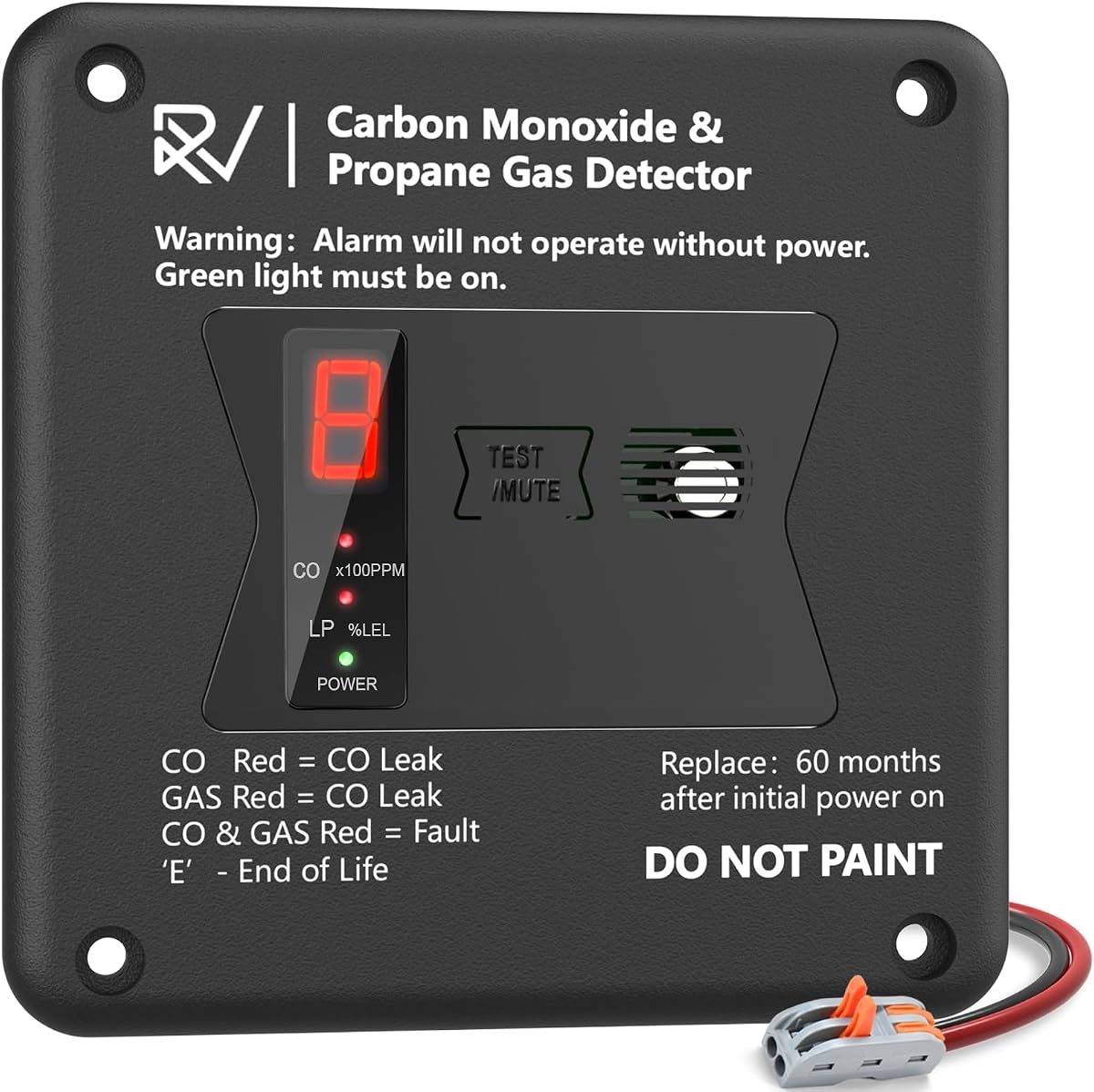
The R503 is a permanently mounted 12-volt RV detector designed to monitor for both explosive gas and carbon monoxide. It carries a 4.6 rating and occupies a different category from the handheld sniffers: it is intended to watch an occupied system continuously rather than help a user hunt for a leak after a smell or other warning appears.
We may earn a commission when you buy through this link, at no additional cost to you.
Two independent, sensitive sensors are dedicated to carbon monoxide and combustible-gas detection. An LED display communicates the level being sensed, and the product title identifies a 100 dB alarm designed to be difficult to miss inside an RV. The detector accepts 12-volt DC with a plus-or-minus 20 percent operating range, making it suitable for typical motorhome electrical systems. Lever-nut connectors are included to reduce wiring effort and avoid conventional taped or wrapped butt connections.
Installation is the central commitment. The face cover measures approximately 4 5/8 inches square, with a listed wall cutout of roughly 2 to 3 15/16 inches wide by 3 3/8 to 3 15/16 inches long. Screw-hole spacing is compatible with the referenced 31011 model, which may simplify replacement, but owners should still verify their existing opening, wiring, and sensor location. Unlike a handheld tool, this detector cannot easily be moved from one compartment to another.
The R503 is a strong choice for an RV owner who prioritizes always-on protection and is comfortable with basic 12-volt wiring. It is especially relevant to motorhomes, travel trailers, motor coaches, and truck campers where gas appliances and sleeping areas require dependable monitoring. The combination of dual sensing, a loud warning, installation hardware, and lifetime technical support gives it a stronger case as a premium permanent system than a basic replacement alarm.
A hardwired detector remains active whenever the RV's 12-volt system is powered, removing the need to remember a handheld check before every trip. That makes it more appropriate for overnight monitoring than any of the battery-powered diagnostic tools in this guide.
Lever-nut connectors are intended to make the electrical connection faster and reduce the need for taped or wrapped butt connectors. RV owners familiar with basic 12-volt wiring will find this more convenient, although correct polarity, placement, and code compliance still matter.
We may earn a commission when you buy through this link, at no additional cost to you.
The TOPTES PT205 is a portable gas leak detector that places a numeric percent LEL reading at the center of its operation. Its 4.6 rating reflects a capable tool for RV owners who want more than a simple yes-or-no alarm. The display helps communicate how much combustible gas the sensor is registering during an inspection.
We may earn a commission when you buy through this link, at no additional cost to you.
The stated methane-based range is 1 to 10 percent LEL, equivalent to 100–5,000 ppm. A bar graph rises as concentration increases, the LCD changes to red at higher levels, and a distinct beep accompanies the visual warning. Detection can occur in 0.5 seconds after the unit is warmed up. The 30-second warm-up is clearly presented through a countdown, helping prevent a user from beginning a test before the sensor is ready.
The primary trade-off is its compact, short-probe format. It is well suited to checking accessible appliance connections, but it does not offer the long reach of the PT520A or PT760. It also remains a handheld maintenance device rather than a permanently installed alarm, and its displayed values are based on methane. Although the detector is compatible with propane, butane, LPG, ethane, natural gas, coal gas, gas fuel, and liquefied natural gas, matching the gas to the stated calibration is important when interpreting a reading precisely.
Choose the PT205 if a numeric reading is more useful than a simple alarm. It is a good middle ground for RV maintenance because it adds context to the response without requiring hardwired installation. Owners who need to inspect behind cabinets or deep inside enclosed spaces may prefer a long-probe model, but for accessible systems the PT205 provides a particularly understandable display and a short, effective warm-up routine.
A numeric display can help an owner compare readings from different points along a propane line. It also gives useful information during repeated checks, provided the reading is understood as a methane-based instrument response and not a substitute for professional system evaluation.
The screen shows a 30-second countdown, reducing the chance that an inspection will begin before the sensor is ready. This is a small convenience that can improve workflow consistency compared with units that provide no visible warm-up status.
We may earn a commission when you buy through this link, at no additional cost to you.
The TOPTES PT177 is a compact gas sniffer designed to be carried in a pocket and used for quick combustible-leak checks. It has a 4.6 rating and keeps the interface uncomplicated: five red LEDs, a 75 dB audible alarm, and automatic calibration after power-up. The absence of a screen or probe keeps it easy to operate in a compact RV workspace.
We may earn a commission when you buy through this link, at no additional cost to you.
After a 30-second auto-calibration in clean, gas-free air, the unit can detect gas and trigger its alarm within approximately 0.5 to 3 seconds. It supports LPG, methane, ethane, propane, butane, natural gas, coal gas, and other combustible sources. As gas concentration rises, the five red LEDs and audible warning intensify, creating a simple way to compare nearby points without needing to interpret a numerical value.
Its limitations are inherent to the basic design. There is no flexible probe, numeric display, or continuous monitoring capability, so the sensor must be placed close to the suspected source. The user manual's warm-up instruction is especially important: calibrating in an area where gas is already present can reduce the reliability of the result. A low-battery light flashes below 2.4 volts, and the detector powers down after five minutes of inactivity.
This model is best for RV owners who want a small, uncomplicated propane detector for periodic checks around accessible valves, hoses, and appliance areas. It is less suited to detailed troubleshooting or inaccessible piping. Still, the pocket clip, included bag, batteries, and fast alert system make it one of the most convenient options for travelers who value portability over advanced readings.
The integrated pocket clip lets the detector remain accessible during an inspection without occupying a work surface. A drawstring storage bag is also included, making it straightforward to keep the unit protected in a cabinet, tool pouch, or storage compartment.
Five red LEDs become more active as the detected concentration increases. Combined with the 75 dB buzzer, this creates an intuitive signal that an owner can recognize quickly while sweeping around an appliance connection.
We may earn a commission when you buy through this link, at no additional cost to you.
The TOPTES PT210S combines a pen-style body, a four-inch probe, and a two-digit percent LEL display. With a 4.6 rating, it is a practical middle ground for RV owners who want a more informative reading than a basic alarm but do not need a long, extendable probe. The compact shape remains easy to carry between appliances.
We may earn a commission when you buy through this link, at no additional cost to you.
The detector can identify propane, natural gas, methane, and butane, with a listed range of 100–5,000 ppm, corresponding to 1–10 percent LEL. It can find gas in 0.5 seconds, after which the screen turns red, bar graphs rise, and a 75 dB buzzer sounds. The response becomes more pronounced as the concentration increases, giving the operator both measured and intuitive feedback.
Its defining feature is dual-mode detection, with high- and low-sensitivity settings. That flexibility can be helpful when moving from a broad search to a closer inspection, although the supplied specifications do not define the exact operating behavior of each mode. The fixed four-inch probe provides some additional reach, yet it cannot access the same tight locations as the 17-inch gooseneck on the PT520A. A low-battery indicator activates below 2.5 volts, and automatic shutoff occurs after five minutes of inactivity.
The PT210S is a strong choice for owners who want numeric information, multiple sensitivity options, and moderate probe reach in one portable tool. It is especially useful for accessible propane appliances and storage-compartment connections where the sensor can be placed near a suspected joint. For deeper or more concealed inspection points, a flexible or telescopic probe would be a better match.
Switching between high and low sensitivity lets the user adapt the search to the immediacy of the suspected leak. The mode choice can help manage the balance between finding a trace and avoiding unnecessary alerts while moving through a densely equipped RV.
The four-inch probe reaches around some nearby obstructions, while the two-digit LEL display supplies a numerical indication of concentration. Together they offer a useful middle ground between a basic pocket sniffer and a more specialized long-probe detector.
We may earn a commission when you buy through this link, at no additional cost to you.
The TOPTES PT760 is a feature-rich portable detector aimed at RV owners who need reach, numerical context, and illumination. It has a 4.5 rating and adds a 12-inch telescopic stainless-steel probe to the familiar handheld format. When extended, the probe can access narrow areas inside pipes, behind cabinets, and around other concealed connections; it retracts afterward for compact storage.
We may earn a commission when you buy through this link, at no additional cost to you.
The unit detects LPG, methane, ethane, propane, butane, natural gas, coal gas, and gas fuel. Its listed range extends from 1 to 20 percent LEL, or 100–10,000 ppm, giving it a broader upper range than the common 1–10 percent LEL group. Audible and visual alarms activate within 0.5 seconds, and the screen displays the current lower explosion limit value. The changing alarm tone and screen color add context as concentration rises.
The built-in flashlight is a particularly relevant RV feature because gas appliances, valves, and storage areas can be poorly illuminated. Rechargeability is another useful distinction, using a Type-C port and including a charging cable. Its trade-offs are the need to maintain the battery and a larger feature set that may feel more complex than necessary for a quick check. The 30-second preheat countdown gives the user clear readiness feedback, while automatic power-off conserves the remaining charge.
The PT760 is an excellent option for owners who perform detailed checks around difficult-to-reach propane components or work in dim RV compartments. It is also a good choice for households that would rather recharge one device than repeatedly replace batteries. Those seeking a simpler pocket alarm can find one elsewhere in the list, but the PT760 earns its place through its combination of reach, lighting, rechargeability, and a broad concentration range.
The stainless-steel probe extends to 12 inches for inspection and retracts to create a smaller footprint afterward. This makes it more adaptable than a fixed-probe model without requiring the owner to carry a separate wand or accessory.
USB Type-C charging eliminates recurring battery purchases, while the included cable and protective case support regular mobile use. A low-battery indicator and automatic power-off help preserve the operating state between maintenance sessions.
We may earn a commission when you buy through this link, at no additional cost to you.
The TOPTES PT299 is a portable propane and natural-gas sniffer whose defining feature is a short retractable pole. It carries a 4.6 rating and is designed to help RV owners inspect pipelines, storage tanks, fireplaces, basements, and other accessible or partly concealed locations without placing the entire detector directly against a suspected leak.
We may earn a commission when you buy through this link, at no additional cost to you.
The extension range is 2.20–6.30 inches, which provides modest additional reach rather than the deep access offered by a long gooseneck or telescopic probe. The detector responds in 0.5 seconds and uses a 75 dB buzzer, nine rising analog bars, and a red screen display to indicate a leak. Its 1–10 percent LEL range, stated as 100–5,000 ppm based on methane, places it alongside the PT205 and PT210S in concentration-readout capability, although the PT299 provides bar graphics rather than digits.
Users must allow a 30-second preheat, and the countdown appears on the display. A low-battery alert, optional five-minute automatic shutdown, and a textured, non-slip body improve routine handling. The unit can identify propane, methane, natural gas, LPG, gasoline, and other combustible leaks. The relatively short extension means it is best for accessible fittings and shallow recesses rather than pipes running deep behind cabinetry.
The PT299 is a good fit for an RV owner who wants a little more distance from a potential leak without carrying a full-length probe. Its rapid response and nine-bar visualization make it effective for methodical searches around common propane appliances. It should not be chosen over a numeric model when precise concentration comparison is the priority, but it offers a capable and portable balance for routine maintenance.
The retractable pole can be extended when the sensor needs to reach around a fitting or into a shallow recess, then shortened for a stable grip or compact storage. It offers a practical middle ground between a bare sensor and a full telescopic inspection wand.
Nine rising bars give a quick visual representation of changing concentration while the buzzer alerts the operator. Although less precise than a numeric LEL display, the pattern is easy to interpret during a point-to-point search of an appliance or pipe.
We may earn a commission when you buy through this link, at no additional cost to you.
The Safe T Alert 20 Series is a compact surface-mount LP gas alarm designed specifically for RV use. Its 4.7 rating is the highest among the ten products listed, and its core purpose is straightforward: continuously monitor for propane or methane while the RV's electrical system supplies 12-volt DC power.
We may earn a commission when you buy through this link, at no additional cost to you.
The alarm activates at less than 25 percent LEL of propane or methane. Its mute button is designed to support safe ventilation, while the rapid-recovery sensor reactivates the alarm if dangerous gas levels remain. The compact housing measures 3.5 inches wide by 2.5 inches high by 1.25 inches deep, and the included mounting bracket supports installation in tight RV spaces. That relatively small footprint is a major advantage in cabinetry and service compartments where every inch matters.
Unlike the R503, this unit focuses on explosive gas and does not combine carbon monoxide detection. It also uses hardwired 12-volt DC power rather than a rechargeable battery, which is a benefit for continuous operation but means it depends on the RV's electrical system. The listed operating range extends from -40°F to +158°F, supporting use across a broad range of RV operating environments. A permanent alarm is less portable and more involved to relocate than any handheld detector.
This is an excellent choice for an RV owner who wants dedicated, continuous propane protection in a known location. It is particularly appropriate for travel trailers, fifth wheels, truck campers, and folding campers where space is limited. Buyers should confirm the installation location, existing wiring, and applicable RV requirements. Within that context, the Safe T Alert's compact housing, rapid recovery, and harsh-condition design make it a strong permanent safety investment.
Operating from 12-volt DC supports ongoing monitoring without scheduled battery changes. The listed current draw is 75 mA at 12 volts, and the circuitry is designed to conserve power for long-term RV use.
The mute control allows an owner to ventilate an area after an alert. Rapid sensor recovery reactivates the alarm if propane or methane remains at a dangerous level, preserving the protective purpose rather than simply silencing the unit indefinitely.
We may earn a commission when you buy through this link, at no additional cost to you.
The Kidde combination alarm monitors both carbon monoxide and explosive natural gas or propane. It has a 4.5 rating and offers the simplest permanent installation in this roundup: plug it into a standard 120-volt wall outlet. A 9-volt battery provides backup when normal power is interrupted, making the unit practical for locations where a hardwired RV alarm would be more involved.
We may earn a commission when you buy through this link, at no additional cost to you.
Its digital LED display shows the carbon monoxide level the sensor is detecting or states GAS when explosive gas is present. An 85 dB alarm announces either condition, and LED status indicators provide visual feedback. Peak Level Memory records the last time carbon monoxide was detected or the unit was tested, which gives users a useful history beyond a purely momentary alarm.
The main limitation is its home-oriented installation format. An RV must have a suitable standard outlet near the intended monitoring location, and the unit cannot be repositioned as freely as a portable sniffer. It detects explosive gas but does not provide the numeric percent LEL display offered by several handheld models, nor does it offer the probe reach that makes point-by-point leak location easier. Those limitations matter if the primary goal is to pinpoint a connection rather than monitor a room.
This Kidde alarm is best for an RV or stationary housing with reliable outlet access and a need for combined carbon monoxide and explosive-gas protection. It is especially useful for travelers who want a recognizable combined alarm with battery backup and easy setup. RV owners focused primarily on propane-system maintenance should still add a handheld sniffer, while those wanting RV-specific surface mounting may prefer the more specialized installed models in this list.
The 9-volt backup battery keeps the alarm available when the normal outlet loses power. That makes it useful in an RV where an interrupted power supply can otherwise remove primary gas and carbon monoxide warning coverage.
The display can show a carbon monoxide level or identify the presence of explosive gas, while the shared 85 dB alarm provides a strong audible warning. Combining both functions in one enclosure can simplify installation in an area where both hazards are relevant.
We may earn a commission when you buy through this link, at no additional cost to you.
The right RV propane leak detector depends on whether you need a portable instrument for finding a suspected source, a permanently installed alarm for continuous protection, or a combination of both. Sensor capability, power, access, and the information provided by the display should guide the decision.
For most RV owners, the two functions complement one another. Use a portable detector to inspect fittings and identify a suspected source, and use an installed alarm to protect the living space. If only one device will be purchased, choose based on whether the immediate need is leak location or continuous monitoring.
Match the probe to the RV layout. Choose a long flexible or telescopic probe if the propane system is hidden behind cabinetry, beneath an appliance, or inside a narrow compartment. A compact sniffer is sufficient for exposed valves and couplings that can be accessed easily.
For a propane-focused RV check, confirm that propane is explicitly listed as compatible. Multi-gas support is useful for home or workshop use, but it does not by itself guarantee identical response characteristics for every fuel.
Choose an alert pattern that is understandable at a glance. A combined audible and visual warning is valuable for continuous alarms, while visual feedback is especially helpful for handheld tools used at close range.
Choose a numeric display when you plan to document or compare readings. Choose a visual bar graph when quick, simple feedback is more important than precise values.
Frequent travelers often prefer a rechargeable or easy-to-swap battery design. For continuous protection, verify that the intended location has reliable electrical service and that the alarm's dimensions fit the available space.
Check the entire safety system rather than assuming one device covers every combustion hazard. Select a combined alarm when installation space is limited or when you want a single display and warning for both hazards.
For a permanent unit, measure first and check the full installation guidance. For a portable model, confirm that the body, probe, and storage case will fit in the places where RV maintenance actually occurs.
Begin by reading the detector's instructions and confirming that its sensor is approved for the gas being checked. For portable models, install fresh batteries, place the unit in clean air, and allow the stated 30-second warm-up or auto-calibration period to finish. The PT205, PT199, PT177, PT299, and PT760 provide a warm-up countdown or readiness process that should be allowed to complete before testing.
Move the sensor methodically along the propane system. Begin with the supply connection and trace the line toward the appliance while keeping the sensing point approximately 1–5 centimeters from the surface being inspected. Use the appropriate probe to reach around fittings without forcing it into a valve. Watch the display, bars, and audible alarm, and compare clean and suspicious areas rather than relying on a single test point.
If an alarm occurs, stop testing and move away from the suspected source. Ventilate the area without operating switches or creating a flame near a possible leak, and arrange qualified service when a fuel-system defect is suspected. For installed units, follow the manufacturer's placement guidance, test the alarm as directed, and replace the battery in a plug-in model on a reliable schedule. A detector is one layer of protection and should complement, not replace, routine RV fuel-system maintenance.
A portable sniffer is moved close to valves, hoses, and fittings to locate a suspected leak. An installed alarm remains in a fixed location and warns occupants when propane or another supported gas reaches its alarm threshold. Portable tools offer better point-by-point inspection, while installed units provide continuous protection when the RV is energized.
A single detector cannot safely cover every propane appliance or compartment in every RV layout. The best approach is usually an installed alarm near the relevant living area or fuel-system zone, plus a handheld sniffer for routine inspection and pinpointing suspected leaks. Placement should follow the alarm manufacturer's guidance and the RV system's design.
LEL stands for lower explosive limit, the concentration at which a combustible gas can ignite under suitable conditions. A percent LEL reading indicates the detected concentration as a proportion of that limit. Lower readings are not automatically safe in every situation, so a professional should evaluate any suspected fuel-system leak.
A warm-up period allows the sensor to stabilize and auto-calibrate in clean air. Starting a test too soon can produce unreliable readings or delay the alarm. Several models in this guide specify approximately 30 seconds, so owners should follow the instructions for their particular unit.
It depends on the design. Most portable sniffers use replaceable AAA batteries, while the PT760 is rechargeable through USB Type-C. Permanently installed models generally use the RV's 12-volt DC system, and the Kidde plug-in alarm uses household power with a 9-volt backup battery.
Inspection frequency should follow the RV manufacturer, maintenance schedule, and the detector's instructions, with additional checks whenever a gas odor, abnormal appliance behavior, or alarm occurs. A handheld detector is most useful as part of regular maintenance, not as a substitute for professional servicing when a leak is suspected.
A combined unit can provide convenient coverage for both explosive gas and carbon monoxide, particularly where space is limited. The R503 offers a hardwired RV installation, while the Kidde model uses a plug-in format with battery backup. A dedicated propane alarm may be sufficient if a suitable carbon monoxide alarm is already installed nearby.
A probe helps reach the sensor near the likely source, but it cannot overcome every physical or safety barrier. Tiny openings may allow some gas to escape, yet enclosed compartments can also trap gas or expose the user to other hazards. Follow the detector instructions, avoid unsafe entry into sealed areas, and use qualified service for concealed fuel-system faults.
The PT520A is the strongest all-around portable option because its 17-inch flexible probe, broad gas support, fast response, and escalating alerts make it effective for detailed RV inspections. The PT177 stands out as a simple and highly portable budget pick, while the Safe T Alert 20 Series is the leading choice for compact, continuous RV installation.
Prioritize the function you actually need. Choose a long-probe handheld model for locating a leak in a confined space, a numeric LEL display for comparing concentrations, or a hardwired alarm for continuous protection. Add carbon monoxide sensing when your RV safety plan does not already cover that hazard, and verify power, mounting space, and sensor compatibility before purchasing.
Product prices and availability can change, so review the current listing, included accessories, installation requirements, and warranty terms before buying. Most importantly, use a detector as part of a broader maintenance routine, respond cautiously to any alarm, and have suspected propane or carbon monoxide problems evaluated by a qualified technician.