
Zoom H1 Essential
4.0Editor score
Compact stereo capture
USB-C microphone mode
Built-in microphones
Portable music recording
Discover the best audio recorder for streaming music in our expert comparison of ten portable recorders, covering USB streaming, sound quality, inputs, and
An audio recorder for streaming music should capture a strong, clean signal while also working smoothly with a computer, phone, or tablet. The right model can improve vocals, instrument parts, ambience, and live performances while reducing background noise, clipping, and accidental level changes during a stream.
We compared the featured recorders by examining their recording formats, built-in microphones, external inputs, USB connectivity, monitoring options, storage support, portability, and suitability for music-focused streaming. The list includes budget-friendly stereo recorders, flexible multitrack models, and more specialized field recorders with professional input options.
Each review shows how the recorder fits into a streaming workflow, who is most likely to benefit from it, and where its trade-offs appear. Ratings and product availability can change, as can pricing, so compare the current listing details and confirm the included accessories before making a final purchase.
4.0Editor score
4.4Editor score

4.5Editor score
The following comparison highlights the main differences in channel count, connectivity, monitoring, recording formats, and portability, making it easier to identify the right audio recorder for music streaming.



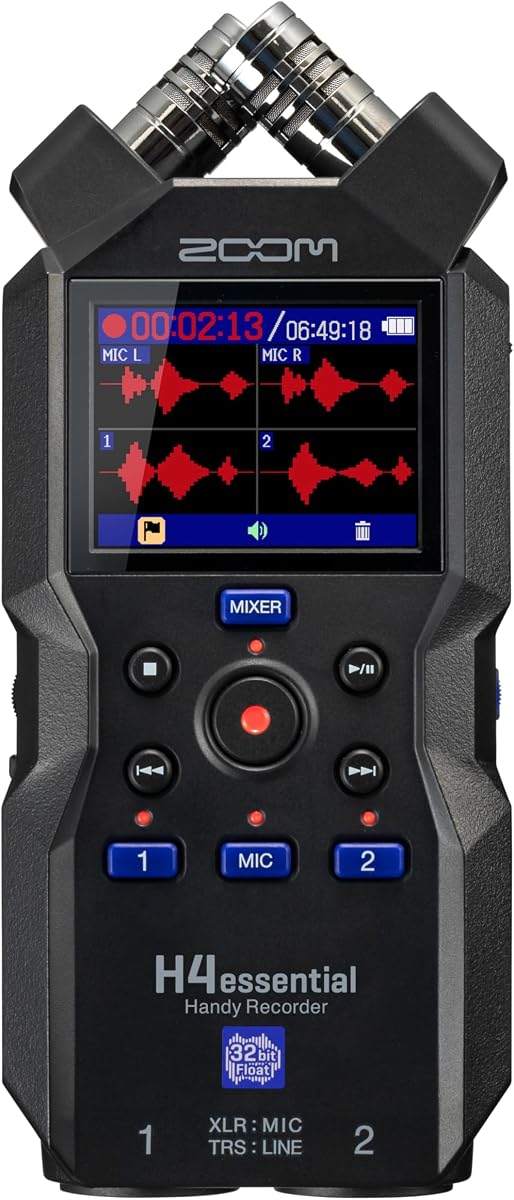
The Zoom H4 Essential is the most versatile all-around choice in this guide, earning a 4.4 rating among users. It combines a compact handheld form with four-track recording, two XLR/TRS inputs, built-in stereo microphones, and USB-C connectivity. Those features give it the adaptability needed for a musician recording an original performance, a producer layering parts, or a streamer capturing a live rehearsal.
We may earn a commission when you buy through this link, at no additional cost to you.
Its strongest feature for music creators is the ability to record more than one source. External microphones, instruments, mixers, and soundboards can be connected through the two XLR/TRS inputs, while the built-in microphones provide a quick way to capture room ambience or a spontaneous idea. The supplied information also highlights 32-bit float-style workflow benefits, including a much greater tolerance for unexpected level changes than conventional fixed-level recording.
USB-C makes the H4 Essential useful beyond isolated takes. It can record to a phone, tablet, or computer, allowing captured music to move directly into a streaming or editing environment. At the same time, it can save a backup directly to an SD card, reducing the risk of losing a session if a computer connection fails. That combination of streaming flexibility and local redundancy is particularly valuable for live music.
This is the recorder to choose when one device must cover streaming, rehearsals, field ideas, and basic multitrack production. It is not the smallest option, and the built-in microphones will not replace a serious studio microphone for polished vocals. Even so, the balance of inputs, recording capacity, and USB-C workflow makes it a convincing primary recorder for most independent musicians and streamers.
Because the H4 Essential can record to a connected device while also saving to an SD card, it can function as both a capture tool and a safety system. That is useful for a rehearsal, podcast, or live performance where preserving the original take matters as much as getting the signal into a live broadcast.
The two XLR/TRS inputs create room for microphones, instruments, and line-level sources. That makes the recorder much more appropriate for music than a dedicated dictation device, especially when a creator wants to record a guitar part, room sound, and vocals in a portable session.
We may earn a commission when you buy through this link, at no additional cost to you.
The Zoom H1 XLR delivers an unusually capable two-channel recording setup and holds a 4.5 rating. It is designed for filmmakers, musicians, and podcasters, with two XLR/TRS combo inputs that accept microphones, instruments, and other sources. The 32-bit / 96kHz recording option places it in a class of recorders capable of capturing detailed, high-resolution audio.
We may earn a commission when you buy through this link, at no additional cost to you.
The OLED waveform display is a particularly useful feature for a musician who needs to judge levels without relying on audio alone. Seeing peaks and overall signal movement makes it easier to avoid clipping, confirm that a microphone is receiving signal, and leave enough headroom for louder performance moments. Dedicated 3.5mm input and headphone output options also add flexibility for monitoring and external connections.
Storage support is another strength. SDXC cards of up to 1TB can hold extended high-quality sessions, reducing the need to move files between devices constantly. Although the H1 XLR records only two channels, that limit is rarely a problem for a focused performance, stereo room recording, interview, or compact livestream setup where a singer and another source are the primary needs.
Choose the H1 XLR when you want more control and input flexibility than a basic stereo recorder but do not need multitrack layering. It is ideal for recording a single performance, producing a two-microphone podcast, or capturing a musician with an external microphone and a room microphone. Its straightforward channel count keeps it manageable for beginners and portable for mobile creators.
A waveform display gives immediate visual confirmation of the signal. For live and streamed music, this helps a performer set a sensible level, notice an overloaded input, and make corrections before repeating a take.
SDXC compatibility up to 1TB supports extended rehearsals and location sessions. Creators can devote more attention to performance and monitoring rather than frequently changing cards, provided they use a suitable high-capacity card.
We may earn a commission when you buy through this link, at no additional cost to you.
The Zoom H1 Essential is a simple, highly portable option for creators who want better sound than a phone or camera microphone without carrying a larger multitrack system. Its 4.0 rating reflects a straightforward approach: built-in stereo microphones for immediate recording and USB-C connectivity for use as a microphone during livestreams, calls, voiceovers, and other digital sessions.
We may earn a commission when you buy through this link, at no additional cost to you.
The device fits particularly well into a mobile music workflow. A songwriter can carry it to a rehearsal, capture a song idea, and later transfer the result to a computer. A streamer can place it near a performance area, connect it by USB-C, and use it as a more focused audio source for a desktop or mobile broadcast. Its simplicity makes it a realistic choice for someone new to standalone recorders.
The main limitation is input flexibility. Unlike the H1 XLR, it does not offer the same pair of XLR/TRS connections for microphones and instruments. Its built-in microphones are useful for ambience, room tone, spontaneous performances, and reference recordings, but they are not intended to provide the control or isolation of a dedicated studio setup.
The H1 Essential is best for mobile streamers, rehearsal capture, social content, and creators who value portability over channel count. It also makes sense as a secondary recorder used to capture room sound or an audience while another system handles the main performance. For more demanding sessions, move up to a model with external inputs.
USB-C allows the recorder to become a microphone for a connected computer, tablet, or phone. This keeps the workflow approachable for creators who want to move from practice recording to a livestream without learning a complicated signal chain.
The stereo microphones make it possible to record immediately, with no additional microphone required. They are especially valuable for song ideas, room ambience, rehearsal notes, and location sounds that can add atmosphere to a later music project.
We may earn a commission when you buy through this link, at no additional cost to you.
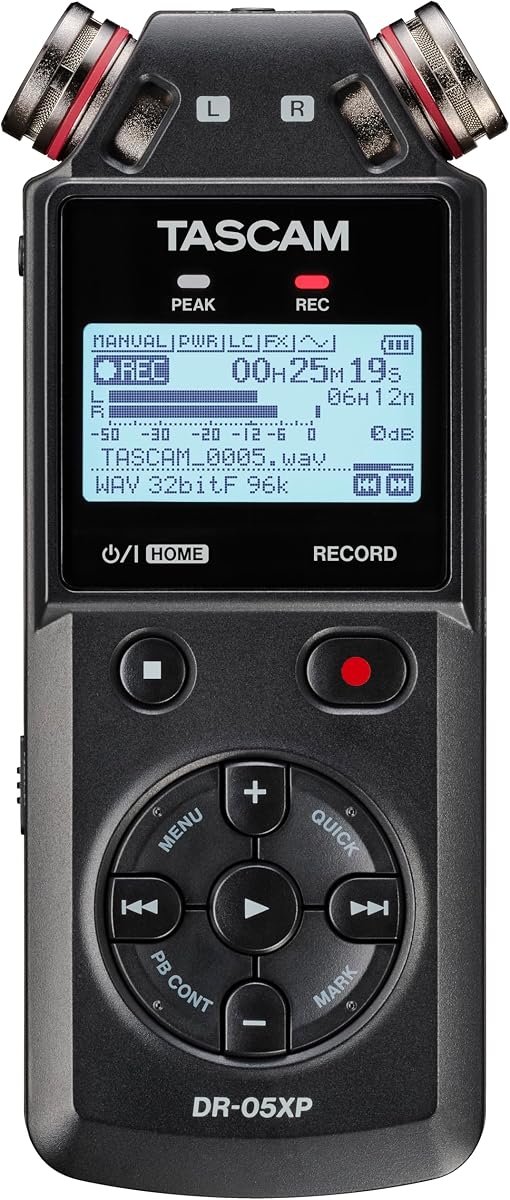
The TASCAM DR-05XP is a portable stereo recorder that supports 32-bit float, 24-bit, and 16-bit capture, along with 96kHz, 48kHz, 44.1kHz, and MP3 recording modes. It has a 4.2 rating and is aimed at musicians, video producers, podcasters, and anyone who needs a compact recorder that can operate as both a standalone device and a USB-C audio interface.
We may earn a commission when you buy through this link, at no additional cost to you.
Its omnidirectional condenser microphones can handle loud environments and sources up to 125dB SPL. That range is useful for rehearsals, gigs, and environmental recording where a sudden peak could exceed the limits of a sensitive microphone. The 32-bit float mode also gives the recorder a greater ability to retain detail when the source is unexpectedly quiet or loud.
As a two-in, two-out USB-C interface, it can record directly to a computer. This makes the DR-05XP useful for a streamer who wants to add a dedicated stereo source to a digital production setup. It is also convenient for multitrack music projects in which a performer wants to capture a take directly into a computer-based session instead of transferring the file afterward.
The best reasons to choose it are portability, format flexibility, and a long operating time of up to 17.5 hours when powered by two AA alkaline batteries. Its limitations are the absence of professional XLR inputs and the fact that an SD card and batteries are not included. It works best for stereo capture rather than demanding isolated track recording.
The choice between lossless WAV-style capture, compressed formats, and different sampling rates lets the creator adapt the recorder to storage limitations and project needs. High-resolution modes are useful for polished source material, while compressed recording can be more practical for lengthy field sessions.
The two-in, two-out USB-C interface removes the transfer step by sending audio directly to a computer. This is helpful when a musician wants to capture live performance takes into a software-based arrangement or use the recorder as part of a compact broadcast signal chain.
We may earn a commission when you buy through this link, at no additional cost to you.
The Zoom R4 is the most song-oriented recorder in the guide, with a 4.5 rating and a feature set designed around capturing, layering, bouncing, and repeating parts. It records up to four tracks, offers two XLR/TRS combo inputs, and includes a built-in microphone, effects, and a library of more than 80 drum patterns across numerous musical styles.
We may earn a commission when you buy through this link, at no additional cost to you.
Its multitrack process gives a musician a way to develop an arrangement away from a full studio. A singer can record a vocal over an instrumental part, a guitarist can add another layer, and a producer can bounce completed parts to a dedicated track to free channels while keeping the creative session moving. Undo functionality adds room for experimentation without making every decision permanent.
The 32-bit float approach reduces the need for careful gain adjustment. Creators can plug in a source and focus more on the performance than on preventing digital clipping. Its XLR/TRS combo inputs accommodate microphones, instruments, and keyboards, while the built-in rhythm section can provide a tempo reference when no drummer or full backing track is available.
The R4 also works as a 32-bit float, two-in, two-out USB audio interface for a computer or smartphone. It can run from four AA batteries or USB-C, making it equally plausible for a mobile rehearsal and a desktop recording session. It is the right choice for songwriters who want structured multitrack work, though beginners may need time to learn its deeper features.
The dedicated bounce workflow allows a creator to consolidate tracks and continue adding material. This is particularly helpful for building a complete performance one part at a time while keeping the device compact enough for rehearsal rooms and home studios.
More than 80 built-in patterns cover rock, hip hop, funk, metal, and other genres. The feature can establish timing and structure during an informal writing session, giving a melody or lyric a useful framework before a full band arrangement exists.
We may earn a commission when you buy through this link, at no additional cost to you.
The Zoom H6studio is a renewed, eight-track handheld recorder designed for creators who need more simultaneous capture than a conventional two-channel device can provide. It features four XLR/TRS combo jacks, an XY microphone capsule, 32-bit float recording, and a two-inch full-color LCD. It is a specialized choice for group rehearsals, ensembles, and producers working with multiple sources.
We may earn a commission when you buy through this link, at no additional cost to you.
The eight-track layout and four physical inputs allow a small ensemble to record separately in a single session. A band could capture a vocal, guitar, keyboard, and another performance source without relying entirely on a computer-based setup. The XY capsule adds a built-in stereo option for ambience, room sound, or a quick reference recording.
Its 32-bit float capture is intended to protect against clipping and reduce the need to react instantly to level changes. Portability is another advantage: the unit weighs 16.84 ounces and measures 3.27 by 8.70 by 2.15 inches, while four AA batteries support extended work away from a power outlet.
Because this is a renewed listing, condition may vary, and no customer rating is provided in the supplied information. The eight-track architecture is the deciding factor. Choose it when a group session needs isolated channels and portability; choose a less specialized model for simple solo capture or a direct USB streaming role.
Eight-track capability and four XLR/TRS connections are valuable when musicians need separate recordings of several performers. The result is easier to balance and edit than a single blended recording made with one microphone.
The two-inch color LCD provides a clear view of recording information while the compact body remains practical for mobile sessions. This balances monitoring convenience with the freedom to move around a rehearsal space or location.
We may earn a commission when you buy through this link, at no additional cost to you.
The Zoom H2 Essential stands out for its three built-in microphones and nine selectable recording patterns. It has a 4.4 rating and can capture everything from intimate interviews to wide stereo soundscapes at up to 32-bit float and 96kHz. That pattern control makes it especially useful for musicians who want to capture a room, a performance, and environmental details with one portable device.
We may earn a commission when you buy through this link, at no additional cost to you.
The pattern system lets a creator choose a narrow or wide configuration as the recording situation changes. This is useful when a rehearsal includes a solo acoustic passage followed by a louder full-band section. Its 32-bit float recording also removes much of the urgency around gain adjustment, helping the performer stay focused on the take rather than the settings.
For streaming and editing, the H2 Essential can function as a USB microphone while simultaneously recording to an SD card. The local copy acts as a backup, while the USB connection makes the signal available to a computer, smartphone, or tablet. Bluetooth timecode synchronization also allows multiple units to be controlled and aligned for multi-unit recordings.
This recorder is ideal for location work, sound design, environmental music, and flexible field capture. It does not offer the same dedicated XLR-style input emphasis as some alternatives, and its numerous patterns can take time to master. Even so, it gives a creator an unusually versatile microphone array in a portable package.
A single recorder can cover close, focused, and wide stereo capture by changing its microphone pattern. That makes the H2 Essential useful for a rehearsal that moves from intimate vocals to a full ensemble without requiring multiple microphones.
Recording to an SD card at the same time as streaming to a connected device provides immediate access and a redundant copy. If the computer workflow encounters a problem, the original session can still be recovered from the card.
We may earn a commission when you buy through this link, at no additional cost to you.
The Zoom F3 is a professional field recorder with a 4.6 rating, tied for the highest listed score among the products reviewed. It is designed for demanding film, music, and location work where secure connections, clean input electronics, and reliable 32-bit float recording are more important than built-in microphone convenience.
We may earn a commission when you buy through this link, at no additional cost to you.
Dual locking XLR inputs are a major practical benefit. On a film set, in a rehearsal space, or on a location shoot, locking connections are less likely to loosen than basic sockets. The recorder's ultra-low-noise preamps are designed to preserve clean, consistent results in uncontrolled environments, while 32-bit float capture helps protect recordings from sudden peaks.
Flexible power options and standalone or USB workflows allow the F3 to remain useful across long days on set or on location. Instead of relying entirely on a computer, a creator can capture isolated tracks directly and transfer them after the session. This reliability is valuable when there is no second chance to recreate a performance or location recording.
The F3 is the choice for a professional who already owns microphones and wants a dependable capture device. It is less convenient for spontaneous music ideas because it does not rely on a generous built-in microphone array, and its specialized design may feel unnecessary for a beginner. For serious location work, however, the secure inputs and clean signal path are compelling.
Locking XLR sockets suit mounted and mobile rigs where cables may be moved or handled frequently. Secure connections reduce interruptions and make the recorder more dependable for a professional session that cannot easily be repeated.
Ultra-low-noise preamps and 32-bit float recording address two common field-recording concerns: unwanted hiss and abrupt level changes. Together, they allow a musician or filmmaker to record in a rehearsal room, on location, or on a set with more confidence.
We may earn a commission when you buy through this link, at no additional cost to you.
The Zoom H5 Studio is a high-resolution handheld recorder with a 4.6 rating, combining large stereo microphones with dedicated physical gain controls. Its 19.4mm X/Y capsule is designed to capture rich, detailed audio across a wide dynamic range, while 32-bit float recording helps prevent a take from being lost because of a sudden level peak.
We may earn a commission when you buy through this link, at no additional cost to you.
The dedicated gain knobs distinguish it from recorders that hide levels inside menus or automate most adjustments. A musician can watch the meter, turn a control, and hear the result immediately. That direct relationship between action and outcome is valuable in rehearsal, where a performer may need to establish a new balance without interrupting the flow of a song.
It can record up to four tracks simultaneously at resolutions up to 192kHz in WAV format. This supports both a polished standalone recording and a multitrack session suitable for later editing. Its lightweight design and battery operation also make it practical to carry to a rehearsal, location, or small performance.
The H5 Studio is most appropriate for creators who value sound capture and hands-on control more than direct streaming. It can serve as a reliable standalone source that is imported into a streaming setup later. Its limitations are the absence of a clearly emphasized USB microphone workflow and a more manual approach compared with the newest streamlined models.
The 19.4mm X/Y capsule is designed to capture a broad, detailed stereo image. It is useful for a full acoustic performance, room ambience, and location sound, giving a creator a fuller starting point than a small built-in microphone.
Dedicated gain knobs allow quick, visible adjustments while recording. Musicians who understand gain staging can shape the balance directly, while the 32-bit float format provides an extra margin against sudden clipping.
We may earn a commission when you buy through this link, at no additional cost to you.
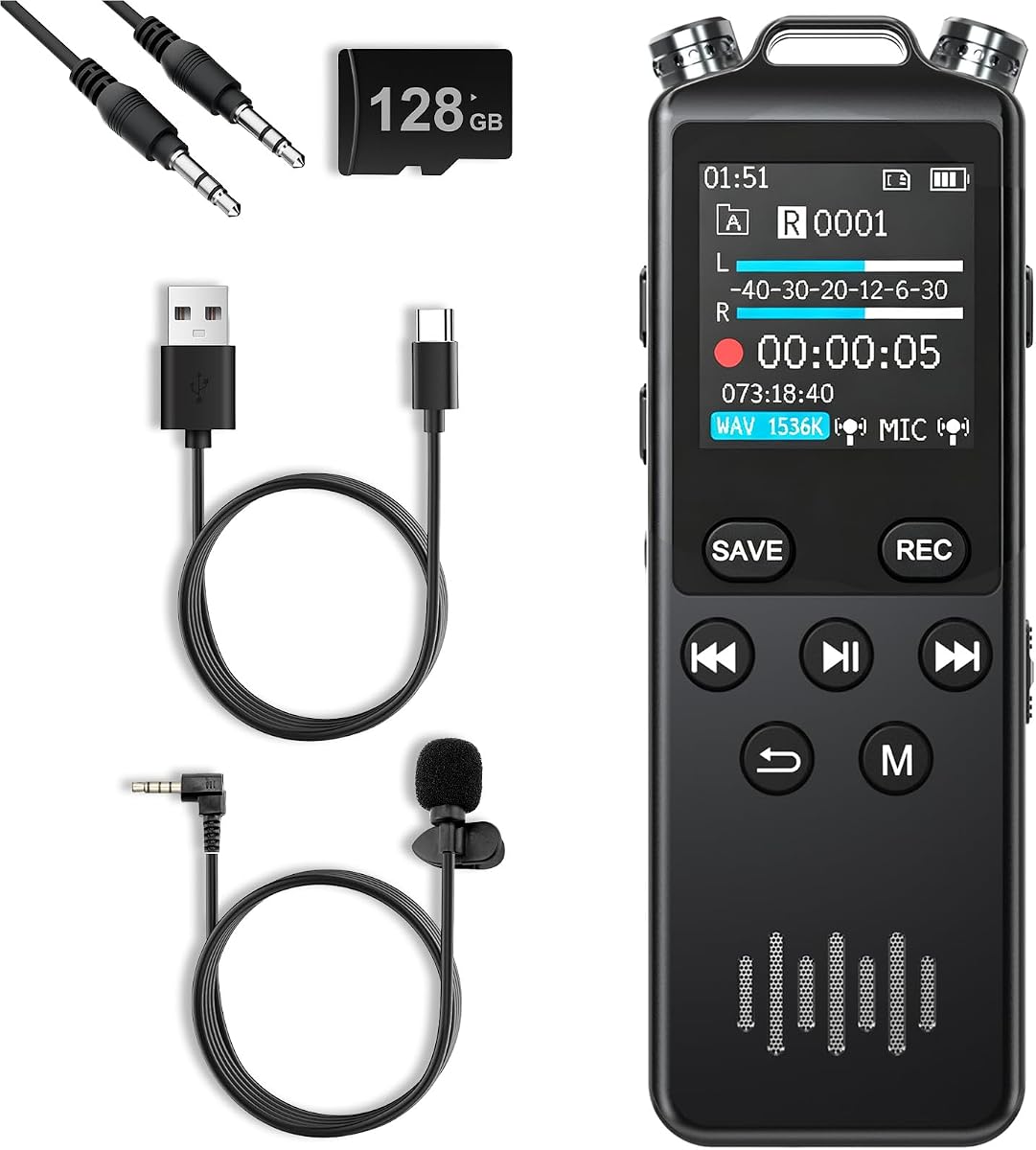
The 160GB Voice Recorder is a high-capacity digital recording device with a 5.0 rating. It is designed primarily for meetings, lectures, interviews, dictation, journaling, and general voice capture rather than for multitrack music production. Its 160GB storage, claimed capacity of up to 11,500 hours, and 1536Kbps stereo recording make it distinctive among the list.
We may earn a commission when you buy through this link, at no additional cost to you.
The recording functions focus on practical memory management and accessibility. One-click recording and saving reduce the chance of missing an idea, while normal, meeting, outdoor, and long-distance modes offer different operating approaches. Voice control, scheduled recording, and segment recording can support hands-free use during extended sessions.
A rechargeable 1100mAh battery is advertised to provide more than 68 hours of continuous operation, making the device suitable for conferences, college lectures, and daily journaling. The zinc alloy and acrylic construction gives it a pocket-friendly form, while password protection helps secure sensitive meetings and interview files.
This product is not the right choice for a musician who needs XLR inputs, low-latency monitoring, or a multitrack interface. It does, however, offer exceptional capacity for capturing a rehearsal narrative, a spoken-word performance, or a large collection of voice notes. Its 5.0 rating should be considered alongside the narrower voice-focused use case.
The combination of 160GB total storage and support for long stereo recordings is ideal when the priority is preserving many hours of material. Users can focus on lectures, meetings, or voice journals without managing storage as frequently.
Password protection adds privacy for confidential recordings, while voice control, scheduling, and segmentation make unattended capture easier. These features are more useful for voice documentation than for a live musical performance.
We may earn a commission when you buy through this link, at no additional cost to you.
The best recorder for streaming music depends on the number of sources, recording format, connection method, monitoring needs, and how much portability matters. The following factors help separate a simple performance capture device from a flexible multitrack or professional location recorder.
Built-in microphones are useful when a creator needs immediate capture without carrying extra hardware. They are especially valuable for room ambience, rehearsal ideas, and performances in a controlled space. External inputs provide much greater flexibility, allowing dedicated microphones, instruments, mixers, and line-level equipment to be connected. A streamer recording one performer may be satisfied with stereo built-ins, while a musician layering vocals and instruments should prioritize XLR or combination inputs.
Two-channel recorders are well suited to a stereo performance, an interview, or a single stereo source. Four-track and eight-track devices allow separate parts to be captured at the same time, making them more useful for song development and group rehearsal. Some multitrack recorders also support bouncing, looping, and effects, allowing a musician to build an arrangement without immediately moving into computer-based production.
Recording resolution determines how much detail is retained, while the floating-point format can offer a wider safety margin against clipping. A higher sampling rate can be useful for source material that will later be slowed, processed, or used in demanding production work. Creators should balance resolution with storage because high-quality files require substantially more space, particularly for long rehearsals and multitrack sessions.
A USB connection can turn a recorder into a microphone, audio interface, or direct capture device for a computer, phone, or tablet. This is essential when the goal is to send a live signal into streaming software. A model that also writes to an SD card provides a local backup, allowing a creator to preserve the original take even if a computer, cable, or streaming session fails.
Accurate monitoring helps a performer judge timing, volume, and sound character during a take. A waveform display provides visual confirmation of levels, while dedicated gain controls make it easier to adjust an input without navigating menus. Headphone output is important for private monitoring, and a 3.5mm input can add flexibility for less common sources. Creators should consider both what they need to hear and how easily they can verify the signal.
The amount of storage needed depends on the format, resolution, channel count, and length of each session. High-resolution multitrack recording consumes considerable space, so a recorder with support for large SDXC cards can be valuable for extended work. Users should verify card compatibility, maintain several cards for backups, and avoid relying on a single card for an irreplaceable performance.
A recorder used for live or mobile streaming should be easy to position and operate quickly. Compact size, manageable weight, and long battery life matter when the creator is moving between rehearsal rooms, stages, and recording locations. Some models can run on standard batteries, while others use rechargeable power or USB-C. The placement of the recorder also matters because a device near a noisy amplifier can capture unwanted interference.
A recorder designed around voice notes has different priorities from one built for music. Look for headphone outputs, external inputs, multitrack controls, and music-oriented rhythm or looping features when the device will become part of a production workflow. Also check what is included, because microphones, headphones, cables, memory cards, and batteries may not come with the recorder.
Begin by testing the complete signal path before the performance. Connect the recorder to the computer or streaming application, confirm that the intended input is selected, and verify the level in both the recorder and the streaming software. Play a short test, listen through headphones, and check for delay, unwanted room noise, clipping, electrical interference, and a mismatch between the local microphone and computer audio.
For each session, set the format and sample rate before recording, use fresh batteries or a reliable power source, and start the SD-card recording before the USB stream whenever possible. Keep the recorder on a stable surface or mount, position it away from fans and vibrating equipment, and use a short test to confirm the level. Save the original track separately from the live mix so future edits do not depend on a streamed copy.
After recording, power down the device before changing cards or removing a USB connection, then copy files to more than one location. Keep the microphone grille clear, store the recorder in a dry protective case, and use appropriate storage for its battery type. Check the current firmware, recording format, card compatibility, and streaming requirements before every major session, since device settings can change between projects.
Yes, but the model must support the appropriate USB connection and operating mode. Several recorders in this guide can function as a USB microphone or audio interface for a computer, tablet, or phone. Confirm the input direction, sample rate, monitoring behavior, and whether the device records to an SD card at the same time before the live session.
It can be very useful because the format provides more headroom for unexpected volume changes than conventional fixed-level recording. A sudden loud passage is less likely to clip the recording, allowing a performer to focus on the music. It does not replace correct gain management, monitoring, or microphone placement, but it can make the captured take easier to recover.
A stereo recorder captures a blended left and right signal, while a multitrack recorder can keep separate parts on independent channels. Stereo is often enough for a room performance or final mix, whereas multitrack recording is better for editing individual instruments or adding layers. The Zoom R4 and H5 Studio offer multitrack workflows, while the H1 Essential focuses on compact stereo capture.
Direct computer recording is convenient because the signal is immediately available in streaming or editing software. However, relying on a single computer workflow creates a vulnerability if the application, cable, or computer fails. Where possible, record to an SD card simultaneously and preserve that local file as the source for later editing.
They are helpful but not always essential. XLR or XLR/TRS inputs allow dedicated microphones, instruments, and other balanced sources to be connected with more control. A creator using only the built-in microphones may not need them, while anyone recording multiple sources or building a more professional signal chain will benefit from dedicated external inputs.
The required space depends on resolution, format, channel count, and session length. High-resolution WAV files use considerably more storage than compressed recordings, and multitrack sessions multiply the amount being written. Check the recorder's card compatibility and capacity limits, format the card in the appropriate system, and keep backup cards available for important performances.
A voice recorder can capture rehearsals, ideas, room ambience, and spoken-word performances, but a dedicated music recorder usually offers better microphones, external inputs, monitoring, and multitrack control. The 160GB Voice Recorder in this guide is best suited to long voice sessions and documentation. Musicians who need isolated instrument tracks should favor a recorder with XLR or combination inputs.
Place it where it can hear the intended performance without sitting directly beside a noisy amplifier, fan, computer, or vibrating surface. Raise the source slightly above the recorder and test the balance with the actual setup. If possible, monitor with headphones, record a short sample, and adjust the position before the full performance.
The Zoom H4 Essential is the strongest all-around recommendation because it combines four-track recording, two external inputs, built-in microphones, USB-C device recording, and SD-card backup. The Zoom H1 Essential is the most portable budget option for quick performances, ambience, and simple livestream microphone use, while the Zoom R4 stands out for musicians who want multitrack layering, bouncing, rhythm patterns, and a USB audio interface.
Prioritize the features your actual sessions require rather than choosing only by channel count. A solo creator may need little more than dependable stereo capture and USB connectivity. A songwriter building an arrangement benefits from multitrack controls, while a filmmaker or field recordist may prioritize locking inputs, low-noise preamps, flexible patterns, and long battery life.
Before purchasing, verify the current product listing, supported storage, required cables, included accessories, and compatibility with your streaming setup. Ratings, product details, and prices can change over time, so checking the latest information ensures that the selected recorder still matches your workflow and budget.