
RIGOL DS1102Z-E Digital Oscilloscope
4.9Editor score
100 MHz two-channel bandwidth
1 GSa/s real-time sampling
24 Mpts maximum memory
60,000-frame playback
USB and LAN connectivity
A digital oscilloscope reveals how voltage changes over time, making it essential for electronics troubleshooting, embedded development, power-system analysis, education, and field service. A useful instrument balances bandwidth, sampling performance, resolution, channel count, display quality, triggering, and specialized analysis features rather than focusing on one headline specification.
We compared the listed products using the specifications and capabilities provided for each model, including analog bandwidth, sampling rate, record depth, vertical resolution, trigger and decode support, connectivity, portability, and integrated instruments. The guide covers conventional bench scopes, portable touchscreen models, multifunction field devices, and one RIGOL model with a built-in signal generator.
Each review explains who the model is best suited to, where its feature set creates real value, and where limitations matter. Ratings reflect the supplied customer feedback, while configurations and availability can vary. Product pricing changes frequently, so compare the current listing, included accessories, warranty terms, and total ownership needs before purchasing.
4.9Editor score
4.3Editor score

4.5Editor score
As an Amazon Associate we earn from qualifying purchases.
This side-by-side comparison organizes the ten products by bandwidth, sampling rate, channel count, memory, and practical instrument functions, making it easier to identify the right scope for bench work, field diagnostics, education, or advanced troubleshooting.


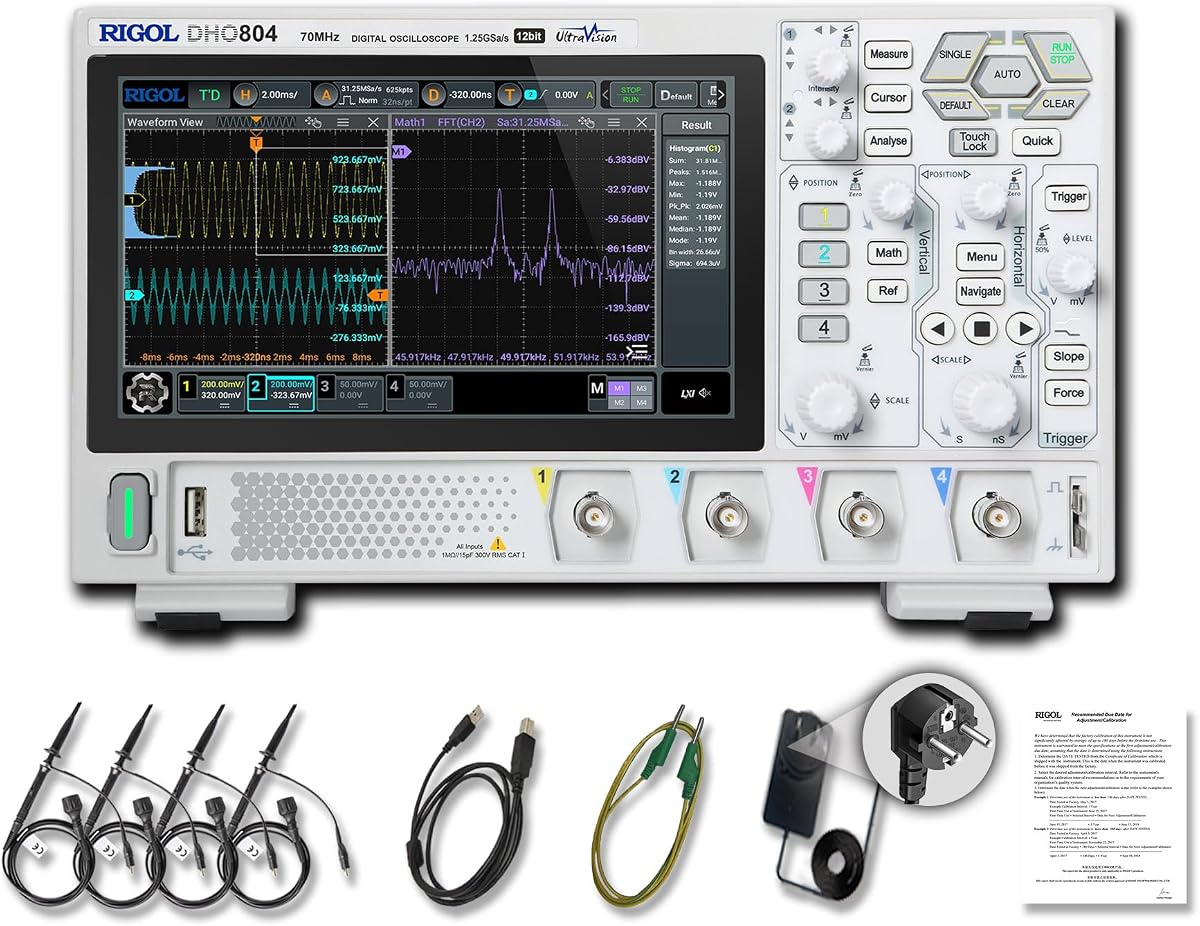
The RIGOL DHO804 combines a 70 MHz bandwidth limit, four analog channels, 12-bit vertical resolution, and 1.25 GSa/s sampling in a compact 7-inch touchscreen platform. Its 4.3 rating reflects generally favorable customer feedback, and the supplied specifications make it the most balanced all-around option in this list. It is particularly well suited to embedded work, teaching, sensor validation, and power-ripple investigations where seeing more than two signals at once is important.
We may earn a commission when you buy through this link, at no additional cost to you.
Its UltraAcquire system can capture up to 1,000,000 waveforms per second, while 256-level intensity grading helps reveal how often transient behavior occurs. Search and event or frame navigation make it easier to locate unusual behavior in long acquisitions rather than repeatedly stopping and scanning manually. Peak detection is listed down to 1.6 ns, FFT analysis can operate with up to 1 Mpts, and 41 automatic measurements reduce repetitive manual calculations.
Serial support is another major strength. Standard trigger and decode functions cover CAN, RS232/UART, I2C, SPI, and 4-bit parallel buses. LAN operation supports LXI-C, browser-based Web Control, and standard SCPI commands, while USB Host, USB Device, and HDMI support data transfer, firmware or file workflows, external displays, and documentation. The result is a scope that can fit both an electronics bench and an automated lab environment.
The main limitation is its 70 MHz bandwidth, which is not intended for the fastest modern digital edges. It also lacks the RIGOL DHO924S model’s built-in signal generator. For most embedded, power, laboratory, and educational tasks, however, the DHO804’s four channels, deep memory, high capture rate, and extensive decoding make it an adaptable choice. It is the strongest recommendation for buyers who want one instrument without paying for the premium DHO924S configuration.
Four analog channels let you compare power rails, clock signals, sensor outputs, and control lines in one coordinated view. This is more useful than a two-channel scope when diagnosing sequencing problems because the relationships among several nets can be observed without changing probes or repeating captures.
A one-million-waveforms-per-second acquisition rate helps the DHO804 expose intermittent glitches, while intensity grading shows the relative persistence of displayed states. Waveform search, an event table, and frame navigation then make it practical to return to the exact captured behavior that deserves closer inspection.
We may earn a commission when you buy through this link, at no additional cost to you.
The RIGOL DHO924S raises the benchmark for a general-purpose bench scope in this roundup, offering 250 MHz bandwidth, four analog channels, 12-bit vertical resolution, 1.25 GSa/s sampling, and up to 50 Mpts of memory. Its 4.5 rating is among the stronger customer ratings among fully specified products here. The added bandwidth and memory are particularly relevant for fast edges, timing analysis, embedded validation, and extended captures.
We may earn a commission when you buy through this link, at no additional cost to you.
Its built-in single-channel arbitrary function generator and Bode plot analysis form a major functional advantage. Together they support stimulus-and-response work, loop and frequency-response testing, and component evaluation without requiring every task to depend on a separate generator. Bode analysis covers 10 Hz to 25 MHz. The model also supports 16 digital channels through the separately sold PLA2216 probe, expanding its usefulness for mixed-signal debugging.
Like the DHO804, it offers UltraAcquire at up to 1,000,000 waveforms per second, 256-level intensity grading, waveform search, event tables, and long-record review. CAN, LIN, UART, I2C, and SPI decoding are listed for embedded troubleshooting. USB Host, USB Device, LXI-C LAN, HDMI, browser Web Control, and standard SCPI commands provide a strong foundation for automated testing, remote operation, and report generation.
The trade-offs are meaningful. The optional digital probe adds a separate purchase requirement, and the product does not support slow sweep or roll mode, which can matter when observing very slow processes. Its higher bandwidth also demands careful probe and signal-integrity practice. Even so, the integrated generator, four channels, 50 Mpts memory, and extensive analysis support make the DHO924S the most capable premium pick for serious bench work.
A built-in signal generator lets the DHO924S create known stimuli for amplifier, filter, feedback-loop, and frequency-response tests. That integration makes it easier to move from a suspected circuit problem to a controlled experiment without arranging several separate instruments.
With up to 50 Mpts of record depth, the scope can preserve substantially more waveform history than the smaller portable models. Combined with 12-bit resolution and a 1.25 GSa/s sampling rate, it is better suited to investigations where short transients, repetitive patterns, and long acquisition windows must be examined together.
We may earn a commission when you buy through this link, at no additional cost to you.
The FNIRSI DPOS350P is unusual because it combines four instrument functions in one handheld enclosure: a 350 MHz digital oscilloscope, FFT-based spectrum analyzer, frequency-response analyzer, and DDS signal generator. Its 4.1 rating is respectable for such a broad feature set. For electronics learners, field technicians, and engineers who want broad analysis functions without several separate devices, the scope is exceptionally versatile.
We may earn a commission when you buy through this link, at no additional cost to you.
The oscilloscope section provides two channels, 1 GSa/s sampling, 47 Kpts of record depth, 8- to 16-bit resolution, and a 50,000-waveform-per-second refresh rate. A 7-inch touchscreen, digital phosphor, X-Y mode, 2 mV/div sensitivity, zoom, 12 automatic measurements, and cursor functions support everyday signal work. The spectrum analyzer extends from 200 kHz to 350 MHz and offers selectable FFT lengths, harmonic markers, cursor readings, and 2D or 3D waterfall views.
Its frequency-response analyzer covers 10 Hz to 50 MHz, supports gain, phase, and frequency measurements, and is intended for Bode plots, loop-stability work, and analog filter tuning. The DDS generator produces 14 standard waveforms plus clipped waveforms, offers a 0- to 50-MHz range with 1 Hz resolution, adjustable amplitude and offset, and duty-cycle control from 0.1% to 99.9%. These functions make it much more than a conventional display-only scope.
The compromises are its two-channel analog configuration and 47 Kpts record depth, both considerably shallower than the RIGOL DHO models. A 150 MHz or 20 MHz hardware bandwidth limiter is available, and the product stores 500 waveforms and 90 screenshots. Its 8,000 mAh battery and USB-C charging are strong portability features. It earns the budget recommendation not through deep-memory performance, but through the amount of functionality packed into a portable package.
A conventional time-domain waveform can show timing and amplitude, while FFT analysis helps identify frequency content and harmonics. The DPOS350P adds real-time 2D and 3D waterfall views, giving users a clearer way to inspect changing spectral activity during EMI checks and signal-integrity investigations.
The DDS output provides standard and custom clipped waveforms with adjustable frequency, amplitude, offset, and duty cycle. It is useful for driving filters, checking amplifier response, tracing signal chains, and performing frequency-response work directly from the same handheld unit.
We may earn a commission when you buy through this link, at no additional cost to you.
The RIGOL DS1102Z-E offers a traditional bench oscilloscope configuration with 100 MHz bandwidth, two analog channels, external trigger input, up to 1 GSa/s real-time sampling, and up to 24 Mpts of memory. It holds the highest listed rating in the group at 4.9. For users who mainly need dependable signal capture rather than a large collection of analysis tools, this is one of the most attractive options.
We may earn a commission when you buy through this link, at no additional cost to you.
Its 30,000-waveforms-per-second capture rate helps reveal intermittent glitches, and the 7-inch WVGA display uses intensity-graded color to provide a digital-phosphor-style view of jitter and noise. Hardware real-time recording and playback can store up to 60,000 frames, giving engineers a practical way to revisit rare events after the initial capture. That combination of acquisition speed and record capacity is especially useful for intermittent embedded faults.
Serial trigger and decoding cover RS232/UART, I2C, and SPI, covering common communication tasks in electronics education and embedded bring-up. USB Host, USB Device, and LXI LAN support file management, external equipment, remote control, and documentation workflows. AUX output provides TriggerOut or PassFail options for bench integration. The scope also supports electronics debugging, power work, and educational labs.
Two channels are the defining limit, particularly when comparing a control line, a supply, and a data signal. The scope also lacks the DHO924S’s built-in generator and the DPOS350P’s spectrum analyzer. Even so, its high customer rating, deep memory, long frame playback, and conventional connectivity make the DS1102Z-E a focused, capable instrument. It is ideal for a student, educator, or working engineer who wants a dependable core scope without a complex touchscreen interface.
The DS1102Z-E can retain up to 24 Mpts in a single-channel configuration and 12 Mpts with both channels active. Combined with 60,000-frame recording and playback, that depth makes it possible to inspect events that would be easy to miss on a scope with minimal storage.
The intensity-graded display gives repeated waveform activity a digital-phosphor appearance. That visual history helps reveal jitter, noise, unstable transitions, and other behavior that may not be obvious in a standard single-intensity trace.
We may earn a commission when you buy through this link, at no additional cost to you.
The FNIRSI 2C53T is a compact 3-in-1 instrument that combines a two-channel 50 MHz oscilloscope, a 4.5-digit 19,999-count multimeter, and a DDS signal generator. Its 4.3 rating reflects a solid balance of useful functions. It is especially attractive for students, hobbyists, educators, and service technicians who want to measure voltage, inspect waveforms, and create test signals without carrying multiple instruments.
We may earn a commission when you buy through this link, at no additional cost to you.
The oscilloscope operates at 250 MSa/s and provides 1 Kpts of record depth, automatic measurement, cursor operation, persistence, X-Y mode, and math functions. Its vertical sensitivity spans 10 mV per division to 10 V per division, and the stated maximum voltage is 400 V. The display is a compact 2.8-inch LCD, so the unit is highly portable but not intended to provide the workspace of a seven-inch bench model.
The integrated multimeter covers AC and DC voltage, AC and DC current, resistance, capacitance, and continuity. The signal generator reaches 50 kHz with 1 Hz steps and offers 13 waveforms. Users can save a reference waveform and display it alongside the measured waveform, which is a useful way to compare expected and actual behavior. Image storage and export are also supported through the Type-C connection.
Its limitations are significant for demanding work: 1 Kpts of memory and 50 MHz bandwidth are modest, and the small screen may become crowded when examining complex signals. The built-in 3,000 mAh battery is rated for up to six hours of standby, and a high-voltage protection module adds reassurance. For education and basic troubleshooting, however, the combination is highly useful. It is less appropriate for fast-edge work, long records, or protocol-heavy analysis.
Combining the meter with the scope reduces the need to carry separate tools for basic diagnostics. A technician can quickly move from checking a resistance or supply level to examining the corresponding waveform, while learners can relate numerical measurements directly to signal behavior.
The ability to store and display a reference waveform beside the live measurement provides a simple visual method of comparison. It is useful for checking repeatable outputs, demonstrating filter or oscillator behavior, and spotting changes during troubleshooting.
We may earn a commission when you buy through this link, at no additional cost to you.
The FNIRSI DSO152 is designed for basic field diagnosis rather than high-speed electronic design work. It offers 200 kHz bandwidth, a 2.5 MSa/s real-time sampling rate, a 2.8-inch 320-by-240 LCD, and a 4.4 rating. Its most useful qualities are portability, quick setup, and the ability to observe low-frequency electrical behavior without setting up a full bench scope.
We may earn a commission when you buy through this link, at no additional cost to you.
Automatic, Normal, and Single trigger modes support both periodic analog signals and aperiodic digital activity. A one-key AUTO function adjusts the operating parameters, while a long press calibrates the baseline quickly. Those controls make the device approachable for maintenance work, R&D education, and quick investigations where the user may not have extensive oscilloscope experience.
The included 10x probe is stated to measure up to 800 VPP, equivalent to 280 V AC, and the scope can measure voltages up to 400 V. Its 1,000 mAh battery provides approximately four hours of continuous use after charging. Type-C supports both data transmission and charging, and firmware upgrades are also listed, which is useful for maintaining a compact tool over time.
The DSO152 is not a substitute for a general-purpose bench oscilloscope. Its 200 kHz bandwidth limits it to slower signals, and the small display offers limited space for complex analysis. There is also no indication of deep record storage, extensive decoding, or remote automation in the supplied information. Its value lies in being ready when a larger scope is inconvenient. It is a sensible companion for field troubleshooting, automotive work, teaching demonstrations, and low-frequency checks.
The one-key AUTO mode allows a user to obtain a visible waveform without manually adjusting numerous parameters. This is particularly useful during field calls, where the priority is identifying whether a signal exists and has the expected shape rather than performing detailed measurements.
A roughly four-hour battery life makes the DSO152 suitable for extended periods away from an outlet. The high-voltage 10x probe extends its usefulness in maintenance and automotive contexts, though the limited bandwidth means users should verify that the signals of interest fall within the instrument’s range.
We may earn a commission when you buy through this link, at no additional cost to you.
The Hantek DSO2D15 is presented as a cost-effective 150 MHz, two-channel digital storage laboratory oscilloscope with a 4.6 rating. It occupies an interesting middle ground: its bandwidth is higher than the 100 MHz DS1102Z-E and 70 MHz DHO804, while the built-in arbitrary waveform output gives it a function not offered by either RIGOL model in this roundup.
We may earn a commission when you buy through this link, at no additional cost to you.
Arbitrary waveform output allows the scope to become part of a self-contained test setup rather than relying exclusively on an external signal source. This is useful for amplifier response, frequency-response checks, and classroom demonstrations where students can generate and measure a signal in one instrument. The supplied information also highlights 14 trigger modes, giving users more control over how the display reacts to changing signals.
Five kinds of serial protocol trigger and decode are included, expanding its usefulness for embedded systems and communication troubleshooting. The manufacturer positions the DSO2D15 for communication, aerospace, national defense, embedded systems, computer work, research, and education. That broad intended-use range suggests a general laboratory instrument rather than a narrowly specialized portable model.
The supplied details do not include sampling rate, record depth, display resolution, connectivity, battery capability, or a complete list of decoded protocols, so buyers should verify those specifications before committing. It is also limited to two analog channels. Nonetheless, the 150 MHz bandwidth, 4.6 rating, waveform output, trigger variety, and protocol support make it a compelling option for education and practical lab use.
An integrated arbitrary waveform source allows a user to create repeatable test signals without carrying a separate generator. That can simplify demonstrations and basic circuit experiments, particularly when the goal is to observe how a circuit responds to a known input.
Fourteen trigger modes give users several ways to stabilize displays that otherwise appear inconsistent. Combined with serial triggering and decoding, this makes the DSO2D15 a practical choice for troubleshooting both analog behavior and embedded communication links.
We may earn a commission when you buy through this link, at no additional cost to you.
The FNIRSI 1013D Plus combines a 100 MHz bandwidth, two channels, 1 GSa/s sampling, and a 7-inch 800-by-480 color touchscreen in a thin portable design. Its 4.4 rating makes it one of the stronger all-round options for users who value a large display and touch navigation. It is well matched to education, prototyping, embedded debugging, and mobile electronics work.
We may earn a commission when you buy through this link, at no additional cost to you.
Complete Single, Normal, and Automatic trigger functions allow it to handle periodic analog signals as well as aperiodic digital signals. Cursor measurement can provide peak-to-peak and frequency readings directly, reducing the need to estimate values from the graticule. The large screen also makes menus, multiple measurements, and waveform navigation easier to work with than on a compact pocket model.
The waveform image manager has 1 GB of storage and can hold up to 1,000 screenshots and 1,000 sets of waveform data. Thumbnails support browsing, detailed viewing, page turning, zooming, and moving through saved captures. This is a useful feature for documenting progress, comparing phases of a repair, or retaining evidence from intermittent faults. Lissajous display supports amplitude, frequency, and phase comparisons between two signals, while FFT viewing provides a rough estimate of harmonic content.
The design is thin and portable, with a high-voltage protection module rated to tolerate up to 400 V continuous voltage. A 6,000 mAh battery supports about four hours of use. The main limitations are the two-channel configuration and absence of a built-in generator. Record depth is also not supplied, so buyers should confirm it for long captures. The 1013D Plus is a strong choice when a large touchscreen and portable form factor matter more than maximum channel count.
The 7-inch 800-by-480 display offers a much larger working area than a pocket oscilloscope. Touch controls make menus and measurement functions easy to reach, while the larger graticule improves waveform readability in teaching, prototyping, and field environments.
With space for 1,000 screenshots and 1,000 waveform sets, the image manager can become a practical log of an investigation. Saved captures allow users to compare a known-good waveform with a problematic one and retain visual evidence for later review.
We may earn a commission when you buy through this link, at no additional cost to you.
The supplied product record for ASIN B0771N1ZF9 does not include a product name, rating, image, or specification summary. As a result, there is not enough factual information to compare this listing accurately with the eight identified oscilloscopes. Treating it as a specific recommendation would risk attributing features, performance, or compatibility to a product that has not been identified.
We may earn a commission when you buy through this link, at no additional cost to you.
A digital oscilloscope’s bandwidth, channel count, sampling rate, memory depth, trigger quality, and input specifications can materially change its suitability. The same physical form factor may contain very different instruments depending on the model and revision, so an unidentified ASIN is not enough to establish whether the listing is a bench scope, handheld model, or accessory.
Buyers should open the product page and verify the displayed manufacturer, exact model number, analog bandwidth, number of channels, real-time sampling rate, record length, supported triggers, decoding, connectivity, display type, and included probes. They should also check whether the listing is for a standalone oscilloscope, a kit, a replacement item, or an older model whose documentation and support status differ from newer releases.
For the same reason, customer feedback and long-term reliability should be assessed only after confirming the exact product. Specifications from a similarly named model are not automatically transferable, and generic reviews can mix variants. This ASIN may still be viable, but it cannot be recommended on the available data. Verification of the current listing is the essential first step.
Start with the manufacturer and full model designation rather than relying on the ASIN or a marketplace title alone. Once the exact model is known, its documentation can clarify which specifications and accessories apply.
Confirm bandwidth, channel count, sampling rate, and memory against the signals you expect to measure. Also verify the trigger, decoding, connectivity, and probe requirements relevant to your project before considering a purchase.
We may earn a commission when you buy through this link, at no additional cost to you.
ASIN B06XZML6RD is also included without a product title, rating, image, or factual feature summary. It therefore cannot be compared responsibly against the identified models in this guide. The responsible approach is to identify the item and confirm its technical capabilities rather than infer a specification set from the ASIN or assume that it is equivalent to a similarly positioned scope.
We may earn a commission when you buy through this link, at no additional cost to you.
Once identified, compare the model’s bandwidth against the highest frequency content in the intended signals. Sampling rate and memory should be checked for the duration and resolution of the capture. Channel count matters when multiple rails, clocks, or data lines must be observed simultaneously, while serial decode support can determine whether the scope is practical for embedded debugging.
The supplied record also lacks information about trigger modes, display characteristics, ports, probes, power requirements, and dimensions. Those omissions can affect the difference between a usable bench instrument and a convenient field tool. If the item is a used unit, a bundle, or an older model, its included accessories and current support situation may also differ from a new purchase.
This listing is included to preserve the supplied ten-product roundup, but it is not recommended based on missing information. Potential buyers should open the listing, locate the exact model and manufacturer documentation, and compare those verified details with the RIGOL, FNIRSI, and Hantek options in this guide. Only after that verification can its value and suitability be judged fairly.
Confirm that the bandwidth is comfortably greater than the frequency range you need to inspect. A higher limit helps display fast edges, though it does not guarantee accurate results unless sampling, memory, probes, and triggering are also appropriate.
Check the included probes, adapters, power supply, carry case, documentation, and warranty. These can materially affect portability and immediate usability, especially when comparing a fully equipped instrument with a bare listing.
We may earn a commission when you buy through this link, at no additional cost to you.
Choose a digital oscilloscope by matching bandwidth, sampling, memory, channels, triggering, analysis features, and portability to the signals and workflows you expect. The cheapest model is not automatically the most capable, while the most advanced model may be unnecessary for basic measurements.
Match the scope to the fastest signal you need to inspect rather than only the nominal operating frequency of the circuit. Transients, switching edges, ringing, and harmonics can extend beyond the basic signal bandwidth. Choose a model with sufficient bandwidth and verify that its probes and displayed time scale do not obscure the behavior of interest.
Do not treat a single sampling-rate number as a complete performance guarantee. Evaluate it together with bandwidth, memory, trigger behavior, and the signal you need to capture. At very fast sample rates, available record depth may fall, so deeper capture and high sampling must be balanced.
For switching-supply ripple, sensor outputs, and low-amplitude overlays, prioritize resolution and useful noise performance along with bandwidth. A larger screen does not itself guarantee greater measurement accuracy, so treat display resolution and ADC vertical resolution as separate specifications.
Count the signals that must be visible at the same time, not merely the number of test points in the circuit. Multi-channel displays can save probe changes and reveal timing relationships that are difficult to infer from separate captures.
Consider both memory and waveform capture rate. Deep memory preserves duration, while a high capture rate increases the chance of catching rare behavior. The DHO models combine 1.25 GSa/s sampling with up to one million waveforms per second, while the DS1102Z-E supports hardware recording and playback of up to 60,000 frames.
Beyond protocol tools, advanced models provide FFT analysis, search and navigation, intensity grading, Bode plots, and waterfall views. Choose these capabilities when they shorten a real diagnostic task. Otherwise, a scope with dependable triggering, adequate memory, and a readable display may deliver more value than a feature-heavy alternative.
Evaluate the controls you will actually use. Touchscreens are convenient for menus and cursors, while physical knobs may be faster for repeated adjustments. Consider screen readability, battery endurance, probe storage, and whether the instrument can support the long work sessions expected in your environment.
Check whether connectivity is present on the model you are considering and whether it matches your workflow. Remote control supports repeatable testing, browser-based operation can help with distributed labs, and USB or HDMI can simplify saving results. Accessories such as the DHO924S’s PLA2216 digital probe are sold separately and should be considered in the total purchase plan.
Begin by identifying the circuit, the maximum expected voltage, the highest relevant frequency, and the ground reference before connecting probes. Use appropriate probe attenuation and verify that the instrument’s input limits and measurement category suit the source. Check probe compensation with the scope’s standard procedure, especially when using a new probe or another instrument’s probe, because incorrect compensation can distort amplitude and waveform shape.
Set the time scale so several cycles or the complete event of interest are visible, then choose vertical sensitivity to keep the signal within the display area. Select the trigger mode and source according to the task: Auto is convenient for repetitive signals, Normal helps isolate expected events, and Single captures one occurrence. For intermittent faults, use the scope’s search, event table, recording, or intensity features instead of watching a single trace indefinitely.
Protect the instrument by powering it down before changing probe connections, avoiding exposed high-energy circuits beyond the instrument’s stated limits, and keeping connectors clean and dry. Store the scope in a protective case, update firmware when appropriate, and periodically inspect probes and cables for damage. Calibration intervals, accessories, and safe-use practices should follow the manufacturer’s documentation and applicable laboratory procedures.
Choose a bandwidth comfortably above the highest frequency or edge rate you need to examine. A 50 to 100 MHz scope works for many educational, embedded, and power applications, while 150 to 350 MHz provides more headroom for faster circuitry. Remember that bandwidth alone does not guarantee accurate measurements; sampling rate, memory, probes, triggering, and signal integrity also influence results.
No. A higher sample rate can reveal short events and improve waveform reconstruction, but it also affects how much record duration is available. Deep memory and fast sampling often trade places, so choose a combination that fits the signal. The RIGOL DHO models, for example, combine high sampling with substantially deeper memory than several of the portable alternatives.
Two channels are adequate for basic comparisons, but four channels are often more useful for system debugging. With four inputs, a technician can compare a supply rail, clock, data line, and control signal simultaneously without repeatedly moving probes. The RIGOL DHO804 and DHO924S offer four analog channels, while most of the other identified models offer two.
Record depth is how much waveform history the instrument can retain, while waveform capture rate describes how many acquisitions it can complete per second. Record depth helps preserve long events, and capture rate improves the chance of catching a rare transient. A useful scope provides a sensible balance between the two rather than optimizing one at the expense of the other.
Yes, when their specifications match the task. The FNIRSI DSO152, 2C53T, 1013D Plus, and DPOS350P each serve different portable roles, ranging from basic field checks to a four-function analysis package. Professionals should still verify bandwidth, memory, triggering, safety limits, probe specifications, and whether required protocol decoding is available before relying on a handheld model.
It depends on your workflow. A built-in generator is valuable for amplifier, filter, feedback-loop, and frequency-response tests because the scope can create the stimulus and display the response. The DHO924S and DPOS350P offer this integration, while the DPOS350P additionally provides spectrum and frequency-response analysis. For basic visual troubleshooting, a separate generator may not be necessary.
A 12-bit converter divides the measurable voltage range into substantially finer quantization levels than a traditional 8-bit converter. That can make small changes more visible and help separate ripple, noise, or low-amplitude signal details from a larger waveform. Real-world accuracy also depends on analog front-end design, noise, probes, calibration, and the complete signal path.
A touchscreen can make menus, cursors, saved waveforms, and analysis tools easier to operate, especially on a portable model with a large display. It is not automatically more accurate than a physical-control scope. Consider readability, glove use, workflow preferences, available buttons and knobs, storage, and the complexity of the features you genuinely need.
The RIGOL DHO804 is the strongest all-around recommendation because four analog channels, 12-bit resolution, 1.25 GSa/s sampling, 25 Mpts of memory, intense acquisition performance, protocol decoding, and remote connectivity create a balanced feature set. The DHO924S is the premium choice for users who need 250 MHz bandwidth, 50 Mpts of memory, a built-in generator, and Bode analysis, while the FNIRSI DPOS350P delivers exceptional multifunction value in a portable format.
For a focused bench scope with strong customer feedback and deep memory, the DS1102Z-E is highly competitive. The FNIRSI 2C53T is useful when an oscilloscope, multimeter, and generator are all needed in one compact device. The DSO152 supports lightweight field checks, the FNIRSI 1013D Plus prioritizes a large touchscreen, and the Hantek DSO2D15 combines 150 MHz bandwidth with waveform output. The two unidentified listings require model verification before any purchase decision.
Finally, compare the current listing and total cost of ownership rather than relying on historical pricing or category labels. Check included probes, optional digital-probe requirements, connectivity, warranty, return terms, and whether the stated bandwidth, memory, and decoding features match your intended work. Specifications and configurations can change, and current product details are the final authority when making a purchase.