
Mcbazel 3 in 1 Handheld Digital Anemometer
4.5Editor score
Triple-line data display
Five selectable speed units
Beaufort wind-level scale
An anemometer for measuring wind speed varies in range, units, sensors, and accuracy; this guide compares 10 leading handheld models for indoor and outdoor use.
An anemometer for measuring wind speed is essential for anyone checking outdoor conditions, balancing a drone, evaluating HVAC airflow, sailing, or planning around gusty weather. A useful model should provide stable readings, readable displays, flexible units, and enough sensing range for the intended environment.
This guide compares ten handheld anemometers based on the specifications and features supplied for each model, including measurement ranges, temperature capabilities, display functions, power management, mounting options, and intended applications. It covers practical options for recreation, light professional work, HVAC assessment, and more demanding field observation.
Each review highlights the features that distinguish its model from the alternatives and explains where that makes it a sensible choice. The top selections represent a balanced feature set, a budget-oriented option, and a premium build, although availability, seller details, and current prices can change over time.
4.5Editor score

4.5Editor score

4.6Editor score
The table below places all ten models side by side, emphasizing the practical differences in wind-speed range, temperature functions, display behavior, mounting support, and outdoor protection that matter most when choosing an anemometer.




The BTMETER BT-100 is a well-rounded handheld anemometer for measuring wind speed, with a 4.5 rating and a feature set that reaches beyond basic velocity readings. It measures wind speed, temperature, and wind chill across a 0.67–67.1 mph range, giving it enough coverage for outdoor recreation, HVAC checks, duct testing, and drone setup.
We may earn a commission when you buy through this link, at no additional cost to you.
Its eight vanes, smooth sensing design, and two temperature sensors are the standout details. The meter can switch among meters per second, kilometers per hour, feet per minute, knots, and miles per hour, while the bright backlit LCD keeps the screen readable in poor lighting. A low-battery indicator, manual or automatic shutdown, and a threaded tripod hole broaden the ways it can be used.
The practical trade-off is that it focuses on wind speed and temperature rather than broader environmental monitoring. It does not list humidity measurement, and operation is described as largely manual or automatic rather than app-connected. Even so, the broad speed range, low-airflow sensitivity, included carrying case, and tripod compatibility compensate for those limitations.
This is the strongest general recommendation for a buyer who wants one instrument for many situations. Choose it when low airflow readings, multiple unit options, temperature data, and hands-free mounting matter more than wireless connectivity or humidity tracking.
The BT-100 is particularly suitable for duct vents, HVAC installation work, and other situations where movement is modest. Its stated range begins at 0.67 mph, and the eight-vane sensor arrangement is designed to remain responsive at the low end.
The bottom metal threaded hole allows the instrument to sit on a tripod for continuous readings. That makes it useful for drone flights, model aircraft operation, sailing, or any task requiring consistent monitoring rather than repeated hand-held checks.
We may earn a commission when you buy through this link, at no additional cost to you.
The Mcbazel 3-in-1 is a budget-minded handheld anemometer that combines wind speed, temperature, and Beaufort wind-level information in one compact instrument. Its 4.5 rating reflects a well-rounded specification set, including five selectable speed units and a double-line display that presents velocity and temperature simultaneously.
We may earn a commission when you buy through this link, at no additional cost to you.
The display also provides MAX, MIN, and AVG functions, along with a data-hold mode that can keep a reading visible for longer inspection. A backlight helps during evening outdoor use, and the Beaufort scale from 1 through 12 gives casual users an intuitive indication of wind conditions without requiring unit conversion.
Its main limitations are practical rather than fundamental. The listed package uses AAA batteries, but they are not included, so a buyer should plan to supply a fresh pair. The device also lacks humidity measurement and does not offer a tripod mount or extended sensor cable.
The Mcbazel is a sensible choice for fishing, sailing, HVAC spot checks, and general household wind monitoring where affordability and a clear multi-function display matter most. It is particularly attractive for buyers who want more functions than a bare velocity meter without moving to a higher-end model.
Wind speed, wind temperature, and the Beaufort scale share a double-line LCD, reducing the need to move between separate screens. This makes the model convenient for quick field checks where context matters as much as the numeric speed reading.
MAX, MIN, and AVG modes help reveal short-term gusts and sustained values. Data hold complements those functions by freezing the current display, which is useful when reading conditions in wind or while handling other equipment.
We may earn a commission when you buy through this link, at no additional cost to you.
The TopTes TS-301 stands apart with its large 2.26-inch backlit LCD and an unusually complete environmental display. It measures wind speed, temperature, and relative humidity, earning a 4.5 rating while giving outdoor users more context than a temperature-only anemometer.
We may earn a commission when you buy through this link, at no additional cost to you.
Wind velocity can be shown in feet per minute, feet per second, miles per hour, knots, kilometers per hour, and meters per second. The temperature range is listed from -4.0 to 140.0 degrees Fahrenheit, while humidity covers 0.0% to 99.9% relative humidity. A ten-minute automatic shutdown helps preserve AAA batteries.
The specification notes that temperature and humidity sensors may need at least 30 minutes to adjust after moving to a new environment. That settling period is worth remembering when comparing readings taken immediately after relocation with established outdoor conditions. The product is also focused on hand-held operation and does not list a tripod socket.
The TS-301 is a good fit for hikers, golfers, sailors, remote-control aircraft pilots, and indoor users who want a large, readable screen. Pick it when humidity and display size are priorities, and allow sensor adjustment time when using it in changing locations.
The oversized illuminated screen is the defining feature. It makes simultaneous wind, temperature, and humidity data easier to read during outdoor activities, when quick interpretation matters and glare or fading light can complicate smaller displays.
Humidity readings add useful context for weather observation, shooting, sailing, and general outdoor planning. The sensor-adjustment note is important, so allow the device to acclimate before treating its first reading as fully settled.
We may earn a commission when you buy through this link, at no additional cost to you.
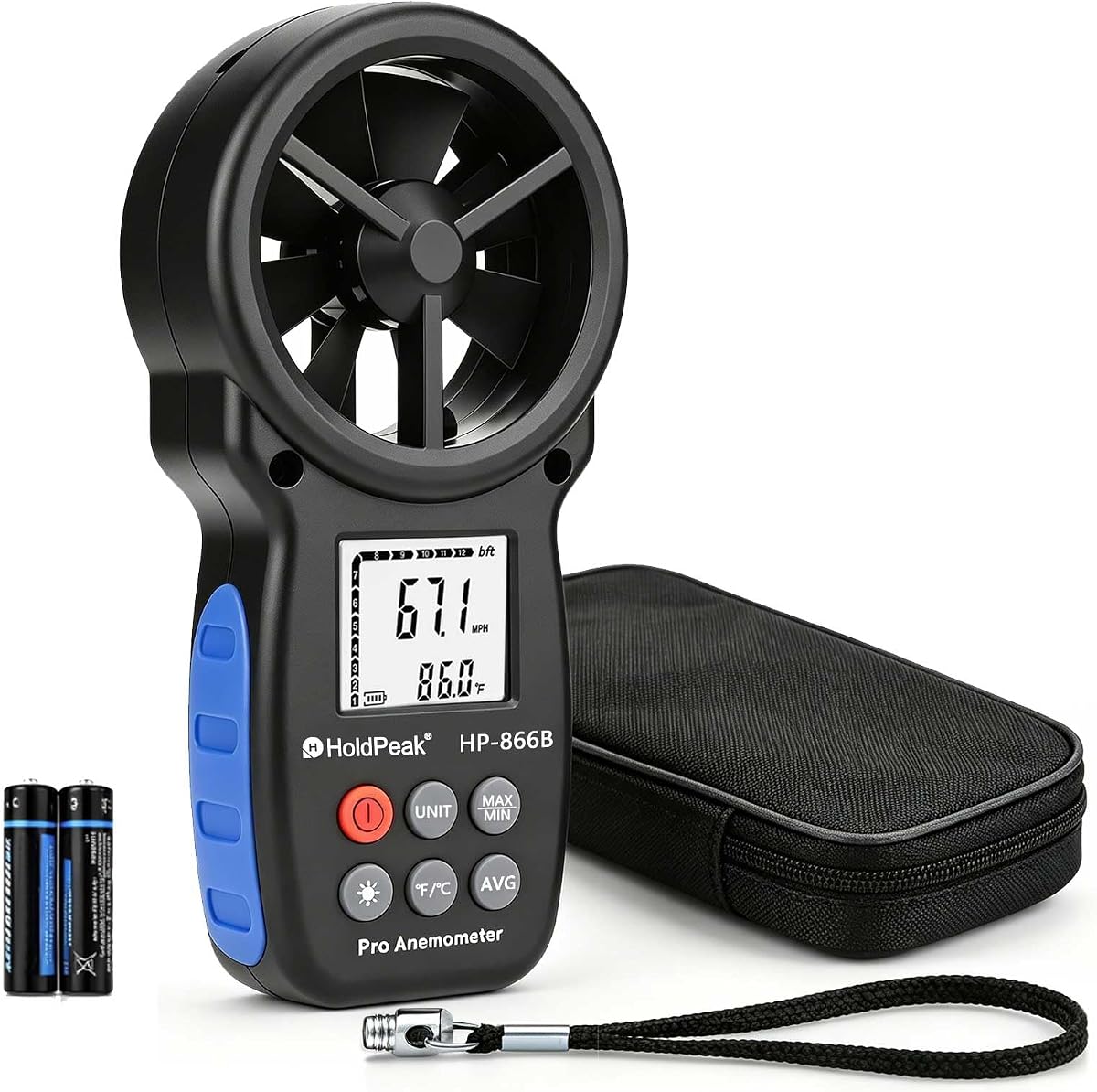
The HoldPeak 866B combines a 0.67–67.1 mph measurement range with the features expected from a serious handheld wind meter. Its 4.5 rating is supported by dual temperature sensors, eight vanes, a smooth fan shaft, and an emphasis on detecting both low and moderate air movement.
We may earn a commission when you buy through this link, at no additional cost to you.
The display offers switching among five speed units, Celsius and Fahrenheit temperature, maximum, minimum, and average readings, battery status, automatic shutdown, and a backlight. A bottom tripod hole allows fixed monitoring, while the included hand strap reduces the chance of dropping the meter during active outdoor use.
Compared with simpler three-function models, the HoldPeak places more emphasis on mounting and extended field use. Its trade-off is that humidity is absent and the included screwdriver appears to offer little practical value for a buyer. The supplied AAA batteries, carrying pouch, and manual help round out the package.
Choose the 866B for HVAC installation checks, low-flow duct work, sailing, shooting, kite flying, drone operation, and other tasks where both portability and fixed monitoring may be needed. It is a particularly versatile choice for users who alternate between handheld readings and tripod-assisted observation.
The tripod hole and hand strap support two very different working styles. Users can take quick readings while moving, then place the meter on a tripod when continuous airflow or outdoor wind monitoring is more important.
The stated sensitivity to low airflow makes the 866B relevant to HVAC installation, duct vents, and CFM estimation. Users still need to know the duct cross-sectional area to calculate airflow, and the instrument itself does not eliminate that setup work.
We may earn a commission when you buy through this link, at no additional cost to you.
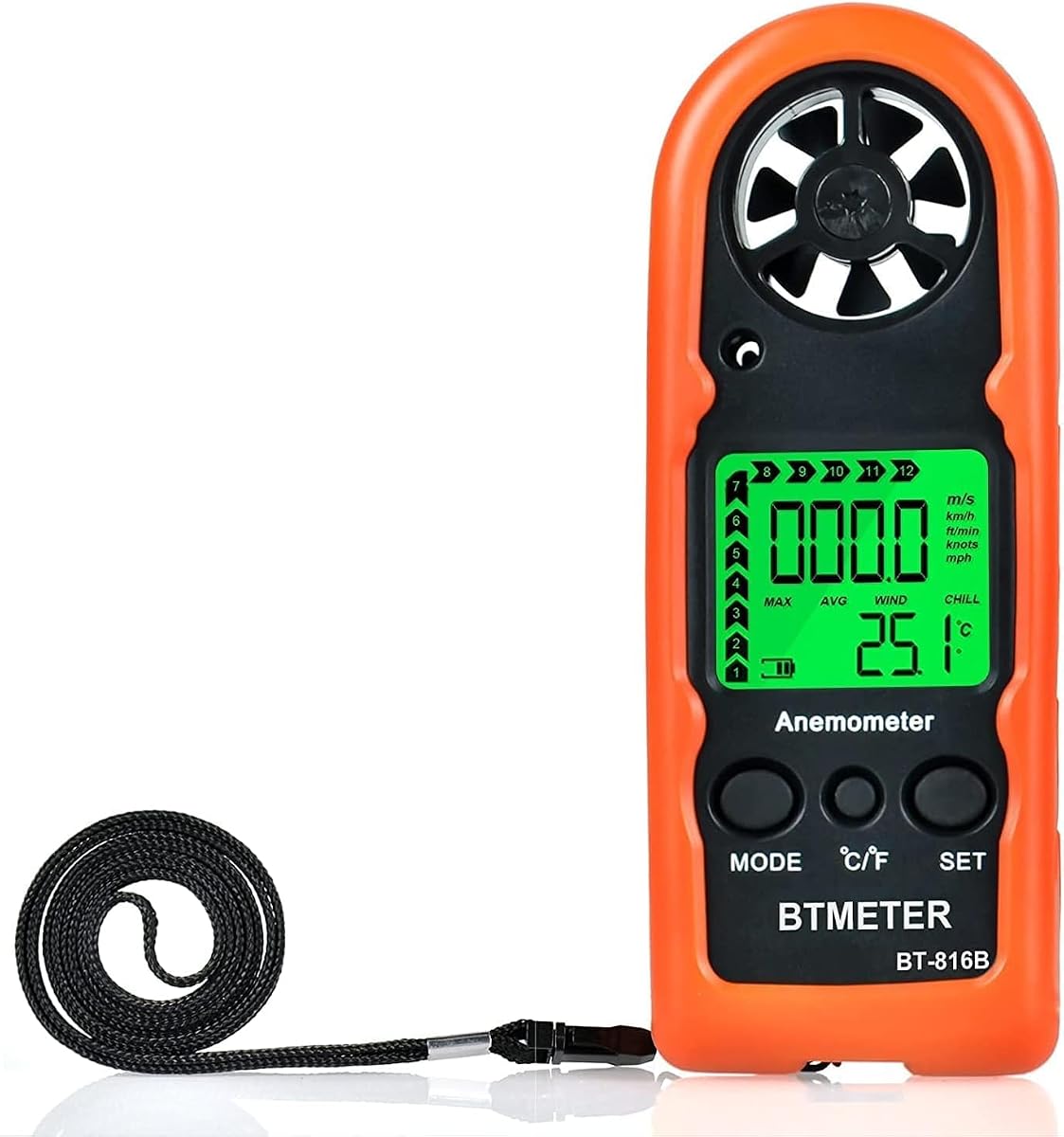
The BTMETER BT-816B is a compact digital anemometer aimed at outdoor activities and portable field checks. Its 4.3 rating reflects a capable specification set, including a 0.3–30 m/s wind-speed range, temperature measurement, wind-chill calculation, and seven smooth fan-shaft blades.
We may earn a commission when you buy through this link, at no additional cost to you.
The body is listed at 53 grams and 114 by 40 by 18 millimeters, making it easy to carry in a pocket or small bag. Speed can be displayed in meters per second, feet per minute, knots, kilometers per hour, or miles per hour, with current, maximum, and average modes available. The backlit LCD supports readings in dim conditions.
The specified accuracy is plus or minus 5% of the reading, which is less tight than the two-percent figure advertised by some higher-ranked alternatives. It also lacks a tripod hole and does not list humidity or air-volume calculations. Those limitations do not prevent regular use for sailing, climbing, shooting, or appliance testing.
The BT-816B is most suitable for buyers who value a small, straightforward meter over advanced data functions. It works well for travel, recreation, and quick professional observations, while users requiring tighter stated accuracy or fixed monitoring should consider a stronger alternative.
At a listed 53 grams, the meter is light enough for prolonged hand-held use. Its narrow body also supports one-handed operation, which is helpful while managing a kite, drone controller, sail, or other equipment.
Temperature and wind-chill readings make the instrument more useful for cold-weather activities and outdoor safety planning. Wind chill combines the measured temperature and wind speed, though users should continue to use appropriate clothing and safety judgment in severe conditions.
We may earn a commission when you buy through this link, at no additional cost to you.
The Soonkoda 3-in-1 is a straightforward handheld instrument for wind speed, temperature, and wind level. It has a 4.3 rating and covers a 0.06–30.0 m/s range, making it relevant to HVAC work, sailing, fishing, shooting, aviation, warehousing, and general outdoor observation.
We may earn a commission when you buy through this link, at no additional cost to you.
Its double-line LCD shows wind speed and temperature together, while a Beaufort scale from 1 to 12 translates the air movement into a familiar wind-level category. Five units are available: meters per second, kilometers per hour, knots, feet per second, and miles per hour. MAX, MIN, AVG, and data-hold functions are also included.
As a basic three-in-one device, it does not add humidity, physical remote sensing, or a wired connection. The specification also omits any mention of a tripod socket or storage pouch, so continuous use and transport protection require separate accessories. Its value lies in delivering the essential functions clearly rather than expanding beyond them.
The Soonkoda suits buyers who need a basic wind meter for occasional checks or want the Beaufort scale as a quick reference. It is especially helpful for comparing wind levels across locations without converting every speed reading into a different unit.
The Beaufort scale gives a less technical way to understand the force of the wind. It is useful for quick outdoor assessments, while the numeric speed and five unit choices support more precise comparisons.
MAX, MIN, and AVG modes help summarize changing conditions, and the hold function freezes the current display. Automatic shutdown and a low-battery indicator reduce the chance that the meter is left powered down when it is not needed.
We may earn a commission when you buy through this link, at no additional cost to you.
The POROMETISTO AEM01S is a speed-focused anemometer with a distinctive three-color warning system. It has a 4.5 rating, samples every 0.5 seconds, and presents wind speed and wind-level information on an LCD with a backlight that changes with conditions.
We may earn a commission when you buy through this link, at no additional cost to you.
The backlight is green for levels 0 through 4, orange for levels 5 through 7, and red for level 8 and above. This makes changes in wind risk easier to notice at a glance. Six speed units are offered, including meters per second, kilometers per hour, feet per second, feet per minute, miles per hour, and knots.
The stated accuracy varies by speed: plus or minus 0.7 m/s below 1.00 m/s and plus or minus 2.0% plus 0.5 m/s from 1.00 through 30.00 m/s. A hold function freezes readings, a maximum mode records peaks, and automatic shutdown activates after ten minutes. The sensor housing is designed to withstand light impacts.
Choose the AEM01S for drone flying or field work where rapid visual awareness matters. Its principal limitation is that it focuses on velocity and wind level rather than temperature or humidity, making it less suitable when a complete environmental profile is required.
The color-changing backlight provides faster visual feedback than a single-color display. Green, orange, and red zones make it easier to recognize when conditions move from normal to caution or danger levels.
A half-second sampling interval suits users who need to follow quick changes rather than only a static average. The MAX button can record the highest observed value for later comparison.
We may earn a commission when you buy through this link, at no additional cost to you.
The Caldwell Wind Wizard II is a focused, durable option for users who primarily need current wind speed. It carries a 4.6 rating, the highest among the ten products in this guide, and emphasizes comfortable handling, water resistance, and dependable outdoor operation.
We may earn a commission when you buy through this link, at no additional cost to you.
The meter measures current velocity in miles per hour, feet per minute, kilometers per hour, meters per second, or knots. Its illuminated LCD makes readings easy to check in changing light, while automatic power-off preserves battery life. The body measures 2.5 inches wide by 4 inches high and 0.75 inches deep and fits comfortably in one hand.
This focused design also creates limitations. Unlike several multi-function competitors, the listed features do not include temperature, wind chill, humidity, or statistical maximum and minimum readings. It is therefore best understood as a straightforward current-wind instrument rather than a complete environmental station.
For long-range shooting, hunting, and other outdoor activities where grip, weather resistance, and simple speed readings matter, the Wind Wizard II is a refined choice. The included lanyard, rubber casing, water-resistant construction, and limited lifetime warranty reinforce its premium positioning.
The non-slip rubber casing supports a confident grip, and the included lanyard helps prevent the meter from being dropped. Those details are especially relevant for shooting, hunting, boating, and other activities where one hand may be occupied.
Water-resistant material helps the instrument cope with changing outdoor conditions. Buyers who need temperature, humidity, or recorded peaks should choose a multi-function model instead of this simpler current-speed-focused design.
We may earn a commission when you buy through this link, at no additional cost to you.
The Proster Digital Anemometer is the most directly oriented toward airflow-volume work in this group. Its 4.4 rating accompanies a clear set of CFM, CMM, and CMS functions, allowing the device to handle both imperial and metric area calculations after the relevant duct dimensions are entered.
We may earn a commission when you buy through this link, at no additional cost to you.
Wind speed is offered in meters per second, feet per minute, kilometers per hour, miles per hour, and knots. The listed velocity ranges extend from 0.4 to 30 m/s, 80 to 5,900 ft/min, 1.4 to 108 km/h, 0.9 to 67.0 mph, and 0.8 to 58.0 knots. Reading hold, maximum, and minimum functions support more careful monitoring.
Its large backlit LCD is easy to inspect in dark conditions, and a low-battery indicator with automatic power-off helps manage the included 9V battery. The instrument supports both hand-held and fixed measurement, although the fixed arrangement may require a suitable support not explicitly described in the supplied information.
Choose the Proster when airflow-volume calculations are more important than temperature or humidity. It is a practical option for HVAC and duct-related work, while outdoor recreation buyers may prefer one of the lighter models with temperature and wind-chill readings.
CFM, CMM, and CMS outputs distinguish this model from basic wind meters. The different area limits shown in the specification support common duct calculations in both imperial and metric workflows.
Maximum, minimum, and hold modes make it easier to watch a reading without losing it. The illuminated large display is useful in mechanical rooms, workshops, and other poorly illuminated working environments.
We may earn a commission when you buy through this link, at no additional cost to you.
The VEVOR Split Handheld Anemometer is designed for users who need more reach than a conventional all-in-one meter. Its 4.4 rating, split construction, and extendable 6.6-foot cord allow the sensing vane to be placed away from the handheld display.
We may earn a commission when you buy through this link, at no additional cost to you.
The stated wind-speed range extends from zero to 100.8 mph, covering the broadest upper limit among the products reviewed. It also measures temperature, airflow, and wind chill, with a temperature range of 14 to 140 degrees Fahrenheit. Six speed units, Beaufort support, and MAX, MIN, AVG, and current-readout modes are included.
Its unusual strengths come with some complexity. The separate cord must be deployed and managed, and the listed USB connection is compatible with Windows 7, XP, and 10 rather than a broader modern range. The water-resistance claim is qualified: the main unit receives an IP54 rating, while the vane unit is listed as IP44.
Choose the VEVOR for duct work, weather observation, agriculture, construction, model aircraft, and outdoor sports where a remote sensor position is advantageous. It is the most specialized entry in the guide and is best for buyers who specifically value reach, broad range, and data access.
The two-meter extendable cord separates the sensor from the display. This is useful around obstacles, inside ducts, or near moving equipment, although users should protect the connection and avoid pulling sharply on the cable.
A range reaching 100.8 mph serves users monitoring stronger conditions, while current, maximum, minimum, and average modes provide useful summaries. The USB port adds a route for transferring data to a compatible computer, though modern software support should be considered before purchasing.
We may earn a commission when you buy through this link, at no additional cost to you.
The right anemometer depends on where it will be used, which measurements matter, and how you expect to record the results. Compare range, low-end sensitivity, display functions, environmental sensors, mounting options, and protection before choosing.
A useful anemometer should cover the conditions you expect to encounter, from gentle indoor airflow through strong outdoor wind. Listed ranges vary considerably: the Mcbazel and Soonkoda begin at 0.06 m/s, while the VEVOR spans up to 100.8 mph. Accuracy claims also differ, with examples ranging from plus or minus 2% of readings to plus or minus 5%, plus a fixed error term. Check the full expression rather than looking only at the number, because accuracy can vary with the measured range.
Prioritize a low starting point for HVAC and duct work, and adequate upper capacity for sailing, exposed sites, or drone operations. In general, match the range and stated accuracy to the environment rather than paying for unnecessary limits.
Wind speed is more useful when paired with environmental context. Most models in this guide measure temperature, but only the TopTes TS-301 lists humidity as well. Wind-chill calculations on the BTMETER models and HoldPeak 866B can be helpful in cold environments. A dedicated temperature range broadens the functions of a basic meter without making it a complete weather station.
Choose temperature when planning outdoor activities or assessing comfort, and add humidity when weather conditions, material handling, or environmental monitoring are central to the task. Remember that a sensor moving between locations may need time to stabilize.
A backlit screen is valuable outdoors, inside ducts, and during low-light work. The TopTes TS-301 leads this group with a 2.26-inch display, while the BTMETER BT-100, Mcbazel, Soonkoda, and others also provide backlighting. Double-line screens can show wind speed and temperature together, reducing navigation through menus. HOLD, MAX, MIN, and AVG functions make readings easier to compare over time.
Select a large display for quick outdoor interpretation and a backlit screen for any dark setting. Statistical modes are especially useful when conditions fluctuate and you need the current, peak, low, or average value.
Wind speeds are expressed differently across sailing, aviation, HVAC, meteorology, and general outdoor use. Most included models offer five units, while the TopTes and VEVOR provide six. Common choices include meters per second, kilometers per hour, miles per hour, knots, and feet per minute or feet per second. A Beaufort scale appears on several models and provides a quick qualitative wind-level reference.
Choose the unit set that matches your most frequent task. Multiple units are convenient, but the most important thing is that the conversion needed for your activity is available and clearly labeled.
Hand-held operation is convenient, but fixed monitoring can be more informative for drones, model aircraft, sailing, and changing outdoor conditions. The BTMETER BT-100 and HoldPeak 866B include tripod mounting holes. The Proster supports fixed measurement, although its supplied details do not identify a specific mount. The VEVOR takes a different approach with a two-meter sensor cable that extends the sensing position.
Choose a threaded mount for continuous readings, an extended cable for reaching inaccessible areas, or a compact body for portable spot checks. The correct setup also depends on whether you need immediate movement readings or recorded averages.
Wind meters are often used near water, on construction sites, or during activities that involve wet or unpredictable conditions. The Caldwell Wind Wizard II has water-resistant material, a non-slip rubber casing, and a lanyard. The VEVOR lists an IP54 rating for the main unit and IP44 for the vane unit, while its qualification means the entire system should not be treated as equally protected. The BTMETER BT-100 includes a carrying case, and the HoldPeak includes a waterproof pouch.
Consider grip, weather resistance, lanyard support, and storage together. A secure grip and protective case often matter as much as a formal rating during repeated outdoor use.
Most compact models use two or three AAA batteries, while the Proster uses an included 9V battery. AAA models are convenient to replace, but batteries are not included with the Mcbazel. Automatic shutdown and low-battery indicators help prevent accidental power loss. The TopTes shuts down after ten minutes, the VEVOR after five minutes, and the Caldwell also includes an automatic power-off function.
Check which batteries are supplied, how readily replacements can be found, and whether the meter will be used for extended sessions. For remote or continuous monitoring, reliable spare batteries are more important than a proprietary power connection.
Airflow-volume functions are useful when testing HVAC systems and ducts. The Proster directly lists CFM, CMM, and CMS calculations, while the BTMETER BT-100 and HoldPeak 866B provide CFM formulas based on wind speed and duct cross-sectional area. The VEVOR is unique in listing USB data transfer, but its computer compatibility is limited to older Windows versions. These features matter more for technical work than for casual outdoor readings.
Choose a calculation-focused model for HVAC tasks and a data-connected model when computer records are essential. For recreational wind checks, the extra complexity may provide little practical benefit.
Before taking a reading, install the specified batteries correctly and select the unit you want to display. Allow the sensor and housing to acclimate to the current environment, particularly when moving between indoors and outdoors or between substantially different temperatures. Position the vane in open airflow, keep hands and obstructions away from the blades, and hold or mount the instrument steadily.
For an instantaneous reading, watch the value until it stabilizes and record the current, maximum, minimum, or average result as needed. For a fixed measurement, use a compatible tripod where provided or position the sensor with the supplied extended cord. When estimating airflow in a duct, use the correct cross-sectional area and the manufacturer's CFM formula, and keep airflow conditions as consistent as possible.
After use, switch off the meter or let automatic shutdown handle power conservation, remove the batteries for long-term storage, and protect the vane from impacts. Wipe the housing with a soft, slightly damp cloth, avoid immersing the instrument, and let it dry fully before replacing the storage pouch or batteries. Do not spin the blades forcefully or clean them with sharp objects, and follow the product instructions for any sensor-specific cleaning precautions.
Choose units that match your activity. Meters per second and kilometers per hour are common in scientific and engineering work, knots are familiar in sailing and aviation, and miles per hour is useful for general weather checks and shooting. Most models support several units, so the best device is one that can quickly display the unit you use most often without repeated manual calculations.
Yes, provided the model has sufficient low-end sensitivity and you position the sensor in the airflow. For CFM, you also need the duct cross-sectional area, so use the calculation provided by the manufacturer. The Proster offers direct CFM, CMM, and CMS functions, while the BTMETER BT-100 and HoldPeak 866B include CFM calculation guidance.
Most models in this guide measure wind speed and temperature, but only the TopTes TS-301 lists humidity measurement. If humidity is important for weather observation, comfort assessment, or material handling, select a model with an explicit humidity specification and allow its sensor time to adjust after relocation.
A handheld meter is convenient for moving between locations and taking quick readings. A tripod-mounted meter is better when you need continuous observations, such as during a drone flight, model aircraft session, or changing-condition test. The BTMETER BT-100 and HoldPeak 866B include threaded tripod mounting points.
Buildings, trees, and other obstacles disturb the airflow and create swirls, eddies, and pockets of faster or slower air. A reading taken in that disturbed flow may not represent the true open-site wind speed. For outdoor conditions, use an open position above nearby obstructions whenever practical and take several readings over time.
The exact settling time depends on the model and the environmental change. The TopTes TS-301 specifically states that its temperature and humidity sensors may need at least 30 minutes to adjust to a new environment. Wind-speed readings can also change while the sensor stabilizes, so waiting is advisable when precise comparisons matter.
No. A high maximum range is useful for exposed outdoor locations and strong conditions, but it should be considered alongside low-end sensitivity, accuracy, and the display. Indoor airflow work may need a meter that performs well near zero, while broad outdoor use benefits from more headroom at the upper end.
Only use a model whose specific water-resistance specifications support wet conditions. The Caldwell uses water-resistant material, and the VEVOR lists an IP54 rating for the main unit and IP44 for the vane unit. For any device, follow its care instructions and avoid exposing electrical controls or battery compartments to water.
The BTMETER BT-100 is the strongest all-around choice because it combines a broad measurement range, low-flow sensitivity, five units, temperature and wind-chill data, and tripod compatibility. The Mcbazel 3-in-1 offers an efficient budget option with a useful Beaufort scale and statistical modes, while the Caldwell Wind Wizard II stands out for grip, water resistance, and warranty coverage.
Prioritize the features tied to your actual use. HVAC buyers should look for low-end sensitivity and airflow calculations, outdoor users should consider temperature and backlighting, and fixed monitoring calls for a tripod socket or remote sensor arrangement. Extra functions are helpful only when they make the intended task clearer or faster.
Before buying, verify the included accessories, battery requirements, measurement range, stated accuracy, and current product details. Prices, seller availability, and product information can change, so checking the latest listing ensures that the selected anemometer still matches the features covered in this October 2026 guide.